About 1 in 5 US Marketing Jobs Ask for AI Skills, and SEO Roles Lead the List: Inside 10,000 Job Postings
We analyzed 10,000+ US marketing job postings. About 1 in 5 ask candidates to use AI, and more than half of SEO roles do. Here’s what else employers ask for.
When people talk about how AI is changing office work, marketing is usually the first example. Scroll through LinkedIn, and you'll see the same two claims again and again: every marketer now needs AI skills, and one person with the right tools can do the work of a whole team.
Our own marketing department works with AI every day, and our recruiters help US companies hire marketers all the time. So we wanted to see how much of that talk shows up in what employers ask for when they hire a marketer.
We analyzed 10,600 unique US marketing job postings published on companies' own career pages and applicant tracking systems in September and October 2026. This article covers what we found: which marketing roles ask for AI, what employers mean when they ask for it, and how much they expect one marketer to handle.
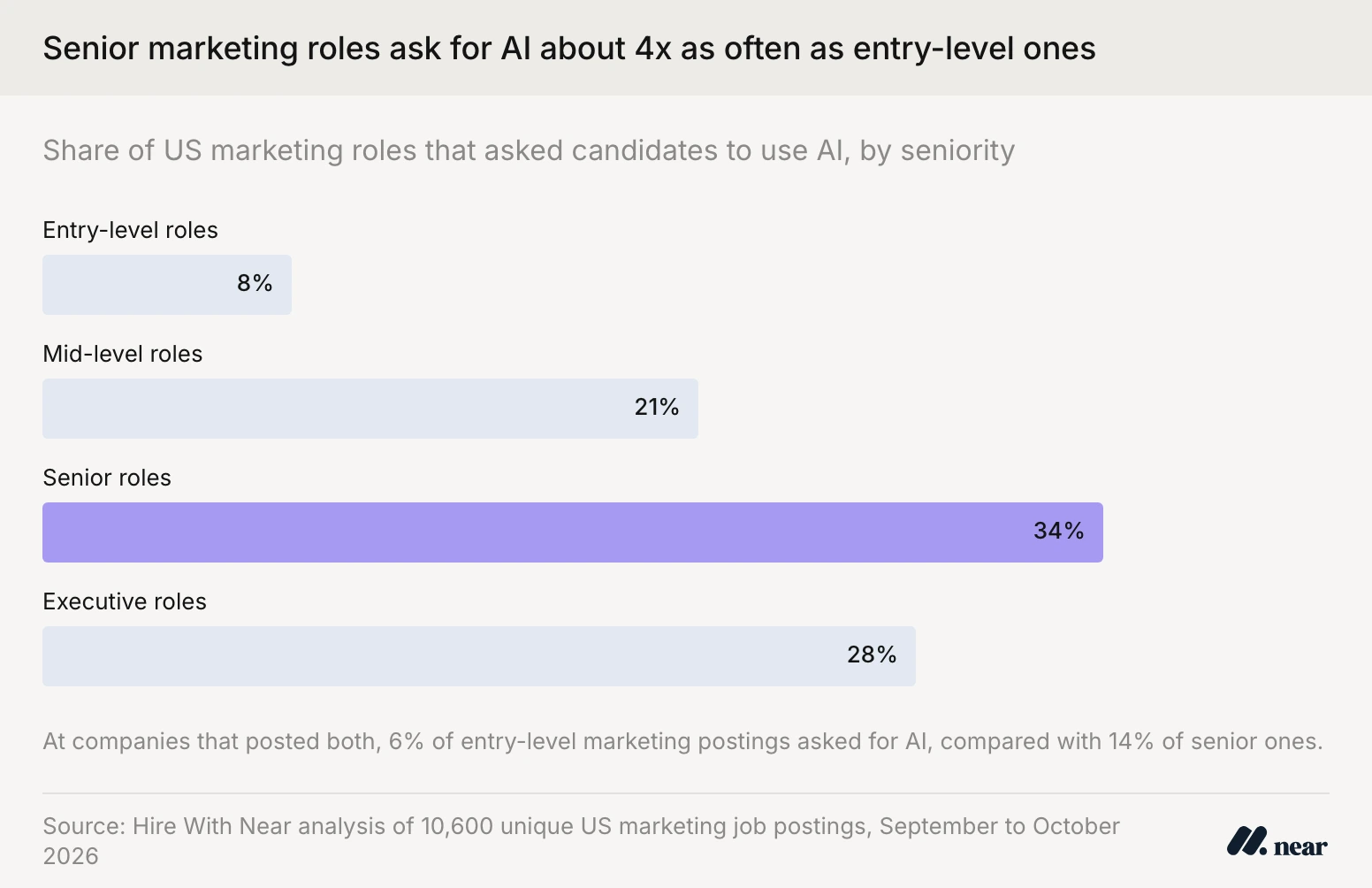
- About 1 in 5 US marketing roles posted in September and October 2026 asked candidates to use AI, according to Hire With Near’s analysis of 10,600 US marketing job postings. The share rose from 8% at entry level to 34% at senior level.
- More than half of SEO roles asked for AI, along with 49% of product marketing roles and about 40% of growth, paid media, and content roles. Only about 10% of events roles did.
- AI didn’t replace the writing ask. Half of the marketing roles that asked for AI also asked for strong writing skills, compared with about a third of the roles that didn’t ask for AI.
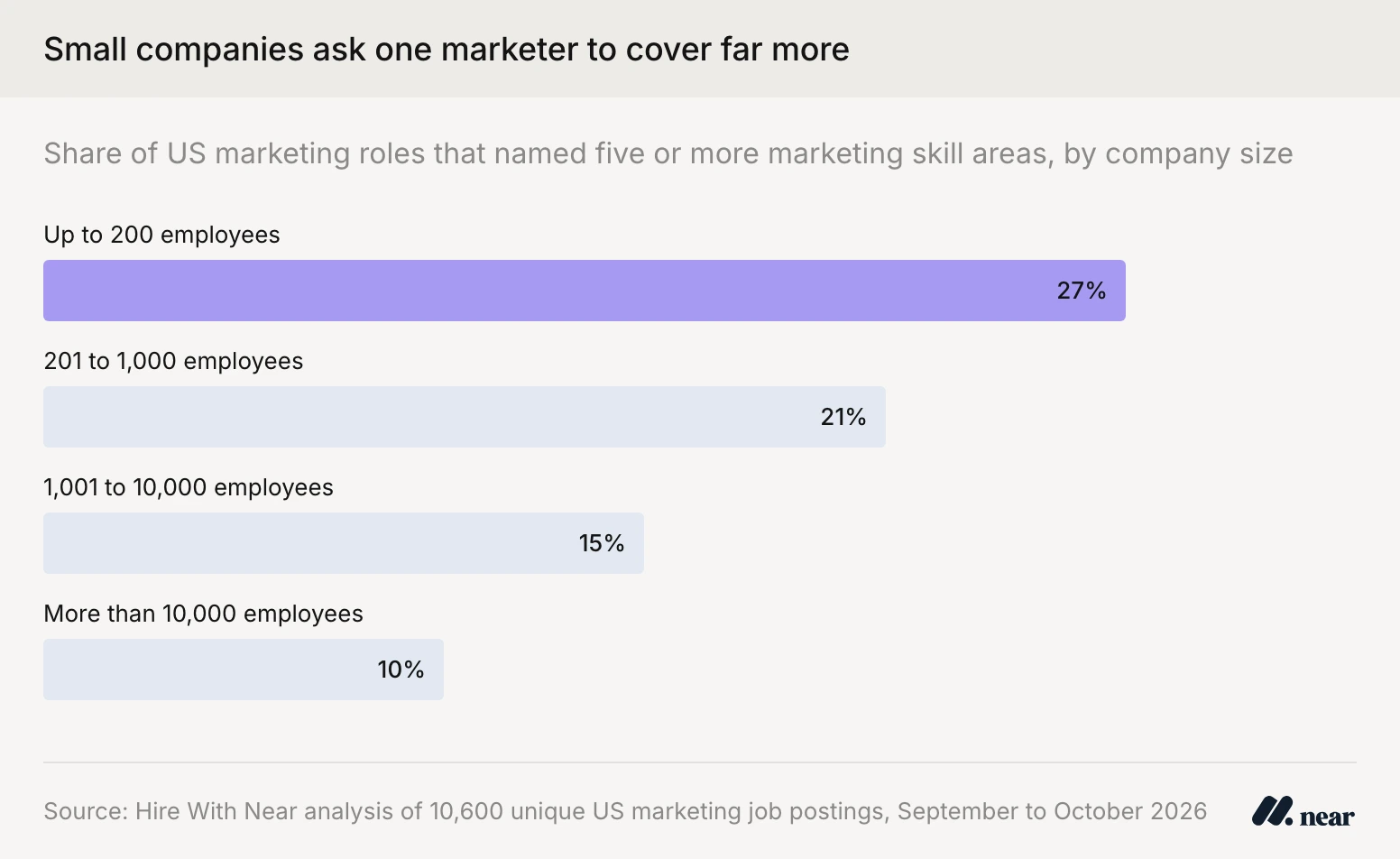
- Small companies asked one marketer to cover far more. At companies with up to 200 employees, 27% of marketing postings named five or more marketing skill areas, compared with 10% at companies with more than 10,000 employees.

How Many US Marketing Jobs Ask for AI?
About 1 in 5 US marketing roles, or 20%, asked candidates to use AI in some way.
That’s lower than the share of job postings that mentioned AI at all (31%). Many of them talk about AI without asking anything of the candidate. For example, a company might describe itself as “AI-powered,” sell AI products, or add a notice about using AI to screen applications. We only counted a posting when it asked the person being hired to use or understand AI.
Even then, most of those asks were soft. Only about 3% of the postings that asked for AI used words like “required” or “must.” Most phrased it as experience, comfort, or fluency with AI tools, or listed it as a plus.
Senior marketing roles ask for AI far more than entry-level ones
The share climbed with seniority. About 8% of entry-level marketing roles asked for AI, compared with 21% of mid-level roles and 34% of senior roles. Executive roles were slightly lower, at 28%.
We saw the same difference at companies that posted both entry-level and senior marketing roles: 6% of their entry-level postings asked for AI, compared with 14% of their senior ones.
Our read is that companies expect experienced marketers to decide where AI fits in the work, while entry-level postings mostly describe the tasks themselves.
We found the same pattern across all nine office functions in our general analysis of entry-level job postings. Senior postings ask for more of almost everything, from tools to years of experience.
Which Marketing Roles Ask for AI Most?
About 20% of marketing roles ask for AI, but this hides big differences between roles. More than half of SEO roles asked candidates to use AI, and 49% of product marketing roles did. About 40% of growth, paid media, marketing operations, and content roles did too.
At the other end, only about 15% of brand, social media, and communications roles asked for AI, and about 10% of events roles did.
Note: Roles grouped by job title. The SEO group is smaller than the others (75 roles).
The roles at the top have something in common. Most of their work happens on screen and produces something measurable: search rankings, campaign results, lead volume, or a steady stream of content. The roles at the bottom lean more on relationships and live work, like managing vendors and venues or building trust with reporters and executives.
Lucia Soccini, a Recruiter at Hire With Near, sees the same split in the marketing roles clients bring to us:
SEO roles have been asking for AI for the longest time, and I think they were the first marketing role to ask for it. Content came next, and growth after that. These roles work mostly with text and data (keyword research, briefs, drafts, analysis, reporting), which is exactly where AI saves the most time. Roles that rely more on in-person relationships or visual and community work, like events or parts of social media, have been slower to ask for it.
— Lucia Soccini, Recruiter, Hire With Near
If you’re hiring an SEO specialist or a growth marketer, most of the candidates you meet will have seen AI in job descriptions for similar roles, and many will already use it daily.
But if you’re hiring an events or PR manager, AI skills are less likely to be part of how candidates describe their work.
Tech companies ask for AI far more than other employers
Where the job is matters too. At tech companies, about 45% of marketing roles asked for AI, compared with 13% at employers in other industries.
When we removed tech companies from the data and looked only at other industries, finance (27%) and media and communications (26%) employers asked for AI most often. Healthcare (18%) and manufacturing (16%) were in the middle. Retail (11%), consumer goods (9%), and entertainment (7%) were at the bottom.
Note: “Tech companies” are employers in software, IT services, and other technology industries. *Based on 24 roles, so treat it as a rough figure.
Because tech companies post so many marketing roles, they push every overall number up. But when we looked only at non-tech employers, the order of roles barely changed: SEO, paid media, and marketing operations roles still asked for AI most often, and events roles asked for it least.
At tech companies, AI comes up in almost every marketing role, including the ones that rarely mention it elsewhere. Nearly half of brand roles at tech companies asked for AI, compared with 7% at other employers.
Remote marketing roles ask for AI more often
About 40% of fully remote marketing roles asked for AI, compared with 31% of hybrid roles and 15% of in-person roles.
Part of that comes from the type of work. Remote marketing roles lean toward digital work like SEO, content, and paid media, the same roles that ask for AI most. Either way, it means companies hiring remote marketers are more likely to see AI skills on the list of requirements.
What Does “Asking for AI” Look Like in a Job Posting?
Most postings that asked for AI kept it short. A line like “experience with AI tools” or “comfortable using generative AI” was common. When postings did say what the AI was for, the uses fell into a few groups.
We sorted the postings that asked for AI by the uses they mentioned:
- Research and analysis (about 44%): Using AI for market research, data analysis, reporting, segmentation, or personalization.
- Content creation (about 40%): Using AI for drafts, copy, ideas, images, or video.
- Speed and efficiency (about 39%): Using AI to work faster, scale output, or streamline workflows.
- Quality and judgment (about 21%): Pairing AI with a check on accuracy, quality, brand voice, or human review.
- AI search (about 11%): Optimizing content to appear in AI-generated answers.
Many postings mentioned more than one use, so the shares add up to more than 100%.
The postings that went into detail often described AI as a tool for the first pass, with the marketer responsible for the final version.
A senior social media manager posting listed “research, ideation, first drafts, repurposing, versioning, and reporting summaries” as the tasks where the hire was expected to use AI.
A marketing manager posting asked for someone who uses AI “to move faster on research, first drafts, and campaign analysis” and knows “when a draft still needs a human edit before it goes out.”
Very few postings asked marketers to build AI tools themselves: only about 1% of marketing roles asked candidates to create AI agents, automated workflows, or custom GPTs.
Which AI tools marketing postings named
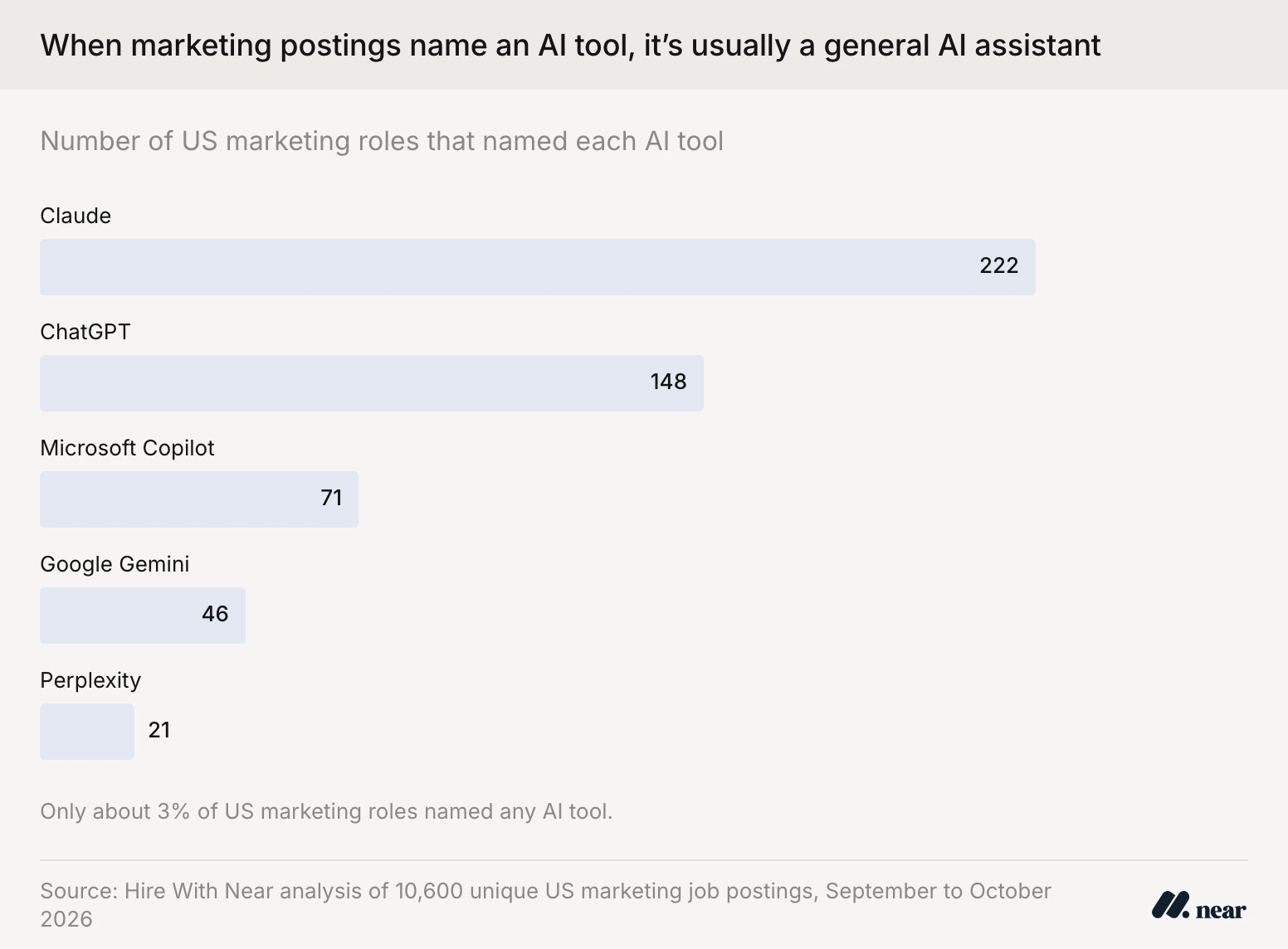
Most postings didn’t name a specific AI tool. Only about 3% of marketing roles mentioned one by name. Among those, Claude came up in 222 roles, ChatGPT in 148, Microsoft Copilot in 71, and Google Gemini in 46.
Those counts are small, so they don’t say which tool marketers use most. What they show is that when employers name a tool, they usually name a general AI assistant.
AI search shows up mostly in SEO roles
About 5% of marketing roles mentioned optimizing for AI search, using terms like generative engine optimization (GEO), answer engine optimization (AEO), AI Overviews, or visibility in large language models.
That share was much higher in the roles closest to search. About 66% of SEO roles mentioned AI search, along with 15% of content roles and 12% of growth roles. One SEO posting, for example, described the work as handling “both traditional SEO” and “optimizing for AI-driven search surfaces like AI Overviews, ChatGPT, and Perplexity.”
If you’re hiring for SEO or content, that’s a skill to ask about directly.
Do Marketing Jobs That Ask for AI Still Ask for Writing?
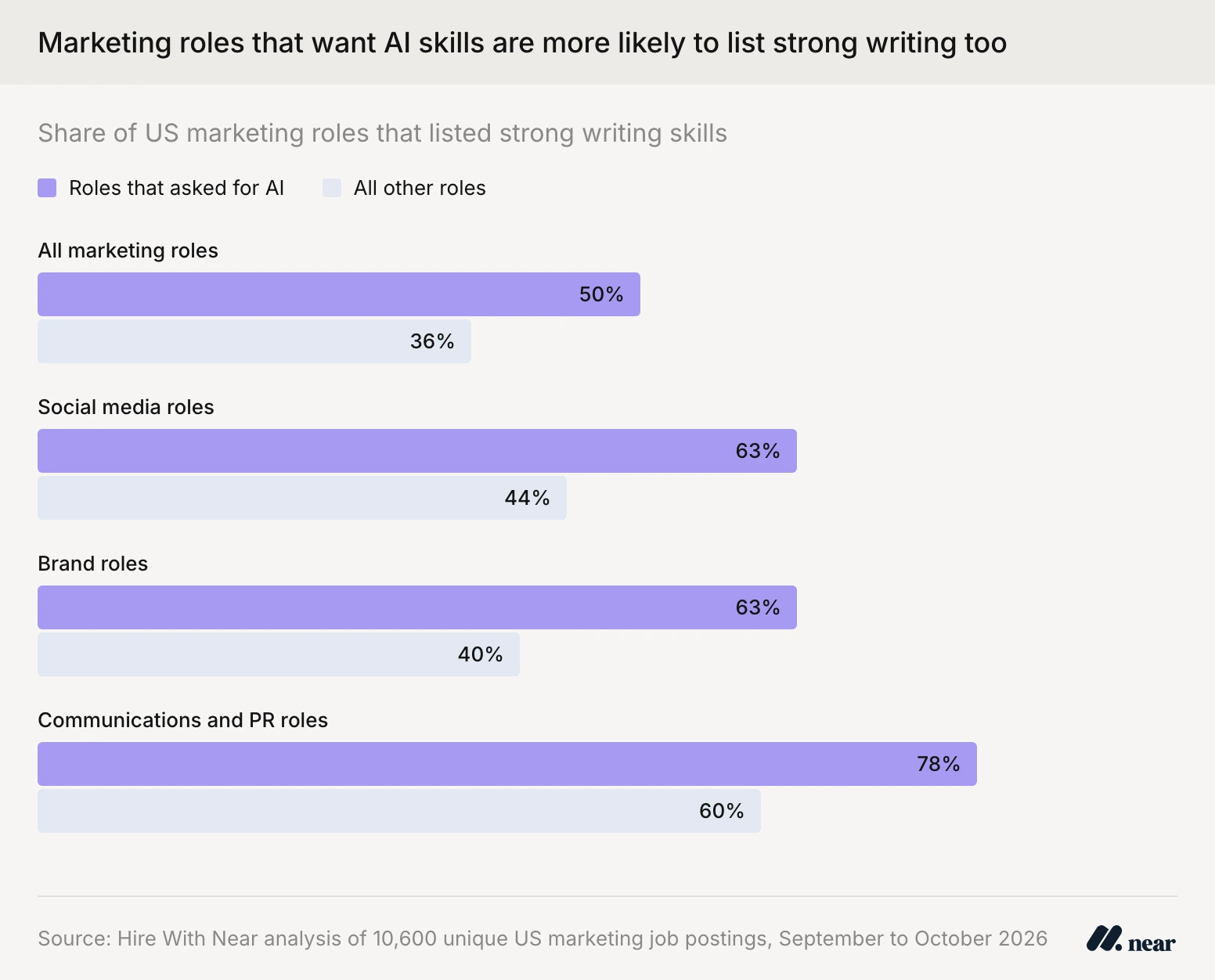
If AI can write a first draft, you might expect employers to care less about writing skills. The postings show the opposite. Half of the marketing roles that asked for AI also listed strong writing skills, compared with 36% of the other roles.
That could just reflect the mix of roles, since content roles tend to want both. But we saw the same result inside almost every group. In 11 of the 12 role groups, the postings that wanted AI skills were more likely to call for strong writing too. In social media roles, for example, 63% of the postings that wanted AI skills also listed strong writing, compared with 44% of the rest.
Looking only at non-tech employers, the result was the same: 49% of their AI-asking marketing roles called for strong writing, compared with 36% of the rest.
Editorial skills, such as proofreading, following a style guide, or keeping a brand voice, came up more often too: 13% of AI-asking roles mentioned them, compared with 10% of the rest.
The postings don’t tell us why. But the way many of them describe AI points to one reading: if AI produces the first draft, someone still has to judge whether it’s good, fix it, and make it sound like the brand. A partner marketing posting, for example, asked the hire to use AI for drafts and research while “reviewing and tailoring all outputs before use.”
For employers, it means that screening for AI skills doesn’t replace screening for writing. A short editing exercise, like giving candidates an AI-generated draft to fix, shows whether they can spot what's off and make it sound like your brand.
How Much Do US Companies Expect One Marketer to Cover?
A lot of the current talk about marketing hires centers on the “T-shaped marketer”: someone with broad skills across marketing and deep expertise in one area. AI is a big part of that conversation. The idea is that with the right tools, one marketer can cover areas that used to need several people, as long as they're strong in at least one.
The postings show how often employers ask for that kind of breadth, and which employers ask for it most.
We checked each posting for 14 marketing skill areas, from SEO, paid media, and social media to email, events, analytics, design, and video. About 43% of marketing roles named three or more of these areas, and 19% named five or more.
The biggest difference was company size. At companies with up to 200 employees, 27% of marketing postings named five or more skill areas. At companies with more than 10,000 employees, 10% did.
Smaller companies were also more likely to say it outright. Phrases like “wear many hats,” “first marketing hire,” or “strategic yet hands-on” appeared in 12% of marketing postings at companies with up to 200 employees, and in 15% at companies with 50 employees or fewer. At companies with more than 10,000 employees, they appeared in only 3%.
Small companies asked for more breadth at every seniority level. This pattern also shows up for generic titles like “marketing manager” or “marketing coordinator”: 28% of those postings at small companies named five or more skill areas, compared with 10% at the largest companies.
In our analysis, small companies also asked for AI more often (29% of their marketing roles, compared with 18% at the largest companies). When we removed tech companies from the data, the gap was smaller: 17% at small companies, compared with 12% at the largest ones.
We can't say whether marketers are asked to cover more today than they were five years ago, since this data covers two months. What it shows is that a broad marketing job description is far more common at small companies, where one person often holds the whole function.
If you're deciding whether to hire a generalist or a specialist, our guide to hiring marketing talent in Latin America covers when each one makes sense.
What Does Hire With Near See in Its Own Hiring?
Hire With Near is a staffing and recruiting agency that helps US companies hire remote marketing talent in Latin America. The job descriptions our clients send us point in the same direction as the market data.
In our analysis of more than 2,000 job descriptions US companies sent us between June 2025 and June 2026, 33% of marketing job descriptions in the first half of 2026 mentioned AI, second only to engineering (42%) and well ahead of sales (17%) and finance (16%).
That's a different dataset, built from the roles companies bring to us and counted with a different method, so the two numbers aren't directly comparable. But they rank marketing the same way. In the job postings we analyzed for this article, marketing was third of nine office functions, behind only software and design.
Our recruiters say AI has become a standard request in recent searches. Soccini explains what clients usually mean when they ask for it:
Pretty much every company is asking for AI tools. For marketers, it depends on the role, but usually clients want someone who knows how to embed AI into their daily tasks. Not only to automate workflows, but also for work like competitor research, analysis, and first drafts.
— Lucia Soccini, Recruiter, Hire With Near
The breadth question comes up in our searches too, and AI has changed how our recruiters answer it. Soccini used to push back on “all-in” marketing roles:
Before AI, whenever a client came with an ‘all-in’ role (content, email, paid ads, and social media in one person), I would tell them it was a no-go. It’s very hard to find someone who can do everything and perform well at all of it. With AI, a lot of that work can be automated, and the marketer gets time back to be more strategic. It’s still a challenge, because it’s also about motivation and finding candidates who want to cover that much. But it’s much more doable now.
— Lucia Soccini, Recruiter, Hire With Near
So a broad role is more realistic with AI. It still needs one person who can own the work, though, and clients still need to be clear about which areas matter most.
What This Means If You’re Hiring a Marketer
If you’re writing a marketing job description or screening candidates, the postings suggest a few practical steps.
- Say what the AI is for: “Experience with AI tools” tells candidates very little. If you expect AI to help with research, first drafts, reporting, or AI search, name those tasks. It makes the job clearer and gives you something concrete to ask about in the interview. Our guide to building a remote marketing team covers what else to put in the job description.
- Match the AI ask to the role: AI skills are most common in SEO, growth, paid media, and content job descriptions, and much less common in events, PR, and brand roles. Ask for them where they’re part of the work, and leave them out where they aren’t.
- Ask for concrete AI examples: “I use ChatGPT” or “I use Claude” doesn’t tell you much. Soccini asks candidates what exactly they automated, with which tools, and what changed as a result, such as time saved or better campaign results.
- Keep testing writing and judgment: The postings that ask for AI are more likely to ask for strong writing. Look for candidates who review and own the AI’s output instead of pasting it as is. Ask how they review and edit AI output before it goes out.
- Be honest about breadth: If you need one person to cover five areas, say so, and decide which one or two matter most. For multi-area roles, Soccini looks for one strong core skill, like SEO, content, or paid media, plus comfort picking up adjacent areas fast. In her experience, candidates who enjoy variety tend to do better in these roles than those who want to go deep on a single channel.
Final Thoughts
About 1 in 5 US marketing roles asked candidates to use AI in September and October 2026. The share depended heavily on the role, from more than half of SEO roles to about 1 in 10 events roles, and on the employer, with tech companies asking far more often than everyone else.
When employers did ask for AI, they mostly described it as a way to research, draft, and work faster, and they kept asking for strong writing alongside it. Small companies, meanwhile, were the most likely to ask one marketer to cover many areas at once.
This analysis is part of a series built on the same US job posting data. If you’re hiring for first jobs, read our analysis of what US entry-level jobs ask for, which covers experience, degrees, pay, and AI asks across nine office functions.
And if you’re hiring a marketer and want to see what experienced candidates in Latin America look like, get a list of pre-vetted candidates. There's no fee to interview, so it costs nothing to see the kind of marketers we can help you hire, including candidates who already work with AI every day.
Free Download: The 2026 State of LatAm Hiring Report
We studied data from 2,000+ remote LatAm hires to reveal how top US companies use nearshore hiring to grow faster and recruit top talent while saving $35,000+ annually per hire.
Most marketing jobs don’t require AI skills, but about 1 in 5 US marketing job postings ask candidates to use AI, according to Hire With Near’s analysis of more than 10,000 postings from September and October 2026. Only about 3% of those postings used words like “required” or “must.” Most described AI as experience, fluency, or a plus.
The marketing jobs that ask for AI skills most are SEO roles, where more than half of postings asked for AI, followed by product marketing at nearly half, and growth, paid media, marketing operations, and content roles at about 40%.
Events, communications, brand, and social media roles asked for it least, at about 10% to 15%.
The AI tools marketing job postings mention most often are general AI assistants: Claude (222 roles), ChatGPT (148), Microsoft Copilot (71), and Google Gemini (46). Only about 3% of US marketing roles named an AI tool at all, so most employers ask for AI skills in general terms.
About 5% of US marketing jobs mention GEO, AEO, or other AI search skills, according to our analysis of September and October 2026 postings. The share is much higher in search roles: about two-thirds of SEO postings mentioned optimizing for AI search, along with 15% of content marketing postings.
Methodology
The data: We collected 14,667 US job postings for full-time marketing roles published September 1 to October 31, 2026, on company career pages and applicant tracking systems, as collected by HireBase. Job boards and LinkedIn aren't included.
Unique postings: Many postings were copies of the same job, either reposted or listed in several cities. We merged those copies so each job counts once, which left 10,648 unique marketing job postings at more than 6,300 companies. We counted at most 10 per company, so high-volume employers can't dominate the results. A posting counts as marketing only if its job title clearly belongs there, and we left out internships. All percentages in this article are shares of those 10,648 unique postings.
AI asks: A role counts as asking for AI when a sentence in the posting asks the candidate to use or understand AI. We left out sentences about the company’s own products, AI used to screen applicants, and lists of industries. Hand-checks found that about 80% to 85% of flagged roles were genuine asks, so we report the overall share as “about 1 in 5.” We sorted the postings that asked for AI into uses (research, content, speed, quality, AI search) based on keywords in their AI wording, so those shares are approximate.
Role groups: We grouped roles by job title. For the table of roles, we left out titles that aren’t marketing jobs but matched marketing keywords, such as event staff, merchandisers, and apartment community managers.
Skill areas: We checked each posting for 14 marketing skill areas: SEO, paid media, social media, email and lifecycle, content, design, analytics, events, PR and communications, video, web and CMS, CRM and automation, influencer and affiliate marketing, and product marketing.
Tech companies: Employers that HireBase classifies in software, IT services, and other technology industries.
Limits: The data covers only postings still open in early November, so September postings are underrepresented. It shows what employers wrote in open job postings at one point in time. It doesn’t measure how many people were hired, whether demand for AI skills is rising or falling, or how marketers use AI once they’re hired.