About 1 in 6 US Office Jobs Are Entry-Level. Here’s What 120,000+ US Job Postings Show About First Jobs
We analyzed 120,000+ US job postings. Only 16% of office roles were entry-level. Most of them asked for no prior experience, and 80% didn’t mention a degree.
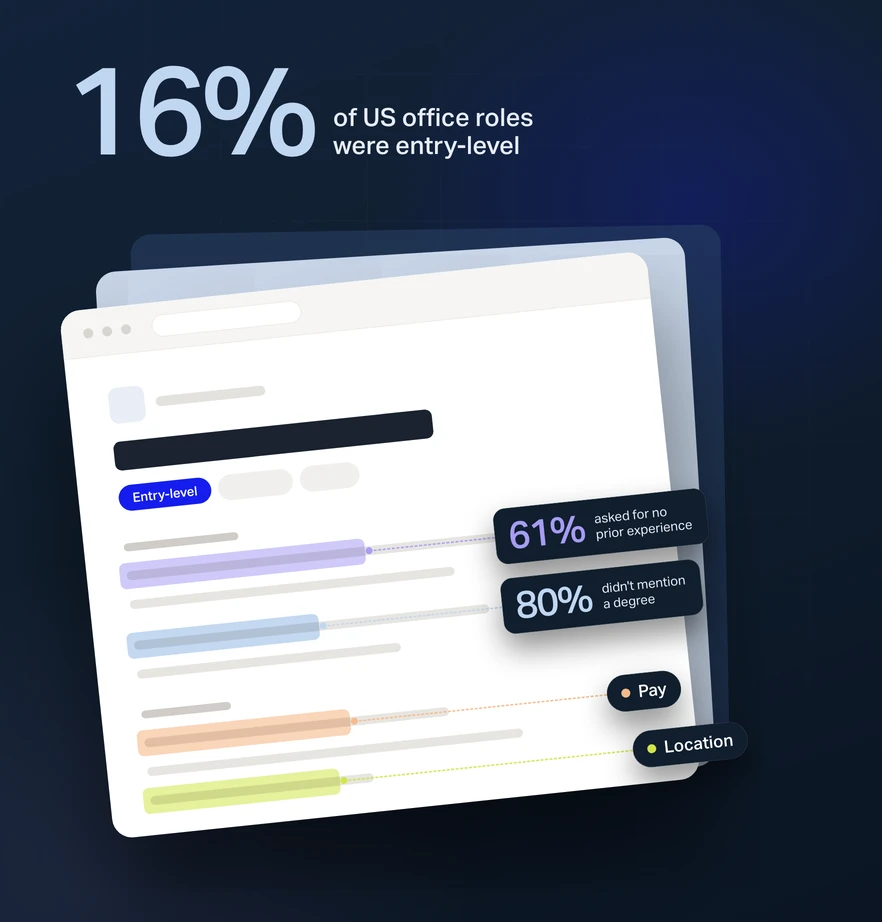
People leaving school or switching fields scroll through “entry-level” job listings, trying to work out which ones they can realistically get. Too often, they find postings asking for experience they don’t have yet. On the other side, employers decide which roles are open to beginners and what those candidates need to bring.
To get a clearer picture of both, Hire With Near analyzed more than 120,000 US job postings published on companies’ own career pages in September and October 2026.
We looked across nine office functions, including administration, customer support, sales, finance and accounting, and software engineering, and sorted roles by seniority to check how much experience entry-level postings demand, whether they require a degree, what they pay, and where the work happens.
What we found depends heavily on where you look. Entry-level jobs were most common in administration and customer support, and at government agencies, nonprofits, and small businesses. They were hardest to find in software engineering and at tech companies.
And despite the familiar complaint about “entry-level jobs that want three years of experience,” most of the postings we analyzed asked for less than that.
Here’s where first jobs are, what employers ask for, what they pay, and how often they mention training or remote work.
- Only about 6 in 100 US software engineering roles posted in September and October 2026 were entry-level, the lowest share of nine office functions, according to Hire With Near’s analysis of more than 120,000 US job postings.
- First jobs were far more common outside tech. About 20% of office roles at non-tech employers were entry-level, against 8% at tech companies, and administration (42%) and customer support (33%) had the highest shares.
- Most entry-level postings set a low bar on paper. 61% didn’t ask for any prior experience and 80% didn’t mention a college degree, though jobs titled “junior” asked for more. Only 4% asked candidates to use AI.

Where Are Entry-Level Jobs Hardest to Find?
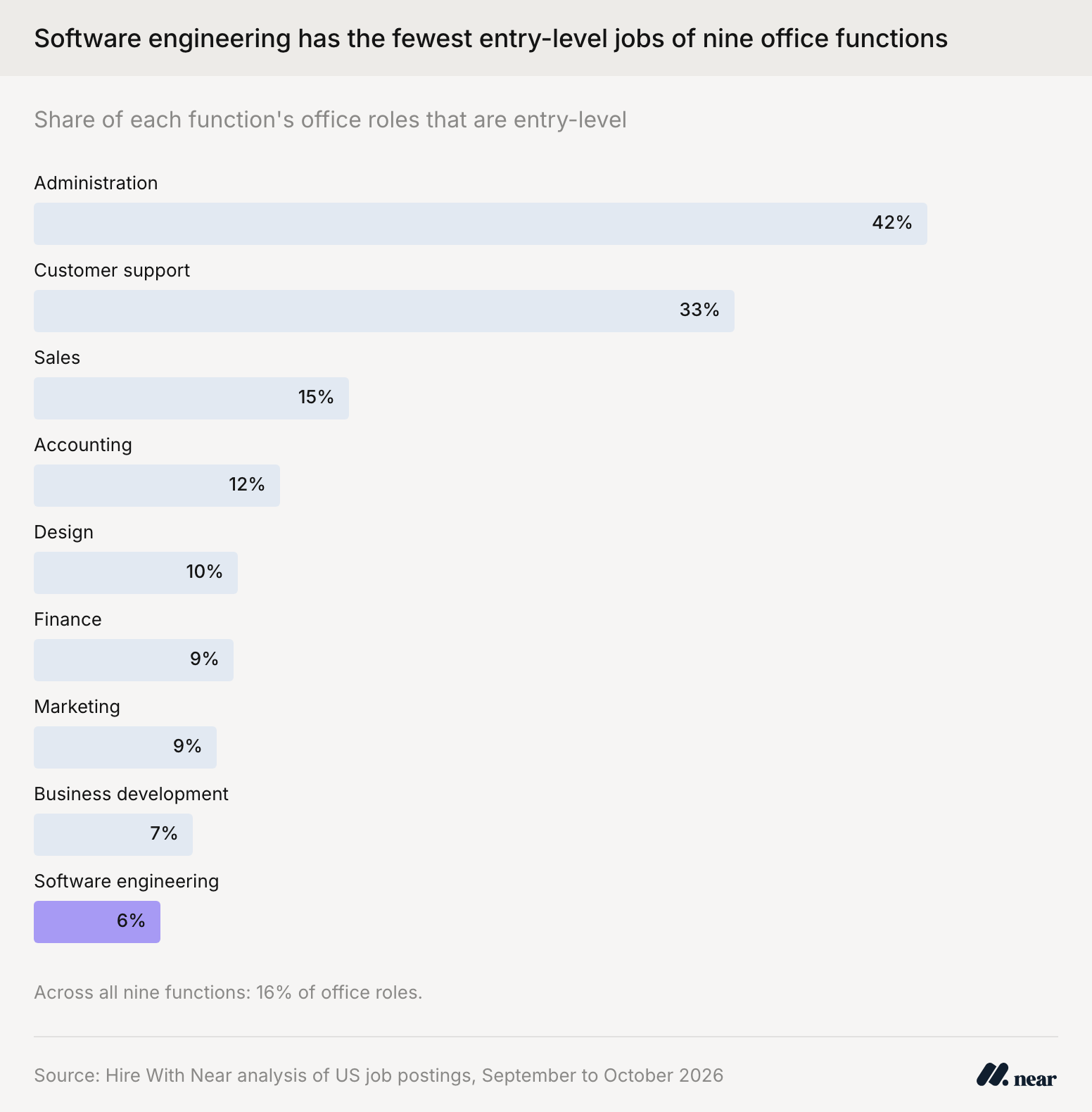
Only about 6 in 100 US software engineering roles posted in September and October 2026 were entry-level. That was the lowest share of the nine office functions we analyzed, and less than half the overall share (16%).
Those few entry-level software jobs paid well. The median advertised annual salary for entry-level software roles was about $100,000, twice the median for entry-level office jobs overall (about $50,000).
Entry-level software jobs also set a higher degree bar
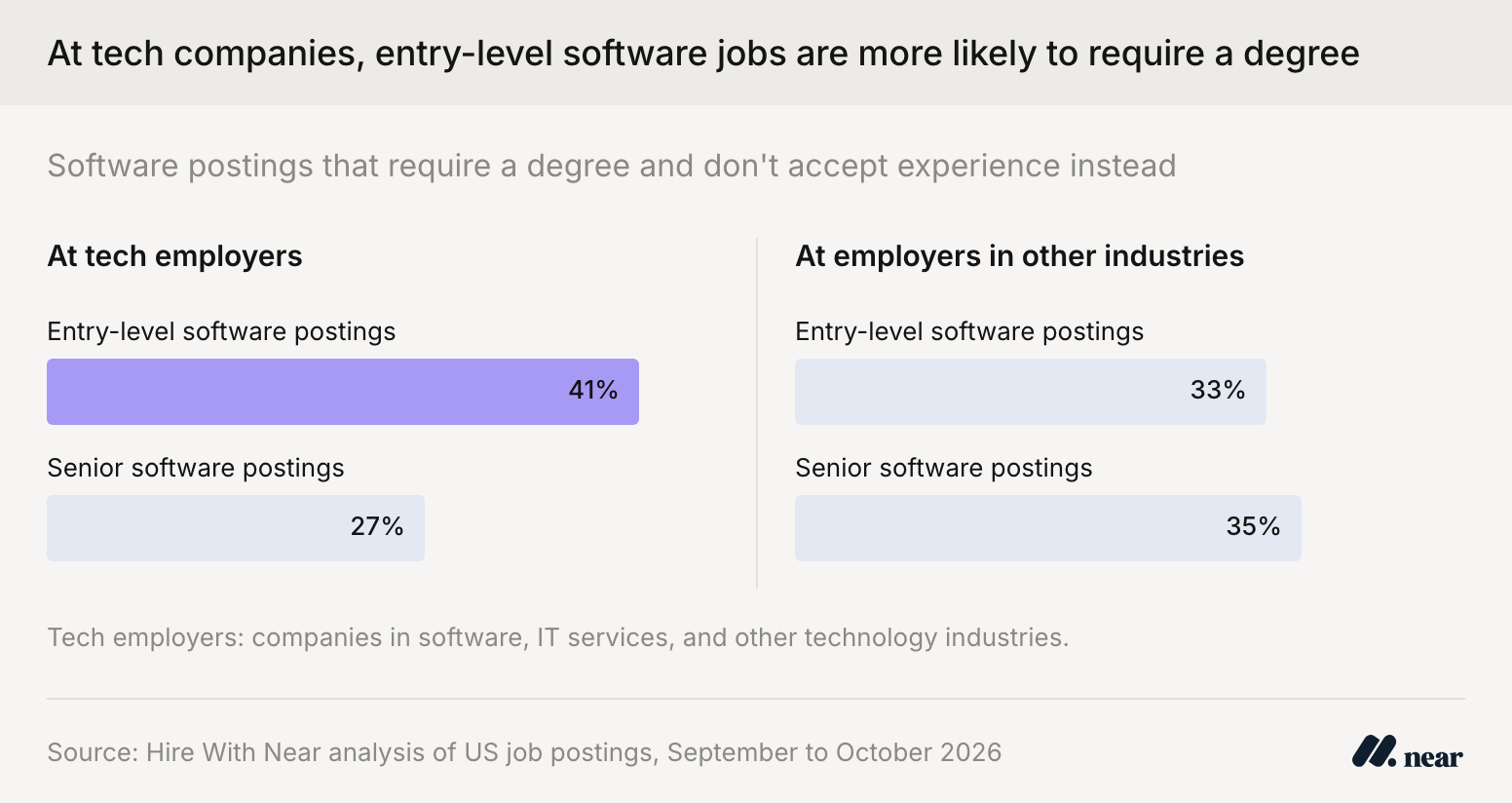
Software engineering was the only function where entry-level postings were stricter about college degrees than senior ones.
The difference was concentrated at tech companies, including employers in software, IT services, and other technology industries. There, 41% of entry-level software postings required a college degree without accepting experience instead, compared with 27% of senior software postings.
At employers in other industries, the two levels were about even: 33% of entry-level postings and 35% of senior postings required a degree.
What other research says about entry-level software jobs
Entry-level software jobs have been harder to find for several years. According to venture firm SignalFire’s 2026 State of Talent Report, new-grad hiring at the largest tech companies is down roughly 65% from 2019.
AI is often named as one reason. In an August 2026 revision of their study, Stanford Digital Economy Lab researchers found that employment of 22- to 25-year-olds in the occupations most exposed to AI was 19% below where it would have been had it kept pace with less-exposed peers.
Our job-posting data can’t separate the reasons behind those trends. What it can show is where entry-level software jobs are scarce today and what employers ask of the people applying for them, which we cover in the next sections.
Where Are Entry-Level Jobs Still Available?
Entry-level jobs were far more common at employers outside the tech industry. About 20% of the office roles at non-tech employers, such as healthcare providers, banks, retailers, and government agencies, were entry-level, compared with 8% at tech companies.
Tech companies also posted fewer entry-level jobs in other functions. Leaving software engineering roles out, 10% of the office roles at tech companies were entry-level, against 22% at non-tech employers. In marketing, for example, 11% of roles at non-tech employers were entry-level, against 4% at tech companies.
By function
Administration positions and customer support roles had the highest entry-level shares, followed by sales and accounting.
Customer support is another function often named as exposed to AI, and it still had the second-highest entry-level share. At tech employers, though, the entry-level share of support roles was about half the share at other employers (19% vs. 39%).
By employer type and industry
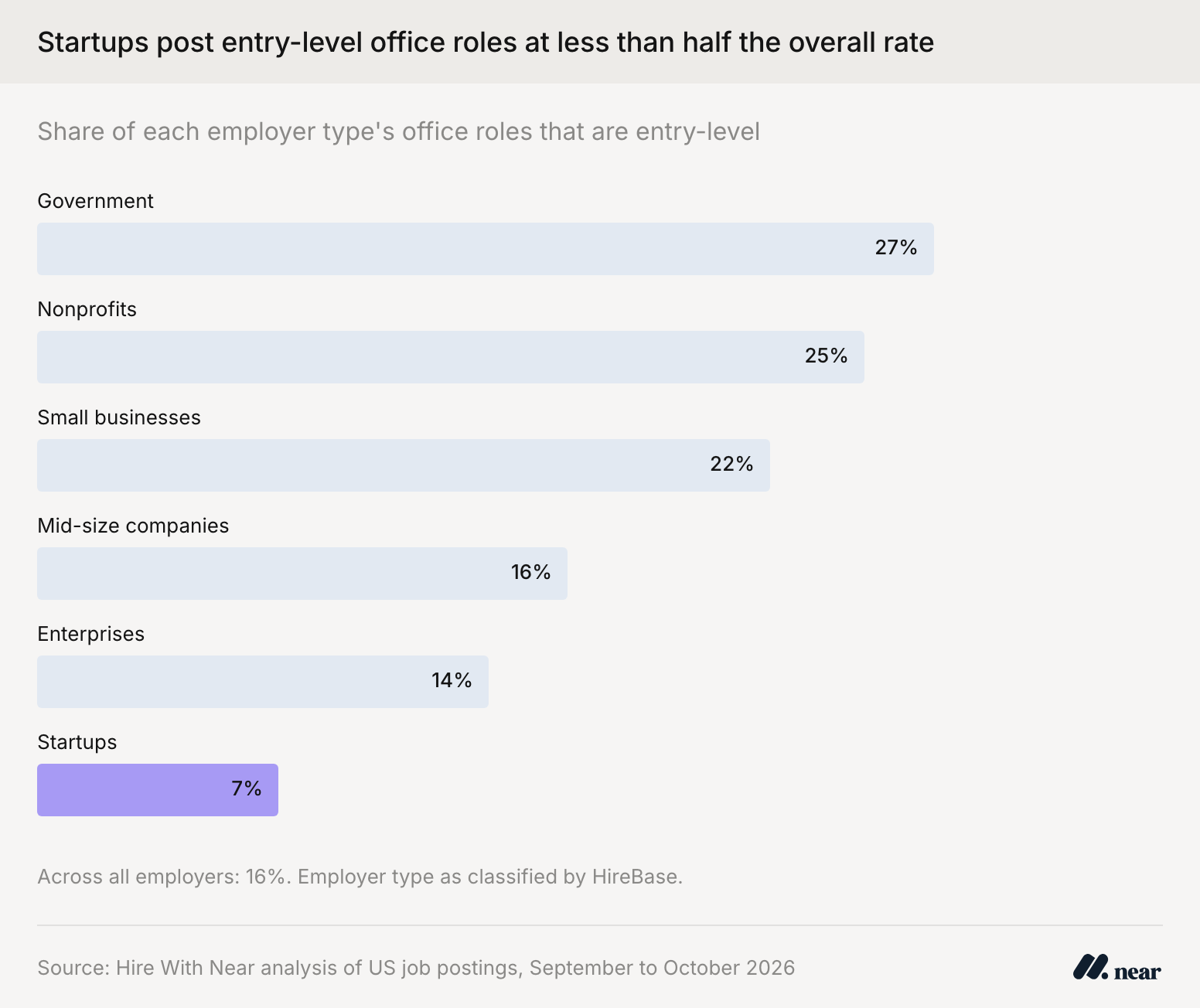
Government agencies (27%), nonprofits (25%), and small businesses (22%) posted the highest entry-level shares.
Startups posted the lowest, at 7%, less than half the overall rate (16%). Many startups are tech companies, which post few entry-level roles, but non-tech startups posted about the same low share.
By industry, construction, education, and healthcare had among the highest entry-level shares, at 21% to 24% of office roles. Tech, software, and IT services had the lowest (8%), followed by media (12%) and manufacturing (13%).
By state
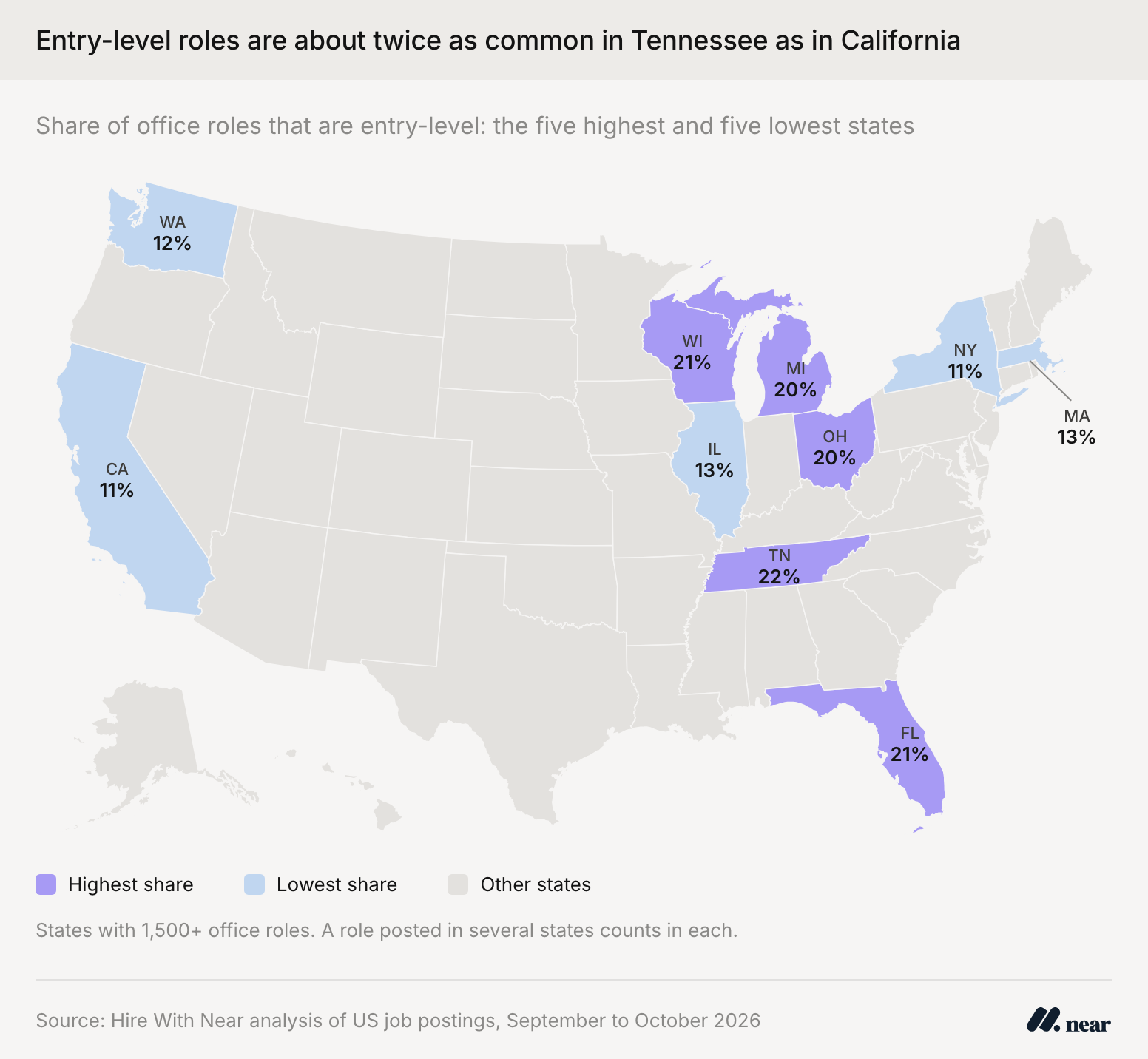
Where a job seeker lives made a large difference in how many of the office jobs open to them were entry-level. Entry-level roles made up about 22% of office roles in Tennessee and 21% in Florida and Wisconsin. In California and New York, the share was 11%.
Pay ran the other way. Among postings that listed pay, the median advertised annual entry-level salary was about $57,000 in California and $52,000 in New York, against about $45,000 in Tennessee and Florida.
Living costs are higher in California and New York, and both states require employers to list pay ranges, so most of their postings included pay. Only about a third of postings in Tennessee and Florida did, so the medians for those two states rest on fewer postings.
What first jobs are called
Most first jobs don’t say “entry-level.” Fewer than 3% of office job titles included words like “junior,” “entry-level,” “new grad,” or “level I.” Job seekers who search only for those words miss most of the openings.
The most common entry-level titles in each function were:
- Administration: Administrative assistant, receptionist, office coordinator.
- Customer support: Customer service representative, call center representative.
- Sales: Sales development representative (SDR), inside sales representative.
- Accounting: Staff accountant, accounting clerk, accounts payable specialist.
- Marketing: Marketing coordinator, social media coordinator.
- Finance: Financial analyst, credit analyst, relationship banker.
- Software engineering: Software engineer I, junior software engineer, new-grad programs.
What Do Employers Ask of Entry-Level Applicants?
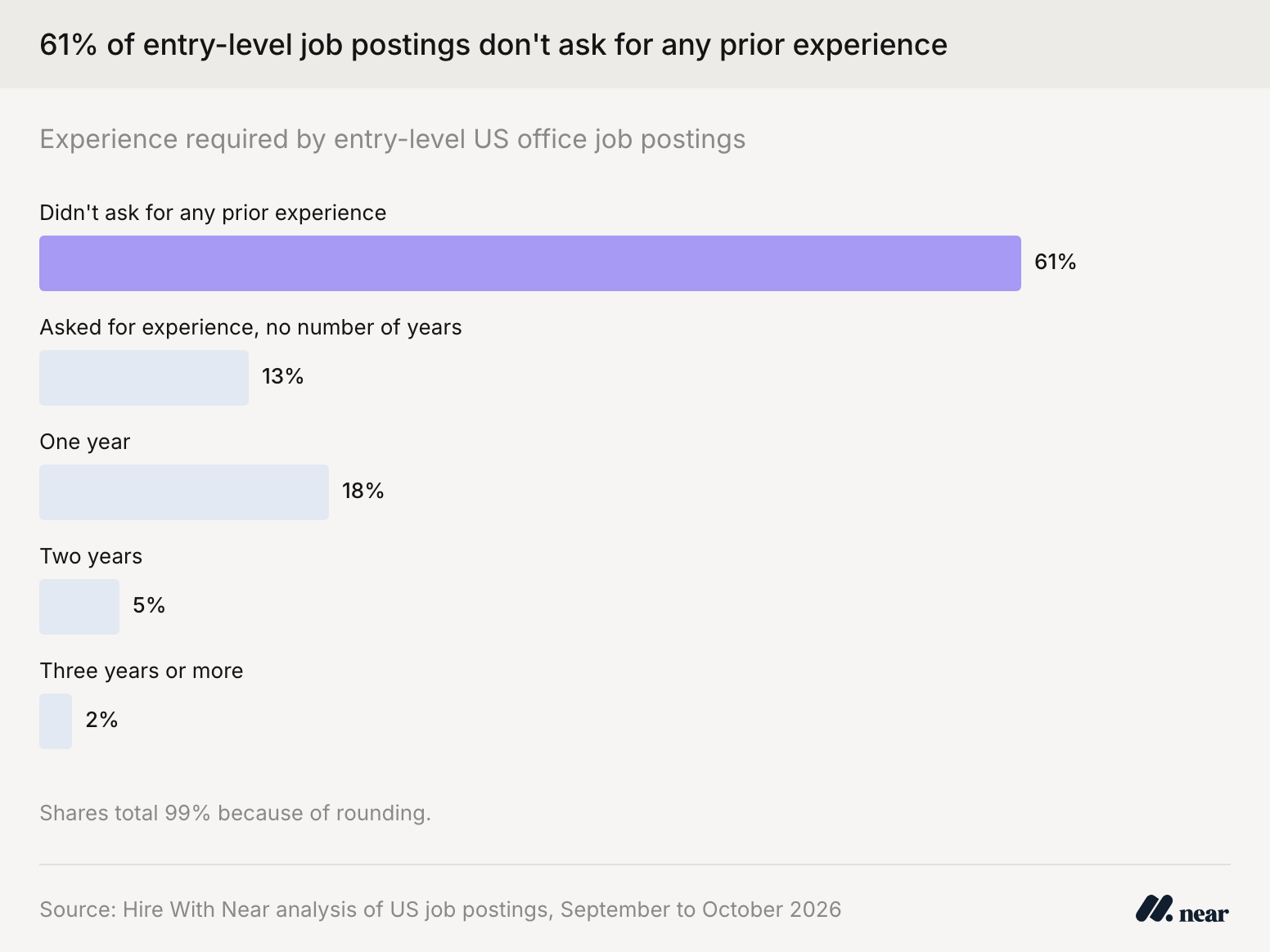
Most entry-level postings asked for little on paper. 61% didn’t ask for any prior experience, and 80% didn’t mention a college degree. The exceptions were jobs with “junior” in the title, accounting roles, and entry-level software jobs.
How much experience entry-level jobs ask for
Most entry-level postings didn’t ask for any prior experience. Here’s how the experience requirements broke down:
- 61% didn’t ask for any prior experience.
- 13% asked for experience without giving a number of years.
- 18% asked for one year.
- 5% asked for two years.
- 2% asked for three years or more.
Software was stricter about degrees, but it was one of the most open functions on experience: 70% of entry-level software engineering postings and 69% of entry-level sales postings didn’t ask for any experience, followed by marketing at 68%. Administration, customer support, and accounting were the least open, at 56% to 58%.
Jobs titled “junior” asked for more years of experience
Jobs with “junior” or “entry-level” in the title asked for noticeably more. About half asked for some prior experience, 22% asked for two years or more, and 9% asked for three years or more. Some examples from the postings:
- An “Administrative Assistant (Entry-Level)” role: “Minimum 2 years of office experience.”
- A “Junior Finance Analyst” role: “2 years of experience in accounting, finance, or a related internship.”
- A “Jr. AI Native Engineer” role: “2–4 years of professional software engineering or application development experience.”
Job titles can mislead. A role called “coordinator” or “representative” may be more open to a first-time candidate than one labeled “junior.”
Which entry-level jobs are most open to beginners
Among common entry-level job titles, these were the most and least likely to state no experience requirement:
Titles with 40+ entry-level postings, using the broader entry-level definition (see Methodology).
Staff accountant, the usual starting job for accountants, was among the least open, at 23%. Of postings for this role that named a number of years, 59% asked for two years or more.
What counts as experience
Few entry-level postings said what kind of experience they would accept. About 2% said an internship could count toward the experience requirement, and about the same share mentioned recent graduates or a graduating class at all. Among jobs with “junior” or “entry-level” in the title, the share that accepted internships rose to about 6%.
For applicants, that leaves a basic question open. When a posting asks for “one year of experience,” it rarely says whether a summer internship, a part-time job, or a class project counts.
Our recruiters hear something similar from the hiring side. In a sample of 10 recent kickoff calls for junior roles at Hire With Near, half of the clients named a number of years of experience, and all of those asked for one to three.
One sales team, for example, wanted two years so new hires would already know how to handle rejection on cold calls, while still being easy to train in the team’s way of working. Several clients said they cared more about how quickly someone learns than about the tools they already knew.
Others accepted experience from related fields, such as a legal assistant role that welcomed backgrounds in mortgage lending or debt collection.
Most clients want at least some exposure to the work world, even if it’s an internship or a university project. But it’s more about identifying who has the potential than years of experience.
— María José Lorenzo, VP of Talent Acquisition, Hire With Near
Which first jobs need a college degree
Only 20% of entry-level postings mentioned a college degree, compared with 49% of senior postings. When a posting did name a degree, about 36% also accepted equivalent work experience in its place, and that share was about the same at every level.
The difference between entry-level and senior roles was largest in accounting and finance. In accounting, 27% of entry-level postings required a degree and didn’t accept experience instead, compared with 58% of senior postings.
In marketing and design, entry-level and senior postings named a degree at about the same rate.
Our recruiters see degree requirements vary by role too. “It’s very much dependent on the role,” says María José Lorenzo, VP of Talent Acquisition at Hire With Near.
Engineering roles may require a related degree, and finance and accounting may require a specific degree or a certification. Business roles like marketing and sales are not so demanding right now.
— María José Lorenzo, VP of Talent Acquisition, Hire With Near
What Do Entry-Level Jobs Pay in the US?
About half of entry-level postings listed pay. Among those, the median advertised annual salary for an entry-level office job was about $50,000.
Software engineering paid the most, at about $100,000. Among common entry-level job titles, sales consultants, financial analysts, and account executives came next, at about $78,000 to $81,000. Staff accountants and business development representatives were at about $71,000, and SDRs at about $68,000.
The table below shows the median advertised annual pay for common entry-level job titles in the US job postings Hire With Near analyzed:
Note: Titles with 40+ entry-level postings, using the broader entry-level definition (see Methodology). Pay is the midpoint of the salary range advertised in each posting. For sales roles, it’s the posted base pay or range, without commission.
Do Entry-Level Jobs Offer Training or Remote Work?
Most first jobs were in-person, and few postings said how new hires would learn the job.
Training and mentoring
Only 13% of entry-level postings mentioned training. The share was highest in sales, at 26%, often in postings for SDR and sales trainee programs. Accounting, software, and design mentioned it the least.
Another 24% of entry-level postings asked for a “self-starter” who could work with “minimal supervision” and mentioned neither training nor mentoring.
The training may still be there even when the posting doesn’t mention it. In our kickoff calls, most clients hiring for junior roles described a plan to train the new hire.
One accounting team set up daily meetings for the first 30 days and expected the new hire to work independently after 60. Another company had its outgoing marketing lead record a video library of core processes for the new hire.
Remote, hybrid, or in-person
Most entry-level postings (87%) were listed as in-person, 7% as hybrid, and 6% as fully remote. The numbers were very different from senior postings: 20% were fully remote, about three times the entry-level share, and 26% were hybrid.
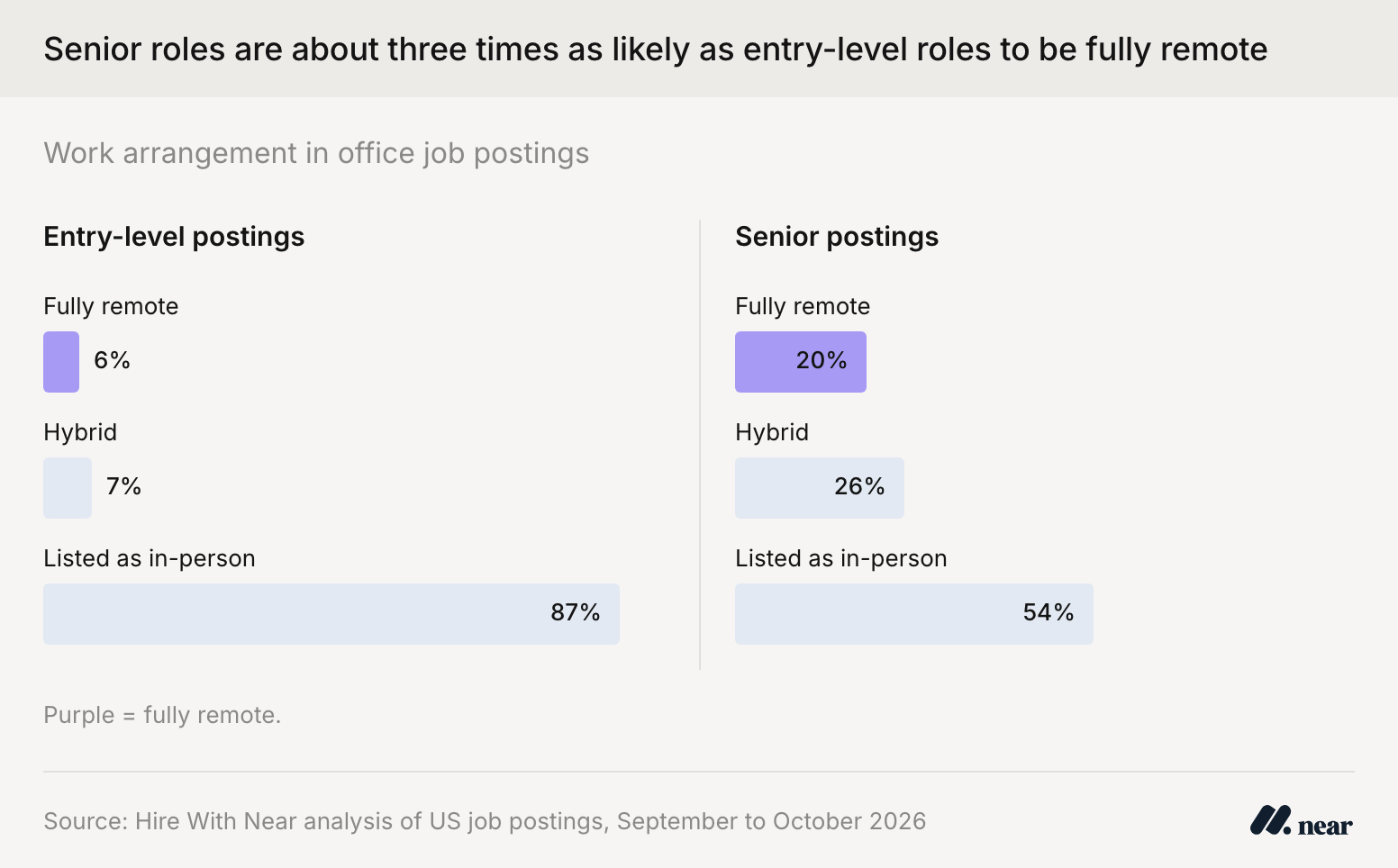
For people starting their careers, that means most first jobs still come with a commute. For employers, it means the roles they open to remote candidates skew senior.
Do Entry-Level Jobs Ask for AI Skills?
Few entry-level jobs ask for AI skills: only 4% of entry-level postings asked candidates to use AI, against about 14% of mid-level and 28% of senior postings.
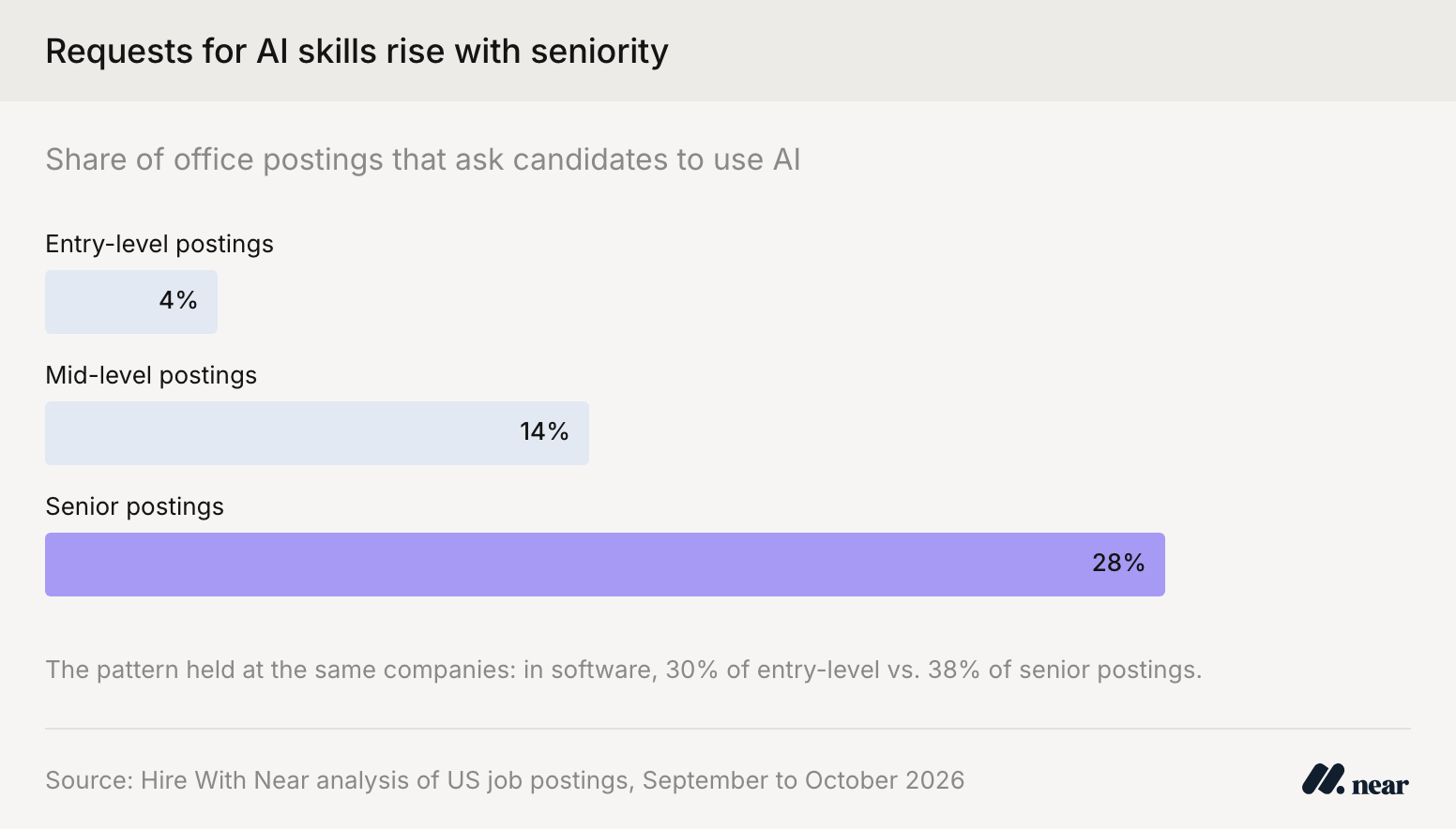
Senior postings asked for AI more often than entry-level ones in all nine functions we analyzed. Part of that reflects seniority in general: senior postings ask for more of almost everything, from tools to years of experience. It could also mean that the companies posting senior roles are more focused on AI than the ones posting entry-level roles.
To check, we looked at companies that posted both entry-level and senior roles in the same function. The pattern held. At more than 400 companies with both entry-level and senior software roles, 30% of the entry-level postings asked for AI skills, against 38% of the senior ones. In marketing, it was 6% against 14%.
Software was the outlier. About 25% of entry-level software postings asked candidates to use AI tools, far more than any other function’s entry-level roles.
Hire With Near’s own client job descriptions show a higher rate: 49% of the engineering descriptions US companies sent us between September 2025 and September 2026 mentioned AI. Those cover roles at every seniority level, so the two datasets aren’t directly comparable.
Among entry-level receptionist and support postings, AI requests were rare.
Other research on whether AI is reducing first jobs points in more than one direction:
- A June 2026 working paper from Ramp and Revelio Labs found that at the companies making the largest AI investments, entry-level headcount grew 12% in the two years after adoption.
- In Hire With Near’s October 2026 survey of 102 US companies, 21% of the companies not adding roles said AI or automation now covers work a new hire would have done. That question covered all new roles, not entry-level ones specifically.
In our own hiring, AI is changing the skills companies look for, in junior roles and at every other level. “We haven’t seen clients drop junior roles because of AI, but companies are rethinking which skills they value most,” says María José Lorenzo. “If we remove the manual tasks and admin work, what are we looking for in those people? That applies to every role, not just junior ones.”
What Does Hire With Near See in Its Own Hiring?
Hire With Near is a staffing and recruiting agency that helps US companies hire remote talent in Latin America. Among the companies that hire through us, demand for entry-level roles hasn’t dropped. Entry-level hires made up about the same share of our placements in Q3 2026 as in Q2.
Even so, most of the people we placed with US companies between October 2024 and October 2025 were mid-level (51%) or senior (33%), according to our 2026 State of LatAm Hiring Report. Entry-level placements made up 16%. In engineering, 98% of placements were mid-level or senior.
That’s a different dataset from the job postings above. It reflects the US companies that hire in Latin America through us and the roles they bring to us, and it fits one pattern in the postings: senior postings were about three times as likely as entry-level ones to be fully remote.
That mix also reflects why many companies come to us in the first place. Salary expectations in Latin America are 30 to 70% lower than comparable US salaries because of the lower cost of living, and for many of our clients that difference decides what level of hire fits the plan.
A company that could only fit a junior hire into its budget in the US can bring on a mid-level or senior professional instead, someone who works independently from the first month and can train the people who join after them.
The companies that do hire for entry-level roles are usually looking for people they can train and grow into future managers. Demand for those hires has led us to open partnerships with universities across Latin America to find high-potential graduates for some entry-level roles.
A junior hire can also be the better choice when the budget is tight, even with Latin American salaries. Lucas Stepanenko, our Finance Sourcing Manager, explains:
When the budget doesn’t stretch to a senior profile, it’s often more cost-effective to hire a more junior one and train them. Always look for high potential: someone sharp who can be coached.
— Lucas Stepanenko, Finance Sourcing Manager, Hire With Near
What Does This Mean for First Jobs?
First jobs are unevenly distributed. In September and October 2026, US job postings showed that:
- Entry-level jobs were scarce in software and at tech companies. Only about 6% of software roles were entry-level, and at tech companies, entry-level software postings were stricter about degrees than senior ones.
- They were far more available in administration and customer support, at government agencies, nonprofits, and small businesses, and in states like Tennessee, Florida, and Wisconsin.
- Most didn’t ask for prior experience. 61% of entry-level postings set no experience requirement, though jobs titled “junior” asked for more.
- Most didn’t mention a degree. 80% of entry-level postings left it out.
- Most were in-person, and few asked new hires to use AI.
For job seekers, that means searching beyond tech and beyond titles with “junior” or “entry-level” in them. For employers, it shows where more first jobs are posted, and how a posting’s wording, such as “junior” in the title or “self-starter” in the description, can raise the bar for first-time applicants.
If you’re hiring for one of these roles and want to see what experienced candidates in Latin America look like, get a list of pre-vetted candidates. There’s no fee to interview, so it costs nothing to see who’s available.
Free Download: The 2026 State of LatAm Hiring Report
We studied data from 2,000+ remote LatAm hires to reveal how top US companies use nearshore hiring to grow faster and recruit top talent while saving $35,000+ annually per hire.
About 16% of US office roles posted in September and October 2026 were entry-level, according to Hire With Near’s analysis of more than 120,000 job postings across nine office functions. The share ranged from 42% in administration to 6% in software engineering. Under a broader definition that also counts assistants, coordinators, SDRs, and staff accountants, the share was about 30%.
Most entry-level job postings don’t ask for experience: 61% of entry-level postings in our analysis didn’t ask for any prior experience. 18% asked for one year, and only 2% asked for three years or more. Jobs with “junior” or “entry-level” in the title asked for more, with about 22% asking for two years or more.
Most entry-level job postings don’t ask for a college degree: 80% of entry-level postings didn’t mention one. Software is the main exception: at tech companies, 41% of entry-level software postings required a degree with no alternative, more than senior software postings (27%).
The highest-paying entry-level jobs in our analysis of US job postings in September and October 2026 were in software engineering, with a median advertised annual salary of about $100,000. Sales consultants, financial analysts, and account executives came next, at about $78,000 to $81,000. The median for all entry-level office jobs was about $50,000.
US companies do hire entry-level talent in Latin America, though most of the placements we see are experienced hires. At Hire With Near, only 16% of placements between October 2024 and October 2025 were entry-level, and demand for entry-level roles has held steady even with the increase in AI use.
Methodology
The data: We analyzed US job postings for full-time roles published September 1 to October 31, 2026, on company career pages and applicant tracking systems, as collected by HireBase. Job boards and LinkedIn aren’t included. Postings from staffing and recruiting firms were largely excluded.
Office roles only: We focused on office and professional roles in nine functions: marketing, sales, business development, customer support, administration, accounting, finance, software engineering, and design. We also left out postings for internships and for part-time, seasonal, and temporary roles, so every role in the analysis is a full-time job. When the article mentions internships, it refers to what entry-level postings said about internships as prior experience. When we say “healthcare” or “construction,” we mean office jobs at those employers, such as receptionists at a clinic or coordinators at a builder.
Roles, not postings: We merged reposts of the same job at the same company, including copies posted in several cities, into single roles. We counted at most 10 roles per company in each function, so high-volume employers can’t dominate the results. We counted a role in a function only when its job title clearly belonged there, such as “staff accountant” in accounting. That gave 91,143 office roles, from about 123,000 postings. Percentages are shares of roles.
Entry-level: A role counts as entry-level if HireBase labels it that way, or if its title says junior, entry-level, new grad, trainee, apprentice, or level I, with no seniority words in the title. That’s 16% of office roles. A broader definition that also counts assistants, coordinators, receptionists, SDRs, BDRs, and staff accountants puts the share at about 30%, and the main findings hold under both. The pay and experience lists by job title use the broader definition, and the text says so.
AI: An AI request means the posting asks the candidate to use or understand AI. We identified these with text rules and checked samples by hand.
Pay: We report the median of the midpoint of the advertised range, among postings that list pay, with hourly pay annualized at 2,080 hours. Postings in states with pay-transparency laws list pay more often. Sales pay is base pay or the posted range, not commission.
Limits: The data covers only postings still open in early November, so September postings are underrepresented. We checked whether that skews the results. The entry-level share was slightly higher among late-October postings than early-September ones (16.8% vs. 15.8%). In software, it went the other way (5.7% vs. 6.2%), so the software finding doesn’t come from the timing. The data shows what employers wrote in open job postings. It doesn’t measure how many people were hired or how hiring has changed over time.