%203.svg)
Key Takeaways
- Outsource projects with a clear end date and hire in-house when the site will need ongoing work after launch.
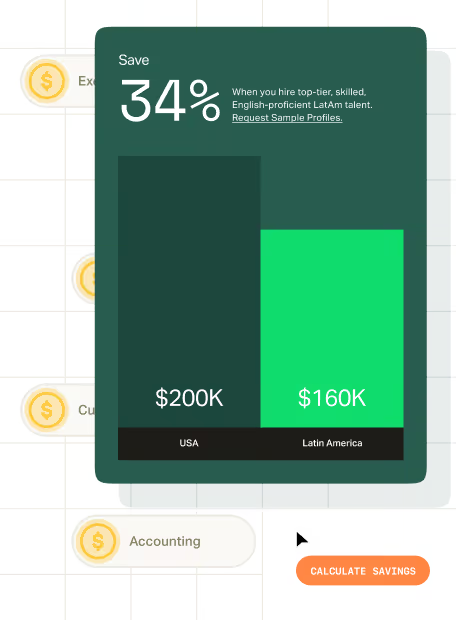
- Consider hiring a developer directly in Latin America. You get the control and continuity of an in-house hire, at $42K–$66K a year for a mid-level website developer instead of $62K–$104K in the US.
- The fastest way to decide is to name the one thing you can't compromise on, a launch date, a budget cap, or control over the roadmap, since each of those points to a different model on its own.
Every website build comes down to the same question: should I choose in-house development vs outsourcing? The short answer is that outsourcing fits a project with an end date, and hiring in-house fits a product that keeps changing after launch.
Most comparisons stop there, but there's a third option worth knowing about before you pick a side: hiring website developers in Latin America directly onto your own team. It gets you a developer who works at your company and reports to you, the same as an in-house hire, without the cost or timeline of a domestic search, which is what Hire With Near does for US companies.
This guide covers what each model costs, where each one wins, and how to decide, including that third option most comparisons leave out.
In-House Development vs Outsourcing: What's the Difference?
With in-house development, you employ the person writing your code. With outsourcing, a vendor does, and you're buying the output of their team instead of directing an employee of your own.
That one difference decides almost everything else: who sets priorities day to day, whether your cost is a fixed project fee or an ongoing salary, and who's still around to maintain the code 14 months from now.
Here's how the two models compare across the ten dimensions that usually decide it:
Most companies weigh five factors when they make the call between outsourcing and in-house development: who is doing the work, what it costs, how fast they can scale, what expertise they can reach, and how much control they keep.
Team composition and level of control
- In-house development: Developing in-house means you have a dedicated team of employees working directly under your supervision. Communication is immediate, feedback loops are short, and the team stays aligned with your company's vision.
- Outsourced development: Outsourcing involves handing off your project to third-party development teams, specialists who build websites for many clients at once. That can bring fresh perspectives and specialized skills, but it limits your direct control over day-to-day work.
The practical difference is the reporting line. With an in-house development team, you set the priority, run the standups, and review the pull requests. With outsourced developers, all three go through an account manager who’s balancing your requests against all the other clients’.
That layer is the single most common complaint we hear from companies coming off a vendor arrangement. The owner of a small US e-commerce holding company that had used a staffing agency for development work described it this way:
The other company, everything goes through them and there was too much back and forth. That was a big issue. I also like the idea of us being able to onboard them as our own.
Cost and team management
- In-house: The initial investment can be high due to recruitment, training, and infrastructure costs and, of course, full-time salaries and benefits. However, it can lead to cost savings in the long run for continuous projects by eliminating the recurring fees associated with outsourcing.
- Outsourced: Typically, outsourcing is more cost-effective for one-off or short-term projects since you only pay for what's needed. This approach can reduce labor costs while maintaining quality standards. However, costs can add up if requirements extend or the project deviates from the original plan.
Scalability and flexibility
- In-house: Scaling an in-house team can be time-consuming due to long recruitment cycles, onboarding, and training. It's also less flexible when you need to add or release developers quickly.
- Outsourced: Outsourcing offers greater flexibility and scalability. A vendor can scale the team up or down as the scope moves, usually within the current billing cycle.
Expertise and innovation
- In-house: An in-house team can develop deep industry-specific expertise over time, which is invaluable for nuanced projects. However, they might fall into routine patterns, potentially stifling innovation.
- Outsourced: Outsourcing often brings broader expertise and experience across various industries and with current market trends, which can drive innovation.
Quality assurance and accountability
- In-house: Direct oversight allows for stringent quality control, with immediate adjustments possible to maintain standards.
- Outsourced: Most vendors run their own QA, but accountability lives in the contract. You'll need defined quality standards in the statement of work and regular performance reviews to hold them to it.
With an outsourced vendor, you're trusting how they screened and trained the specific people writing your code, and you never see that process yourself.
When you hire in-house, you can run that screen on the actual candidate before they touch your codebase, and it doesn't have to be complicated: a real project walkthrough and a live technical conversation catch most of what matters.
Natasha Tarapow, Recruitment Consultant at Hire With Near, uses one question above all others:
We always ask candidates to tell us about a project they've worked on, not just that they use this language and that one, but what their role was and what they actually did. It's important that they can explain their work to someone who isn't a developer. If they can do that, that tells me a lot.
— Natasha Tarapow, Recruitment Consultant, Hire With Near
What Are the Advantages and Disadvantages of In-House and Outsourcing Web Development?
In-house wins on control, continuity, and security. Outsourcing wins on cost flexibility, access to specialists you never hired, and speed to scale.
Each of those advantages carries a matching cost, and the two lists below put them side by side.
In-house web development
Here are the advantages of in-house web development:
- Direct communication: With in-house development teams, communication is more straightforward and immediate. This can speed up decision-making and change implementation.
- They hear what you hear: In-house developers sit in your standups and on customer calls, so they make product and brand judgment calls without a briefing.
- Confidentiality and security: Keeping development internal reduces the risk of sensitive information being exposed to external parties.
The challenges of in-house website development cluster in three places:
- Higher costs: Salaries, benefits, training, and infrastructure all land on your budget from the first day. Hiring a mid-level website developer costs $62K–$104K a year in the US, according to our salary data, before you add benefits or equipment.
- Limited expertise pool: The diversity of skills will be limited to the experiences and knowledge of your team, which leaves gaps when a project needs a specialist you didn't hire, like a front-end developer for a rebuild in a framework nobody on staff has used. Those gaps are getting harder to close: ManpowerGroup's 2026 Global Talent Shortage Survey found that 69% of US employers struggle to find the skills they need.
- Slow to resize: Adding a developer takes weeks of sourcing and onboarding, and scaling back carries severance and morale costs.
Outsourced web development
The advantages of choosing to outsource web development are:
- Pay for the scope you define: Outsourcing often reduces costs because you pay only for the work you scope instead of carrying the overhead of a permanent team. There's a deep market of companies that handle this kind of outsourcing for US businesses.
- Access to global talent: Outsourcing opens access to a diverse pool of experts around the world, bringing in specialized skills that may not be available locally.
- Scalability and flexibility: Outsourcing makes you adaptable to changes in project scale or scope, so a bigger phase two doesn't require a hiring plan.
On the other hand, the disadvantages are:
- Slower feedback loops: Depending on the location of the outsourced team, their work will happen while your office is closed. A question sent in the afternoon waits until the next day, and enough of those two-day round trips on small decisions can be all it takes to push back a launch date.
- Less control: Less direct oversight can lead to challenges in enforcing quality standards and maintaining tight control over project specifics.
- Potential security risks: Sharing intellectual property and sensitive information with external parties can expose you to data security risks. Read the contract for the three things that matter most: what the NDA covers, whether IP assignment transfers the code and the design files to you upon payment, and how wide repository access goes and when it gets revoked.
The first three disadvantages show up while the project is running. But there's also a fourth that arrives a year later: the vendor's team has moved on to other clients, the people who actually built your site are gone, and nobody on either side still remembers why a given piece of the code works the way it does.
The Third Option: Hire Your Own Developer in Latin America
There's a third path between the two this guide has covered so far: keep your core team in-house, and extend it with developers you hire directly in Latin America, not through a vendor.
Two shifts make this a real option rather than a compromise:
- Hiring in-house stopped meaning hiring into an office years ago: The Stack Overflow Developer Survey 2025 found that 45% of US developers now work fully remote, the highest share of any top-reporting country, while only 16.2% are fully in person. Once your own developers are remote, adding a teammate in another country is a payroll question, not a culture change.
- Companies are already doing it: Hire With Near's research into why US companies turn to Latin American hiring found that 12% made the move specifically because they were switching from outsourcing to direct hiring. IT and engineering is one of the top departments making that switch, at 16%.
In dozens of conversations I've had with Hire With Near's recruiting team this year, the pattern has been consistent: these companies aren't rejecting vendors on principle. They want the person who knows the codebase to still be on their team when something breaks.
In practice, that means the developer you hire in Latin America works exactly like the rest of your in-house team: they attend your standups, use your processes, and work in your repositories, which is exactly how we describe it in our guide to hiring remotely in Latin America. They're a teammate, not a vendor you brief and wait on.
You build out your engineering team role by role, at a known salary instead of a change-request meter, and you keep the priority-setting and the code review because there's no account manager in between.
The part companies tell us they value most, though, is that the same person is still there in month 14. A vendor's economics depend on spreading people across clients and rotating them between contracts. A teammate's don't.
Your options for adding a developer in Latin America to the team
If you decide this third path is the right one, there are two realistic ways to get there:
- Source and hire the developer yourself: Nearshore job boards, LinkedIn, referrals, and your own screening. You also need a way to employ them: your own legal entity, or an employer of record that handles payroll, compliance, and local benefits while the person works as part of your team under your day-to-day management. The catch is that an employer of record employs, but it doesn't recruit, so finding and vetting every candidate is still your job.
- A specialist staffing and recruiting partner: This is the option that does both jobs at once. It finds and vets the person and handles payroll, benefits, and compliance in a single relationship. You describe the role, you interview pre-vetted candidates, and the employment logistics are handled for you. For most companies hiring a full-time remote web developer, it's the shortest route from an open role to someone starting work.
How Much Does It Cost to Build a Website In-House vs Outsourcing?
Hiring a mid-level website developer costs $62K–$104K a year in the US. Outsourcing the build instead runs $25–$49 an hour for most agencies globally, or $100–$149 an hour if you stay US-based, with the average full project landing around $66,500 over roughly nine months, according to Clutch's pricing data.
The third option, hiring that same role through a recruiting partner in Latin America, runs $42K–$66K a year, according to Hire With Near's salary data.
That's why the three never compare cleanly line for line. A salary, US or Latin American, is a known annual number that covers whatever lands in the queue. A vendor bill is a variable number that moves with scope. The things that move it most are the ones you can't fully predict at kickoff: design revisions, integrations that turn out harder than they looked, and the maintenance retainer you sign after launch.
The hiring side, at least, you can price exactly, whichever country you're hiring in. These are Hire With Near's own salary benchmarks for the roles a website build usually needs:
For the most up-to-date figures, see Hire With Near's US vs Latin America Salary Guide.
A lower number in the Latin America column doesn't mean a less experienced developer. According to Hire With Near's 2026 State of LatAm Hiring Report, 98% of our engineering placements last year were experienced professionals, 51% of them senior-level. The gap between the two columns reflects local salary markets and cost of living, not a step down in experience.
One line item most budgets miss: a website is rarely one role. Design, front-end work, and a CMS integration add up to two or three people, whether you hire them or contract them. Price the version of that team you'd hire before you compare it to a vendor quote.
How Do You Decide Between In-House, Outsourcing, and Hiring in Latin America?
Decide on the one thing you can't compromise on, and the model follows from it. Most development decisions come down to that single constraint.
Maybe it's speed to market. Maybe it's budget. Or maybe it's keeping tight control over your intellectual property.
Here are the common scenarios that point clearly to one of the three models.
Budget constraints
Outsource if you need to manage costs on a short-term or one-time project. Outsourcing gives you the skills for a defined stretch of work without carrying a salary once the build is finished. The same tradeoff applies beyond websites, and it's worth seeing how it plays out when you're hiring a developer versus outsourcing in general.
Choose in-house if you have the budget to invest in building a team for ongoing, long-term projects where the continuity and accumulated domain knowledge of an in-house team will be beneficial.
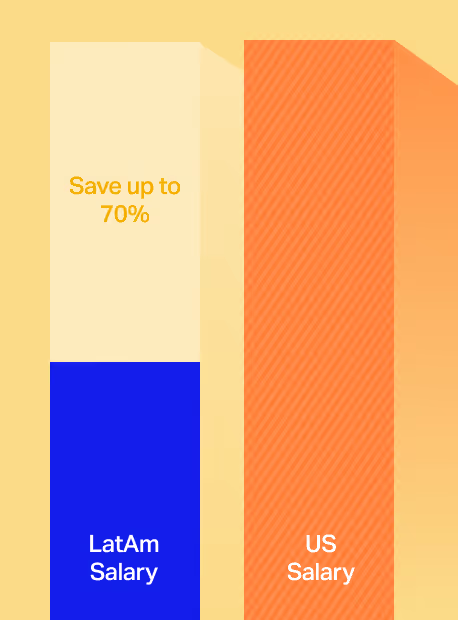
Hire in Latin America if you want the continuity of a permanent team member without a US salary line. You get a direct employee, not a contractor, typically 30–70% below the US rate for the same role.
Project timeline
Outsource if your project has a tight deadline and requires rapid development. A vendor starts from an existing bench, so work usually begins within days and can add developers when the schedule demands it.
Choose in-house if your timeline is flexible, allowing for more deliberate and iterative development processes that an in-house team can provide.
Hire in Latin America if you can allow a few weeks rather than a few days, in exchange for someone still on your team after launch. Most Hire With Near placements land a shortlist in 3 to 5 days and a hire in under three weeks, faster than most US searches, though not as immediate as pulling capacity from an outsourced bench.
Project complexity and scope
Outsource if your project involves niche technologies or specific web development skills your current team lacks. External vendors can bring in that specialized expertise efficiently.
Choose in-house if the project is deeply integrated with your core business activities and requires a nuanced understanding of your processes and project requirements, which an internal team is more equipped to deliver.
Hire in Latin America if the work needs both: someone embedded in your stack over the long term, and a specific technical skill your local market is priced out of. A wider hiring pool gets you the specialization without giving up ownership of the hire.
Need for control and customization
Outsource if you are comfortable with a more generalized approach, focusing on achieving results without needing exhaustive oversight of processes.
Choose in-house if the project demands high customization and constant monitoring. These are easier to manage with an in-house team, and you can directly influence each stage of development.
Hire in Latin America if you want the same direct oversight as a domestic hire. The developer reports to you, not to a vendor account manager, so you influence every stage the way you would with any employee.
Cultural and company alignment
Outsource if the work is self-contained enough that the team doesn't need your product context to make good calls. A clear brief and a defined scope carry it.
Choose in-house if maintaining company culture and aligning the team with your brand's ethos is important to the project's success.
Hire in Latin America if cultural fit and product context matter but a domestic hire isn't in budget. The developer joins your team, sits in your standups, and absorbs your context the way an in-house hire would; the only difference is where they're logging in from.
If you read those five and found yourself wanting outsourcing's speed and in-house's continuity at the same time, that's the case for the third option: a developer who's yours, at a Latin American rate, without the multi-week ramp-up of a domestic search.
Final Thoughts
Name your constraint first, whether it's the launch date, the budget, or control of the roadmap, and the model picks itself: a vendor for a bounded build, your own developers for a site that keeps changing.
The third path is the one most comparisons leave out. Hiring developers in Latin America puts you in front of people who have shipped and maintained production sites for US clients. They work during your business hours and follow your own review process, at a known salary rather than a change-request meter.
Tribu, a San Antonio creative agency, needed a web designer who could handle both the design and the build, someone fluent in Webflow, Figma, and HTML/CSS/JavaScript, not just one or the other. Their local talent pool didn't have that combination, and the job boards weren't surfacing it either.
Hire With Near filled the role in 24 days with a UX/UI designer and no-code developer who'd already worked remotely with North American companies, saving Tribu $37,000 a year against what hiring that professional would’ve cost locally.
Tribu's Recruiter, Carmen Lopez, put it this way:
The experience was nothing short of exceptional. From start to finish, the entire process was remarkably smooth, and the team at Hire With Near played a pivotal role in making our hiring journey a success.
— Carmen Lopez, Recruiter, Tribu
We also handle executive-level engineering hires when the gap you're filling is a VP of Engineering rather than a developer.
Price the hiring option against your last vendor quote before you renew the retainer. That comparison usually settles it, and we can give you the benchmarks.
Schedule a free, no-commitment consultation call today.
{{latam-hiring-cta-v2}}
Frequently Asked Questions
Should I outsource software development or build an in-house team?
Outsource when the work is bounded, one-off, and tied to a hard date; build in-house when the software is a product you'll keep changing. A site that ships changes every sprint costs more through a vendor over two years than through a salary.
A third option: hiring developers directly, including in Latin America, at a cost between the two.
What are the key differences between in-house and outsourced software development?
Three differences decide it: control, cost structure, and continuity. In-house, you set priorities and review the code yourself; outsourced, both run through an account manager on the vendor's cadence. In-house cost is a fixed salary; outsourced cost is variable and grows with every change request. A vendor can also rotate engineers inside the same contract.
How do you know a developer can code before you hire them?
You run the filter yourself, which is the part a vendor never shows you. The screen our engineering recruiters rely on isn't a take-home test: ask a candidate to walk through a project they shipped, name which parts were theirs, and explain it to someone who isn't a developer. It's the fastest signal we get on whether someone can do the work.
When to outsource vs build in-house?
Outsource when the work has an end date and build in-house when it doesn't. If you can write a scope that's finished at launch, a vendor is the faster route. If the site keeps absorbing changes for two years, the scoping cycle becomes the real cost. Spiky work suits a vendor; a steady weekly queue suits a hire.
What is in-house development?
In-house development means the developers building your software are employed by your company and work under your direction, on your priorities, in your tools. It no longer means in-office or US-based. Most in-house developers now work remotely. What makes it in-house is the payroll, not the desk.
How does outsourcing impact time-to-market compared to in-house development?
Outsourcing is usually faster to the first launch and slower to everything after it. A vendor starts from an existing bench, so work begins within days, while hiring takes weeks, though most companies hiring through Hire With Near make a hire in under three weeks. After launch, the order flips: your own developer ships changes on request.
What is outsourcing in web development?
Outsourcing in web development means contracting a third-party agency, dev shop, or freelancer to build or maintain your website under a project or retainer agreement. The vendor employs and manages the people doing the work, and you buy a defined scope rather than a team. Your requests are then prioritized alongside the vendor's other clients.
What web development roles can I hire instead of outsourcing?
A website build usually needs two or three roles, and all of them can be hired directly. Webflow developers handle CMS-based sites and ongoing maintenance, front-end developers work on the interface, full-stack developers handle cases where the site talks to a backend, and web designers handle the visual work.
Hiring these roles in Latin America costs 30–70% less than the US equivalent.
Will developers I hire in Latin America work my hours and join our standups?
Yes. A developer you hire in Latin America works a normal business day that overlaps yours, so standups, code review, and same-day answers happen live rather than overnight. The overlap is near-total if your team runs on Central or Eastern time, and still covers most of the working day on Mountain or Pacific.
Is hiring developers in Latin America the same as outsourcing?
No. With outsourcing, a vendor owns the people and the process and you buy a scope. A developer you hire in Latin America joins your team, works in your tools on your priorities, and reports to you. A vendor can swap engineers inside a contract; a teammate can't be.
Hire With Near placements stay an average of three years.






.webp)


%203.svg)
.avif)





%20(1).avif)

%20(1).png)