


%203.svg)
Key Takeaways
- Outsourced payroll typically makes sense for small businesses that want to hand off compliance and tax filings to a specialized provider at a lower cost.
- In-house payroll gives larger organizations with dedicated finance teams full control and direct visibility over their own data.
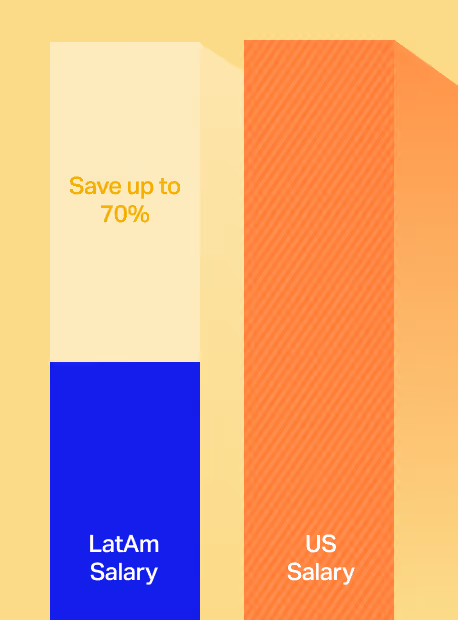
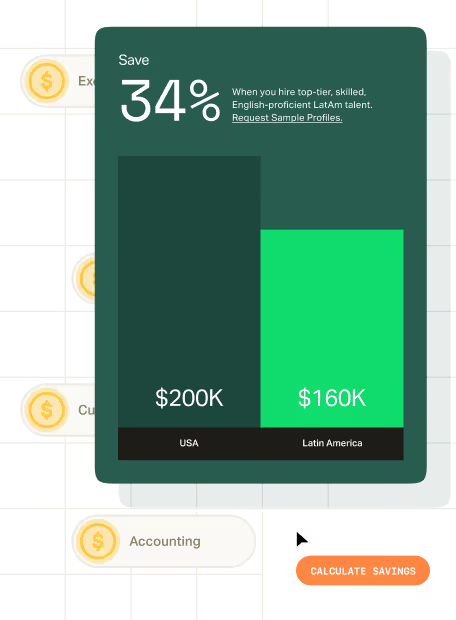
- A third path, hiring a dedicated and full-time Latin American payroll specialist, delivers the control and continuity of in-house, but at a 58–70% lower cost than a US hire.
5When payroll goes wrong, do you want a customer support queue number, or a name and face on your own team to fix it? Most would choose the second. But if you think your only payroll options are in-house or fully outsourced, you’re missing the most interesting (and often, profitable) path.
Alongside the usual two models, more teams hire finance and accounting talent in Latin America. They keep in-house control while paying something much closer to outsourced rates.
If you’re building your finance function, you should weigh this option before you lock in a direction.
After five years recruiting finance talent at Hire With Near, I’ve seen that the “right” answer usually comes down to this: do you want a service processing your payroll, or a person on your team who owns it?
If you’re leaning toward a direct hire, get a sense of what a dedicated payroll specialist in Latin America costs before you go further.
In this article, we’ll break down the pros and cons of in-house, outsourced, and a dedicated LatAm payroll specialist so you can choose the best fit for your headcount, compliance exposure, and level of control. For a wider lens, see our companion piece on outsourcing accounting and payroll.
Benefits of In-House Payroll Management
In-house payroll management gives you complete control over your workflows, data, and timelines, which matters most for companies with complex compensation structures or specialized compliance requirements.
Here’s how they play out in different common scenarios for enterprises.
Flexibility in processes
With in-house payroll, you can design and implement payroll systems that align precisely with your unique policies and procedures. This level of customization is valuable for companies with specialized payroll needs or those operating in niche industries.
It also lets you respond quickly to changes in regulations or internal policies without waiting for a third-party provider's update schedule. When you’re ready to pivot, your in-house professional can sit on the training and pivot with you.
Immediate data access
Whether for routine checks, audits, or quick adjustments, having direct control over payroll information means data is always available when you need it. It also means you have accountability in being able to audit that data whenever you want; you can ensure it’s being managed in the way you’ve promised customers and stakeholders.
For businesses managing payroll in-house, dedicated software like QuickBooks, Gusto, or ADP automates tax calculations and reduces errors in complex submissions. This cuts the time it takes to resolve issues, generate reports, or respond to employee inquiries.
What Are the Drawbacks of In-House Payroll?
In-house payroll costs more than most companies anticipate, and the risks compound if the team handling it lacks the deep specialization needed for a high ROI.
High cost
The large compensation packages given to in-house teams are one of the largest obstacles to overcome. Full-time staff have salaries and benefits to budget for, but they also need continuous training to stay current with tax laws and regulations. Additional costs, like external certifications, software, workstations, and office space, all add up.
Those costs are rising. According to the U.S. Bureau of Labor Statistics Employment Cost Index, wages and salaries for civilian workers increased 3.6% for the 12-month period ending March 2025. That trend applies directly to every in-house payroll hire you make, even those that don’t need the specialized training and support of a finance professional.
Increased risk of errors
Payroll processing requires meticulous attention to detail and a thorough understanding of tax laws, employment regulations, and accounting principles.
But not every new hire has the same proficiency, and it’s typical for in-house staff to lack deep payroll expertise. As such, the risk of errors in calculations, tax withholdings, or compliance reports rises substantially at a very real cost to you.
According to an ADP report, global payroll operations achieve only about 78% accuracy, which means a significant share of payroll runs still contain errors.
When you combine that with an older Ernst & Young survey finding that each payroll error carries an average cost of $291, the financial impact of even “minor” mistakes adds up quickly at scale.
For companies running high-volume payroll in-house without deep specialization, those error costs stack on top of the technology, maintenance, and training investments required just to keep the system compliant and up to date.
Infrastructure costs
Setting up and maintaining a payroll system requires significant investment in software, data security, and IT infrastructure. These systems need regular updates to comply with changing laws, which means ongoing maintenance costs.
You also need IT support and staff training to keep everything running accurately, and possibly specialized IT help that’s well-versed in financial tech and security.
What Are the Benefits of Outsourced Payroll?
Outsourcing payroll transfers responsibility to specialists whose entire business depends on getting it right, which reduces your administrative burden and compliance exposure at the same time.
Time savings
Managing payroll in-house involves calculating wages, withholding taxes, filing with government agencies, and staying current on regulatory changes. By handing these tasks to a provider, your HR and accounting teams regain that time to focus on work that moves the business forward, such as developing deeper strategies, analyzing data, or exploring new financial integrations.
For lean finance teams supporting rapid growth, that reallocation often adds up to several hours per pay cycle.
Reduced error risk
Third-party payroll providers live and breathe payroll processing and stay current on tax laws, regulations, and compliance requirements as part of their focus. This specialized expertise reduces the chance of errors in calculations, withholdings, and compliance reporting, and lowers your exposure to financial penalties. They know and recognize errors in ways less-experienced professionals typically don’t.
Providers whose only job is payroll process fewer errors; they also carry the liability when they do make them.
Enhanced scalability
Outsourcing payroll scales more easily than an in-house team, making it a practical option for businesses with fluctuating headcounts. As your company grows, the demand for payroll processing naturally increases, but this can overwhelm internal resources. Outsourced providers increase their support without requiring you to hire, train, or manage additional staff on compressed timelines.
Improved data security
Sensitive employee information, including Social Security numbers, bank account details, and personal addresses, must be protected against breaches and unauthorized access. Reputable payroll providers invest in encryption, secure servers, and compliance with data protection regulations. Smaller businesses may find it difficult to match that level of security infrastructure on their own or without significant cost.
Cost savings
Outsourcing payroll eliminates the need for full-time payroll staff and reduces overhead costs for software, equipment, training, and office space. Payroll companies spread overhead across many clients, which typically results in lower per-service costs than maintaining an in-house team. You also pay only for the services you use, which is especially cost-effective when staffing levels frequently change.
What Are the Drawbacks of Outsourced Payroll?
Outsourced payroll has its own tradeoffs, which mainly come down to visibility and control. For companies that need quick answers or handle non-standard pay arrangements, the bureau model creates friction that adds up over time.
Lack of control over processes
When payroll is handled in-house, businesses have direct oversight and can make immediate adjustments. Outsourcing shifts that control to an external provider. Any changes or updates must go through the third party, which can delay implementation, add confusion, and reduce your ability to respond quickly to internal changes or regulatory updates. It can also make simple personnel issues more complicated than they need to be.
Hire With Near's analysis of 2,000+ hiring conversations with US companies highlighted this concern. One company rep stated,
Dealing with a 'middleman' is hard because we don't manage [our workers]. They're managed by the agency. So if someone's sick, it takes us hours to find out. They have to tell their manager, and the manager has to tell us.
That visibility gap is especially problematic in payroll, where a missed deadline or unreported exception can cascade into a compliance issue by the end of the pay period.
Our data reinforces this theme. Of the companies that leave outsourcing models, 12% do so because of a lack of control, a revolving door of contacts at the provider, and workers who never feel like part of the team.
Dependence on third-party providers
When you outsource payroll, you depend on an external provider to manage critical functions accurately and on time. If the provider faces operational issues or service disruptions, your payroll can be affected. So, every issue experienced by your payroll vendor is experienced by you downstream.
{{offshore-talent}}
Key Factors to Consider When Choosing Between In-House and Outsourced Payroll
These two very different options both have their merits and challenges. Therefore, the right choice depends on your company size, regulatory complexity, and how much direct control you need over day-to-day payroll operations.
Business size
Small businesses with limited resources often find in-house payroll difficult to manage because of the complexity and time demands involved. Outsourcing offers a more cost-effective solution and frees staff to focus on other work.
Larger companies with dedicated HR and finance departments may find the control and customization that in-house payroll provides to better match their existing workflows.
Compliance with regulations
Outsourcing payroll can lower your legal risk because the provider is responsible for staying current on regulations and filing the right forms. If you’re in a niche industry with unusual rules, handling payroll in-house can give you more freedom to design processes that match your exact compliance needs.
Payroll management responsibilities
In-house payroll requires dedicated personnel with skills across data entry, tax filing, and compliance reporting. If you have the resources to hire and support that team, in-house management can work well.
Outsourcing shifts those responsibilities to the provider, letting your internal teams concentrate on core business functions. This is a better scenario for smaller businesses or companies in a growth stage, where staff are stretched across multiple roles. Outsourcing frees up precious time that would otherwise go to payroll administration.
Why Choose Outsourcing over In-House Payroll?
Outsourcing creates even better returns when your company needs predictable costs, compliance coverage, and the ability to scale without adding headcount.
Free your finance team to focus on growth
Third-party providers bring focused expertise, clear processes, and modern payroll tools that boost accuracy and speed. When HR and finance are not buried in payroll admin, they can spend more time on hiring, developing people, and other work that actually grows the business.
Keep payroll costs predictable as you grow
Initial setup costs for payroll software, ongoing maintenance, and dedicated personnel add up quickly. Outsourcing provides a more predictable alternative: most payroll service providers charge $20–$100 per employee per month, on a scalable pricing model that adjusts with your headcount rather than locking you into fixed overhead.
Long-term scalability without adding headcount
As your business grows, payroll gets more complicated. Handling that in-house means spending more on people, training, and systems. Outsourced providers can scale with you without those internal costs. For companies with fluctuating or seasonal headcount, that flexibility can be a real operational advantage.
A Third Option: Hire a Dedicated Payroll Specialist
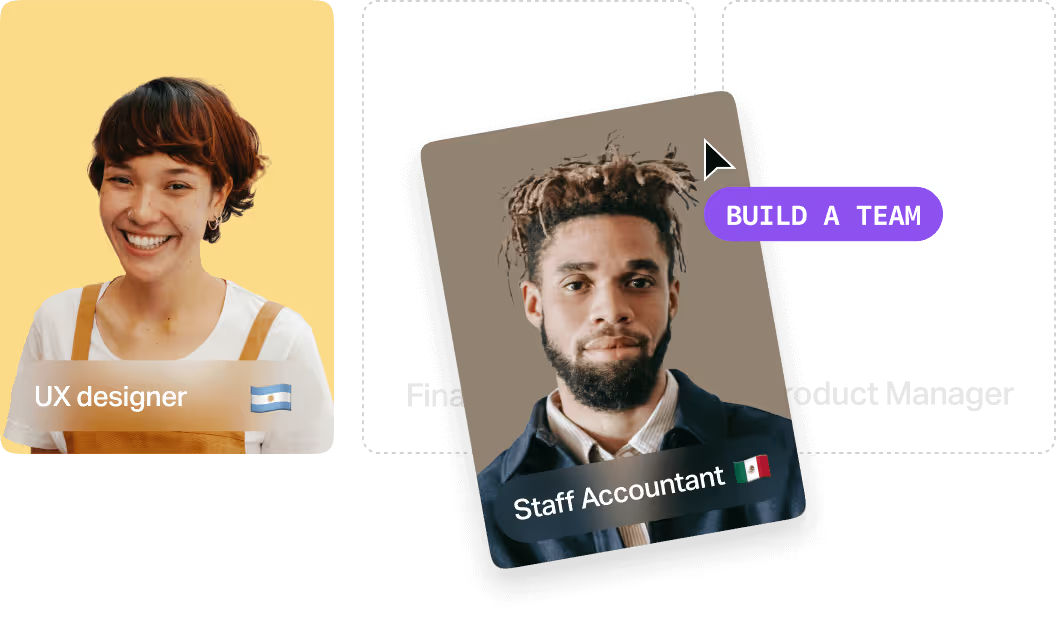
The choice between outsourcing and in-house payroll is real, but it is also incomplete, because there’s a true third path you may not have considered. It gives you the cost savings of outsourcing and the control of a direct hire, and it’s a dedicated payroll specialist based in Latin America.
This professional works full-time for your company, and your company alone. They also work in your time zone, using the same tools your team already uses. They are not a contractor or managed by an agency. They are your hire.
What the salary difference actually looks like
Compensation benchmarks show that a dedicated payroll specialist based in Latin America typically costs considerably less than a US equivalent:
For a full breakdown of compensation by role and seniority level, see our accounting roles salary guide and finance roles salary guide.
In my work sourcing finance professionals from Latin America, I consistently see candidates with rigorous academic backgrounds and meaningful experience at Big Four firms.
That exposure to cross-border work means they are comfortable with international markets and highly fluent in core accounting standards such as US GAAP and IFRS, which come up in most US client requirements.
Those candidates are available through Hire With Near's nearshore staffing model, which sources pre-vetted Latin American professionals and handles the logistics of international employment.
Why the US talent pipeline is getting harder to navigate
Finding a qualified US-based payroll professional is getting structurally harder. According to Accounting Today, citing data from the American Institute of CPAs, the number of candidates sitting for the CPA exam has fallen 27% over the past decade. The number of accounting graduates dropped by nearly 17% between 2016 and 2020.
That shrinking supply pushes demand up, and along with it, salaries. It also extends hiring timelines for finance and accounting roles, such as payroll. Latin America's accounting programs have not seen the same decline, which is part of why Argentine and Colombian finance professionals now make up the majority of Hire With Near's finance placements.
Further reading: What Smart Companies in America Are Doing to Overcome the Accounting Talent Shortage
Time zone alignment matters for payroll deadlines
Payroll deadlines are time-sensitive. A late direct deposit, a missed tax filing, or a miscalculated withholding can create real problems for employees and compliance exposure for your business. A specialist working overlapping US hours can catch and resolve issues the same day, without the communication lag that offshore arrangements often create.
Our data shows that 30% of companies switching to LatAm hiring are doing so specifically because offshore arrangements in Asia disrupted real-time collaboration. For payroll work, that issue is an operations requirement and not just a workplace culture preference.
What the dedicated hire model looks like in practice
FinanceWithin, a fractional finance services firm in Austin, Texas, had tried both US hiring and offshore recruitment in India before working with Hire With Near. The offshore engagement produced high turnover and inconsistent quality. On the other hand, US candidates demanded salaries that did not fit the business model.
After a client referral, FinanceWithin began placing Senior Bookkeepers through Hire With Near, then expanded to Accounting Managers and Financial Analysts. Hire With Near placed multiple bookkeepers within days to support 10 new client engagements simultaneously.
"The talent pool from Near has been outstanding, far beyond what I could find on LinkedIn. The process has been a pleasure." Sheena Malson, Director of Accounting at FinanceWithin, shared.
Miles Eggart, COO of FinanceWithin, added, “Partnering with Near has been a major win. The speed, talent pool, and quality have raised our expectations."
FinanceWithin saved $535,000 annually, a 64% reduction compared to US-based hires, and cut time-to-hire from three weeks to seven days.
Retention is stronger than most companies expect
One common concern about this model is whether a LatAm hire will stay. But Hire With Near's reporting found that LatAm hires stay 66% longer than their US counterparts. Why? Professionals hired through Hire With Near typically earn above their local market rates and gain access to more skills development and growth opportunities than local companies offer. That combination often turns a one-time cost decision into a long-term staffing asset.
Hire With Near's Finance industry and Accounting industry pages cover more on what this looks like for US teams. For companies that need more than payroll, Hire With Near also handles executive-level finance hiring for CFO, Controller, and VP of Finance roles.
Top 4 Companies To Outsource Payroll Services
If outsourcing payroll or hiring a dedicated specialist is the right fit for your business, the first step is finding a reliable provider. This list covers the main options: three established payroll service bureaus and one staffing firm that takes a fundamentally different approach.
1. Hire With Near
Hire With Near helps US companies hire a payroll specialist based in Latin America as a dedicated full-time team member. This is direct hire, not outsourcing. Your payroll specialist works exclusively for your company, reports to your team, and owns your payroll function as an integrated hire rather than an external service.
For companies that want the cost savings of outsourcing without giving up control or visibility over their own payroll data, this model is the practical alternative. Compensation benchmarks show that LatAm payroll specialists cost 58–70% less than US equivalents at the same experience level.
Hire With Near typically places payroll specialists within 21 days.
FinanceWithin, a fractional finance services firm in Austin, saved $535,000 annually after moving to this model and reduced its time-to-hire to seven days.
2. ADP
ADP is a global payroll and HR service provider with more than 75 years of experience. It offers solutions for small, midsize, and large businesses across a wide range of payroll needs.
Its payroll services include automated online payroll, automated tax calculation and filing, compliance support, time tracking and HR integration, a self-service employee app, and expert support.
3. QuickBooks Payroll
Intuit's QuickBooks Payroll serves more than 1.4 million customers and integrates directly with QuickBooks accounting software. It is a practical option for businesses already running their books on QuickBooks.
Features include automatic payroll runs, same-day direct deposit, tax penalty protection, time tracking management, team benefits, and access to the Workforce app.
4. Gusto
Gusto is a payroll and HR platform built specifically for small and midsize businesses. It handles federal, state, and local tax filings automatically, supports contractor and employee payroll in one place, and includes tools for benefits administration and onboarding.
Gusto's interface is designed to be accessible without a dedicated HR function, which makes it a practical starting point for companies that need payroll and benefits management without significant setup complexity.
If you would like more options to consider, see our article on the best outsourced payroll services.
Final Thoughts
In my five years sourcing finance and consulting talent at Hire With Near, the companies that make the switch to a dedicated LatAm payroll specialist consistently tell me the same thing: once you have someone who owns your payroll and works in your time zone, going back to a bureau is hard to justify.
The cost difference is real, the quality holds up, and having someone who knows your business changes how you handle payroll deadlines.
If you want to explore hiring a payroll specialist in Latin America, the best first step is to schedule a free, no-commitment consultation call to talk through your specific requirements with our team.
They will walk you through salary benchmarks and explain the process so you have the information you need to decide if it is the right fit. Hire With Near typically has companies up and running with a new payroll specialist within 21 days.
{{consultation}}
Frequently Asked Questions
What is the main difference between outsourced and in-house payroll?
Outsourced payroll means a third-party provider runs your pay cycles on your behalf, while in-house payroll means your own staff manages those functions directly. Outsourcing trades control and visibility for lower upfront cost and reduced administrative burden. In-house gives you full ownership of the process but requires dedicated personnel and ongoing investment in software and compliance.
A third option, hiring a dedicated payroll specialist based in Latin America, delivers direct control in-house at a cost level much closer to outsourcing.
How much does it cost to outsource payroll?
Third-party payroll services typically charge $20–$100 per employee per month, depending on the provider and the services included. ADP, Gusto, and QuickBooks Payroll all use per-employee pricing in this range. A dedicated payroll specialist based in Latin America costs $2,000–$2,800 per month total at the mid level, often less than a mid-sized company pays for a third-party service, while also giving you a team member you manage directly. For a detailed cost breakdown by provider and model, see our guide on payroll outsourcing costs.
What are the 4 types of payroll systems?
The four main types of payroll systems are:
- In-house manual payroll, where a team member calculates wages and files taxes without dedicated software
- In-house payroll software, where tools like Gusto, QuickBooks Payroll, or ADP automate calculations while your team runs the process
- An outsourced payroll service, where a third-party bureau handles everything end-to-end on a subscription basis
- A dedicated remote payroll specialist, where a full-time hire based in Latin America owns your payroll function directly at a fraction of US staffing costs.
Most small businesses start with option one or two, then graduate to outsourcing or a dedicated hire as complexity grows.
Is outsourced payroll better than in-house for small businesses?
For most small businesses with fewer than 25 employees, outsourced payroll is the more practical starting point. It provides lower cost, no hiring overhead, and no compliance burden on the owner. However, as headcount grows past 25–50 employees, or if payroll becomes more complex through multi-state filings, variable pay, or a mix of employees and contractors, the case for a dedicated specialist strengthens. At that point, the control and continuity of a direct hire often outweigh the simplicity of a vendor.
What payroll software is best for in-house processing?
Gusto Payroll is the most widely recommended option for small businesses managing payroll in-house. It handles federal and state tax filings automatically, runs direct deposits, and integrates with accounting software, including QuickBooks. QuickBooks Payroll is the natural choice if your books are already in QuickBooks. ADP is better suited for companies with 50 or more employees that need more sophisticated HR and benefits integration. For a LatAm-based payroll specialist, QuickBooks proficiency is widely available across the candidate pool; NetSuite is harder to find but not uncommon at the mid-market level.
Can I hire a dedicated payroll specialist based in Latin America instead of outsourcing?
Yes. Hiring a dedicated payroll specialist based in Latin America is a direct alternative to a payroll bureau for companies that want a team member who owns payroll rather than a vendor who processes it.
For a broader look at where to source this role globally, see our guide on where to hire an offshore payroll manager.
What other finance and accounting roles can I hire based in Latin America?
Beyond payroll specialists, US companies commonly hire a range of finance and accounting roles based in Latin America through Hire With Near, including accountants, bookkeepers, financial analysts, and controllers.
For a full breakdown by role and seniority, see our finance roles salary guide.







.webp)


%203.svg)
.avif)




%20(1).avif)

%20(1).png)