Key Takeaways
- The most effective AWS developers have hands-on experience with core services like EC2, Lambda, and CloudFormation, along with strong communication, problem-solving skills, and a deep understanding of scalable infrastructure design.
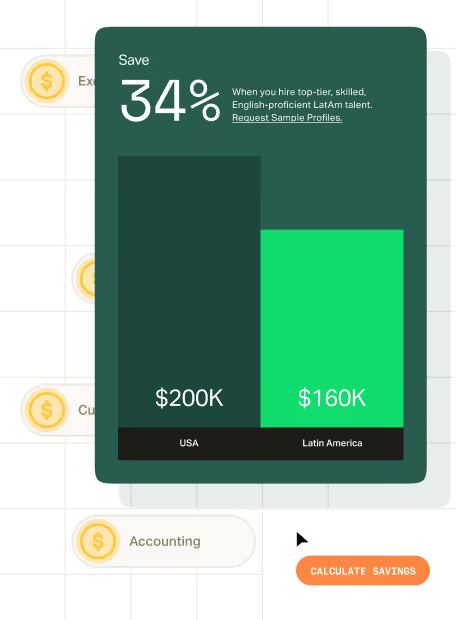
- Hiring AWS developers internationally, especially from Latin America, can cut costs by up to 64%. These savings reflect different living costs, not lower skill. For example, many developers in LatAm have deep AWS experience and strong English fluency.
- Partnering with a specialized recruiter allows you to hire pre-vetted AWS developers faster, avoid hiring delays or mismatches, and access high-quality talent that fits your technical stack and collaboration style.
AWS developers are the ones who keep your cloud from becoming a storm. They build, manage, and optimize the backbone of your infrastructure so your products stay fast, secure, and reliable.
But figuring out how to hire AWS developers who can actually do that? That’s where it gets tricky.
Demand for AWS talent keeps climbing, and salaries are rising right alongside it. Whether you’re scaling a DevOps function, migrating legacy systems, or building something entirely new, the right developer will make or break your timeline.
This guide covers everything from essential skills and sourcing strategies to salary expectations, red flags, and interview tips.
Whether you’re hiring in-office, remotely in the US, or building a global team, the fundamentals don’t change. The stakes are high, but with the right process, finding great AWS talent doesn’t need to be hard.
What Do AWS Developers Do?
AWS developers design, build, and maintain scalable cloud infrastructure using Amazon Web Services to power digital products and services.
Their work supports everything from deployment pipelines and performance optimization to disaster recovery and automated scaling. In short, they make sure your cloud environment is efficient, secure, and built to grow.
While their responsibilities often overlap with DevOps engineers, AWS developers specialize in the AWS ecosystem. They work directly with tools like EC2, Lambda, CloudFormation, and S3.
While they do support the app infrastructure in the cloud itself, AWS developers don’t usually handle front-end development or infrastructure outside the cloud.
The demand and popularity of the AWS ecosystem are high. AWS commands about 28% of the global cloud infrastructure market, ahead of Azure at 21% and Google Cloud at 14%. The 2025 Stack Overflow Developer Survey found that 43% of developers have worked with AWS, compared to 26% for Azure.
In many organizations, cloud data roles often intersect with AWS infrastructure projects, so collaboration with cloud data engineers is also common.
How Much Does It Cost to Hire an AWS Developer?
In the US, AWS developers earn between $97,000 and $172,000 a year depending on seniority, and that is the number most hiring budgets have to start from.
AWS developer salaries in the US have steadily increased as demand remains high across industries.
That demand sits at the experienced end of the market. According to SignalFire's 2026 State of Tech Talent Report, which draws on data covering more than 650 million professionals, hiring has concentrated on experienced engineers: software engineers now make up 55% of hires at major tech companies, up from 46% in 2019, while new-grad hiring has fallen sharply.
Based on our current salary data, these are the rates per year:
- Junior AWS developers typically earn $97,000 to $149,000
- Mid-level developers fall in the range of $103,000 to $159,000
- Senior developers can command between $111,000 and $172,000
Hiring internationally can open access to experienced talent at significantly lower salary bands.
According to my experience working at Hire With Near helping US companies hire developers across Latin America, these are the typical salary ranges we see:
- Junior-level AWS developers: $36,000 to $54,000
- Mid-level AWS developers: $54,000 to $72,000
- Senior-level AWS developers: $72,000 to $108,000
That translates to up to 64% in savings compared to hiring US-based developers, with the widest gap at the junior end and the narrowest at senior level, where LatAm AWS talent is scarcer and priced accordingly.
Here is the full side-by-side comparison, according to Hire With Near’s salary benchmarks:
For the most up-to-date figures, see Hire With Near’s US vs Latin America Salary Guide.
These differences reflect regional costs of living and not a difference in capability.
In practice, that gap is what lets a team hire a senior AWS developer on a mid-level US budget, or staff two engineers where they had planned for one.
Many companies choose to hire outside the US for this reason, getting highly skilled professionals while staying within budget.
What Skills Should You Look for When Hiring an AWS Developer?
Great AWS developers can deploy services and understand how to build infrastructure that scales with your business. They write clean, maintainable code, automate where it’s needed most, and collaborate across teams to solve problems before they escalate.
Finding the right person means looking beyond certifications or years of experience. You want someone who knows how AWS works under the hood and why certain decisions matter at scale.
Below are the typical skills you are going to want to include in a job description for an AWS developer, depending on your particular needs.
Hard skills (the must-haves)
The best AWS developers bring:
- Core AWS service expertise: At a minimum, they should be fluent in EC2, S3, Lambda, RDS, and IAM. The more complex your stack, the deeper their AWS knowledge should go. Listen for candidates who can explain trade-offs between similar services.
- Infrastructure as Code (IaC): Tools like Terraform and CloudFormation allow developers to provision infrastructure reliably and consistently. Strong candidates should have hands-on experience using IaC to automate environments and manage complex configurations.
- CI/CD pipeline setup and automation: Continuous integration and deployment are core to any modern development workflow. Look for candidates who’ve built or maintained CI/CD pipelines using tools like CodePipeline, Jenkins, or GitHub Actions. Ask them how they handle rollbacks or environment parity.
- Monitoring and logging: Experience with CloudWatch is key, but candidates who have also used third-party monitoring tools like Prometheus, Grafana, or Datadog can offer stronger insights into performance and uptime.
- Microservices and containerization: Developers should understand how to break applications into smaller services using Docker and manage them with ECS or EKS. Ask how they’ve approached service discovery or scaling containers under load.
Note: ECS (Elastic Container Service) is AWS’s native container orchestration solution, while EKS (Elastic Kubernetes Service) runs Kubernetes within AWS. Both are used to manage containerized applications, but EKS is often preferred by teams with existing Kubernetes expertise. - Security and compliance: The AWS IAM security best practices state that AWS implementations must follow least-privilege access by default. Therefore, familiarity with VPCs, IAM roles, and encrypted data flows is essential, especially for regulated industries.
Soft skills (equally important)
Technical skills are foundational, but soft skills determine whether someone can succeed long-term on your team.
- Clear communication: The most successful AWS developers I screen are the ones who can explain their decisions to stakeholders. If someone can’t clearly articulate their thought process, chances are they don’t fully understand the problem.
- Ownership and accountability: Great AWS developers don’t wait to be told what to fix. They take initiative, follow through, and care about the bigger picture.
- Problem-solving under pressure: When a pipeline breaks or an instance fails, you need someone who can troubleshoot calmly and make smart decisions quickly. Ask how they’ve handled real incidents.
- Adaptability: Developers need to stay current with new services, deprecations, and best practices. Look for candidates who enjoy learning and can explain how they’ve kept up.
- Ability to explain complex concepts: Strong candidates can translate technical ideas into plain language. A good test? Ask them to explain how an industry-specific concept works to someone who is non-technical.
The “nice-to-have” skills (the differentiators)
While these skills aren’t essential, they can give candidates an edge, especially for teams building long-term cloud strategies.
- AWS certifications: Certs like the Solutions Architect or DevOps Engineer show commitment to learning, but don’t treat them as substitutes for experience.
- SQL and NoSQL database fluency: It’s useful to be familiar with DynamoDB, PostgreSQL, MongoDB, and other database services. This is especially important for developers supporting back-end systems.
- Global-scale application experience: If you’re building for international users, someone who’s tackled challenges like latency, caching, or multi-region failover can offer big value.
- Business awareness: The best developers don’t just ask how—they ask why. Look for people who consider the business implications of infrastructure decisions, not just the technical ones.
Tip: If you’re hiring an AWS developer for a remote role, there are a few additional skills worth highlighting, like self-management, clear async communication, and comfort working across time zones. For help writing a strong listing that reflects those needs, check out our guide on how to write a software developer job description.
Which AWS Services Should an AWS Developer Know?
A strong AWS developer should be fluent in the compute, storage, networking, identity, and monitoring services your workload actually runs on, starting with EC2, S3, Lambda, RDS, IAM, and VPC.
Amazon Web Services publishes more than 200 services, and nobody uses all of them. What matters is whether a candidate knows the handful your architecture depends on, and whether they can explain what each one does for your business rather than reciting its documentation.
Here is what the core services do for you in practice:
Two of these are worth paying attention to when you screen. Comfort with the AWS CLI separates developers who automate their work from developers who click through the console, and it shows up fast when you ask how they’d repeat a task across three environments.
IAM depth also matters more than most hiring managers expect, because loose permissions are the most common finding in a cloud security review.
Your stack decides the rest. SaaS companies running multi-tenant workloads need someone strong on VPC design and tenant isolation. Data-heavy teams lean harder on RDS, S3, and the analytics services. Ask candidates which services they have run in production, at what scale, and what broke.
Where Can You Find and Hire Great AWS Developers?
Finding AWS developers starts with two core decisions:
- Where you want to hire
- How you’ll actually find the right candidates
The talent is out there. However, getting to the right fit means weighing location, cost, and how involved you want to be in the sourcing process.
Let’s break it down.
Choosing the right hiring location: Local, remote in the US, or international
Hiring locally for in-office or hybrid positions
Hiring local, in-office AWS developers can offer simplicity and stronger day-to-day collaboration. You don’t have to navigate time zones, onboarding is faster, and syncing on architecture decisions is easier in real-time.
However, those benefits come at a premium as US salaries are steep, especially in major tech hubs.
Hiring in the US for remote-only positions
Remote US-based developers give you a broader talent pool while keeping cultural alignment and business familiarity intact.
However, compensation expectations are often on par with in-office hires, and high demand means strong candidates don’t stay available for long.
Hiring outside the US (offshore) for remote-only positions
Offshore hiring opens access to a much larger pool of AWS professionals and can come with significant cost advantages. As we covered in the salary section, offshore developer rates run well below US salaries, and for AWS developers specifically the gap is 37% to 64% depending on seniority. That said, time zones and collaboration styles vary by region and need some consideration.
From our experience, Latin America offers the best balance of affordability, skill level, and time-zone compatibility for US teams.
These are just a few of the reasons why hundreds of leading US companies already look to LatAm for their talent needs. Real-time collaboration makes things simple, and many developers have worked with US companies before.
Eastern Europe (e.g., Poland, Serbia) and South/Southeast Asia (e.g., India, Vietnam, and the Philippines) also have deep technical talent pools but may require more adjustment around working hours and team communication.
Choosing the right sourcing channel
Once you’ve decided where to search, you’ll need to decide how.
Each channel has trade-offs. Some offer speed, others offer quality, and some offer both if you know how to use them well.
Recruitment partners are especially helpful when hiring internationally or for hard-to-fill AWS roles. They can cut down on sourcing time, handle pre-vetting, and find candidates that aren’t actively applying elsewhere. We’ll be covering using recruitment partners later in this guide.
That said, each approach has its own advantages, which can benefit your business depending on your goals, internal resources, and timeline.
In some cases, a combined approach could work best.
How Do You Hire the Best AWS Developers?
Hiring a great AWS developer means finding someone who understands your infrastructure goals, writes scalable code, and contributes to long-term system health.
With AWS demand continuing to rise, the best developers aren’t sitting around waiting for job offers. The good news is that with a clear process, you can avoid the guesswork and hire with confidence.
Stage 1: Get specific before you start sourcing
Know what outcomes you’re hiring for
Before you start reviewing resumes or posting on job boards, take a step back. What do you actually need this AWS developer to deliver?
Maybe you’re rebuilding a monolith into microservices, automating deployments, or scaling an application that’s outgrown its current setup. Each scenario calls for different skills. The more clearly you define those needs, the faster you’ll spot the right fit.
Don’t look for someone who does “everything.” Prioritize what matters for your business in the next 3–6 months.
Write a job description that filters for the right people
A job description should act as your first filter. Strong candidates will use it to assess whether they’re a match, and if it’s too vague, you’ll waste time on misaligned applicants.
For AWS roles, describe your current architecture (e.g., EC2 vs. containers, use of Terraform or CloudFormation), any near-term projects, and the services the developer will actually be working with.
Stage 2: Evaluate beyond the resume
Use hands-on tasks that reflect the role
Strong AWS developers are good at theory but also solve real infrastructure problems. A short technical challenge (like refactoring a CloudFormation template, debugging a broken API deployment, or adding monitoring to a Lambda) shows you how they actually think.
The goal isn’t to stump them. It’s to see how they approach problems, write code, and communicate their decisions. In our experience, this reveals far more than a resume or GitHub link ever could.
I also ask candidates to walk me through a project they have worked on, not just which languages they used but what their role was and what they actually built. If they can explain it to someone who isn’t a developer, that tells me a lot.
The ones who can explain it in plain language, without hiding behind jargon, are usually the ones who did the work and understood the whole system.
Look for clarity, not just credentials
It’s easy to get distracted by big company logos or AWS certifications. What matters more is whether the candidate can explain how their work impacted system performance, cost, or security.
In my screens, the strongest candidates can clearly articulate why they made certain architectural choices. They’re also not afraid to talk about lessons learned from mistakes.
Confirm fit for your stack and team culture
If your team relies on Docker, EKS, or CI/CD pipelines, ask about hands-on experience rather than just exposure. You want someone who’s used these tools to solve real-world problems, not just read the documentation.
Likewise, if your team is async or distributed, check how they manage time, communicate progress, and ask for help. Their behavior during the hiring process will often tell you what you need to know.
Stage 3: Make an offer that actually lands
Speed matters more than you think
Good AWS developers are in high demand. If your hiring process drags, they’ll move on.
Set clear timelines, communicate regularly, and be ready to make an offer quickly once you’ve found the right person.
Even a one-week delay can cost you a standout candidate.
Build an offer around what matters to developers today
Salary is important. But the best candidates are also looking at flexibility, autonomy, and future-proof environments.
The 2025 Stack Overflow Developer Survey found that 84% of developers are using or planning to use AI tools in their development process, up from 76% the year before. If your team is already exploring tools like Amazon Q or other AI-enhanced developer tools, say so. It shows you’re forward-thinking and developer-friendly.
Need help putting the right offer together? We break it down in our guide to making a good job offer to retain top talent.
{{salary-guide-cta}}
Which Interview Questions Reveal a Great AWS Developer?
Interviewing AWS developers isn’t about asking which services they’ve used.
It’s about uncovering how they think, how they work under pressure, and how they approach system design, scalability, and collaboration.
These five questions go beyond the basics and help you identify whether someone’s just good, or genuinely great.
“Can you walk me through how you optimized a cloud environment for performance or cost?”
This question reveals technical depth, awareness of business trade-offs, and an ability to improve existing systems rather than just build new ones.
What to listen for: Specific examples of identifying bottlenecks, adjusting autoscaling rules, changing EC2 instance types, or introducing caching layers. Great candidates will talk about what prompted the optimization, how they measured success, and what the outcome was.
Red flags: Vague answers that focus on generic AWS features without clear action or impact. Watch for candidates who can’t explain the why behind their decisions.
“How would you explain a VPC (Virtual Private Cloud) to a non-technical stakeholder?”
This tests communication skills, clarity, and conceptual understanding, which is especially important if your AWS developer will interact with cross-functional teams.
What to listen for: Simple, accurate language that breaks down complex infrastructure ideas without oversimplifying. For example, a strong answer might compare a VPC to a secure, private workspace in the cloud with clear boundaries and controlled access.
Red flags: Overly technical explanations that lose the audience. If they can’t explain it clearly, they may not understand it clearly themselves.
“Describe a time when you debugged a complex production issue. What was your process?”
This question reveals how they operate under pressure and whether they follow a logical, structured debugging process.
What to listen for: Strong candidates will walk through how they isolated the issue, ruled out false leads, and restored service. Bonus if they reference logging, monitoring, or rollback strategies. A calm, methodical approach is a great sign.
Red flags: Blaming others or describing a vague situation with no clear resolution. If they skip over root cause analysis, they may not have driven the solution.
“Tell me about a piece of feedback you received that changed how you work.”
This question surfaces humility, self-awareness, and a growth mindset. These are traits that separate high performers from average ones.
What to listen for: Candidates who reflect honestly, show what they learned, and explain how they applied the feedback in future work.
Red flags: Defensiveness, or claiming they’ve never received constructive feedback. That’s usually not true—it just means they didn’t learn from it.
“What AWS services or features are you most excited about right now? And why?”
This question reveals curiosity, passion for the craft, and whether they’re staying current with the platform.
What to listen for: Answers that show they’re exploring new features (e.g., AWS Step Functions, EventBridge, or using Amazon Q within IDEs). You want someone who’s interested in growing with the tech, not just getting the job done.
Red flags: Answers like “I haven’t really looked into anything new lately.” If they’re not keeping up, they’ll struggle in a fast-moving environment.

What Mistakes Should You Avoid When Hiring an AWS Developer?
Even with a strong pipeline, it’s easy to miss the mark when hiring AWS developers. The wrong approach can really slow things down. Worse still, it can lead to mismatched hires, costly turnover, and infrastructure decisions you’ll regret six months from now.
Here are some of the most common mistakes we see, and how to avoid them.
1. Dragging out the hiring process
AWS developers are in high demand, and the market moves fast. We’ve seen strong candidates disappear from processes in a matter of days. It wasn’t that they weren’t interested; another company simply moved quicker.
If your interview loop stretches over weeks, involves multiple layers of approval, or leaves candidates waiting for feedback, you’re likely losing top talent before you even realize it.
What to do instead: Set a clear timeline for your process before you begin.
Let candidates know what to expect and keep the momentum going.
Quick, consistent communication can make the difference between landing your first-choice hire or having to start over.
2. Filtering out great candidates based on degree requirements
Some of the best AWS developers in Latin America and beyond never completed a formal computer science degree. Many started working professionally while still studying.
Many just skipped university altogether in favor of real-world experience.
That kind of hands-on experience often leads to stronger practical skills than what a classroom can offer.
A lot of the great engineers I place in Latin America don’t have a college degree, and that doesn’t make them weak candidates. Many of the best ones started working before they graduated, landed a good job, and never went back to finish.
I always tell clients not to make a degree a must-have, because they may be filtering out developers who have already been solving real-world AWS problems for years.
What to do instead: Focus on practical experience, not diplomas.
Look for proven work with AWS services, scalable infrastructure, and cloud deployments. A great developer’s resume is their projects, not their paperwork.
3. Prioritizing cost over quality
Hiring offshore developers doesn’t mean hiring “cheap.” It means accessing great talent in markets with different cost structures.
When companies focus purely on lowering salary spend, they often end up with candidates who lack the depth, initiative, or architecture experience to support real growth.
In AWS environments, cutting corners on quality can lead to unstable deployments, higher maintenance costs, or even security risks.
What to do instead: Think in terms of value.
The goal is to find developers who can deliver long-term results at a sustainable rate and not just the lowest bidder.
Focus on experience, ownership, and system thinking. Cost savings should be a bonus, not the driving force.
4. Overloading one person with too many responsibilities
AWS developers are not plug-and-play replacements for DevOps engineers, back-end developers, and security architects combined. Yet many companies write job descriptions that assume they’ll do it all.
Provisioning infrastructure, monitoring, deployments, compliance, and business logic. It’s simply too much for one role to handle sustainably.
What to do instead: Clarify the actual scope of the role.
If you need someone who’s also setting up CI/CD, handling incident response, and owning observability, you may need more than one hire.
Be realistic about workload and capabilities.
5. Being vague about your AWS tech stack
When companies say “We use AWS,” but don’t specify the actual services or architecture involved, candidates are left guessing.
That makes it harder for them to evaluate fit. Being intentionally vague and hoping the right fit comes along often results in mismatches once the work begins.
What to do instead: Be transparent.
Share which AWS services are in play, how your environment is structured, and what you expect the developer to take ownership of.
The clearer your stack and roadmap, the better your chances of attracting aligned talent.
Why Does Working With a Recruiting Partner Make a Difference?
Plenty of companies successfully hire AWS developers on their own. If you’ve got a dedicated hiring team, a clear process, and time to spare, handling the sourcing and screening in-house can work just fine.
But when the role is urgent, the skillset is specialized, or you’re hiring outside the US for the first time, partnering with a recruitment company can save you a lot of time (and mistakes).
That’s especially true for AWS roles. These developers are in high demand and often already working full-time.
A recruitment partner with experience sourcing and screening developers can help you move quickly, find better-aligned candidates, and manage the challenges within tech hiring with far less friction. Specialist IT and tech recruiters will already know what a strong AWS candidate looks like, which is the part generalist agencies most often get wrong.
Some of the biggest benefits of working with a partner include:
- Faster access to pre-vetted AWS specialists.
- Stronger alignment between your role and candidate expectations.
- Support with international logistics like contracts, payroll, and compliance.
- Reduced risk of a bad hire costing you money.
- Lower total cost of hire by expanding into global talent markets.
Outsourcing your recruitment process saves time and gives you access to lower-cost, high-skill regions.
The best companies specialize in hiring from LatAm, where AWS talent is strong, culturally aligned with US teams, and available to work during US working hours.
{{prevetted-banner}}
Final Thoughts
The best AWS developers are defined as much by judgment as by tooling. The ones worth hiring can explain why they made an architectural call, scope their own work honestly, and walk a non-engineer through a trade-off. That's rarely the candidate with the longest list of certifications.
So keep the process tight and specific. Be clear about your stack, resist piling three roles onto one hire, and move quickly once you find the right person, because strong AWS developers don't stay available for long.
And don't screen people out over a degree or a location. The deepest talent and the biggest budget savings often sit outside the US.
At Hire With Near, we specialize in helping teams hire pre-vetted AWS developers in LatAm who fit both the role and your company culture. It is one part of how we help US companies hire software engineering talent in Latin America.
We take the time to understand your tech stack, timelines, and working style, then match you with candidates who align on all fronts.
If working with a recruitment partner seems like the right approach, we can help you find a hire for your next AWS project. Most of our clients make a hire in under three weeks.
Book a free consultation with our team today, and let’s get your cloud roadmap the support it deserves.
Frequently Asked Questions
How is an AWS developer different from a DevOps engineer?
The two often overlap, but here’s the difference: AWS developers focus on building and optimizing cloud-native applications within the AWS ecosystem.
DevOps engineers are usually more focused on tooling, deployment pipelines, and CI/CD across environments. If you’re building on AWS specifically, hiring a dedicated AWS developer helps you go deeper on that stack.
What’s the average salary of an AWS developer in 2026?
In the US, AWS developers earn between $97,000 and $172,000 depending on experience, according to our salary data. In Latin America, comparable talent typically earns between $36,000 and $108,000, reflecting regional cost of living differences.
Can I hire AWS developers in Latin America who speak fluent English?
Yes. Many AWS developers in LatAm have worked with US-based teams, have strong English skills, and are familiar with US business culture.
What other engineering roles should I consider hiring in Latin America?
Most teams that hire an AWS developer end up hiring alongside them rather than instead of them. The closest adjacent roles are a DevOps engineer for deployment pipelines and incident response, a cloud developer if your stack spans more than one provider, a back end developer for application logic, and a software engineer for broader product work.
Splitting the work across two hires in LatAm often costs less than overloading one person in the US.