


%203.svg)
Key Takeaways
- The essential steps to hiring an offshore AR specialist include defining clear requirements, setting a budget, screening for technical skills and cultural fit, and implementing a thorough onboarding process.
- Latin America offers significant advantages for US companies seeking AR specialists, including time zone alignment, strong accounting expertise, and cultural compatibility at competitive rates.
- While you can source candidates independently through platforms like LinkedIn and Upwork, working with a specialized recruitment agency can streamline the process by providing pre-vetted candidates and handling complex aspects like compliance and onboarding.
It’s time for a new hire to own your invoicing, collections, and payment follow-up. Typically, you might post a job, get applicants from across the globe, and spend weeks sorting through candidates. But many of them can't do a client call in your time zone, or their English isn't strong enough for dispute resolution.
This isn’t just a recruiting issue. While you figure this out, your receivables continue aging, creating a more pressing cash flow concern for your business.
With the option of hiring an offshore accounts receivable specialist in Latin America, many of these concerns go away. I’ll go over why the region outperforms farther-offshore alternatives for AR roles specifically, what to look for in candidates, and what your actual hiring options are.
Before I tell you how to hire finance and accounting talent from Latin America, let’s start by defining the role, setting a budget, and choosing the right hiring model, all covered below.
What Does an Accounts Receivable Specialist Do?
An accounts receivable (AR) specialist manages the full incoming payment cycle for a business. Day-to-day, they typically:
- Generate customer invoices and track outstanding payments
- Follow up with customers on overdue accounts
- Reconcile payments against the general ledger
- Resolve billing disputes. In most companies, they also report on receivables aging so finance leadership can monitor cash flow in real time.
What makes the AR role different from other back-office accounting functions is the client-facing dimension. Your AR specialist processes numbers, and that’s an important component.
They also communicate directly with the customers who owe you money. That means handling questions about invoices, negotiating payment timelines, and managing sometimes delicate collections conversations in a way that doesn't damage the relationship.
For any company where billing volume, cash flow, and customer communication intersect, this role sits at the center of financial operations. When AR runs well, your receivables age cleanly, your DSO stays low, and your sales team isn't getting pulled into collections disputes. When it doesn't, cash flow suffers, and customer relationships break down.
Why Latin America Is the Best Region for Hiring an Accounts Receivable Specialist
Companies find Latin America to be the strongest offshore region for accounts receivable roles specifically. The main reasons for this are time zone alignment and cost.
The US accounting talent pipeline is also shrinking. According to Accounting Today, the number of candidates sitting for the CPA exam has fallen 27% over the past decade, and between 2016 and 2022, the number of accounting graduates dropped by nearly 17%. The domestic pipeline problem makes offshore hiring a structural need as well as a cost consideration.
Even if you’re open to global talent, you still need to choose between regions. The Philippines, India, and Latin America all have skilled accounting talent. But for accounts receivable roles specifically, Latin America has a decisive advantage: time zone alignment.
This time zone compatibility matters because your AR specialist will be jumping on calls with customers who have billing questions or need to pay their invoices. All of that happens in real time, during US business hours.
On the other hand, a specialist based in India or the Philippines working standard local hours is 10–13 hours ahead of the East Coast. That hour gap is a structural problem for a role that runs on real-time communication, and it directly affects how effectively your AR specialist can perform.
One of the things that is attractive about South America, provided that the English speaking, because this would be a role where there would be the potential to get on calls. So we need somebody that's fluent in English, is the fact that the time zones are effective because we do need East Coast and West Coast U.S. time zone support.
Hire With Near's research on 2,000+ companies that turned to LatAm hiring found that nearly 1 in 3 were switching from an offshore-Asia arrangement, with time zone friction cited as the primary driver. Finance and Accounting is the second most common department among those switchers, at 29%.
A finance manager at a clean energy company described what that switch looked like from the inside, after running a finance team in India for a year:
We learned very quickly that nearshoring is a much better option for us at this size... [Rather than] trying to manage someone in such a different time zone, and they don't work U.S. hours, right?... To us, moving to LatAm and staying kind of within the same reasonable time zone just makes so much more sense for us.
Beyond time zones, the talent pool itself is strong. In my five years sourcing finance and consulting talent at Hire With Near, roughly 80% of the accounting candidates I place are from Argentina. Here's why: to earn an accounting degree in Argentina, you study for five or six years. The academic training is rigorous, and the public university system produces graduates who are well-versed in US GAAP and IFRS, the two accounting standards our clients ask for most often.
The EF English Proficiency Index 2024 also ranks Argentina 28th globally for English proficiency. The country is second in Latin America, which matters when your AR specialist needs to communicate clearly with US customers and internal teams in real-time.
(For a deeper look at the Argentine talent pool specifically, see our guide to nearshore hiring in Argentina. You can also reference our complete guide to hiring remotely in Latin America for an in-depth look at the hiring process.)
How Much Does an AR Specialist in Latin America Cost?
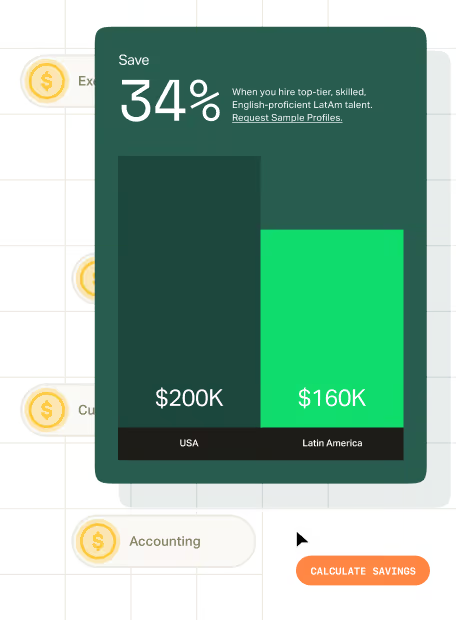
Hiring an AR specialist in Latin America costs 38–68% less than a US equivalent, depending on seniority. Compensation benchmarks show the following ranges for various experience levels:
This chart also calls out one of the top questions companies ask: “Does hiring offshore mean settling for junior talent?”
The answer is no, and the data support this.
According to Hire With Near's 2026 State of LatAm Hiring Report, 84% of Latin American finance and accounting placements were mid-level or senior professionals. Companies are accessing experienced talent, not cutting corners on quality.
(For more details on compensation ranges by role and seniority, see our accounting salary benchmarks in Latin America and the finance roles salary guide for Latin America. You can also use the LatAm salary guide to compare roles across departments.)
How to Hire an Accounts Receivable Specialist in Latin America
If you’re sold on the benefits of Latin American talent, you may be wondering about the first step in getting started. Here’s the general process for finding, screening, and onboarding the right AR specialist.
1. Define your business requirements
You can’t get what you want if you don’t express it first, and AR specialists can handle a wide range of tasks. Outline exactly what you need, whether it's invoicing, payment tracking, collections calls, account reconciliation, dispute resolution, or some combination. The more specific you are upfront, the better your sourcing will go.
This is where you’ll also decide on experience level, the software tools you use (more on this in step 7), and whether you need someone with industry-specific knowledge. For example, a SaaS company billing on recurring subscriptions has different AR needs than a construction firm billing on project milestones. The more information you provide here, the happier you’ll be with the candidate pool.
2. Set your budget
Use the salary table above as your starting point for what you should reasonably expect to pay. While offshoring AR to Latin America typically costs 38–68% less than a comparable US hire, rates vary based on experience level, the specific country, and the complexity of your AR operation.
The accounting salary benchmarks in Latin America (linked above in the salary section) can help you calibrate your budget for the experience level you need. For mid-level AR work, which covers most business needs, plan for $2,000–$2,800 per month. That range gives you access to professionals with multi-client experience and a solid command of standard invoicing workflows.
3. Identify top regions for sourcing
Latin America is the strongest region for this role type, and within LatAm, Argentina is the top source for accounting and finance talent. The academic training is rigorous, the talent pool is deep, and the time zone alignment with US business hours is close enough for real-time collaboration.
For a full breakdown of the top countries and what each offers for AR talent, see the top 6 countries for accounts receivable outsourcing.
4. Source candidates
Once you have your requirements and budget defined, you need to decide how you'll source candidates. See the "Your Three Hiring Options" section below for a full breakdown of your choices: freelance platforms, job board plus EOR, or a specialist staffing partner.
If you're sourcing independently, post on a job board for LatAm talent, LinkedIn, or referrals. Post clearly defined job descriptions with specific software requirements and English-proficiency expectations. Use the guidance in step one to craft your role expectations.
If you want a specialist recruiting partner to do the sourcing, Hire With Near focuses on finance and accounting placements and has a pre-vetted pool of LatAm candidates ready to screen. This saves you several steps in the process.
5. Build a screening process that finds the right candidate
This is where most independent hiring efforts fall short. A resume review alone won't tell you what you need to know.
When I'm screening accounting candidates, I always start with experience evaluation and communication skills before going deeper into their background, industry exposure, and project history. For AR roles specifically, here's what to look for:
US GAAP knowledge. AR specialists working with US companies need to record and report transactions under US accounting standards. Ask directly about their experience with US GAAP. This is the primary technical differentiator.
QuickBooks and NetSuite proficiency. These are the two most commonly required tools for AR roles. QuickBooks proficiency is widely available in the LatAm talent pool. NetSuite experience is harder to find but worth screening for if you're on that platform. Ask candidates to walk through how they've used it.
Multi-client experience. AR specialists who've managed multiple client relationships simultaneously are better at handling high-volume invoicing without letting accounts slip. Ask about the number of accounts they've managed at once and how they prioritized follow-up.
Collections process fluency. The signal I look for is how they explain their collections process. For example, what's their protocol for 30-day, 60-day, and 90-day past-due accounts? Strong candidates give specific, procedural answers. Vague answers like "I follow up regularly" are a red flag.
English communication skills. For an AR role that involves client calls, near-native English fluency is essential. Run part of the interview in English. Listen for clarity, confidence, and the ability to handle pushback or explain billing discrepancies calmly.
Attention to detail. A typo on an accounting resume is an automatic red flag. Accounts receivable work is precision-sensitive: errors in invoices cost you money and credibility with customers. The resume is your first data point on their attention to detail.
Big Four exposure (PwC, EY, Deloitte, KPMG) on a resume is one of the strongest signals for finance and accounting candidates. It indicates the candidate has US GAAP and IFRS training and has worked in structured, high-standard environments.
6. Evaluate previous experience and industry knowledge
Candidates with experience in your industry will ramp faster. A SaaS billing background is directly transferable to another SaaS company. A construction finance background maps well to project-based billing.
That said, don't over-index on industry match at the expense of technical competence. A strong AR specialist with solid US GAAP knowledge and collections experience can adapt to a new industry. A weak one with perfect industry experience is still a weak hire.
7. Assess technology proficiency
Check specifically for the tools you use. QuickBooks and NetSuite are the most commonly required AR platforms. Beyond those, ask about their experience with:
- Invoicing software (FreshBooks, Bill.com, Sage)
- CRM integration for account management
- Communication platforms for remote collaboration
An AR specialist who can't get up and running in your software stack quickly will cost you time and money in the onboarding phase.
8. Consider cultural fit and communication skills
Cultural fit matters in AR because this role involves ongoing client relationships. Latin American professionals, particularly from Argentina and Colombia, tend to have strong familiarity with US business culture and are often accustomed to direct, professional communication.
Clear communication is non-negotiable. Your AR specialist will be representing your company in conversations with customers who owe you money. That requires tact, professionalism, and the ability to hold firm on payment terms without damaging the relationship.
9. Conduct effective interviews and assessments
Structure interviews around real scenarios. Examples you can use include:
- "Walk me through how you'd handle an account that's 60 days past due and the customer says they never received the invoice."
- "Tell me about a time you recovered a large overdue balance. What steps did you take?"
- "How do you prioritize when you have 40 open accounts and three of them need immediate follow-up?"
Practical assessments can also help. You could give candidates a sample invoice reconciliation exercise or a collections email to draft. You'll often learn more from those exercises than from a polished interview answer.
10. Request references and check previous work quality
Always verify references. Ask prior employers about the candidate's accuracy rate, their follow-through on collections, and whether they'd hire the person again. For AR roles, reliability and accuracy matter as much as raw skill.
{{salary-guide-cta}}
How to Hire an AR Specialist in Latin America: Your Three Options
Once you've defined what you need, you have three practical paths to hiring an AR specialist in Latin America. Each has trade-offs.
For a full breakdown of the cost implications of outsourcing your AR function, see breaking down the costs and savings of outsourcing your accounts receivable.
Option 1: Freelance platforms
Platforms like Upwork give you fast access to AR contractors. You can post a job, review proposals, and have someone working within days.
The trade-off: These platforms are built for project-based or part-time contract work. If you need a dedicated full-time AR specialist who knows your processes deeply and owns your invoicing and collections function, a contractor splitting time across multiple clients isn't the right fit. Quality control and retention are entirely on you.
Freelance platforms are the right choice for one-time projects such as a reconciliation cleanup, a backlog of invoices to process, or a short-term coverage gap. However, the other two options are better suited for a full-time hire who becomes part of your team.
Option 2: Job board or LinkedIn sourcing plus an Employer of Record
If you want to source candidates yourself and maintain more control over the hiring process, you can post on a job board for hiring in Latin America or LinkedIn, run your own screening process, and then use an Employer of Record (EOR) to handle the legal employment side.
An EOR becomes the legal employer on paper while you manage the work day-to-day. The EOR handles local payroll, tax withholdings, benefits administration, and employment law compliance in the country where your specialist is based. Many reputable EOR companies serve the LatAm market.
The trade-off: An EOR handles employment logistics, not recruiting. You still have to source, screen, and vet every candidate yourself. For companies that have strong internal recruiting capabilities or want tight control over the hiring process, this works well. For companies that don't have dedicated finance recruiters in-house, the sourcing burden is real.
Option 3: A specialist staffing and recruiting partner
This is the simplest path for most companies hiring a full-time AR specialist. You work with one of the specialist staffing firms for LatAm hiring that handles both talent acquisition and employment in a single relationship.
The partner recruits on your behalf and presents pre-vetted candidates who match your requirements. Once you make a hire, the partner handles payroll, benefits, compliance, and local employment requirements through nearshore staffing and recruiting services.
You describe the role; the partner does the sourcing, screening, and employment administration. Hire With Near operates this way.
FinanceWithin, a fractional finance services firm in Austin, tried to scale by hiring in India, but got inconsistent quality and high turnover.
After switching to Hire With Near, they cut their time-to-hire from three weeks to seven days and saved $535,000 annually. Sheena Malson, their Director of Accounting, put it this way:
When we saw candidate quality, it became clear these were truly top-tier professionals — better than what we found independently.
For a curated list of providers, see the top companies to hire LatAm finance talent and top accounts receivable outsourcing companies. Both are good starting points if you're evaluating multiple vendors.
We share more on breaking down the costs and savings of outsourcing your accounts receivable.
How to Onboard and Manage Your Offshore AR Specialist for Long-Term Success
Set your AR specialist up for success from day one by establishing performance metrics, onboarding documentation, and communication protocols before they start.
1. Establish clear performance metrics
Define key performance indicators (KPIs) and other measurables before your new hire ever starts. For AR roles, the most useful benchmarks are:
- Days Sales Outstanding (DSO)
- Invoice processing time
- Collections rate on past-due accounts
- Accuracy rate on invoices issued
Set these benchmarks early and review them monthly for the first quarter. They give you an objective read on performance and support concrete feedback conversations.
2. Build a documented onboarding process
A well-structured onboarding process is the difference between a new hire who ramps in two weeks and one who takes three months. Onboarding should cover your company's billing processes, the specific tools they'll use, your escalation protocols for disputed invoices, and who on your team they'll coordinate with.
Even if it’s your first time hiring, document the process. If you've hired AR specialists before, your best current specialist is a great source for what that documentation should include.
3. Create a collaborative work environment
Use sharing tools and schedule regular sync calls, especially in the first 60 days. Video check-ins, shared dashboards for invoice tracking, and a clear communication protocol for flagging collections issues keep your offshore AR specialist integrated with your in-house team.
4. Monitor performance regularly and provide feedback
Don't wait until a problem has been building for months. Schedule formal performance reviews at 30, 60, and 90 days. Give consistent feedback early to set expectations and give your new hire the information they need to course-correct earlier than later.
5. Address compliance and regulatory considerations
Make sure your AR specialist understands both your company's internal policies and the compliance requirements relevant to your industry. If your business handles sensitive customer payment data, your specialist needs to follow the same data security protocols as any in-house team member. Explaining why these protocols exist can help them develop ownership of the processes.
6. Build solid customer relations strategies
Every collections call is a representation of your company, so your AR specialist needs to know how to interact well with your specific customers. Set clear standards for tone, escalation thresholds, and how to handle a customer who disputes a charge. Remind them that customers who feel respected, even when they owe you money, pay faster and stay longer.
7. Make sure data security and privacy standards are met
Implement stringent security protocols for access to financial systems, customer account data, and payment information. Review access privileges regularly and make sure your offshore specialist uses the same secure channels as your in-house team.
8. Set up the tools that keep remote AR work visible
Video conferencing, project management tools, and shared communication channels keep your AR specialist connected to your team. The time zone overlap with Latin America means most of this happens in real time; you're not waiting until the next morning for answers.
9. Recognize the human element in remote work
Building trust takes time. Recognize contributions, give public credit for good work, and treat your AR specialist as a full member of your team, because they are. Turnover in a role this operationally important is expensive, so try to make your professionals feel valued so they stay longer.
{{latam-hiring-cta-v2}}
Common Mistakes When Hiring an Offshore AR Specialist
Even companies that do their research make predictable errors when hiring for this role. Avoiding these four mistakes can save you time and money from a bad hire.
Hiring on salary alone without screening for English fluency
AR is a client-facing role, not a heads-down accounting function. So, a candidate whose English isn't strong enough for those conversations will create friction with customers and force your internal team to step in. Failing to properly screen for English fluency early can create downstream issues for your business.
Skipping practical assessments
An interview can tell you how someone presents, while a practical assessment tells you how someone works. Before making an offer, give candidates a sample invoice reconciliation exercise or a collections email to draft. The quality of that work tells you far more than interview answers alone.
Not defining DSO and collections KPIs before the hire starts
If you don't set benchmarks before your AR specialist's first day, you won't know whether performance is on track until a problem has already developed. Define Days Sales Outstanding, collections rate on past-due accounts, and invoice accuracy rate upfront, and don’t ever skip regular reviews.
Mistaking time-zone flexibility for time-zone overlap
Some offshore arrangements offer flexible scheduling as a workaround for large time zone gaps. I see this with a specialist who works US hours but is based 10 time zones away. For AR roles, this isn't enough.
Real-time overlap means your specialist is working concurrently with your US team and your US customers. The LatAm advantage is that candidates' natural working hours already overlap with yours, with no schedule adjustment required.
Final Thoughts
Hiring an accounts receivable specialist in Latin America gives you something difficult to find elsewhere: experienced finance talent, working in your time zone, at 38–68% of the cost of a US equivalent. One electronics manufacturer saw that range play out directly: after a first hiring attempt fell through, they placed a senior AP/AR specialist through Hire With Near in 23 days, at 68% below the US average.
The key is getting the hiring process right. Define your requirements carefully, screen for US GAAP knowledge and collections fluency, prioritize candidates with strong English communication skills, and choose a hiring model that fits your internal capacity.
If you're ready to move forward, you can hire a dedicated accounts receivable specialist through Hire With Near. Book a free consultation to get salary benchmarks for your specific situation and understand what the process looks like.
Our team can typically have pre-vetted candidates in front of you in under a week.
And if you want a country-by-country breakdown of LatAm sourcing options, our dedicated guide to hiring AR specialists in Latin America covers the full picture.
And for a direct comparison of how LatAm AR talent stacks up against India and the Philippines, see where to hire offshore accounts receivable talent.
Frequently Asked Questions
What is another name for an accounts receivable specialist?
Accounts receivable specialists are also called AR coordinators, billing specialists, collections specialists, or credit and collections analysts. In some companies, the role is titled "billing and collections associate" or "invoice specialist." The specific title varies, but the core function is the same: managing the incoming payment cycle, from invoice generation through collections.
What does an AR specialist do?
An AR specialist manages the full incoming payment cycle for a business. Day-to-day responsibilities include anything to do with sending out invoices and collecting/managing payments. In client-facing environments, the role also involves direct customer communication, which is why English fluency and time zone alignment matter so much for offshore AR hires.
How much does an accounts receivable specialist in Latin America cost?
A mid-level AR specialist in Latin America typically earns $24,000–$34,000 per year, compared to $54,000–$79,000 for the same role in the US. Junior specialists start at $18,000–$24,000 annually; senior specialists command $34,000–$42,000.
How long does it take to hire an AR specialist in Latin America?
Working with a specialist recruiting partner, most companies have pre-vetted AR candidates to review within one week, and a hire is made within two to three weeks. FinanceWithin, for example, cut their time-to-hire from three weeks to seven days after switching to Hire With Near. DIY sourcing with a job board and EOR typically takes four to six weeks, depending on your internal recruiting capacity.
What industries most commonly hire accounts receivable specialists in Latin America?
Companies across many industries hire AR specialists in Latin America, with especially high adoption where billing volume, cash flow management, and client-facing collections are central to operations. Financial services recruiting in Latin America has been an early-adopter space, particularly for fractional finance firms and financial services providers that need to scale their accounting teams efficiently. Accounting firm staffing in Latin America is also common, with CPA firms and outsourced accounting providers building LatAm teams to serve US clients at lower cost. Beyond those, SaaS companies, e-commerce businesses, professional services firms, and healthcare organizations all regularly hire AR talent from LatAm.
What other finance and accounting roles can I hire from Latin America?
Finance and accounting are one of the strongest departments for LatAm hiring. Beyond AR specialists, companies regularly hire accounts payable specialists, bookkeepers, staff accountants, and controllers from Latin America. Each role has a strong talent pool in Argentina and Brazil, and the cost savings apply across the board.
Are there risks to hiring an offshore AR specialist?
The main risks are language barriers, data security, and time zone misalignment. For LatAm hires, the first and third are significantly reduced. Argentina ranks second in Latin America for English proficiency. The time zone gap with most of the US is two hours or less. For data security, the protocols you'd apply to any financial role apply here: controlled access, documented procedures, and regular audits. The biggest residual risk is a bad hire, which is why thorough screening and using a specialist recruiting partner matter.







.webp)


%203.svg)
.avif)






%20(1).avif)

%20(1).png)