%203.svg)
Key Takeaways
- For client-facing accounts receivable work, offshoring to Latin America rather than India or the Philippines gives you the strongest combination of US business-hours overlap, English proficiency, and cultural fit for collections calls and customer follow-up, even though LatAm wages run higher.
- India and the Philippines stay viable for lower-touch, pure back-office reconciliation, but their 10-to-12-hour offset from US business hours forces overnight shifts and slows real-time collaboration.
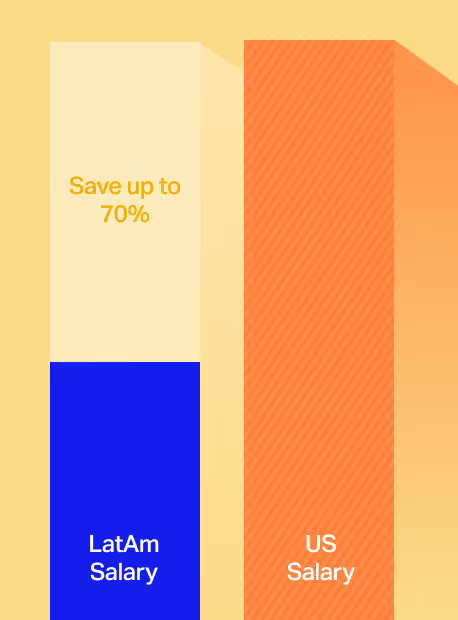
- Hiring an accounts receivable specialist in Latin America runs roughly $18,000 to $42,000 per year, depending on seniority, 30% to 70% below the US equivalent, with the time-zone overlap cutting the hidden coordination costs that erode offshore savings.
If you’re evaluating where to hire offshore accounts receivable talent, three places come up consistently: Latin America, India, and the Philippines. Each offers significant cost savings. What separates them is time zone alignment, English proficiency, and how well the model holds up for client-facing AR roles that require same-day responsiveness.
For collaborative, client-facing AR work, Latin America is the stronger fit: full US time zone overlap, strong English, and cultural alignment with US business norms, even though its salaries run higher than India’s or the Philippines’. These two countries remain reasonable for low-touch, back-office reconciliation where real-time contact isn’t required.
This isn’t a niche preference. Hire With Near’s research on why US companies turn to Latin American hiring found that 30% are switching from offshore destinations like India and the Philippines to nearshore Latin America, primarily to close the time-zone gap.
The talent pressure driving companies offshore is also structural: the US Bureau of Labor Statistics projects only 124,200 new openings for accountants and auditors each year through 2034, many of them replacement roles as experienced professionals leave the profession.
If you want to hire finance and accounting talent for AR, this guide compares all three regions on cost, time zone, English, cultural fit, and the specialized skills an accounts receivable specialist needs, and gives you a clear recommendation.
What Is Accounts Receivable Offshoring?
Accounts receivable offshoring is hiring a remote individual or team in another country to manage your company’s incoming payments.
The AR function stays the same, but the work happens outside the US, typically at a lower salary cost than a comparable domestic hire.
A dedicated offshore AR specialist typically handles:
- Issuing and sending invoices to customers
- Tracking outstanding balances and aging reports
- Following up on overdue accounts via email and phone
- Applying payments and reconciling discrepancies
- Coordinating with sales and operations on billing disputes
- Escalating unresolved accounts when necessary
The goal is the same as any AR function: get paid faster, reduce days sales outstanding, and keep the books clean.
What makes offshoring different from domestic hiring is that where the work happens changes everything about how it gets done. A collections specialist who can’t reach your customers during US business hours, or who can’t join a quick call to resolve a billing dispute the same day, is missing the core of what the role requires.
That’s why time zone, English proficiency, and cultural fit matter as much as cost when choosing a region to hire an offshore accounts receivable.
Offshoring Accounts Receivable to Latin America vs. India vs. the Philippines: At-a-Glance Comparison
Latin America, India, and the Philippines each offer real advantages for offshore accounts receivable, but they differ most in time-zone overlap.
Here’s how the three regions compare across the factors that matter for hiring an AR specialist:
The time zone row is the one to read twice. For AR work that involves picking up the phone, chasing a customer, or coordinating live with your US finance team, Latin America’s full overlap is the deciding advantage.
Overview of the Latin America Accounts Receivable Talent Pool
Latin America has become a favorable destination for businesses offshoring accounts receivable, largely because it solves the time-zone problem that breaks most offshore AR engagements.
In a conversation with our team, a finance leader at a legal-services startup described the requirement for that kind of role:
This would be a role where there would be the potential to get on calls. So we need somebody that’s fluent in English, and the time zones are effective because we do need East Coast and West Coast US time zone support.
That’s exactly what Latin America offers: a growing talent pool with multilingual capabilities, US time zone coverage, and cultural alignment with US business practices.
Together, these factors make hiring in Latin America a strategic move toward US-aligned work.
English proficiency in LatAm
English proficiency is crucial when you choose an offshore region for accounts receivable services. In LatAm, Spanish and Portuguese (in the case of Brazil) are the dominant languages.
However, countries like Argentina and Costa Rica have recognized the importance of English in global business, leading to increased English education and training programs that produce near-native business English in client-facing hires.
According to the 2025 EF English Proficiency Index, Argentina ranks 26th globally and 1st in Latin America in the ’High’ proficiency band, Honduras ranks 32nd globally and 2nd in Latin America, and Costa Rica ranks 55th globally in the moderate proficiency band.
Related reading: Hiring in Argentina: What US Companies Need to Know in 2026
Cultural compatibility in LatAm
LatAm offers a high degree of cultural compatibility with US businesses. Shared business hours due to time-zone similarities support real-time collaboration. Many LatAm countries have also adopted business practices and corporate cultures similar to those in the US, which makes integration smoother.
Michael Girdley, Co-Founder at Hire With Near, puts it plainly:
The great thing about Latin America is it’s basically the same time zone, and the cultures are very similar. Living in Texas, I deal with people in Mexico and I’m just like, this is just Texas but a little further south. Pretty much the same thing.
Government support for outsourcing in LatAm
Several LatAm governments have implemented business-friendly policies specifically designed to attract foreign investment in professional services and outsourcing.
Colombia has developed free trade zones for business process services, offering reduced corporate tax rates and streamlined regulations for foreign companies.
Costa Rica’s CINDE investment promotion agency actively recruits US companies for shared services operations, which is why multinationals like Amazon, HP, and Western Union have established finance and accounting operations there.
Mexico’s proximity to the US, combined with USMCA trade protections and a growing network of industrial and services parks, makes it one of the most accessible LatAm markets for US companies building remote finance teams.
Related reading: Hiring in Mexico: Deep Talent, Close Time Zones, and What US Companies Need to Know
Specialized skills available in LatAm
LatAm’s AR and accounting industry is stronger than most US finance leaders expect.
The region has a growing pool of professionals with expertise in finance and business services, and the depth of academic training behind them is the reason their work holds up.
Hire With Near’s finance recruiters consistently point to Big Four exposure as the strongest quality marker on a LatAm finance resume. Lucas Stepanenko, Sourcing Manager for Finance and Accounting at Hire With Near, puts it directly:
LatAm finance professionals have strong academic training and a lot of exposure to Big Four firms. That gives them experience with international markets and makes them very well versed in key accounting standards like US GAAP and IFRS, which are among the most common requirements we see from our clients.
Two details from our recruiting team make the quality argument concrete.
First, roughly 80% of the accountants we place are based in Argentina, where an accounting degree takes five to six years and is roughly equivalent to a US degree plus a postgraduate qualification, so the absence of a US CPA license isn’t a quality gap.
Second, common tools like QuickBooks are plentiful in the talent pool, while NetSuite is a harder ERP to find, which is worth knowing before you write your job description.
For a broader view of the AR talent pool in Latin America, see our guide on how and where to find the best accounts receivable specialists in LatAm.
And since hiring finance and accounting talent isn’t only about AR, Hire With Near also handles executive search in Latin America for senior roles like controller, VP of finance, and CFO when companies are building out a full team rather than a single seat.
Overview of the Indian Accounts Receivable Talent Pool
India is a long-established global hub for outsourcing business processes, including accounts receivable, and it remains the lowest-cost destination of the three options.
Known for its cost-effective labor market, large English-speaking population, and significant government support for the outsourcing sector, offshoring accounting to India has become one of the most established models for US companies.
The trade-off is time zone. India sits roughly 9.5 to 12.5 hours ahead of US business hours, which means there’s close to zero natural overlap with a US workday.
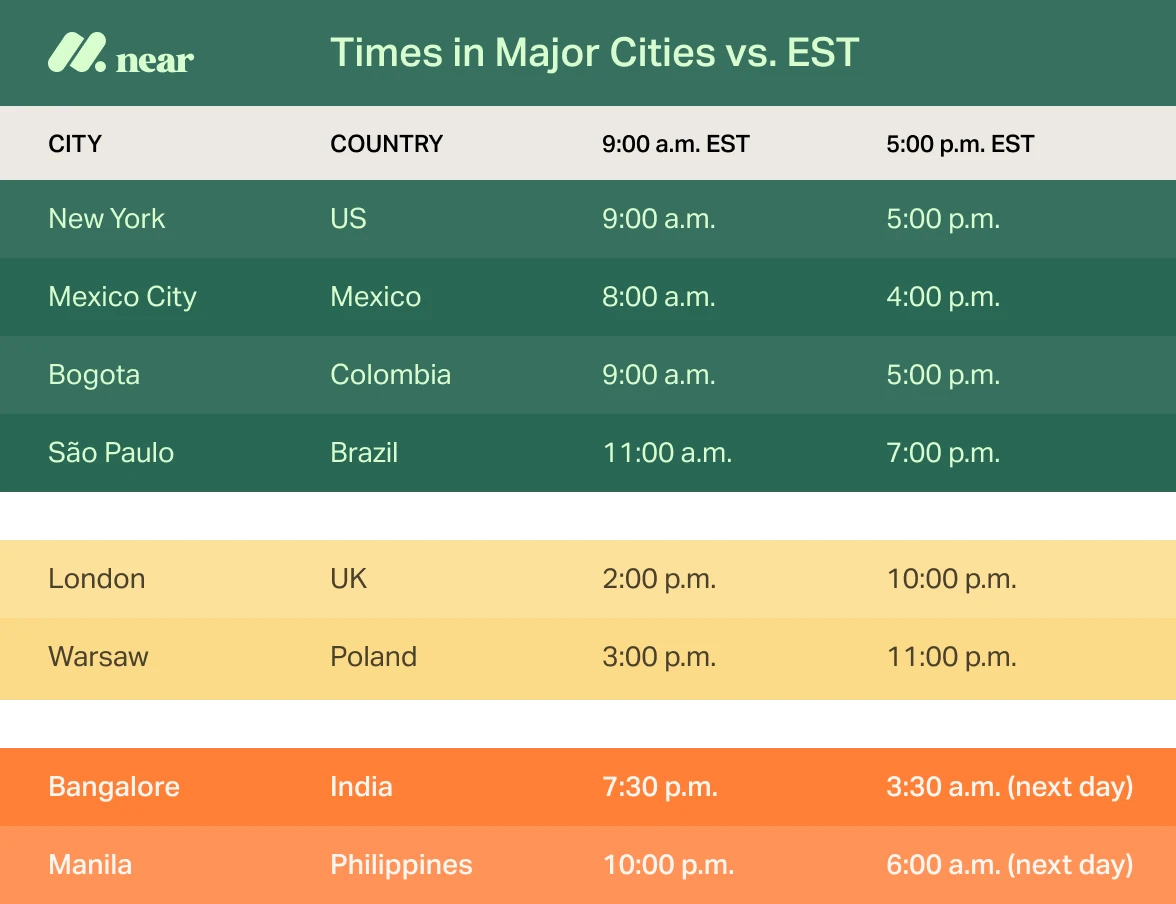
To reach US clients in real time, Indian AR teams typically work overnight shifts. For purely back-office reconciliation that can happen asynchronously, that works. For collections calls and live coordination, it’s a structural limit.
This is exactly the pattern that drives the India-to-LatAm switch. A finance leader at a growth-stage company that had run an India-based accounting and FP&A team described why they moved:
We learned very quickly that nearshoring is a much better option for us at this size. Trying to manage someone in such a different time zone, and they don’t work U.S. hours, right? That would suck if you asked me, if I was on that side, having to work U.S. hours constantly. So moving to LatAm and staying within the same reasonable time zone just makes so much more sense for us.
Language proficiency in India
India’s language proficiency is one of its standout features in the global outsourcing landscape. English is an official language in India and is widely used in business, education, and government.
This high level of English proficiency supports clear communication between offshore teams and their US clients.
That said, some nearshore regions rank higher on English proficiency, including Argentina and Honduras.
Cultural compatibility in India
Indian professionals are familiar with US business practices and etiquette, thanks to extensive exposure to international markets and long-standing relationships with global companies. That said, some cultural differences do show up in practice.
Communication styles tend to be more indirect than US norms: feedback is often framed diplomatically rather than directly, and pushback on a deadline or scope is less common than US managers expect.
For AR roles that require proactive collections follow-up or direct client communication, these differences can affect how independently the hire operates without close management.
Government support for outsourcing in India
The Indian government has been highly supportive of the outsourcing industry, recognizing its significant contribution to the country’s economy. Various initiatives and policies support the outsourcing sector.
These include tax incentives, relaxed regulations, and investment in infrastructure and technology parks.
Programs such as Make in India and Digital India further enhance the business environment, making it easier for foreign companies to set up and operate offshore accounts receivable services in India.
Specialized skills available in India
Indian AR professionals are generally strong in high-volume transaction processing, reconciliation, and structured reporting.
Many have direct experience with enterprise accounting platforms, including SAP, Oracle, and Tally, which are widely used across India’s outsourcing sector. US GAAP exposure is common among professionals who have worked with multinational firms or BPO providers serving US clients.
Where India’s talent pool is most reliable is in back-office, process-driven AR work: batch invoice processing, payment application, aging report generation, and structured collections workflows that follow a defined script.
For roles where the work is repeatable and doesn’t require improvisation or direct client judgment calls, this depth is a genuine advantage.
Overview of the Philippine Accounts Receivable Talent Pool
The Philippines is one of the top global outsourcing destinations, especially in customer service and financial services, and it pairs strong English with low cost. The country’s English proficiency, cultural alignment with US businesses, government support, and well-established BPO skill base make it a capable choice for back-office AR. It is a common destination for offshoring accounting.
The limit, again, is the clock. The Philippines runs about a 12-hour offset from US business hours, so live overlap is minimal without night shifts. The work gets done, but it gets done on a delay, and for client-facing AR that delay shows up as missed calls and slower communication.
A Canada-based bookkeeping and fractional CFO firm running a Philippines-based bookkeeper described the pattern bluntly:
They constantly miss meetings and they’re falling behind a little bit with communication. They get all the work done, like eventually, like it’s just, it’s not the same time zone.
The owner of a real estate tax consulting firm with prior Philippines offshore experience ran into both halves of the problem, the time-zone refusal and the specialization gap:
The CPAs they sent me were from the Philippines, and the problem was they didn’t want to work on our time zone was one of the problems. And then they started sending me people from like [other countries] with no experience, no knowledge of how U.S. tax works. They just didn’t send me very highly qualified candidates.
Language proficiency in the Philippines
One of the most striking advantages of the Philippines as an outsourcing destination is its high level of English proficiency. English is one of the official languages of the country and is widely used in business, education, and daily interactions.
The Philippines consistently ranks high on global indices for English language proficiency, making it one of the most capable non-native English-speaking countries for business operations.
Cultural compatibility in the Philippines
Cultural compatibility is another strong suit of the Philippines. The country has a long history of US influence, which has shaped its business practices, educational systems, and cultural norms.
This close alignment produces a workforce familiar with and adaptable to US business standards and practices, despite being in a significantly different time zone.
The country’s cultural similarities, coupled with its focus on customer-oriented service, make it easier for US businesses to integrate and collaborate with their offshore teams on back-office work.
Government support for outsourcing in the Philippines
The Philippine government has been proactive in fostering a supportive environment for the outsourcing industry. Recognizing its vital role in the country’s economy, the government has introduced several initiatives to attract and retain foreign businesses.
These initiatives include tax incentives, simpler regulatory processes, and significant investments in infrastructure and technology.
Programs such as the Philippine Economic Zone Authority (PEZA) offer benefits like tax holidays and duty-free importation of capital equipment, making it more attractive for companies to offshore their operations to the Philippines.
Specialized skills available in the Philippines
The Philippines offers a well-educated and skilled workforce, particularly in business, finance, and accounting services.
Many professionals in the country hold degrees from reputable universities and possess certifications and training that are internationally recognized, preparing them to manage invoice disputes, reconcile payment discrepancies, and run collections workflows.
The country also has a strong presence in the business process outsourcing (BPO) industry, with a deep pool of talent experienced in financial services, customer service, and back-office operations.
Comparison of Outsourcing Costs in Latin America, India, and the Philippines
LatAm wages run higher than India’s or the Philippines’ for accounts receivable, but the total value usually favors the LatAm countries once you account for the advantages of time-zone overlap and quality: effective collaboration, cultural fit, and the hidden coordination overhead of an overnight team change the real number.
Here is a closer look at expected salaries in each region and how other factors influence the real cost:
Latin America
Hiring an accounts receivable specialist in LatAm runs roughly $18,000 to $42,000 per year, depending on seniority. It’s a higher range than India or the Philippines, but still well below the US equivalent.
Based on current compensation benchmarks, a junior AR specialist runs about $1,500 to $2,000 per month, a mid-level specialist about $2,000 to $2,800 per month, and a senior specialist about $2,800 to $3,500 per month.
For salary benchmarks across other finance and accounting roles in Latin America, see our Accounting Roles Salary Guide.
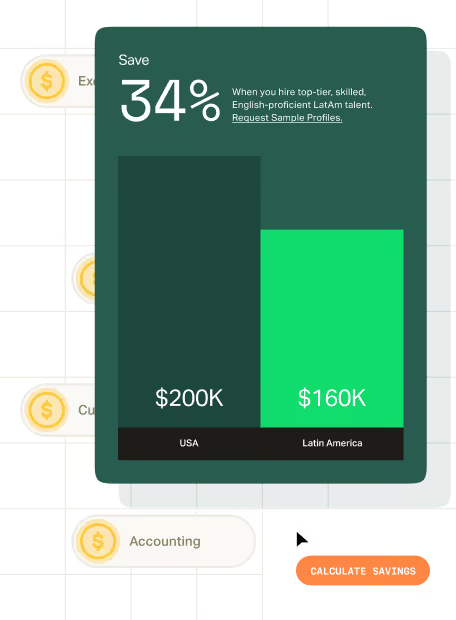
This is the point where the "but India is cheaper" objection usually comes up, and the data answers it. According to Hire With Near’s 2026 State of LatAm Hiring Report, companies save an average of $35,000 to $64,000 per LatAm hire, and 84% of those placements are mid-level or senior professionals.
You’re not trading down to lower-quality junior hires; you are accessing experienced AR and accounting talent within reach of these budgets.
A real example makes the trade-off concrete.
FinanceWithin, a fractional finance services firm in Austin, first tried building offshore finance capacity in India and hit high turnover and inconsistent quality, while US salaries blew their budget.
After switching to LatAm hiring through Hire With Near, they staffed senior bookkeepers, accounting managers, and financial analysts from a pre-vetted talent pool, cut time-to-hire from three weeks to seven days, and saved $535,000 a year, a 64% reduction versus US hires.
Their Director of Accounting, Sheena Malson, put the quality question to rest:
When we saw the quality of candidates coming through, it became clear that these were truly top-tier professionals—better than what we were finding on our own.
India
India is known for its cost-effective labor market. The average salary of accounts receivable professionals in India is among the lowest globally, usually between $3,500 and $6,500 per year, a major factor for businesses focused on reducing wage spend.
That lower wage should be weighed against the time-zone gap and cultural differences, which can slow collaboration and add coordination overhead that doesn’t show up on the payroll line.
The Philippines
The Philippines offers labor costs that are competitive and often comparable to India. Cost-effectiveness, high English proficiency, and strong cultural compatibility with the US make the Philippines an attractive option for back-office AR.
Base salaries for accounts receivable professionals run low, averaging around ₱390,000 per year (roughly $6,500), with experienced staff up to ₱424,800 (roughly $7,000), according to Talent.com.
As with India, the question is whether the wage savings survive the time-zone offset on client-facing work.
For a wider view of where US companies are finding the best mix of cost and quality, our roundup of the best LatAm outsourcing companies and our list of the best companies to hire LatAm finance talent are good next reads.
{{salary-guide-cta}}
Final Thoughts
Choosing where to offshore your accounts receivable comes down to one question: how client-facing is the work?
For collections, customer follow-up, and any AR that needs real-time contact, Latin America’s full US time-zone overlap, strong English, and cultural fit make it the best choice, and the savings versus US hires still run well into the high double digits.
For purely back-office reconciliation where timing matters less, India and the Philippines remain reasonable, lower-wage options.
If Latin America is the right choice for your company, Hire With Near recruits pre-vetted finance and accounting talent based in the region and handles the contracts, onboarding, and payroll so you can focus on the work.
If you’d like to explore hiring AR talent in Latin America, the best next step is to book a free consultation to talk through your specific requirements with our team.
We’ll give you salary benchmarks and walk you through the process so you have the information you need to decide if it’s right for you. You can also get ahead and read our How to Hire the Best Offshore Accounts Receivable Specialists: A Step-by-Step Guide.
{{latam-hiring-cta-v2}}
Frequently Asked Questions
Which region is best for accounts receivable specifically?
Latin America is the best region for client-facing accounts receivable work because of its full US time-zone overlap, strong English, and cultural fit. For AR roles that involve collections calls, customer follow-up, or real-time coordination with a US finance team, those three factors matter more than the lowest wage.
India and the Philippines stay viable for pure back-office reconciliation that can run asynchronously, where their 10-to-12-hour offset is less of a problem and their lower salaries are the main draw.
Is outsourcing to India worth it?
Outsourcing AR to India is worth it when the work is low-touch, back-office reconciliation and your top priority is the lowest possible wage, with salaries often between $3,500 and $6,500 per year. India has a large, well-educated finance talent pool and strong government support for outsourcing.
The catch is time zone: India has close to zero natural overlap with US business hours, so client-facing AR like collections calls forces overnight shifts and slows real-time collaboration.
As one finance leader told us after approximately a year managing a finance team in Mumbai: “The talent is solid…but boy, trying to manage someone in such a different time zone has been hard. Hiring in LatAm and staying kind of within the same reasonable time zone just makes so much more sense for us.”
Why is the Philippines the top BPO destination?
The Philippines is a top BPO destination because of its very high English proficiency, strong cultural alignment with US business norms, government incentives through programs like PEZA, and a deep talent pool experienced in customer service and back-office finance. Those strengths make it excellent for high-volume, back-office AR and reconciliation.
The limitation for client-facing AR is the roughly 12-hour time zone offset, which keeps live overlap with US teams minimal without night shifts.
Where real-time contact drives results, Latin America’s full overlap tends to win.
How much does it cost to hire an offshore accounts receivable specialist?
An offshore accounts receivable specialist costs roughly $3,500 to $6,500 per year in India, about $6,500 to $6,900 in the Philippines, and roughly $18,000 to $42,000 in Latin America, depending on seniority.
LatAm wages are higher, but they still land 38% to 68% below the US equivalent, and the full time zone overlap reduces the hidden coordination costs that often eat into offshore savings.
Does Latin America’s higher labor cost cancel out the savings?
No, Latin America’s higher labor cost doesn’t cancel out the savings, because savings versus US hires still run about 56% to 68% for accounts receivable roles.
The wage gap with India and the Philippines is real, but it is small in absolute dollars compared with the US baseline, and LatAm’s full time zone overlap removes the overnight-shift and next-day-delay overhead that drives up the true cost of an offshore team.
FinanceWithin, a fractional finance services firm in Austin, switched from offshore providers in India to Latin America through Hire With Near and still saved 64% versus US-based hires, while significantly improving quality and cutting time-to-hire from three weeks to seven days.
What other finance roles can you hire offshore besides accounts receivable?
Beyond accounts receivable, you can hire a full range of finance and accounting roles offshore, including an offshore accounts payable specialist, a dedicated bookkeeper from Latin America, and a staff accountant.
AP and AR are routinely hired together for the same back-office function, and bookkeepers and staff accountants are common companion hires as a finance team scales.
In Latin America, all of these roles offer the same US time zone overlap and strong English that make client-facing AR work, with cost savings of roughly 30% to 70% versus US equivalents.







.webp)


%203.svg)
.avif)





%20(1).avif)

%20(1).png)