


%203.svg)
Key Takeaways
- An outsourced controller manages your financial operations remotely. The model differs depending on whether you hire through a fractional firm or directly as a full-time, dedicated team member through a nearshore staffing partner.
- Hiring a controller from Latin America gives you the in-house expertise and integration of a direct hire, combined with cost savings of 55–69% compared to a US-based controller.
- Most companies can access mid-level controller talent in Latin America for $42,000–$60,000 per year, well within reach for SMBs that can't justify a $150,000+ US hire.
Your books are a mess, your auditor is asking questions, and the part-time CPA you've been leaning on can't keep up anymore. It’s time to hire a controller. But quotes for US-based talent are coming in at $130,000–$180,000, and that's before benefits.
Meanwhile, the fractional CFO firm you called told you it would cost $6,000 a month for a part-time controller who splits their attention across four other clients.
If neither of these sounds promising, there’s a third path to consider. You can hire a controller in Latin America as a full-time, dedicated team member. They’ll work exclusively for your company, in your time zone, for a fraction of US rates.
This guide covers what an outsourced controller actually is and how the different hiring models compare in practicality and cost. When the time comes, use these tips to add that much-needed support and even apply the principles to hire finance and accounting talent in Latin America for other roles.
What Is an Outsourced Controller?
An outsourced controller is a financial professional who manages your company's accounting operations, financial reporting, and internal controls remotely rather than as an on-site employee.
The responsibilities are the same as those of an in-house controller and may include:
- Overseeing the general ledger
- Preparing financial statements
- Managing the close cycle
- Making sure the company stays compliant with US Generally Accepted Accounting Principles (GAAP)
- Maintaining the internal controls that keep your financial data accurate
The term “outsourced controller” covers two distinct models, with very different setups.
The first is a fractional controller. This person works part-time across multiple client companies, usually on a retainer. You're buying a fraction of their time.
The second is a full-time, dedicated hire who works exclusively for your company but is based outside your local area. This controller is your employee in every practical sense. They are fully committed to your business, embedded in your team, and building the institutional knowledge that makes a controller genuinely valuable.
Most of the confusion around "outsourced controller" comes from conflating these two models. Clarifying which one you're evaluating changes the cost comparison, the management model, and the outcome. It can also help you find the best fit.
Related reading: A Comprehensive Guide to Finance Outsourcing With Pros and Cons
What Is the Difference Between a Fractional Controller and an Outsourced Controller?
As we shared earlier, a fractional controller works for several clients at once, usually with a set monthly retainer agreement. They may be hired through a direct relationship or with the help of a fractional CFO firm.
When you go fractional, you're buying a share of their capacity, often 10 to 20 hours per week. For companies with genuinely limited monthly accounting needs, that model can work. For companies with active, ongoing controller responsibilities, the shared-attention constraint shows up quickly. You could see a more reactive posture overall as priorities compete across multiple clients.
On the other hand, a dedicated outsourced controller, hired through a nearshore finance staffing partner, works for you (and only you) full time.
They attend your team meetings, own your close cycle, know your systems inside and out, and build the kind of business-context knowledge that makes a controller effective at the strategic level. The geography is different, but the commitment is the same as that of any on-site employee.
When you need someone to manage an audit response, coordinate month-end close, or prepare board financials on a tight deadline, that difference between the two models matters significantly.
In-House vs. Outsourced Controller: Which Is Right for Your Business?
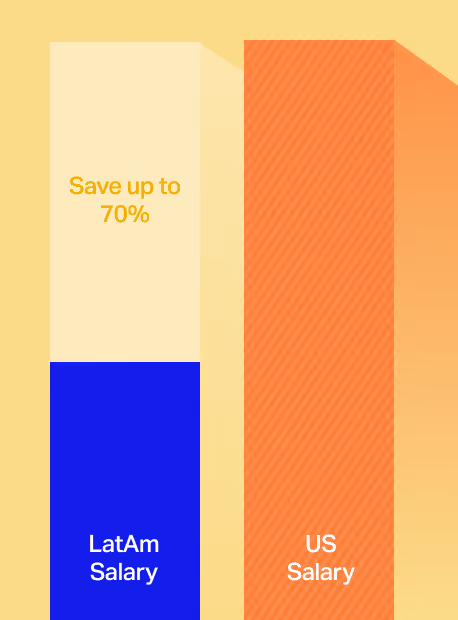
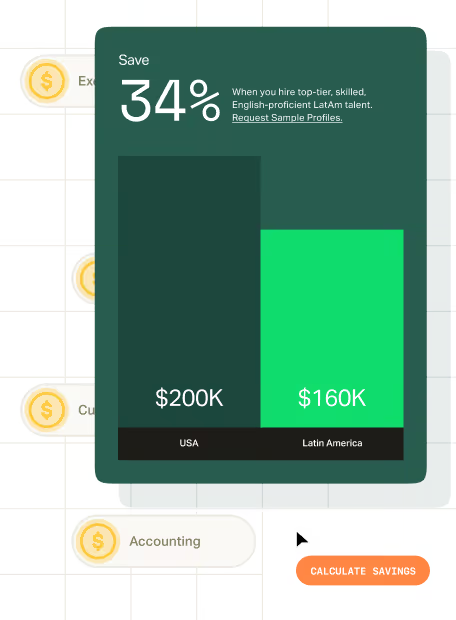
For most SMBs, a full-time US controller is the most expensive option and one of the hardest positions to fill. A direct nearshore hire gives you the same full-time dedication at 55–69% lower cost. Here are some of the other ways the three models stack up.
Full-time US controller
Compensation benchmarks put a mid-level US controller at $110,000–$192,000 per year, and a senior controller at $134,000–$230,000. Add benefits, payroll taxes, and recruiting costs, and the true cost of employment exceeds those figures considerably.
There is an upside with full-time commitment and deep integration. The downside, however, is a high fixed cost, long hiring timelines, and a very competitive market for qualified candidates. If you do find the right fit, you may pay dearly for it.
The U.S. Bureau of Labor Statistics projects about 124,200 new accounting and auditing job openings each year through 2034, many of them replacement roles as experienced professionals retire. That structural shortage makes finding a strong US-based controller more difficult (and expensive) every year.
Fractional controller via managed-service firm
With this model, you pay a lower monthly cost on paper, but the model has a well-documented failure mode. As one media entrepreneur who came to Hire With Near explains it: "When you use these accounting firms that you work with, they're good, but they put a lot of burden back on you, and it's not your team that's aware of it. So it ends up falling back on the principals of the company."
You pay for financial expertise but end up managing the work yourself anyway.
Dedicated controller via nearshore staffing
This model most closely replicates in-house hiring at outsourced economics. A full-time controller based in Latin America, hired through nearshore staffing, costs $42,000–$60,000 per year at the mid level, compared to $110,000–$192,000 for a US equivalent. They work your hours, in your systems, on your team. They're not splitting attention across other clients.
For companies that have outgrown a fractional arrangement but can't justify a $180,000 US hire, this is the practical path forward.
In Hire With Near's research on why US companies hire in LatAm, 30% of companies exploring Latin American hiring were switching specifically from offshore providers, with time zone alignment as the primary driver. For a step-by-step walkthrough of the hiring process itself, see our guide to how to hire an outsourced controller.
Why Hiring a Controller in Latin America Is the Best of Both Worlds
The Latin America advantage for controller roles runs much deeper than saving on salary cost. It's about harnessing the talent of professionals who meet US accounting standards, work in real time with your team, and bring the experience that senior financial roles require.
In my five years sourcing finance and consulting talent at Hire With Near, the most common concern I hear from clients considering a LatAm controller is whether the credentials will hold up. They do.
Here's why.
Latin American finance professionals have strong academic training and significant exposure to Big Four firms. That background gives them experience with international markets and makes them familiar with key accounting standards like US GAAP and IFRS, which are among the most common requirements I see from US clients.
Also, almost 80% of the accountants and controllers I place come from Argentina. To earn an accounting degree there, candidates take a rigorous path of study for five or six years. Argentina has strong public universities, and the quality of the talent pool reflects that.
That credentialing depth can easily show up in placement outcomes. According to Hire With Near's 2026 State of LatAm Hiring Report, 84% of Latin American placements in 2025 were mid-level or senior positions.
Companies using this model aren't accessing new grads or junior talent at a discount. Instead, they onboard experienced professionals they couldn't afford or find domestically.
Time zone alignment is the other factor that separates Latin America from traditional offshore alternatives. For a senior, collaborative role like controller, your leadership team needs to reach that person during the day, where month-end close requires real-time coordination. This is one stand-out advantage of hiring in Latin America because you don’t give that up.
One client described why they chose Latin America over the Philippines for their controller search:
The Philippines can be great for roles that don't need time overlap... but what we were feeling is that it'd be better to look for a more senior candidate, not like an introductory candidate for this role, and whose natural time is more overlapping with the Pacific time zone of the US. So that's why we decided to go with Latin and Central America.
That's the right instinct for a role like controller.
In one case study, we also see the model working in practice. Kordis, a fractional CFO services firm in NYC, had tried offshore hiring through onlinejobs.ph and Support Shepherd. Both failed for the same reasons, including an unmanageable 12-hour time zone gap, language barriers, and unresponsiveness during US business hours.
After working with Hire With Near, they hired a staff accountant with a Bachelor of Commerce (Accounting) from the University of Toronto, an Executive MBA in Financial Management, and 5+ years of North American accounting experience. That first hire provided an annual savings of $109,000—a 72% reduction versus comparable US talent.
Joshua Thompson, Partner and COO at Kordis, said it well:
Hire With Near offers an easy hiring experience where they take the burden of all the posting, screening, and initial screening interviews off your plate, and all you do is final interviews to make sure the cultural fit is right. I made a hire in only 14 days.
For companies that need to hire at the CFO or VP of Finance level, Hire With Near also handles executive search for senior finance and accounting leadership. And if you're looking for accounting recruiting services specifically tailored to the Latin American talent market, that's where our finance team focuses.
What Does It Cost to Hire a Controller in Latin America?
The comparison between Latin American and US rates is significant, and this table explains it well.
Remember, these are full-time, dedicated professionals, not hourly contractors or fractional hires splitting their time across multiple clients. For a mid-level hire, the annual savings typically range from $68,000 to $132,000, depending on the candidate's seniority and specific profile.
But this isn’t the only place you can save. For other detailed compensation comparisons across all finance and accounting roles, see Hire With Near's salary guide and the dedicated accounting roles salary guide.
What Are the Services of an Outsourced Controller?
Outsourced controllers typically manage six core functions, including:
- Accounting and bookkeeping oversight
- Financial reporting
- Budgeting and forecasting
- Tax compliance
- Financial analysis
- Internal controls
The scope may vary by company, but these are the responsibilities most clients hire for.
Management of accounting and bookkeeping processes
These workflows achieve more when they are steady, consistent, and close to the business. An experienced controller does more than “oversee” things, as they actively shape and reinforce internal controls that protect assets, reduce risk, and keep financial data reliable.
Outsourced controllers can support audits and help keep records organized for due diligence, but this is often where the gap between a truly embedded controller and a loosely coordinated support function becomes visible. When documentation, follow-ups, and financial narratives are handled in fragments, the result can feel more assembled than owned. And while clean records do build confidence with investors or partners, that confidence is stronger when there is clear, continuous accountability behind them.
Financial reporting
Outsourced controllers prepare and review monthly and annual financial reports, including consolidated financial statements, income statements, balance sheet statements, and cash-flow statements.
They also implement accounting systems and controls to mitigate the risk of misstatements in financial reporting. This ensures compliance with US Generally Accepted Accounting Principles (GAAP) and established accounting standards.
Controllers own the financial reporting process with reports on the company’s performance and its variances from the budget and forecast. These reports are then distributed to senior management, the board, and key finance leads for decision-making.
Budgeting and forecasting
This service focuses on putting structured, repeatable processes in place to ensure books are maintained accurately and general ledger accounts are reconciled each month. That foundation matters, and without it, even the best forecasts are built on shaky data.
However, with consistent processes and reliable financial information, budgeting and forecasting become far more effective. You get a clearer view of where the business is headed and how to plan for what’s next.
Outsourced controllers also actively engage in cross-functional interactions to better understand business issues. They work closely with department heads and finance leads to identify factors that affect the underlying accounting treatment of revenue recognition, expense recognition, asset valuation, and depreciation methods.
When done well, these activities align budgeting and forecasting with the specific needs of the organization. The outcome is more accurate financial records, greater transparency, and better-informed decision-making across the entire organization.
Tax compliance
Outsourced controllers have a foundational understanding of corporate income tax regulations and requirements, including federal, state, and international tax law changes. Because they follow the updates closely, they know the best ways to keep their clients compliant to avoid penalties.
In some cases, outsourced controllers may work with third-party tax advisors to handle complex tax issues or seek specialized expertise. They take on the role of managing these external advisors, which may involve facilitating documentation, communication, and quality assurance tasks.
Financial analysis
Outsourced controllers conduct a thorough analysis of the company's financial data, processes, and operations to find any gaps or bottlenecks. This helps them meet US GAAP requirements and standard internal control frameworks.
They also review expense patterns, identify areas of excessive spending, and suggest strategies to reduce costs without compromising productivity or quality. This may include evaluating vendor contracts, renegotiating terms, or identifying alternative suppliers or solutions.
Based on what they uncover, outsourced controllers may recommend ways to streamline the close process, strengthen controls, and reduce manual work. In practice, though, these improvements often depend on consistent follow-through, which can be more difficult with a fractional model.
The goal is still to reduce costs while maintaining financial stability and operational efficiency, but getting there requires ongoing ownership rather than periodic input.
Internal controls
Outsourced controllers can help you establish and maintain internal controls that safeguard the revenue receipts, costs, program budgets, and actual expenditures. They put appropriate controls in place to mitigate risks and prevent unauthorized activities.
They also work closely with their clients to develop and document business processes and accounting policies to maintain and strengthen those internal controls for the company's financial integrity. This may involve implementing segregation of duties, improving authorization and approval workflows, or introducing automated systems to minimize the risk of errors or fraud.
{{state-latam-hiring}}
Why Do Companies Need an Outsourced Financial Controller?
By outsourcing the controller function, you gain access to a few benefits you won’t find with other options. Many organizations go this direction to boost talent without stressing their budgets.
Cost savings
As shown in the earlier cost comparison, a controller based in Latin America typically costs less than half of a comparable US hire, freeing up tens of thousands of dollars each year for product, sales, or hiring in other functions.
Access to financial experts
Recruiting and training an in-house US controller can be time-consuming and expensive. Outsourcing eliminates these costs; you gain access to experienced financial professionals who are already well-versed in their field.
You can also hire an outsourced controller to augment your existing financial team. Because they stay current with financial best practices and relevant tools, outsourced controllers can introduce knowledge and practices that enhance the capabilities of your accounting staff and drive better financial outcomes.
Addressing a structural talent shortage
Finding qualified US accounting talent is getting harder. According to the U.S. Bureau of Labor Statistics, about 124,200 accounting and auditing positions open each year through 2034, many of them replacement roles as experienced professionals retire. The number of candidates sitting for the CPA exam has fallen 27% over the past decade, according to Accounting Today.
For companies that can't wait months for a US controller search to close, the Latin American talent pool isn't a workaround. It's a strategic decision that solves a structural problem.
Scalability
In the early stages of a business, financial needs may not be complex enough to justify a full-time US hire. Outsourcing this role makes it easier to access the right level of expertise for your stage without overcommitting resources.
This flexibility is particularly valuable if you are a small business or startup still building out your financial infrastructure.
Focus on core business processes
Outsourcing controller work takes the day-to-day strain of managing financial operations off your leadership team. This frees up leadership to focus on the work that drives growth, rather than reconciling accounts and managing the close.
Bonus resource: Are you struggling to decide between hiring an in-house controller or partnering with a staffing firm? Discover the advantages of keeping your outsourced controller on the staffing firm's payroll vs. hiring in-house in this article.
Looking to Hire Accounting or Finance Talent in Latin America?
If you're comparing specific providers or want a breakdown of where to source finance talent, these guides cover both.
- For a curated list of firms that place Latin American finance talent, see the roundup of the best companies to hire LatAm finance talent.
- If you're weighing options by country, the best countries for outsourcing a financial controller compares the key sourcing markets and what each one offers.
Both are worth reading before you decide on a model or a partner.
{{prevetted-banner}}
Final Thoughts
Hiring an outsourced controller doesn't have to mean accepting a professional who splits their attention across multiple clients. The direct nearshore model gives you the full-time commitment of an in-house hire combined with the cost efficiency that traditional outsourcing promises but rarely delivers.
For most SMBs, the numbers are clear with savings of $68,000 or more annually for a dedicated professional who works your hours, in your systems, on your team.
If you want to explore hiring a controller in Latin America, the best place to start is a free consultation to talk through your specific requirements with our team.
They'll give you salary benchmarks and explain the process so you have the information you need to decide if it's right for you.
Whether you're a growing SMB or a finance company evaluating your options, Hire With Near can help you hire finance and accounting talent in Latin America with confidence.
Book a free consultation with our team today.
{{latam-hiring-cta-v2}}
Frequently Asked Questions
Is a controller higher than a CPA?
A controller is a job title, while a Certified Public Accountant (CPA) is a professional credential. They're different things.
A controller manages a company's accounting function (financial reporting, internal controls, the close cycle) and may or may not hold a CPA license. In Latin America, accounting degrees in countries like Argentina require five to six years of study and are broadly equivalent to a US degree plus postgraduate credentials. Requiring a US CPA from a LatAm candidate is generally unnecessary and narrows your search without adding meaningful assurance of quality.
What is the difference between a controller and a CFO?
A controller owns the accounting function and the mechanics of the financial data. The CFO operates at the strategic level, interpreting and acting on that data for the entire organization. Many growing companies hire a controller first and bring in a CFO, or a fractional CFO, as the business scales.
What does it cost to hire an outsourced controller?
Based on current compensation benchmarks, a mid-level controller based in Latin America costs $42,000–$60,000 per year, compared to $110,000–$192,000 for a US equivalent. Senior-level LatAm controllers typically cost $60,000–$90,000 per year versus $134,000–$230,000 in the US. The savings typically range from roughly 55% to nearly 70%, depending on seniority. These figures apply to full-time, dedicated professionals, not fractional or hourly arrangements.
Can a small business benefit from an outsourced controller?
Yes. Small businesses are often an excellent fit for this model. A company with $2M–$10M in revenue typically has financial operations too complex for a bookkeeper but can't justify a $150,000+ US controller salary. A LatAm controller at $42,000–$60,000 per year handles the full controller function at a cost that fits a growth-stage budget.
What industries hire outsourced controllers most often?
Controllers are hired across industries wherever financial operations require active management. The most consistent demand comes from accounting firms and finance companies that need dedicated accounting oversight, SaaS companies managing subscription revenue recognition and investor reporting, and fintech companies navigating regulatory compliance requirements.
What other finance and accounting roles can I hire with talent based in Latin America?
Controllers are one of many finance and accounting roles US companies hire from Latin America. Common placements include financial analysts, staff accountants, bookkeepers, and FP&A analysts. All benefit from the same combination of cost savings, time zone alignment, and US GAAP familiarity that makes LatAm a strong sourcing region for controller talent. You can explore the full range through Hire With Near's finance recruiters team.









%203.svg)
.avif)





%20(1).avif)

%20(1).png)