


%203.svg)
Key Takeaways
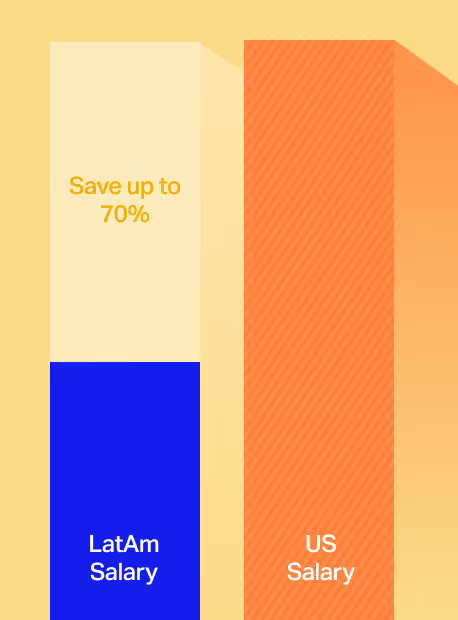
- Offshore accounting services cover bookkeeping, payroll, accounts payable and receivable, tax preparation, financial reporting, and controller-level work. The most commonly offshored functions are transactional roles where quality LatAm professionals can reduce your annual cost by 35–70%.
- The top 8 offshore accounting providers in 2026 include nearshore staffing firms, freelance marketplaces, and managed BPO services, each with different service models, price points, and trade-offs worth understanding before you contact anyone.
- An increasing number of US companies are moving away from Asia-based offshore firms and toward hiring dedicated, full-time accounting professionals in Latin America: better time zone alignment, comparable technical training, and lower turnover make the nearshore model the stronger long-term choice for most US finance teams.
If you need an accountant and you're struggling to find qualified candidates at a price that makes sense, you're facing a common problem in the accounting industry. According to Accounting Today, the number of candidates sitting for the CPA exam has fallen 27% over the past decade.
The trend has continued: accounting graduates declined 6.6% in the 2023–24 academic year, following a 9.6% drop the year before. Total accounting completions hit a 20-year low in 2023–24, with just 55,152 degrees awarded.
At the same time, the US Bureau of Labor Statistics projects only 124,200 new openings for accountants and auditors each year, on average, from 2024 to 2034. That gap between supply and demand is pushing more companies to look outside the US.
Many businesses are relying on offshore accounting services to address this problem. In this article, I selected 8 top providers across different service models, price points, and levels of control, so you can build a shortlist and know who to contact.
What Are Offshore Accounting Services?
Offshore accounting services involve delegating accounting tasks to professional firms or individual specialists based in other countries.
Most US companies use offshore accounting to reduce labor costs, access specialized expertise, or cover functions they can't staff domestically.
Common users include small businesses, startups, and fast-growing companies that need full finance coverage without building a large in-house team.
Commonly outsourced finance and accounting processes include, but aren't limited to:
- Bookkeeping tasks
- Payroll processing
- Tax preparation
- Financial reporting
- Accounts payable and receivable management
- Financial analysis and consulting
In the traditional model, you contract with a third-party firm that assigns staff to your work. Those professionals are the firm's employees, not yours. You're buying a service, not hiring a person.
A separate model (hiring a dedicated, full-time accountant from Latin America) gives you an exclusive employee relationship, but that's distinct from what most offshore accounting service firms offer. Hire With Near works with this model.
For a deep look at common questions about hiring accountants remotely, Hire With Near's finance team has compiled the most frequently asked questions from US finance leaders.
Types of Accounting Services You Can Offshore (and Which to Prioritize)
Most offshore accounting providers cover a wide range of functions. Here's what US companies most commonly offshore and what each involves:
Bookkeeping and reconciliation
Bookkeeping is the most commonly offshored accounting function for US small businesses. A remote bookkeeper records and classifies daily financial transactions, maintains the general ledger, reconciles bank and credit card statements, and prepares trial balances.
Because bookkeeping is process-driven and software-reliant (QuickBooks, Xero, NetSuite), it's well-suited for offshore or nearshore professionals who can work asynchronously or during overlapping US hours.
Accounts payable management
Accounts payable covers invoice processing, vendor payment scheduling, expense tracking, and general ledger coding. An accounts payable specialist working offshore can handle all of this within your existing systems.
For companies processing high invoice volumes, offshoring AP is one of the fastest ways to reduce finance headcount costs without sacrificing accuracy.
Accounts receivable management
Accounts receivable includes customer invoicing, collections follow-up, payment application, and aging report management. An accounts receivable specialist keeps your cash flow predictable and your DSO (days sales outstanding) in check.
This function works well offshore when there's clear process documentation and regular communication with the US billing team.
Payroll processing
Payroll management involves calculating employee compensation, withholding taxes and deductions, running payroll on schedule, and generating reports.
Offshore payroll specialists work within US payroll platforms (Gusto, ADP, Paychex) and are particularly valuable for companies with large hourly or multi-state workforces where payroll complexity is high.
This is a function where accuracy is non-negotiable. Find a provider or hire someone with a clear track record.
Tax preparation and planning
Tax accountants working offshore can prepare federal and state tax filings, manage estimated tax payments, identify deductions, and assist with tax planning strategy. Most LatAm-based tax professionals are trained in GAAP and can work within US tax frameworks.
For highly complex tax situations (multi-entity structures, M&A, R&D credits), you may want to pair an offshore accountant with a US-licensed CPA who reviews the final work.
Financial reporting and analysis
Beyond transactional accounting, offshore providers and professionals can deliver monthly financial statements (income statement, balance sheet, cash flow), budget-to-actual variance analysis, KPI dashboards, and management reporting packages.
Financial analysts in Latin America with Big Four experience often bring strong modeling skills and familiarity with US reporting standards.
Controller-level services
Month-end close management, journal entry oversight, variance analysis, and policy compliance fall under controller-level work. This is the most senior function commonly offshored and is better suited for dedicated full-time hires than outsourcing firms.
A strong offshore controller or senior staff accountant can own the close calendar, manage junior staff, and interface directly with your CFO or executive team.
Top 8 Companies for Offshore Accounting Services
The top 8 companies for offshore accounting services are Toptal, BruntWork, Remote CoWorker, Hire With Near, MyOutDesk, Upwork, Wishup, and Stealth Agents. They're in no particular order.
In this list, only companies with at least 50 client reviews on at least one established review platform (G2, Clutch, Trustpilot, GoodFirms, or ClearlyRated, client ratings only) with an overall rating of 4.5 or above are included.
From those qualifying companies, I evaluated accounting-specific service offerings, pricing signals, software proficiency, and service model fit for US small businesses on their official websites.
It's important to mention that I've included Hire With Near on this list, and yes, I'm obviously biased. But no comparison article can tell you what's best for your situation. Our goal is to give you clear, honest information so you can build an informed shortlist and figure out which company fits what your company needs.
Here's what sets each apart:
1. Toptal
Website: toptal.com
Headquarters: San Francisco, CA
Rating: 4.7/5 on G2 (265+ reviews) as of June 2026
Services: Freelance CPAs, controllers, interim CFOs, US GAAP experts, financial modelers, FP&A specialists, part-time CFOs
Focus Regions: Global
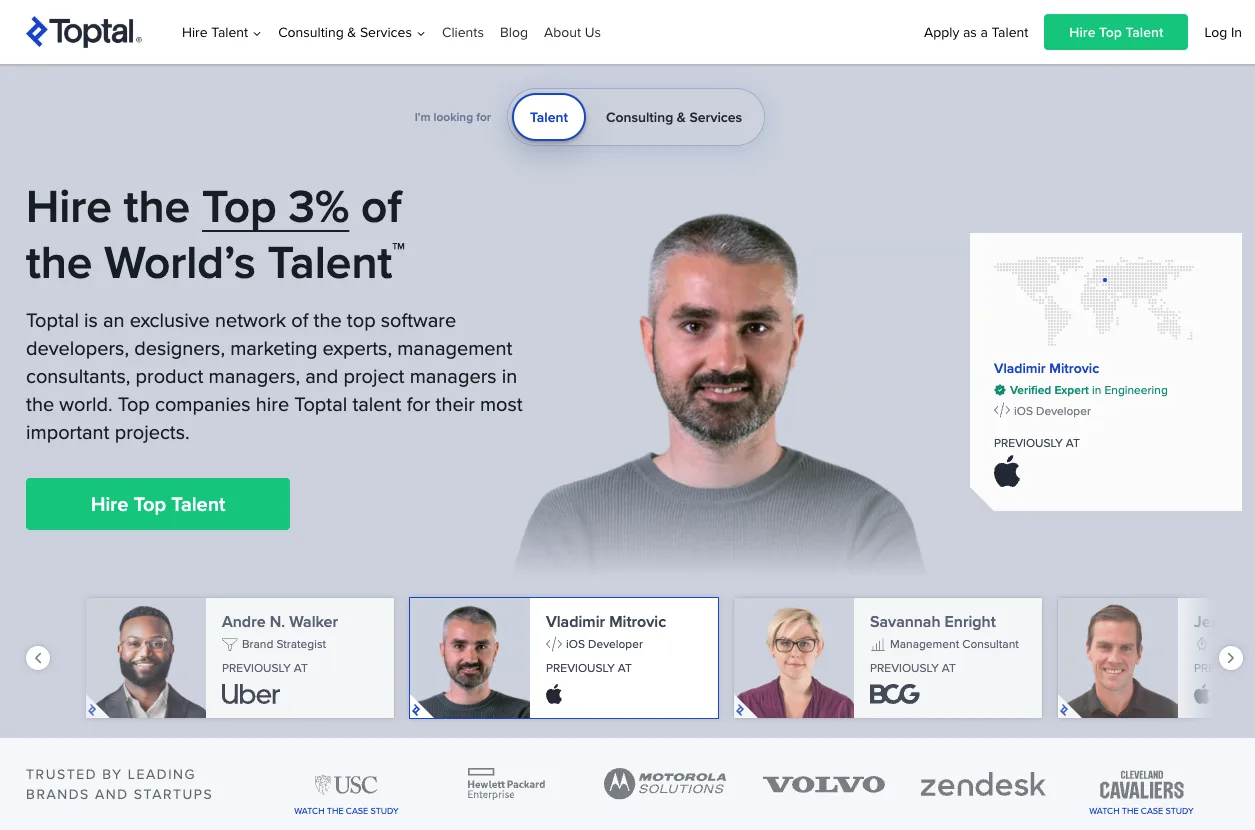
Toptal earned a spot on this list because of its top-3% talent selectivity and its depth of senior finance expertise. The platform connects US companies with freelance finance professionals screened for the highest skill levels, and it's one of the few services where you can realistically access a US-licensed CPA, an interim controller, or a fractional CFO within 48 hours.
With 30,000+ clients served globally, Toptal is a strong fit when you need senior-level finance talent for a defined engagement rather than ongoing operational bookkeeping.
Key features:
- Senior-tier finance access: CPAs, US GAAP experts, financial modelers, interim CFOs, and part-time CFOs. All are available through a single platform, with 48-hour matching for most placements.
- Rigorous vetting: Only 3% of applicants pass Toptal's screening process, which includes skills assessments, live problem-solving sessions, and test projects before anyone reaches a client.
- Flexible engagement: Project-based, part-time, or full-time engagements available, making Toptal suitable for one-time financial modeling work, month-end close support, or fractional CFO retainers.
Best for: Companies needing senior-level finance talent for a defined project: interim CFO coverage, controller backfill, financial modeling, fundraising prep, or US GAAP reporting. Less suited for ongoing high-volume operational bookkeeping.
Client perspective: “Toptal's ability to match talent to our exact needs has been consistently impressive. Support and process quality are both strong.” — Customer review on G2
Limitations: Not designed for high-volume transactional bookkeeping at scale. Freelancer availability varies by specialty.
Pricing: Not publicly listed. Premium pricing consistent with senior freelance finance talent.
See our Hire With Near vs. Toptal comparison to understand how the two models differ.
2. BruntWork
%206.02.09%E2%80%AFp.%E2%80%AFm..webp)
Website: bruntwork.co
Headquarters: Global (Philippines-based talent)
Rating: 4.9/5 on Trustpilot (1,270+ reviews) as of June 2026
Services: Bookkeeping, accounts payable and receivable, bank reconciliation, payroll processing, financial reporting, tax preparation, general ledger management
Focus Regions: Philippines primary, global
BruntWork caught my attention for its high Trustpilot volume: 1,144 reviews at 4.9/5 is one of the strongest review profiles in this space.
The company operates as a general outsourcing platform with a dedicated accounting and bookkeeping practice, and every bookkeeper placed has a minimum of five years of experience.
There are no lock-in contracts, and pricing is transparent at $4–$8 per hour, which makes BruntWork a competitive option for cost-sensitive businesses that want experienced offshore accounting professionals without a large monthly commitment.
Key features:
- No lock-in contracts: Month-to-month engagement with no setup fees. The hourly rate includes computer, internet, and all fees, with no hidden charges.
- Experienced bookkeepers: Every offshore bookkeeper carries a minimum of five years of experience, covering general ledger management, AP/AR, bank reconciliation, payroll, and financial reporting.
- Flexible scaling: Adjust your staffing level up or down as your accounting workload changes, with no penalties or renegotiation required.
Best for: Cost-focused US businesses that need experienced bookkeeping or back-office accounting support without a large monthly commitment. Strong fit for SMBs with variable accounting workloads.
Client perspective: “Our experience with BruntWork has been exceptional. They have consistently connected us with talented professionals who have become valuable extensions of our team.” — Customer review on Trustpilot
Limitations: Philippines-based talent means time zone differences for US East Coast clients. Focus is primarily on operational bookkeeping and back-office tasks rather than senior-level financial analysis or controller-level work.
Pricing: $4–$8/hour. No setup fees. No lock-in contracts.
3. Remote CoWorker

Website: remotecoworker.com
Headquarters: Hallandale Beach, FL
Rating: 4.8/5 on Clutch (185+ reviews) as of June 2026
Services: Bookkeeping, accounts payable and receivable, bank reconciliation, payroll processing, financial statement preparation, data entry, client follow-up
Focus Regions: Philippines primary, global
I included Remote CoWorker because they combined strong Clutch ratings, verified enterprise-grade security certifications, and a dedicated finance and accounting practice.
The company holds ISO 27001, SOC 2, HIPAA, and PCI Level 1 certifications: a compliance stack that makes them one of the more rigorously certified options on this list for businesses that handle sensitive financial data.
With rates starting at $7.99/hour and a 48-hour onboarding timeline, Remote CoWorker is positioned for businesses that want fast deployment with security assurance baked in.
Key features:
- Enterprise-grade compliance: ISO 27001, SOC 2, HIPAA, and PCI Level 1 certified. This is a strong differentiator for businesses in regulated industries or those handling client financial data.
- Dedicated QA oversight: Every client account includes a quality assurance manager who monitors performance and addresses issues proactively.
- Software integration: Remote CoWorker bookkeepers work within existing platforms including QuickBooks, Xero, and Sage, reducing transition friction.
Best for: US businesses in regulated industries (healthcare, financial services, legal) that need offshore accounting services with verified data security compliance. Also a good fit for companies managing client financial data that require SOC 2 or HIPAA coverage.
Client perspective: “I have found their communication, oversight, guidance, and value to all to be excellent. Also Remote Coworker provided the strongest candidates of the six firms that I interviewed for this work.” — Customer review on Clutch
Limitations: Philippines-based talent means asynchronous communication for US-based teams during business hours. Primarily suited for operational and transactional accounting rather than strategic financial analysis.
Pricing: Starting from $7.99/hour. Contact for custom pricing based on scope and team size.
4. Hire With Near
Website: hirewithnear.com
Headquarters: San Antonio, Texas
Rating: 4.9/5 on G2 (140+ reviews) as of June 2026
Services: Full-service nearshore staffing and recruiting, RPO, staff augmentation, executive search
Focus Regions: LatAm only
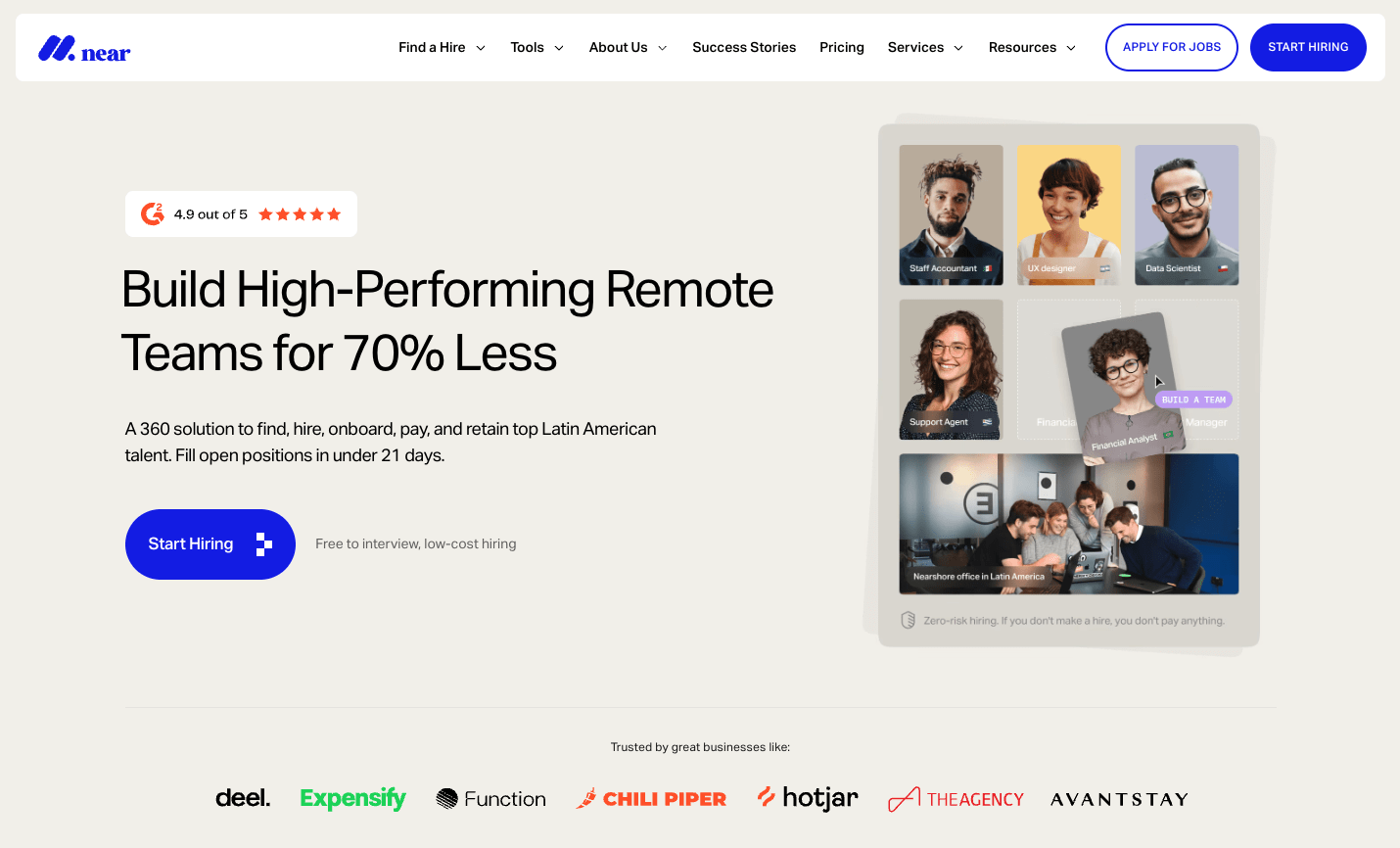
Hire With Near is a full-service staffing and recruiting agency that helps US companies hire dedicated, full-time accounting and finance professionals from Latin America.
Unlike every other provider on this list, Hire With Near doesn't assign shared staff to your account. We place a professional who works exclusively for your business, learning your systems, your processes, and your reporting cadence, and stays.
We handle everything end-to-end: sourcing, vetting, candidate presentation, payroll, compliance, and onboarding, so the finance and accounting hiring process stays simple on your side. We've served 950+ US companies, maintain a pre-vetted pool of 160,000+ LatAm professionals, and hold a 4.9/5 G2 rating across 140 verified reviews.
Most outsourcing firms assign accounting work to shared resources who handle multiple clients at once, which means divided attention, shallow context on your business, and staff turnover in the people touching your books. Hire With Near solves that by giving you one dedicated professional who builds institutional knowledge over time.
Key features:
- Elite talent for finance positions: We place controllers, financial Analysts, senior Accountants, and bookkeepers every week, with specialist finance recruiters screening beyond certifications for real-world impact. Our recruiters understand technical accounting, US GAAP compliance, and what it takes to handle month-end close, variance analysis, and financial modeling at a high level. Top-tier LatAm finance professionals deliver the same rigor and strategic thinking as your best US hires.
- Quality-first approach: Our 97% placement rate and 9.1+ client satisfaction score come from obsessing over fit: not just skills, but the drive, readiness, and cultural match to contribute from day one. We screen for technical accounting proficiency, compliance rigor, and the work ethic that keeps your books accurate and your close on schedule.
- One partner, one process: Scale across functions, not just finance, with one dedicated team and a repeatable hiring cadence. First candidates in 3–5 days with video introductions, most hires in under 3 weeks. We remember what worked last time, and we adapt based on your feedback so each search gets faster and more effective.
- 180-day replacement guarantee: Double the industry standard. If a hire doesn't work out in the first six months, we find a replacement at no additional cost to you.
Best for: US companies that want a dedicated, full-time Latin American accounting professional who works exclusively for them. Strongest fit for businesses replacing or supplementing US-based staff, or those switching from an Asia-based offshore model.
Client perspective: “Great experience from start to finish. The team at Hire With Near listened carefully to what we needed and delivered candidates that genuinely impressed us. The person we hired has become one of our strongest performers.” — Customer review on G2
Limitations: Hire With Near only hires in Latin America. We're not an outsourcing firm, we're a recruiting partner, so you own the employment relationship and manage day-to-day work directly.
Pricing: Two engagement models: direct hire (one-time recruiting fee) or staffing model (monthly fee includes payroll and compliance). No upfront costs. You pay nothing until you make a hire. Transparent benchmarks provided upfront.
5. MyOutDesk
%204.16.23%E2%80%AFp.%E2%80%AFm..webp)
Website: myoutdesk.com
Headquarters: Sacramento, CA
Rating: 5.0/5 on Clutch (65+ reviews) as of June 2026
Services: Bookkeeping virtual assistants, accounts receivable and payable, payroll processing, reconciliation, invoicing, collections management
Focus Regions: Philippines
What stood out about MyOutDesk is their 5.0/5 Clutch rating (the highest of any company on this list), combined with a dedicated bookkeeping virtual assistant practice.
Unlike most providers on this list that cover the full accounting function, MyOutDesk focuses specifically on bookkeeping-level work: transaction recording, reconciliation, accounts payable and receivable, payroll processing, and invoicing. If that's the scope you need, they do it well.
Each engagement includes a dedicated account manager who oversees VA performance, handles onboarding, and serves as a single point of contact for escalations.
Key features:
- Full-time dedicated VAs: Every bookkeeping VA works exclusively for your account (not shared across clients), which builds consistent context and reduces errors over time.
- Built-in account management: A dedicated account manager is included in every engagement to oversee onboarding, monitor quality, and manage performance.
- Bookkeeping task depth: VAs handle AR, payroll, reconciliation, basic accounting and reporting, invoicing, and collections management within your preferred bookkeeping software.
Best for: SMBs, real estate firms, and owner-operated businesses that want a full-time dedicated bookkeeping VA with structured management oversight built into the engagement.
Client perspective: “Tasks and deliverables were consistently completed on time, with clear communication and proactive follow-ups to ensure priorities were addressed efficiently. They responded quickly to changing needs, customer concerns, and operational requests, often taking initiative to resolve issues before escalation was necessary.” — Customer review on Clutch
Limitations: Philippines-based talent means time zone overlap may be limited for US West Coast evening workflows. Not a fit for senior-level financial analysis or controller-level work.
Pricing: From $1,988/month (full-time VA, 40 hrs/week). Specialized bookkeeping roles from $2,500/month. Month-to-month, 6-month, and 12-month pricing tiers available.
6. Upwork

Website: upwork.com
Headquarters: San Francisco, CA
Rating: 4.5/5 on G2 (3,200+ reviews) as of June 2026
Services: Freelance accounting professionals across bookkeeping, tax preparation, financial reporting, payroll, financial analysis, and controller-level work
Focus Regions: Global
Upwork earned its place on this best offshore accounting services list through sheer review volume: over 3,200 verified G2 reviews at 4.5/5, representing one of the largest independent data sets for any platform in this space.
As a global freelance marketplace, Upwork gives US companies direct access to accounting professionals at virtually every seniority level and price point, without requiring a contract with a vendor.
The trade-off is that sourcing, vetting, and managing freelancers falls primarily on the client. Upwork provides the platform and payment infrastructure, but the relationship management is yours to run.
Key features:
- Largest global talent pool: Access to accounting freelancers across every seniority level, from entry-level bookkeepers to senior CPAs and financial analysts, with transparent hourly rates and work history visible before you hire.
- Flexible engagement terms: Hire by the hour, by the project, or on a retainer. No vendor contract required, and you can work with multiple freelancers simultaneously for different accounting functions.
- Direct control: You post the job, screen candidates, and manage the relationship directly. This gives you full control over who touches your books and how they work.
Best for: US businesses that want flexible, on-demand accounting support without a vendor contract. Strong fit for one-off projects, overflow bookkeeping during busy periods, or companies with the bandwidth to manage freelancers directly.
Client perspective: “Each freelancer I have hired have had strong communication skills and competence in their field of expertise. Upwork's rating system for freelancers is an excellent start.” — Customer review on G2
Limitations: Vetting and management responsibility fall on the client. Quality varies significantly across freelancers. Not a managed service: you won't have an account manager, performance oversight, or quality assurance built in. Not suitable for businesses that need a fully managed, hands-off accounting solution.
Pricing: Varies by freelancer. Typical bookkeeping rates range from $15–$75/hour depending on location, experience, and specialization. Platform fee applies.
7. Wishup
%204.18.54%E2%80%AFp.%E2%80%AFm..webp)
Website: wishup.co
Headquarters: New York, NY
Rating: 4.8/5 on Trustpilot (100+ reviews) as of June 2026
Services: Dedicated bookkeeping virtual assistants, accounts payable and receivable, bank reconciliation, payroll support, financial reporting, QuickBooks, and Xero management
Focus Regions: India and the Philippines
Wishup earned its spot on this list by providing a managed, low-cost solution for the heavy administrative lifting that drains an accounting firm’s time. While they don't place specialized tax or CPA-track talent, Wishup excels at handling the essential day-to-day bookkeeping layer through a structured, fully managed model.
Rather than simply placing a freelancer and stepping back, they provide continuous oversight, software-ready tool support, and guaranteed backup coverage. Their bookkeeping assistants focus strictly on core data entry, accounts payable/receivable, and bank reconciliations, with micro-packages starting as low as $299/month.
Sourcing talent from India and the Philippines, Wishup gives growing accounting firms an affordable way to offload routine books so their high-level staff can focus on complex advisory and tax season demands.
Key features:
- Managed bookkeeping service: Oversight, backup coverage, and tool support are built into the engagement, so your books stay consistent even when your VA is unavailable.
- Accounting-only VAs: Wishup's bookkeeping virtual assistants are dedicated strictly to accounting and bookkeeping tasks, not split across unrelated administrative duties.
- Fast deployment: Wishup advertises VA placement within 60 minutes for most bookkeeping roles, making it one of the faster-start options on this list.
Best for: Small US businesses or solo founders who want a managed bookkeeping VA with structured oversight at a lower entry price point. Particularly suited for businesses that need QuickBooks or Xero management with backup coverage.
Client perspective: “Each person I’ve worked with has been focused, productive, responsive, and incredibly kind. They take ownership. They follow through. They care about outcomes, not just outputs.” — Customer review on Trustpilot
Limitations: India and the Philippines talent pools mean asynchronous communication during US business working hours. Not a fit for controller-level or senior financial analysis work.
Pricing: Managed bookkeeping service from $299/month. Dedicated bookkeeping VA from $999/month. General VA plans from $1,299/month.
8. Stealth Agents
%204.20.46%E2%80%AFp.%E2%80%AFm..webp)
Website: stealthagents.com
Headquarters: Philippines
Rating: 4.9/5 on Trustpilot (85+ reviews) as of June 2026
Services: Dedicated bookkeeping virtual assistants, QuickBooks and Xero management, accounts payable and receivable, payroll support, financial reporting, and bank reconciliation
Focus Regions: Philippines
The reason Stealth Agents made this list is their combination of Forbes recognition and a dedicated bookkeeping practice backed by a structured management layer.
Every client gets a Campaign Manager who handles onboarding, quality assurance, and ongoing performance review at no additional cost.
Their bookkeeping VAs are pre-vetted specialists who maintain a stated accuracy rate of 98%+, and they support the full range of common accounting software, including QuickBooks and Xero.
Key features:
- Dedicated Campaign Manager included: Every engagement comes with a Campaign Manager who handles onboarding, QA, and performance oversight at no extra charge.
- Software-specialized VAs: Stealth Agents' bookkeeping VAs are trained specifically for QuickBooks and Xero workflows, covering AP/AR, bank reconciliation, payroll, and financial reporting.
- Forbes-recognized VA Provider: Stealth Agents has been rated one of the best virtual assistant companies by Forbes, which provides independent credibility beyond standard client review platforms.
Best for: SMBs that want a Philippines-based dedicated bookkeeping VA with structured account management and a recognized BPO provider behind it. Good fit for businesses using QuickBooks or Xero that want software-specific expertise.
Client perspective: “Since bringing them on board, I’ve been able to free up a significant amount of my time from admin tasks, which has allowed me to focus on the higher-level work that truly moves the needle.” — Customer review on Trustpilot
Limitations: Philippines-based talent means time zone differences for US teams that need real-time collaboration. Not suited for senior-level financial strategy or interim CFO-type work.
Pricing: From $15/hour. Full-time bookkeeping VA engagements typically $1,920–$2,880/month for 40 hours/week. Contact for custom quotes.
{{consultation}}
What Are the Benefits of Offshore Accounting Solutions?
Partnering with offshore accounting companies offers real advantages for US businesses, and the numbers make the case clearly.
Here are six key benefits that make accounting services offshoring a practical choice for businesses of all sizes:
1. Cost savings
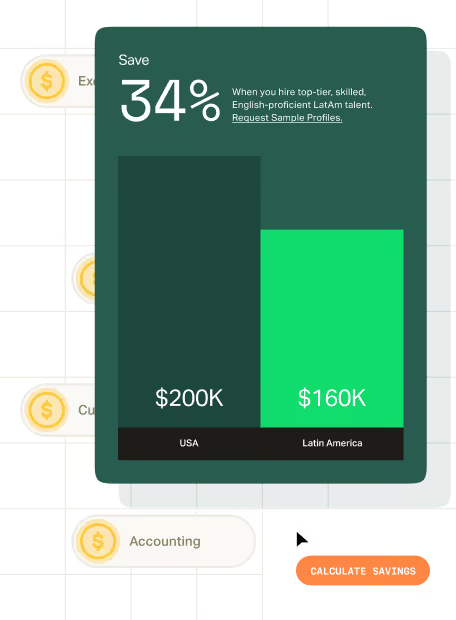
Labor costs for accounting roles in Latin America are considerably lower than in the US. A mid-level bookkeeper in LatAm typically earns $30K–$36K per year, compared to $47K–$72K per year for a US-based bookkeeper, representing savings of 36–57% on salary alone.
A financial analyst in LatAm runs $24K–$48K/year versus $80K–$133K in the US, a difference of 59–70%.
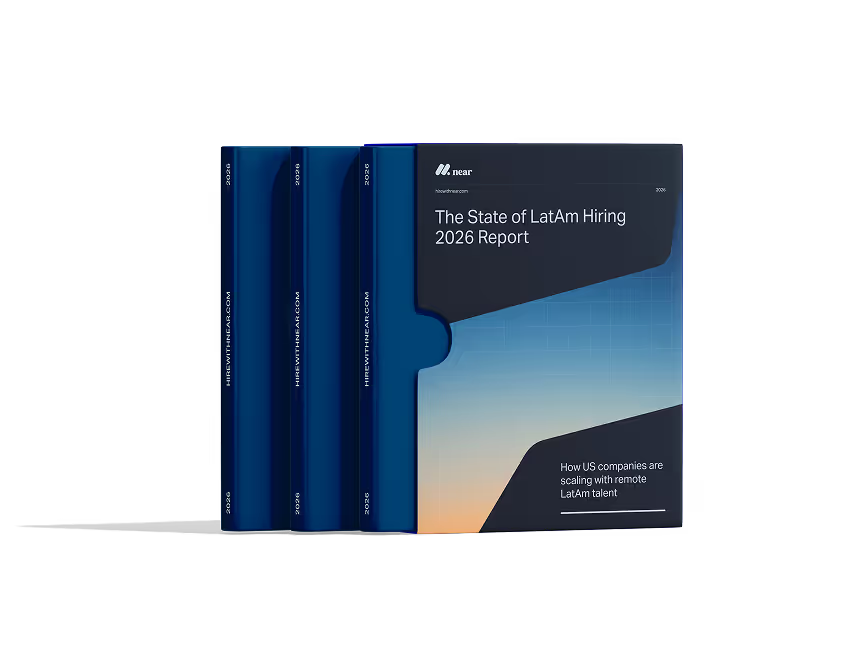
According to Hire With Near's 2026 State of LatAm Hiring Report, companies hiring accounting talent in Latin America save $33,000–$66,000 per year per accountant compared to US equivalents, with 84% of placements in 2025 being mid-level or senior professionals. That last point matters: the cost advantage doesn't require accepting junior-level work.
By reducing in-house staff costs with an offshore recruiting partner or outsourcing firm, your business can reallocate budget to growth, product, or customer-facing functions.
2. Time savings
Delegating accounting activities to an offshore team frees up internal bandwidth that can be redirected to core business priorities.
This is especially valuable for founders and small business operators who are currently doing their own bookkeeping or managing a fractional accountant relationship that isn't working.
3. Access to skilled professionals
Offshore accounting firms draw from talent pools with strong academic and professional training. In some Latin American countries, accounting programs typically run five or more years at the university level, and many professionals have Big Four exposure.
You can access specialized knowledge (US GAAP compliance, NetSuite, financial modeling) that may be difficult to find locally at a price point that works.
4. Compliance with international standards
Many LatAm-based offshore providers are SOC 2- or ISO 27001-certified and work within US GAAP and IFRS frameworks, which means your records meet the standards your auditors and investors expect.
This matters particularly for businesses operating in multiple jurisdictions or with international clients.
5. Use of advanced technology
Offshore accounting firms typically work within your existing software stack (QuickBooks, Xero, Sage, NetSuite, Gusto) rather than requiring you to adopt new tools.
The better providers bring platform-specific expertise that reduces onboarding time and transition friction.
6. Operational efficiency
Offloading accounting functions to a dedicated offshore team reduces errors, improves turnaround on financial close, and frees your internal team from repetitive transactional work.
For companies with messy or backlogged books, a strong offshore partner can also help catch up and build better processes going forward.
{{state-latam-hiring}}
How Much Does Offshore Accounting Cost? US vs. Offshore Rate Comparison
The table below shows current compensation benchmarks for common accounting roles in Latin America compared to US averages. These are salary figures only, before benefits, office space, and overhead, which compound the savings further.
Source: Hire With Near 2026 Salary Guide and State of LatAm Hiring Report
A few things this table doesn't show: outsourcing firms add a service markup on top of the underlying talent cost, which narrows the savings relative to what you'd see hiring directly.
For a full breakdown of role-by-role benchmarks, including seniority tiers and country-level variation, see the US vs. LatAm salary comparisons guide.
Compliance, GAAP Standards, and CPA Licensing: What to Know Before Offshoring
One of the most common concerns US finance leaders raise about offshore accounting is compliance: Are these professionals GAAP-trained? Are they licensed CPAs? How do I know my books are in good hands?
These are fair questions, and the answers are more nuanced than a simple yes or no.
GAAP vs. IFRS
Most offshore and nearshore accounting professionals working with US companies are GAAP-trained or have significant GAAP project experience.
Latin America uses IFRS as the primary standard in many countries, but professionals hired through US-focused staffing firms or outsourcing providers are typically selected for their familiarity with US GAAP requirements, particularly in financial reporting, consolidations, and multi-entity accounting.
Ask specifically about GAAP experience during your evaluation process, and test it with practical questions, not just credential checks.
CPA licensing
CPAs are licensed on a state-by-state basis in the US, and that license doesn't transfer to offshore professionals. This creates a misconception: that offshore accountants are less qualified. Lucas Stepanenko, Sourcing Manager for Finance & Accounting at Hire With Near, notes that this framing misses the point entirely:
Getting a university degree in accounting in Latin America — in a country like Argentina — takes five years or more. When you try to get that degree recognized in the United States or Europe, it's generally equivalent to a university degree plus a postgraduate degree. So requiring a CPA license from a LatAm candidate doesn't really make sense.
The credential to look for isn't a US CPA license. It's rigorous academic training, practical experience in the relevant functions you need, and proven familiarity with US accounting standards.
Those things are common in LatAm accounting talent, particularly from Argentina, Colombia, and Mexico.
Data security
Before signing with any offshore accounting provider, verify their data security posture. Minimum requirements to look for: a signed NDA or confidentiality agreement covering your financial data, clear data handling policies that describe where your data lives and who can access it, and preferably SOC 2 compliance or equivalent security certification.
For businesses in regulated industries (healthcare, financial services, legal), ISO 27001 and HIPAA compliance add an additional layer of assurance.
What Are the Main Challenges Involved in Offshore Accounting Services?
While offshore accounting outsourcing services offer real advantages, it's worth understanding the challenges before you commit:
1. Communication
Time zone differences and communication norms vary significantly depending on where your offshore provider is based.
A Philippines-based provider is 12–15 hours ahead of US time zones, which means little real-time overlap. A Latin American provider typically sits within 0–3 hours of US Eastern time.
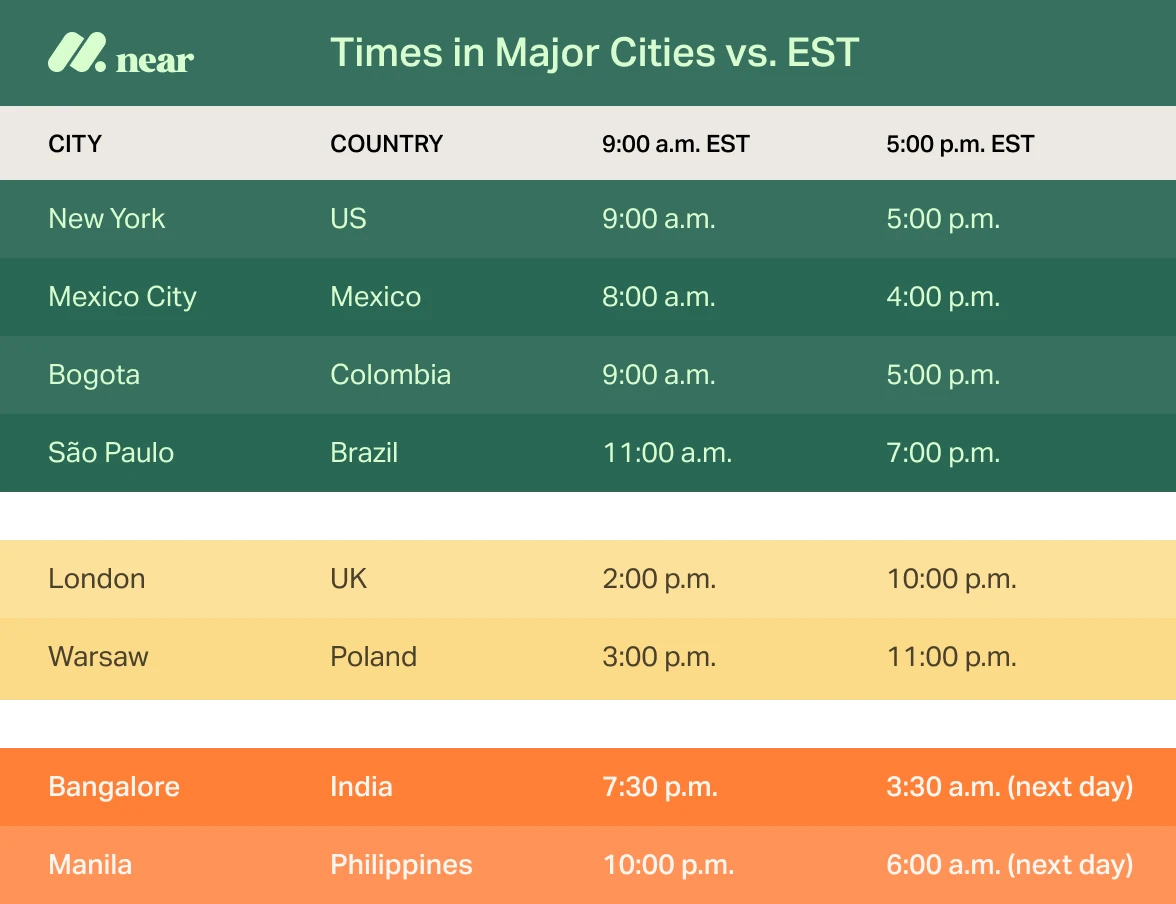
If real-time collaboration on financial close, investor reporting, or month-end questions matters to you, the geography of your provider matters too.
See nearshoring vs. offshoring vs. onshoring for a clear breakdown of the trade-offs.
2. Security measures
Your financial data is among your most sensitive business assets. Before entering any offshore accounting partnership, verify what security certifications they hold (SOC 2, ISO 27001, HIPAA where applicable), what their data access controls look like, and what happens to your data if the relationship ends.
This isn't a nice-to-have. It's a baseline requirement.
3. Accounting standards and compliance differences
Different countries operate under different accounting frameworks. Most offshore providers working with US companies are familiar with US GAAP, but it's worth confirming this explicitly rather than assuming.
Ask how they handle GAAP-specific requirements like revenue recognition (ASC 606), lease accounting (ASC 842), and multi-entity consolidations.
Misaligned assumptions here can create problems at audit time.
4. Tax compliance
Tax laws vary significantly across jurisdictions, and the interplay between your US obligations and your offshore provider's home country can create complexity. This is particularly relevant for payroll tax, international contractor payments, and any transfer pricing considerations.
Partnering with a provider that has demonstrated US tax experience reduces this risk considerably.
5. Talent pool variation
The quality and depth of accounting talent vary significantly by geography.
The Philippines has a large volume of bookkeeping professionals but fewer with US GAAP specialization or controller-level experience.
Latin America, particularly Argentina, offers strong academic training and a growing pool of Big Four-experienced professionals, but the supply of NetSuite-proficient talent is tighter.
Knowing what you need before you evaluate providers helps you match the pool to the role.
For a direct comparison, see outsourcing accounting to LatAm vs. the Philippines.
6. Cultural differences
Working across cultural contexts requires intentional effort on both sides. Setting clear expectations for communication cadence, deliverable format, and escalation paths at the start of the relationship prevents the misunderstandings that derail offshore partnerships.
5 Factors To Consider To Choose the Right Offshore Accounting Partner
With 8 providers covered in this guide, and dozens more in the broader market, evaluating potential partners on the right dimensions saves time and prevents costly mismatches.
1. Reputation
A solid reputation reflects reliability, professionalism, and consistent delivery. Look at verified client reviews on G2, Clutch, or Trustpilot (the platforms used in this article's methodology), check for industry recognition, and ask for references from clients in your industry or of a similar size.
Platforms with high review volume at high ratings offer a more reliable signal than a handful of curated testimonials.
2. Experience and expertise
Choose an offshore accounting partner with a proven track record working with businesses similar to yours in industry, complexity, and size.
Ask specifically about their experience handling the functions you need: not just “accounting” in general, but month-end close, multi-entity consolidation, or payroll across multiple states if those are your requirements.
3. Proficiency in accounting software
Your offshore partner needs to work within your existing tools: QuickBooks, Xero, Sage, NetSuite, or another. Confirm proficiency during evaluation, not after onboarding.
NetSuite, in particular, has a thinner talent pool. If it's your core platform, verify this specifically.
4. Compliance with regulations
Compliance with accounting standards, data security requirements, and anti-money laundering obligations is non-negotiable.
Confirm your provider has the certifications that are relevant to your industry and that they can articulate their data protection practices clearly.
5. Service quality
Assess the provider's commitment to quality through their SLA terms, turnaround commitments, escalation processes, and communication responsiveness. A strong provider will tell you what happens when something goes wrong, not just when everything goes right.
Why Are More US Companies Hiring Full-Time Accounting Talent in Latin America Instead?
There's an important distinction worth making before you decide which type of offshore accounting solution to pursue: outsourcing a function to a firm isn’t the same as hiring a dedicated accounting professional.
When you outsource to a firm, you're paying for a service. The people doing the work are the firm's employees, handling multiple clients simultaneously. Turnover among those staff members is common. The institutional knowledge of your business stays with the firm, not the person, and continuity depends on the quality of the firm's internal handoffs.
When you hire a dedicated remote employee based in Latin America, you own the relationship. That professional works for you, builds institutional knowledge over time, and is accountable to your team's standards and processes. The continuity is built into the model.
For simple, transactional bookkeeping that doesn't require deep business context, an outsourcing firm works fine. For anything requiring judgment, institutional knowledge, or cross-functional collaboration with your finance or leadership team, a dedicated hire is a fundamentally different model.
The time zone problem
In dozens of conversations with Hire With Near's finance recruiting team this year, the pattern that emerges is consistent: companies that started with offshore outsourcing and eventually switched to direct LatAm hiring almost universally describe the switch as the better model for their long-term needs.
According to Hire With Near's analysis of 2,000+ hiring conversations, 30% of US companies turning to LatAm hiring are switching specifically from offshore models in India and the Philippines, driven by time zone gaps that made real-time collaboration impractical.
One clean-energy company in Hire With Near's hiring network described the switch directly:
We learned very quickly that nearshoring is a much better option for us at this size... the last year, trying to manage someone in such a different time zone, and they don't work U.S. hours, right?... all that being said, to us, moving to LatAm and staying kind of within the same reasonable time zone just makes so much more sense for us.
The time zone issue isn't the only driver. A real estate tax consulting firm that had tried Philippines-based CPAs through an offshore agency described why they eventually switched:
The CPAs they sent me were from the Philippines, and the problem was they didn't want to work on our time zone was one of the problems. And then they started sending me people from like [other countries] with no experience, no knowledge of how U.S. tax works. They just didn't send me very highly qualified candidates.
The results speak for themselves
The FinanceWithin case illustrates what the switch looks like in practice. They're a fractional finance services firm that had previously worked with an offshore provider in India and experienced the high turnover and quality inconsistency that many US companies describe.
After switching to hiring dedicated accounting talent through Hire With Near, they reduced annual costs by $535,000 (64% compared to US-based hires) and cut time-to-hire from three weeks to seven days.
Sheena Malson, their Director of Accounting, described the talent quality this way:
When we saw candidate quality, it became clear these were truly top-tier professionals — better than what we found independently.
Lucas Stepanenko consistently flags Latin America as a strong fit for accounting roles specifically because of the academic rigor:
LatAm finance professionals have strong academic training and a lot of exposure to Big Four firms. That gives them experience with international markets and makes them very well versed in key accounting standards like US GAAP and IFRS — which are among the most common requirements we see from our clients.
If you're weighing the outsourcing vs. direct-hire decision, the best companies for hiring LatAm finance talent and the guide to hiring remotely in Latin America are useful resources for the next step.
Final Thoughts
No comparison article can tell you which offshore accounting provider is right for your business. Every company has different needs, different constraints, and a different definition of what “the right fit” looks like.
But now you have a clear picture of eight providers with verified client ratings, distinct service models, and different price points. You also have a clearer sense of when an outsourcing firm is the right answer, and when hiring a dedicated accounting professional in Latin America is the better long-term move.
The next step is conversations. If you're open to exploring how dedicated LatAm accounting talent could strengthen your finance team, Hire With Near offers a no-commitment consultation.
A 20-minute call is enough time to walk through your specific situation, share salary benchmarks for the roles you need, and answer any questions you have. You can also browse available positions to hire finance and accounting talent in Latin America and see the types of professionals US companies hire through Hire With Near.
No sales pitch. No pressure. Just a direct conversation that helps you make a better decision faster.
Frequently Asked Questions
What are offshore accounting services?
Offshore accounting services involve hiring professionals or firms in other countries to handle your company's accounting functions, including bookkeeping, payroll, tax preparation, accounts payable and receivable, financial reporting, and controller-level work.
US companies use offshore accounting primarily to reduce labor costs, access specialized expertise, and cover functions they can't staff domestically, particularly as the US accounting talent pipeline has tightened significantly over the past decade.
How much does it cost to offshore accounting?
Offshore accounting costs vary by role, seniority, geography, and whether you use an outsourcing firm or hire directly.
As a benchmark, a mid-level bookkeeper in Latin America typically runs $30K–$36K per year, compared to $47K–$72K/year for a US-based equivalent, a savings of 36–57%. A financial analyst costs $24K–$48K/year in LatAm versus $80K–$133K in the US.
See the cost comparison table above for a full role-by-role breakdown, or the full salary guide for additional detail.
Are CPAs being offshored?
Most offshore and nearshore accounting professionals working with US companies aren’t US-licensed CPAs, since CPA licensing is state-by-state in the US and doesn't transfer internationally.
However, accounting credentials in Latin America are rigorous: a university degree in accounting in countries like Argentina typically takes five or more years and is generally recognized as equivalent to a US degree plus postgraduate certification.
Hire With Near's finance recruiting team notes that requiring a US CPA license from a LatAm candidate misses the point. The more useful criteria are academic training, practical GAAP experience, and demonstrated competency in the functions you need.
What accounting tasks can be safely offshored?
The most commonly offshored accounting tasks are bookkeeping and bank reconciliation, accounts payable processing, accounts receivable and collections, payroll management, tax preparation support, and standard financial reporting.
These are process-driven functions where clear documentation, solid software proficiency, and reliable communication protocols are sufficient to maintain quality remotely.
More complex work, including multi-entity consolidations, audit preparation, and highly specialized tax situations, can also be handled offshore, but typically requires more vetting and a more senior professional.
Which accounting functions do US small businesses offshore the most?
Bookkeeping and accounts payable are the entry points. Companies typically start with these two, stabilize, and then expand into payroll, AR, and reporting. Controller-level work usually requires a longer relationship and a stronger vetting process.
How do you ensure compliance with an offshore accounting team?
Compliance with an offshore accounting team comes down to three things: verifying that your provider or hire has relevant GAAP experience (not just general accounting credentials), confirming their data security posture through certifications like SOC 2 or ISO 27001, and building clear escalation protocols for questions that require US-specific expertise. For companies in regulated industries, ask specifically about HIPAA or PCI compliance.
The provider's willingness to answer these questions in detail is itself a signal of their professionalism.
What finance and accounting roles can I hire from Latin America?
US companies regularly hire a broad range of finance and accounting professionals from Latin America through Hire With Near, including offshore accountants, dedicated bookkeepers, staff accountants in Latin America, accounts payable specialists, accounts receivable specialists, remote payroll specialists, and LatAm tax accountants.
Latin American accounting talent typically offers strong US GAAP familiarity, real-time time zone overlap with US teams, and compensation benchmarks 36–70% below US equivalents, with the majority of 2025 placements at the mid-level or senior tier.







.webp)


%203.svg)
.avif)





%20(1).avif)

%20(1).png)