Key Takeaways
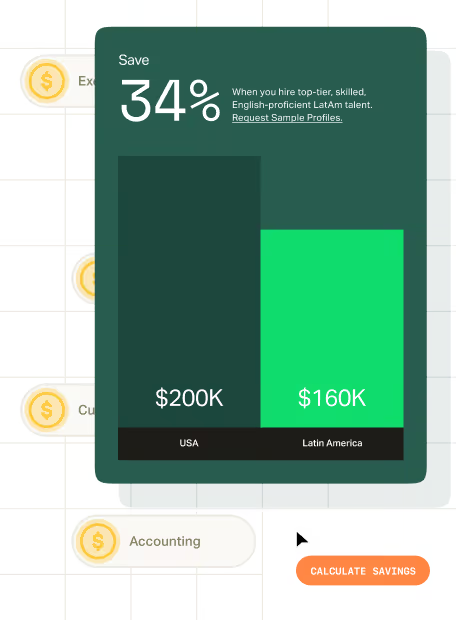
- Offshore AI developers build, train, and deploy machine learning systems from outside the US. Hiring an offshore AI developer in Latin America costs roughly $42,000 to $108,000 a year depending on seniority, against $116,000 to $224,000 for the US equivalent.
- Judge an offshore AI developer on models they have put into production. Ask them to describe a project they shipped in plain language, and treat a vague answer about what excites them in AI as a warning sign.
- The main ways to hire are sourcing and employing the person yourself, a freelance marketplace, an offshore development agency, staff augmentation, or a staffing and recruiting partner that places a full-time employee on your team.
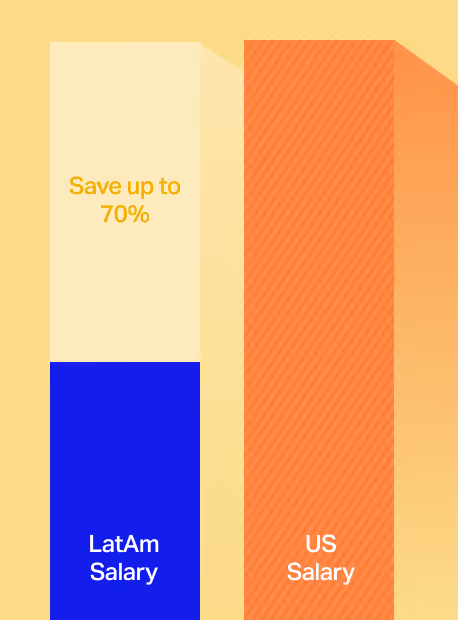
Hiring an offshore AI developer means bringing on a machine learning specialist based outside the US to build, train, and deploy your AI systems, usually at 50 to 70% below US salaries, from a far larger pool than you'll reach at home.
Cost is what starts most of these searches. In our analysis of 2,000+ hiring conversations, 41% of companies said budget was the reason they looked outside the US at all.
But the bigger decision isn't the rate, it's how you engage: a full-time developer placed on your own team, a marketplace contractor for a short build, or an agency for a fixed-scope project.
This guide covers what offshore AI developers do, what they cost, what to screen for when you're not technical, and where to find them.
What Are the Benefits of Offshoring AI Developers?
Offshoring an AI role puts experienced machine learning talent in range at 50 to 70% below US salary expectations, from a candidate pool many times larger than the one inside commuting distance of your office.
For most companies that's the difference between hiring an AI developer this quarter and postponing the work.
The skills problem behind that is getting sharper. According to ManpowerGroup's 2026 US Talent Shortage Survey, 69% of US employers report difficulty finding the skilled talent they need, and 72% do globally. For the first time in the survey's history, AI skills rank as the hardest of all skills to find worldwide.
So if your search has stalled, it isn't a sign you're hiring badly. It's a market-wide constraint, and offshoring the role is one of the few levers that changes the size of the pool you're fishing in.
Some key benefits of offshoring this role:
- Lower cost to hire: A lower cost to hire makes the role viable for companies that can't clear US salary expectations.
- A far bigger candidate pool: Senior machine learning experience is scarce everywhere, so a multi-country search is often the only way to see real candidates.
- Specialist profiles, not generalists: You can hire for the exact job, including a ChatGPT developer who has shipped production assistants, not demos.
- Faster time to a working system: Someone who has deployed models before moves through data preparation, evaluation, and monitoring faster than a generalist learning them on your project.
- Patterns your team hasn't tried: Developers who shipped AI work in other markets bring approaches that matter where the first attempt usually fails.
- Less operational load on you: Firms and staffing partners absorb turnover, replacement, and scaling, so a departure is theirs to solve.
One factor deserves more thought than it usually gets: working hours. An AI developer whose day sits entirely outside yours can still do excellent work, but every clarifying question costs you a day, and AI projects generate a lot of them as the model's behavior becomes clear.
By offshoring, companies can tap into a global pool of talent, making it easier to find a ChatGPT developer experienced in creating advanced conversational AI platforms.
If you want live standups and same-day answers during your own business day, wherever your team sits in the US, that narrows the map, and the countries worth offshoring machine learning to differ a lot on this point. Decide how much overlap you need before you decide where to hire.
What Do Offshore AI Developers Do?
Offshore AI developers design, build, train, and maintain the machine learning systems behind a product feature or an internal process, from preparing the training data through to keeping the deployed model working.
The title, offshore artificial intelligence developers in the spelled-out form you'll still see on job boards, covers a wide range: some are research-leaning AI/ML specialists, some are applied engineers wiring models into an existing product, and some are closer to automation builders.
The US Census Bureau's Business Trends and Outlook Survey puts current AI use among US businesses at 17 to 20%, with another 20 to 23% expecting to use it within six months, and 37% of firms with 250 or more employees already using it. In other words, most of your competitors are deciding what to build at the same time you are.
These are the services offshore AI developers most often deliver:
- Data tagging and preparation: Annotation, labeling, and cleanup, the unglamorous foundation of training accuracy. This often sits with data engineers, not the model builder.
- Custom model development: Training and refining models for a specific business problem instead of bolting a general-purpose API onto an existing workflow.
- AI strategy and implementation support: Helping you decide what's worth building, what to buy, and what to leave alone.
- Analytics and interpretation: Experienced data scientists turning raw data into decisions your team can act on.
- Text and language processing: Models that understand and generate language for recommendations, sentiment analysis, summarization, and search.
- Automation builds: Connecting systems and models so a manual process runs on its own. Our roundup of AI automation examples shows what companies build here.
- Support and maintenance: Retraining, monitoring, and updating live systems long after launch, which is where a lot of AI projects run into trouble.
A note on titles before you write the job description, because getting this wrong is one of the most expensive mistakes at this stage.
Kevin Dubon, Operations Systems Architect at Hire With Near, sees it constantly:
An AI engineer means something more specific, it goes more toward training LLMs and building advanced data structures for AI, rather than gathering data from different APIs and building automations. Operations systems architect is the more general role that covers the full automation stack. A lot of companies searching for an ‘AI engineer’ actually need an operations systems architect.
—Kevin Dubon, Operations Systems Architect, Hire With Near
If what you want is a process that runs itself, our breakdown of which automation hire your business needs will save you from paying a premium for the wrong role. When the work is model development, AI and machine learning recruitment is its own specialization.
Offshore chatbot and conversational AI specializations
Offshore chatbot and conversational AI developers are a distinct specialization within AI development, focused on dialogue design, intent handling, retrieval, and the guardrails that keep an assistant from saying something it shouldn't. They usually cost the least to hire of any AI role, because the scope is narrower than a full model build.
The work splits into two jobs that often get confused. One is the conversation layer: intents, fallbacks, escalation paths to a human, and tone.
The other is the retrieval layer: connecting the assistant to your knowledge base, product data, or ticketing system so its answers are grounded in something real. Ask which of the two a candidate has built, because most have done one and talked about the other.
For assistants built on large language models rather than older intent-based bots, a ChatGPT developer is the closer profile. If the assistant has to handle regulated or customer-identifying data, say so in the brief early. It changes both the architecture and the shortlist.
How Much Does It Cost to Hire an Offshore AI Developer?
Hiring an offshore AI developer in Latin America costs roughly $42,000 to $108,000 a year depending on seniority, compared with $116,000 to $224,000 for a US hire at the same level. That's a saving of 50 to 70%, and it holds across the seniority range rather than only at the junior end.
To put that in concrete terms, here is what hiring an AI developer costs compared to equivalent US hires, according to Hire With Near's salary benchmarks:
For the most up-to-date figures, see Hire With Near's US vs Latin America Salary Guide.
Read those rows against your own budget, not against each other. Hiring a senior AI developer offshore often costs less than hiring a mid-level one in the US. On AI work that difference shows up immediately, because a senior engineer has already watched a model behave badly in production and knows what to check for.
These figures come from our own placement data. Rates vary by country and region. And a published starting rate rarely covers everything. Ask whether it includes payroll, benefits, and compliance, or just the person's pay.
Our guides to what data and AI roles cost and to AI engineer salaries break the ranges down further.
Salary isn't the whole number, though, and the part that surprises people is the commercial model sitting on top of it.
- A one-time placement fee: A recruiting partner sources and vets the candidate, you employ and pay them directly, and the fee is charged once when you hire. Lowest ongoing cost, but payroll and compliance stay with you unless you buy that separately.
- A monthly staffing or staff-augmentation fee: One monthly figure covers the person's compensation plus the firm's margin, with payroll, benefits, and local compliance included. Higher recurring cost, far less administration.
- A marketplace hourly rate: You pay by the hour or week with a platform margin built in. Flexible, easy to start and stop, and typically the most expensive per hour of senior work.
- An agency retainer or project fee: You buy an outcome, not a hire on your team. Project management is included; the engineers aren't yours and don't stay.
Across the 2,000+ placements in Hire With Near's 2026 State of LatAm Hiring Report, companies saved an average of $35,000 to $64,000 per hire per year, and 84% of those placements were mid-level or senior rather than junior.
Get to an all-in annual figure before you compare providers. Four questions do most of the work: what the fee covers, what's billed on top, what happens to the cost if the person leaves in month three, and what the total looks like over twelve months. A provider who can't answer those quickly is not a good sign.
What Skills Should You Look For in an Offshore AI Developer?
The skill that separates a strong offshore AI developer from an impressive resume is deployment: they've taken a model from an idea to something running in production, with monitoring on it, and they can explain how without hiding behind terminology. Everything else is secondary to that.
In my nearly four years recruiting technical talent at Hire With Near, that's the single filter that has held up best. Academic machine learning knowledge is common and easy to display. Someone who has watched their own model drift, retrained it, and explained to a non-engineer why last month's numbers moved is rare, and that person is worth paying for.
The specific technical stack is narrower than most job descriptions suggest. Python is effectively the working language of production machine learning, alongside TensorFlow, PyTorch, and Scikit-learn.
Above that, look for experience with large-scale data tooling such as Hadoop, Spark, or Amazon S3, and familiarity with at least one cloud machine learning platform, usually AWS SageMaker or Google Cloud Vertex AI. Backgrounds tend to come from mathematics, physics, computer science, or engineering.
Here is how that typically maps across seniority levels:
Treat years as a rough guide, not a filter. I usually tell clients not to make a degree a must-have on technical roles either. Plenty of strong engineers started working before they finished university and never went back, and they're not weaker candidates for it. What matters is what they've shipped.
Soft skills carry more weight on AI roles than on most engineering hires, for one practical reason. The developer will spend a lot of time telling non-technical people what a model can and can't do, and how confident they are in it. A candidate who can't do that clearly will make your team over-trust the system or abandon it, and both outcomes are expensive.
How Do You Hire Offshore AI Developers Successfully?
Successful offshore AI hires come down to three things: hiring for deployed experience rather than rate, putting a real technical filter in front of the shortlist, and setting up the working relationship so that problems surface in week two instead of month four. The tips below are in the order you'll need them.
Here's the short version of how to approach the hire before you start screening:
Consider value for money, not the hourly rate
Cost efficiency is one of the main reasons to offshore, but the lowest rate is rarely the lowest total cost. Weigh the rate against the skills, the deployment track record, and the quality of what the person produces.
On AI work, the gap between a strong and a weak hire is large, because a badly built model can pass early tests and only fail once it's handling real traffic.
Paying more for someone who has shipped before usually means fewer rebuilds and a system you can trust.
Separate AI experts from AI-adjacent generalists
AI development isn't an entry-level role, and a lot of candidates have moved into it recently from adjacent work. The relevant question is what they've built, not what they know.
Offshore hiring gives you access to specialized profiles: machine learning engineers who build and deploy models, natural language processing specialists, computer vision engineers, and prompt engineers who work on assistant behavior rather than model training. Those are different jobs.
Decide which one you need before you screen, then use technical assessments and structured screening to confirm the candidates you interview have done it before.
Vet for technical skill without a technical background
You don't need to read code to vet an AI developer. Ask them to walk you through a model they built and deployed, and listen for specifics: a real problem, real numbers, what broke, and how they fixed it. A strong developer can explain it to a non-engineer without hiding behind terminology.
Start with four questions, and listen to the shape of the answers, not the vocabulary:
- How do you keep up with advances in AI and machine learning? A specific answer (a paper, a conference, a newsletter) shows real engagement. A generic one usually means the interest stops at the paycheck.
- What models have you worked with, and can you describe one you built and deployed? The core question. You want a real project with a problem and an outcome.
- How do you handle people who don't fully understand what AI can and can't do? Managing expectations is half the job once the model is live.
- What excites you most about machine learning, and why? Vagueness here is the reliable warning sign.
Then add a technical assessment like a take-home exercise or a live session after the screening call. If you don't have the skills in-house, a technical advisor, an investor, or a friendly CTO can run 45 minutes of live questioning.
Any staffing partner worth hiring will run your assessment as part of their process and tell you where a candidate fell short, not just show you the wins.
Partner with a company that knows AI hiring
Working with a firm that specializes in hiring data and AI talent gives you recruiters who can tell the difference between a candidate who has deployed a model and one who's only read about it. Their existing networks also mean the first shortlist arrives in days rather than after a month of sourcing.
Ask any partner how they screen for this specific role before you sign. A firm that recruits across every function without a technical screening layer will send you resumes that match keywords.
Set up the working relationship so problems surface early
Agree on the definition of done, the owners, and the review cadence before the first sprint, then treat the first three months as the period where you either build the working relationship or find out it won't hold. Six habits do most of the work:
- Agree on goals and timelines first: On AI work, working is a number, so settle what accuracy, latency, or error rate counts as done.
- Run a paid trial: Two to four weeks on real, scoped work tells you more than any interview. Watch for problem-solving under ambiguity and whether they raise problems early.
- Write down who owns what: Who owns the data, who owns the model, and who signs off on a release.
- Agree the tools and the cadence: A shared board and defined milestones keep in-house and offshore work visible, which is what makes deadlines hold.
- Communicate often and in writing: A short written summary after every decision costs ten minutes and saves a week.
- Manage against measurable expectations: Review output regularly instead of waiting for a quarterly check-in.
Avoid the four costliest hiring mistakes
The four mistakes that cost the most are hiring the wrong role title, hiring on rate, skipping the technical assessment, and hiring the whole team at once.
- The wrong role title: Searching for an AI engineer when the work is automation means paying a premium for the wrong skill set.
- Hiring on rate: The lowest hourly rate is rarely the lowest total cost once rebuilds are counted.
- No take-home or live technical session: Skipping the assessment stage moves the filtering into month four.
- Building the team before the first senior hire has seen the system: The architecture usually changes after the first month of real work.
Where Do You Find Offshore AI Developers?
You can find offshore AI developers five ways: source and employ them yourself, use a freelance marketplace, hire an offshore development agency, use staff augmentation, or work with a specialist staffing and recruiting partner.
The right one depends on how long you need the person and how much of the hiring work you want to own.
Building it yourself costs you a technical recruiter's time plus either a local entity, which takes months, or an employer of record to act as the legal employer. An employer of record handles payroll, benefits, and compliance, but it doesn't recruit, so you still find and vet every candidate yourself.
Marketplaces reverse the trade: fast to start, easy to stop, and shallow enough on screening that the technical assessment is on you. Agencies hand you an outcome and keep the engineers.
Staff augmentation sits in between, and it's the honest answer for part-time and project-based needs: the firm employs a pre-vetted professional who works on your team under your direction, and you can scale up or down.
When you want a full-time developer, a specialist staffing and recruiting partner is the simplest option, because it both finds and vets the person and handles payroll, benefits, and compliance.
One thing stays on your plate in every model: the final interview and the hiring decision. Any provider offering to take that away is selling something you shouldn't buy.
None of this depends on where your own team sits. Hiring an offshore AI engineer for a New York, Austin, or Seattle team works the same way mechanically; what changes is how much of your working day overlaps with theirs.
Which Companies Can Help You Hire Offshore AI Developers?
Seven companies stand out for hiring offshore AI developers: Toptal, Andela, Hire With Near, STX Next, Innowise, Uplers, and Second Talent.
They fall into three shapes. Talent marketplaces match you with a vetted individual, offshore development agencies deliver a project or a squad on their own payroll, and staffing and recruitment agencies place a full-time hire on yours.
How I determined this list: I only included companies with at least 50 client reviews on at least one established review platform (G2, Clutch, Trustpilot, GoodFirms, or ClearlyRated, client ratings only) and an overall rating of 4.5 or above. From the companies that cleared that bar, I looked at AI and machine learning capability rather than general software development.
That means which AI/ML roles they fill or build with, where their engineers sit, how the engagement is structured, and what they publish about pricing, vetting, and guarantees.
The companies below are in no particular order, and the list implies no ranking. The right fit depends on the roles you're filling, your budget, your timeline, and how you like to work.
Hire With Near is on this list, which means we're biased. But no comparison article can name the objectively best company for you. What it can do is give you enough straight information to build a shortlist and work out who is worth a call.
Every company here can put a competent AI or machine learning engineer in front of you. What differs is who employs the engineer, how deeply they're vetted, where they sit, and what happens once the contract starts. Here's the shortlist in one view.
Note: To keep the list up to date with our selection criteria, we regularly check ratings on third-party review sites and update as required.
If you want a wider field to compare against, we keep longer roundups of AI engineering staffing companies and of LatAm staffing firms.
Hire With Near
Website: hirewithnear.com
Headquarters: United States, with recruiters based across Latin America
Rating: 4.9/5 on G2 (150+ reviews) as of September 2026
Services: Full-service staffing and recruiting, direct hire, staff augmentation, RPO, and executive search across AI, data, and software developer roles
Focus Regions: Latin America only
We're the one company here that places a full-time employee onto your team, rather than a contractor engagement or a project squad, and the only one recruiting exclusively in Latin America. We run the hire end to end: sourcing, screening, candidate presentation, payroll, compliance, and onboarding.
More than 950 companies have hired through us, including Expensify and Deel, from a pool of 160,000+ pre-vetted professionals. We hold a 4.9 rating on G2 across 150+ reviews and were ranked No. 118 on the 2026 Inc. 5000 list of the fastest-growing private companies in America.
Delve, a Boulder digital consulting firm, came to us when conflict disrupted its offshore offices in Warsaw and Minsk and specialized data roles proved unfillable in the US. We placed ten people, including a Data Scientist, for roughly $500,000 a year less than the US equivalent would have cost.
Key features:
- Elite talent for AI and data positions: We place machine learning engineers, data scientists, data engineers, and AI developers every week, and our recruiters ask for the evidence that a candidate has put a model into production rather than only worked in notebooks.
- Quality-first approach: Our 97% placement rate and 9.1 client satisfaction score come from obsessing over fit: the drive, the readiness, and the cultural match to contribute from day one. We'll tell you when a candidate who looks strong on paper doesn't hold up.
- One partner, one process: Scale across functions, not just AI, with one dedicated team. First candidates in 3 to 5 days with video introductions, most hires in under 3 weeks.
- Long-term retention: 80% of our hires stay 2+ years, building institutional knowledge inside your systems.
Best for: US companies that want a dedicated, full-time AI, machine learning, or data hire working during their own business hours, with sourcing, vetting, payroll, and compliance handled for them. Our guide to hiring remotely in Latin America covers how the employment side works.
Limitations: We recruit in Latin America only, so if your requirement is an India- or Asia-based team, we're not your fit.
We also place people rather than deliver projects: if you want a fixed-scope build managed end to end, an agency or a nearshore software development outsourcing partner is the closer shape.
Pricing: Two engagement models: direct hire (a one-time recruiting fee) or a staffing model (a monthly fee with payroll and compliance included). You set the salary and pay nothing until you hire. Every placement carries a 180-day replacement guarantee, double the industry standard.
Toptal
Website: toptal.com
Headquarters: San Francisco, California
Rating: 4.7/5 on G2 (270+ reviews) as of September 2026
Services: Freelance talent marketplace covering AI and machine learning engineers, data scientists, and software developers, on hourly, part-time, and full-time engagements
Focus Regions: Global
I included Toptal for the screening bar it publishes and the speed that comes from a pre-screened bench. The network accepts fewer than 3% of applicants, and it breaks the funnel down openly: 26.4% pass the language evaluation, 7.4% clear the skill review, and 3.2% finish a test project.
For a buyer who isn't technical and has no way to run a deep AI assessment in-house, that published filter is the closest thing on this list to a vetting process you can point at.
Key features:
- Matching in about a day: Toptal states it introduces candidates in under 24 hours, with hiring generally completed in roughly 48 hours.
- No-risk trial period: Engagements open with a trial of up to two weeks that you pay for only if you keep the person. Toptal reports a 98% trial-to-hire rate.
- AI specialties, not generalists: The network is organized around machine learning engineering, natural language processing, computer vision, neural networks, predictive analytics, chatbot integration, and generative AI.
Best for: Short-cycle or highly specialized AI work where you want a vetted individual quickly and are comfortable paying a premium rate for the filter.
Limitations: Talent is engaged as freelancers through the platform rather than hired onto your team, so the rate carries a platform margin and long-term retention isn't part of the model. Because the network is global, your match's working hours depend on where that person happens to live.
Pricing: Not publicly listed. Hourly, part-time, and full-time engagements, with the trial period unbilled if you don't proceed.
Andela
Website: andela.com
Headquarters: Fully remote, with no central office
Rating: 4.7/5 on G2 (110+ reviews) as of September 2026
Services: Global technical talent network, team augmentation, and fully managed engineering teams
Focus Regions: Global, with talent in 135+ countries
Andela earned a spot on this list because it rebuilt itself around AI work rather than bolting it on. The company says it has certified 17,000 AI-native engineers out of more than 200,000 technologists trained since 2014, and reports 98% enterprise client satisfaction. It also sells what a lot of buyers at this stage need, which is a team rather than a person: you can augment your own engineers or hand over a fully managed unit.
Key features:
- Three deployment shapes: Andela packages AI talent as Builders (application engineering), Integrators (systems and infrastructure engineering), and Scalers (platform and production engineering).
- Current AI stack coverage: LLM engineering and fine-tuning, retrieval-augmented generation, agentic and multi-agent systems, MLOps and LLMOps, computer vision, and data platform architecture.
- Global sourcing: Blended teams are drawn from Europe, Kenya, Brazil, India, and North America, out of a network spanning 135+ countries.
Best for: Companies that need a whole AI capability stood up rather than a single hire, and want one vendor accountable for the team.
Limitations: Engineers are engaged through Andela rather than employed by you, and no pricing, guarantee, or time-to-match figures are published, which makes it harder to compare on paper.
Pricing: Not publicly listed.
STX Next
Website: stxnext.com
Headquarters: Poznań, Poland
Rating: 4.7/5 on Clutch (100+ reviews) as of September 2026
Services: Python engineering, AI and machine learning development, MLOps and platform engineering, data and cloud
Focus Regions: Poland and wider Europe, with offices in the UK, Germany, Mexico, and the United States
What stood out about STX Next is how narrow it is by design. The company calls itself Europe's largest Python-focused digital engineering partner, which matters because Python is the working language of most production machine learning.
It runs 450+ engineers, designers, and data specialists, with 20+ years of building production systems, 1,000+ projects delivered, and 300+ clients worldwide. That's a depth of delivery history few agencies that rebranded around AI in the last two years can show.
Key features:
- Fixed-price entry point: Proofs of concept run two to four weeks at a fixed price, so you can test whether the idea works before committing to a build, then scale only what proves out.
- Production AI rather than demos: Service lines cover AI agents and agentic systems, enterprise retrieval-augmented generation, OCR and document intelligence, predictive analytics, computer vision, predictive maintenance on IoT data, and MLOps.
- Delivery on both sides of the Atlantic: Offices in Poznań, London, Eschborn, Houston, and Mérida give it coverage across European, US, and Mexican working hours.
Best for: Companies with a defined AI problem who want an agency to prove it out on a fixed price before scaling the team.
Limitations: Engineers stay on STX Next's payroll, so this is a delivery partnership rather than a hire. Clutch lists a $50,000 minimum project size, which rules out small experiments, and a Poland-based team finishes its day around the time many US teams are starting theirs.
Pricing: Clutch lists a minimum project size of $50,000+ and an hourly rate range of $50 to $99. Fixed-price proofs of concept are offered as the entry point.
Innowise
Website: innowise.com
Headquarters: Poland, with offices across Europe, the United States, and the UAE
Rating: 4.9/5 on Clutch (70+ reviews) as of September 2026
Services: Custom software development, AI and LLM development, MLOps consulting, team augmentation, and dedicated teams
Focus Regions: Europe, delivering to clients in 40+ countries
Innowise is here because of its bench. The firm has been running since 2007 and has 3,500+ vetted engineers and 1,600+ completed projects for clients in 40+ countries.
That's the kind of scale that matters when an AI project suddenly needs a data engineer and a DevOps specialist alongside the model work. Its AI practice is smaller and more senior than that headline suggests: 40+ AI developers, 75% of them mid-level or senior.
Key features:
- Three ways to engage: Team augmentation, a dedicated team, or full outsourced delivery, so the same firm can handle a two-person top-up and an end-to-end build.
- Broad AI service line: Custom AI and LLM development, generative AI, AI and MLOps consulting, computer vision, natural language processing, predictive analytics, and AI automation.
- Published budget bands: Its own project enquiry form runs from under $15,000 to more than $500,000, an unusually clear signal of the range it will take on.
Limitations: The AI practice is 40+ developers inside a much larger general software firm, so AI specialization isn't the whole business. No rate card is published, and the engineers are Innowise's employees rather than yours.
Pricing: Not publicly listed. Innowise's own project form uses budget bands from under $15,000 to more than $500,000.
Uplers
Website: uplers.com
Headquarters: India
Rating: 4.8/5 on Clutch (125+ reviews) as of September 2026
Services: Tech hiring platform for AI and machine learning engineers, covering full-time and contract hiring with employer-of-record employment
Focus Regions: India
I chose Uplers based on how directly it answers the India question. India is the default when US companies think offshore, and Uplers is built to make hiring there work without an Indian entity.
It absorbs the legal and payroll complexity as employer of record, and draws on a network it puts at 3.5 million+ professionals, 2.3 million+ of them technical. It describes itself as an AI-native hiring platform, running AI interviews alongside human review before a profile reaches you.
Key features:
- Shortlists in two days: Uplers says it returns the top three to five AI-interviewed profiles from its network within 48 hours.
- Replacement cover on both models: A 90-day replacement guarantee on full-time hires and a lifetime replacement on contract roles, alongside a 30-day cancellation policy.
- Published starting rates: The company states that hiring an AI engineer through it starts at around $2,500 a month, which is rare transparency in this category.
Best for: Companies that specifically want India-based AI talent, at published rates, without setting up an entity.
Limitations: India only, so you can't compare regions inside the same partner. The engineer is employed through Uplers rather than by you, and an India-based hire's working day overlaps a US one only at the edges, which pushes collaboration toward written handoffs.
Pricing: Stated to start at around $2,500 a month for an AI engineer, varying by experience level and requirements. 90-day replacement on full-time hires, lifetime replacement on contract hires, 30-day cancellation.
Second Talent
Website: secondtalent.com
Headquarters: Singapore, with offices in Hong Kong, Vietnam, the Philippines, Malaysia, and San Francisco
Rating: 4.9/5 on G2 (130+ reviews) as of September 2026
Services: IT staffing and direct hire across Asia, employer-of-record employment, and AI and LLM engineering roles
Focus Regions: Asia, across 10 markets
Second Talent caught my attention for the specificity of its AI role catalogue. Most vendors in this category list "AI developer" and stop there. Second Talent splits it into LLM engineers, agentic AI specialists, AI automation and AI agent developers, LangChain developers, RLHF specialists, AI evaluation specialists, and data annotation specialists.
If you already know which kind of AI work you're buying, that granularity means you can ask for exactly the role you need instead of explaining it. The company reports 200+ client companies and a 92% talent retention rate.
Key features:
- Matching inside a day: The platform states it matches clients with vetted candidates within 24 hours, screened through coding tests, peer interviews, and role checks against your stack.
- Ten Asian markets under one partner: India, Vietnam, the Philippines, Indonesia, Singapore, Malaysia, Thailand, Hong Kong, Taiwan, and China, with employer-of-record coverage in nine of them.
- No cost until you hire: The company advertises no fee until a hire is made, alongside a claimed 50 to 70% saving on payroll against local equivalents.
Best for: Companies that want to compare several Asian talent markets under one partner and already know the specific AI role they're hiring for.
Limitations: Asia only, and under the employer-of-record model the engineer sits on Second Talent's entity rather than yours. No public rate card, and an Asia-based team's working day sits largely outside a US one.
Pricing: Not publicly listed. The company advertises no cost until you hire, with rates quoted per role on request.
Final Thoughts
The decision in front of you is rarely whether to hire offshore. It's which shape of engagement fits the work: a marketplace contractor for a short build, an agency for a fixed scope, or a full-time developer who stays and learns your systems. Get that right and the cost question mostly answers itself.
Whichever way you go, the filter matters more than the source. Ask candidates to explain a model they deployed, run a real technical assessment, and be honest with yourself about how much working-hours overlap the project needs.
At Hire With Near, we help US companies hire data and AI talent in Latin America as full-time members of their own teams, and we handle the finding, interviewing, and onboarding.
If you want to go deeper before deciding, we've covered the most common questions hiring managers ask in our FAQ on hiring data and AI talent in Latin America.
Ready for the next step? Book a free consultation to talk through your requirements with our team. They'll give you salary benchmarks and walk you through the process, so you have what you need to decide whether it's right for you.
{{consultation}}
Frequently Asked Questions
How do you build an offshore team for AI?
Build an offshore AI team by hiring one senior developer first, then adding around them once that person can tell you what the system needs.
A common sequence is a senior AI or machine learning engineer, then a data engineer to build and maintain the pipelines, then a more junior developer for model training and evaluation work. Hiring the whole team at once is the most frequent mistake we see, because the architecture usually changes after the first month of real work.
What are the alternatives to offshore AI development?
The main alternatives are hiring onshore, using a domestic AI consultancy, buying an off-the-shelf AI product instead of building one, or nearshoring the work to a country closer to your own time zone.
Each trades cost against control: an off-the-shelf tool is fastest and least flexible, an onshore hire is the most expensive and the easiest to manage. If the differences between the models are what you're weighing, our explainer on nearshoring, offshoring, and onshoring breaks them down.
How long does it take to hire an offshore AI developer?
Most offshore AI hires close in 3 to 6 weeks, and the timeline is often determined by the service model and the partner you choose rather than the region.
With Hire With Near, you typically receive a curated shortlist within 3 to 5 days and complete the hire in under 3 weeks, including technical interviews and reference checks.
Staff augmentation platforms may move faster for contract positions but often carry less vetting depth.
Self-service marketplaces can surface candidates within 72 hours but leave more evaluation work on your end. Speed almost always trades against how deeply the person has been screened, so decide which one you need more.
What happens if an offshore AI developer doesn't work out?
Most reputable providers carry a replacement guarantee, so a hire that fails inside the guarantee window is replaced at no additional fee. Windows commonly run from 30 to 180 days depending on the provider and the model, and some offer a refund instead of a replacement.
Ask three things before you sign: how long the window runs, whether it pays out as a replacement or a refund, and what voids it. A paid trial period is a useful separate safeguard, but it isn't the same thing as a guarantee.
How do you protect your data, IP, and confidentiality when you hire offshore AI developers?
Protect your data and IP through four mechanisms: a written NDA, an explicit IP assignment clause in the contract, identity and background verification on the person, and company-provisioned equipment with access controls you administer.
Give the developer access to the narrowest slice of data the work requires, and use anonymized or synthetic training data where the model doesn't need the real thing. If your work touches regulated data, ask any provider where data will be stored and processed and get the answer in writing before the engagement starts.
What other technical roles can I hire from Latin America beyond AI developers?
Beyond AI developers, Latin America has established talent pools in machine learning, data science, data engineering, Python, and full-stack development. You can hire machine learning engineers who focus on building and deploying ML models, data scientists who turn raw data into business insights, and data engineers who build the pipelines those models depend on.
You can also hire Python developers skilled in backend systems and data processing, full-stack developers who handle both frontend and backend development, and back-end developers who build scalable server-side applications.
What industries hire offshore AI developers?
AI and machine learning companies, customer service operations, insurance carriers, and administrative services firms are the most active hirers of offshore AI developers.
Any business building AI-powered products, automating complex workflows, or extracting intelligence from large datasets has a reason to bring this expertise in.
Offshoring brings the cost of that hire within range for companies that can't clear US salary expectations for the role.
AI and machine learning companies rely on offshore AI developers to build and scale the core systems their products depend on. Customer service businesses use them to build chatbots, automate ticket routing, and deploy sentiment analysis tools that improve response quality at scale.
Insurance companies build fraud detection models, automate claims processing, and develop underwriting tools that cut manual review time.
Administrative services firms automate document handling, scheduling, and routine workflows, which is a practical way to scale operations without growing headcount.