Key Takeaways
- The offshore WordPress development companies worth shortlisting in 2026 are GetDevDone, WPWeb Infotech, Hire With Near, Codup, Capital Numbers, Aalpha Information Systems, xfive, Konstant Infosolutions, ambiscale, and Tridhya Tech. Each holds a 4.5/5 or better client rating across at least 50 verified reviews on G2 or Clutch.
- Judge any offshore WordPress partner on seven things. Three come first: verified third-party review volume, whether WordPress is a genuine practice area rather than one service line among thirty, and a technical vetting process you can see into. The rest, background checks, overlap with your working day, whether the developer is dedicated to you, and pricing, matter once those three check out.
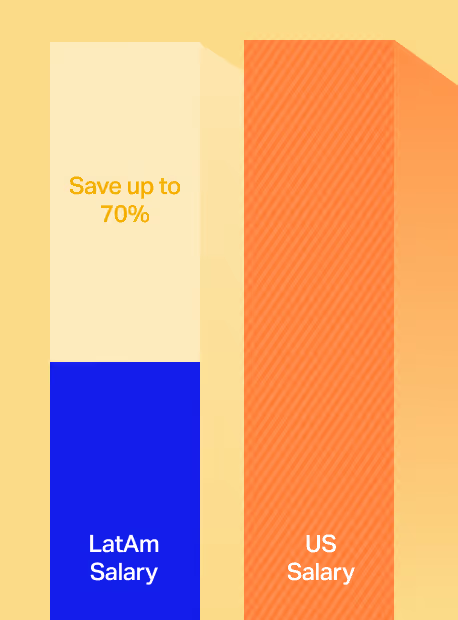
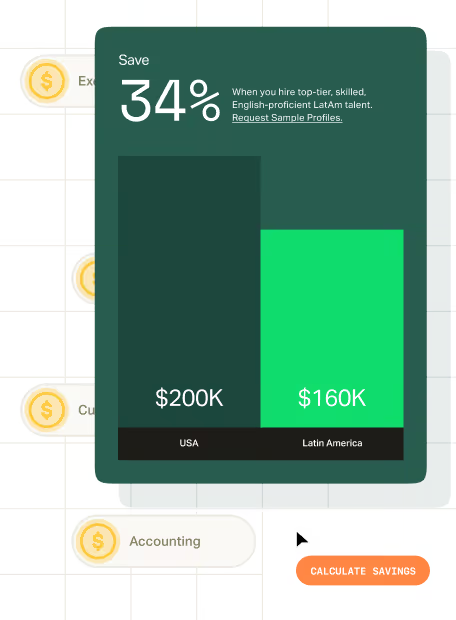
- Hiring a WordPress developer in Latin America costs $30K to $108K a year depending on seniority, against $80K to $189K for the equivalent US hire, and the working day overlaps yours instead of ending as yours begins.
Hiring an offshore WordPress development company is how most growing businesses solve a specific problem: they need real WordPress expertise, custom theme work, plugin development, site migrations, ongoing maintenance, and they need it without the cost and the months-long timeline of hiring that expertise domestically.
The right company brings developers who already know Advanced Custom Fields, WooCommerce, and WordPress’s quirks cold, so you skip the ramp-up a generalist hire would need.
To help you make the best choice for your business needs, I prepared this guide comparing 10 companies. I disclose what each one is good at, how they price the work, and what to check before you sign with any of them.
Hire With Near is one of the ten. Through our nearshore staffing and recruiting services, we help you hire highly qualified developers for 30–70% less than a US hire. That said, we’ll be straight about where a different company fits your project better than we do.
What Is Offshore WordPress Development?
Offshore WordPress development is the practice of building, customizing, or maintaining a WordPress site with developers based outside your own country, usually in a region where salaries sit well below US rates.
New grad and entry-level tech hiring has fallen roughly 65% at the largest tech companies, according to SignalFire’s 2026 State of Tech Talent Report, while senior and staff-level roles keep growing as a share of hiring. The experienced WordPress developer you want is exactly the profile the US market has priced up. That’s more of a budget problem than a scarcity problem, and it’s what sends most teams looking outside the US.
Offshoring can take one of two forms:
- Contracting a full-service development company to deliver a project.
- Hiring a dedicated WordPress developer of your own through a staffing partner.
A development company sells you an outcome: a scope, a team it assembles, a delivery date, and a handover. A staffing partner sells you a person: one developer who joins your team, learns your codebase, and reports to you.
Offshoring is an umbrella term for hiring outside your own country, regardless of where that country is or how much its working day overlaps yours. Nearshoring is the same idea with one variable changed: the developers sit in countries close to yours, so their working day overlaps yours. A developer in Colombia or Mexico is offshore because they aren’t in the US, and nearshore because they’re online when you are.
If the vocabulary still feels slippery, we break down the difference between offshoring and nearshoring in more detail.
What Types of Offshore WordPress Development Services Can You Hire For?
Offshore WordPress development services split into seven areas that require different skill sets. A company that builds fast custom themes isn’t automatically the one you want debugging a WooCommerce checkout or hardening a site that keeps getting compromised, because those are different specialties even inside the same platform.
That’s why “WordPress development company” on its own tells you almost nothing. Name your actual setup in the brief, including page builder, plugin stack, hosting, and integrations, and look for a company that can point to developers who’ve shipped that exact combination in production. A company strong in one of these areas isn’t automatically strong in the next one.
Here are the types of WordPress development services you can hire for, and the kind of expertise each one really takes.
Custom theme development
Custom themes give your WordPress site a look and feel tailored to your brand, and they’re where performance is won or lost.
This is front-end work. A front-end developer writes the templates, the block patterns, and the CSS; a web designer decides what they’re building toward.
Ask to see a theme they built from scratch rather than a page-builder site they configured.
Plugin development and customization
Plugins add specific features to your site, and building or modifying one properly means writing PHP against WordPress hooks rather than stacking more plugins on top.
That’s a job for a PHP developer who knows the WordPress plugin API, not a generalist. A well-built custom plugin replaces three off-the-shelf ones and takes the performance hit with them.
WooCommerce development
If you’re running an ecommerce business on WordPress, WooCommerce is a strong option, and it’s the area where a generic WordPress background shows up fastest.
Checkout flows, payment gateways, tax logic, and subscription handling are their own specialty. An ecommerce developer who has run a live store through a peak season is worth more here than a stronger generalist.
WordPress maintenance and support
Maintaining a WordPress site means regular core and plugin updates, security patching, backups, and troubleshooting when something breaks after an update.
Offshore teams can carry this ongoing post-launch work so your site stays secure and current without a member of your team owning it.
Ask what the response commitment is when the site goes down, not just what the monthly scope covers.
WordPress SEO optimization
Technical SEO on WordPress is mostly engineering: load times, Core Web Vitals, crawlable structure, schema, and clean internal linking. Offshore developers can handle that layer so your content has a fair chance of ranking.
It’s separate from content and keyword strategy, so be clear which one you’re buying.
Custom solutions and integrations
From CRM systems to email marketing tools and internal databases, most WordPress sites eventually need to talk to something else.
That’s full-stack developer territory: API work, authentication, error handling, and a plan for what happens when the third-party service changes its endpoints.
Multi-language and accessibility development
Offshore developers can make your website usable by a wider audience, including adding multi-language support for international customers and meeting accessibility standards such as the Web Content Accessibility Guidelines (WCAG).
Accessibility, in particular, is worth scoping explicitly. Retrofitting a finished site to meet WCAG costs more than building to it from the start.
Related reading: Top Companies to Hire an Offshore Web Developer
Why Should You Offshore Your WordPress Development?
Offshoring your WordPress development work gets you specialized WordPress expertise faster and at a lower cost to hire than building the same capability in-house.
WordPress is one of the world’s most popular content management systems (CMS), powering more than four out of ten websites worldwide. The platform is feature-rich enough that creating and maintaining a professional WordPress site often requires specialized expertise.
Hiring that expertise locally, though, can take months and cost more than you planned, delaying the launch or upgrade of your site.
Here are the main reasons US companies offshore their WordPress development instead.
Access to a global talent pool
Offshoring opens the door to a wide range of skilled developers from around the globe. By sourcing talent from the best countries for hiring remote software engineers and developers, you can fill qualified tech roles that your local market prices out of reach.
It also widens the kind of experience you can reach. A developer who has spent five years shipping WooCommerce stores or maintaining high-traffic publishing sites is easier to find across several markets than in one metro area.
Working with developers who build on WordPress every day can also give you insights into practices and platform changes that haven’t reached your local market yet.
Cost-effectiveness
Hiring WordPress developers in-house means paying benefits, payroll taxes, and other overhead on top of a salary that starts around $80K a year for a junior developer in the US, according to our salary data.
Offshoring changes the salary side of that equation, letting you connect with strong developers in regions with a lower cost of living while still getting high-quality work.
That difference is real money you can redirect to other priorities, like marketing or customer engagement. The full breakdown by seniority is further down, in the cost section.
Faster project completion
Offshore development companies often have ready-made teams of skilled developers and established workflows in place, so they can start within days of a signed scope rather than the weeks or months it takes to assemble a team yourself.
That speed has a limit worth knowing about. A company that can start on Monday is selling you bench capacity, so ask who specifically is on the team, what else they are assigned to, and what happens to your timeline if that person gets pulled onto another account.
An offshore team that works your hours
How much of your working day a team shares with you decides whether an offshore arrangement actually works day to day. A big gap can still work for well-specified, self-contained tickets you can hand off overnight, but it costs you on anything that needs a same-day decision or a live code review, which is why 30% of the US companies in Hire With Near’s research were switching away from offshore teams in regions like India and the Philippines over exactly this gap.
Nearshoring solves it directly. Latin American developers share most of a US working day, whichever time zone your team sits in, and most Latin American countries skip daylight saving, so that overlap barely moves through the year.
Our recruiters see it show up in how the work runs: fast to flag a blocker, comfortable with how US teams operate, and available for the live conversations a big offshore gap can’t offer.
Focus on core business functions
Handing your WordPress development to an offshore team lets your in-house team concentrate on what they do best: managing core business activities.
When plugin conflicts, the staging environment, and the Core Web Vitals score belong to someone else, your marketing lead stops being a part-time webmaster and goes back to campaigns.
That split of responsibility makes sure every part of the business gets real attention instead of whatever is left after the site breaks.
Rigorous quality assurance
When offshoring WordPress development, quality assurance decides whether your project meets expectations. If you’re working with a full-service development company, quality assurance is often built into their delivery process, including testing and issue resolution, to deliver a polished final product.
Alternatively, if you’re hiring individual developers through a top staffing agency, you benefit from their vetting process, which confirms candidates have the technical expertise and experience to deliver high-quality work.
A nearshore staff augmentation arrangement works the same way: the partner sources, screens, and handles payroll and compliance, while the developer joins your team and works to your standards and your review process.
What Should You Look for in an Offshore WordPress Development Company?
Judge an offshore WordPress development company on seven aspects. Three come first: verified third-party reviews with real volume, WordPress as a genuine practice area rather than a side offering, and a technical vetting process you can actually see into.
The other four matter once those check out: background and reference checks, honest overlap with your working day, whether the developer assigned to you is dedicated to your project alone, and pricing you can model before you sign.
Verified reviews with volume, not testimonials on their own site
A vendor’s own website will never carry a bad review. A third-party platform will. Every company I selected for the list below holds at least a 4.5 out of 5 across 50 or more client reviews on G2 or Clutch.
Volume matters as much as the score. A 5.0 across four reviews tells you almost nothing, while a 4.8 across 200 tells you the company survives contact with difficult clients.
Then, go one step further and ask for a reference call with a client whose site looks like yours, in your industry, at your scale. A reference who runs a WooCommerce store on a $40K budget is worth more to you than a logo from an enterprise program.
WordPress as a core practice, not one line on a services page
Plenty of development companies list WordPress alongside thirty other services. That’s fine if you need WordPress and a mobile app from one vendor, but a problem if WordPress is the whole job.
Look at the case studies rather than the services menu. If the WordPress work shown is three brochure sites and the rest of the portfolio is Salesforce implementations, your custom Gutenberg block is going to be somebody’s first attempt.
A technical vetting process you can see into
Ask any vendor to walk you through exactly what happens between your brief and the first profile you see. A real process has named steps: an intake on your actual stack and scope, sourcing, a technical assessment, an English assessment, reference and background checks, and a shortlist that comes with a written rationale for each candidate.
Natasha Tarapow, Recruitment Consultant at Hire With Near, describes what her team listens for in that assessment:
We always ask candidates to tell us about a project they’ve worked on, not just that they use this language and that one, but what their role was and what they actually did. It’s important that they can explain their work to someone who isn’t a developer. If they can do that, that tells me a lot.
— Natasha Tarapow, Recruitment Consultant, Hire With Near
The question that exposes a weak process: how many candidates did you screen to produce this shortlist, and what did the ones you rejected get rejected for? A vendor with a real filter can answer that in a sentence.
Real background and reference checks
Find out which companies run a background check, what it covers, and whether it costs extra before you onboard anyone. This one sounds like paperwork until it isn’t.
The operations lead at a mid-market digital agency that builds and maintains WordPress sites for small businesses described what happens when nobody owns it:
I onboarded somebody and then two days later, we see them have some serious legal issues. I was told I had to pay an extra $150 per candidate for a background check, which makes no sense. I just want a long-term partner, so I don’t have to go through this due diligence process again and have that kind of embarrassing situation come up.
Honest overlap with your working day
Ask how many hours of your business day the developers assigned to you will be online, and get it written in the proposal. Some companies with delivery teams far from the US will shift hours for a client, and some won’t.
If your WordPress work is scoped, documented, and handed over in batches, a small overlap is survivable. If it’s ongoing site work with a marketing team filing requests all day, you need most of your day covered.
A developer dedicated to you, or an honest answer about the split
A full-service company necessarily allocates people across accounts. That’s fine for scoped project work, but it can be a problem for ongoing ownership of a live site. A dedicated hire works on your site and nobody else’s.
So ask it directly: will this specific person be dedicated to us, and if not, what percentage of their week do we get?
A developer split across four accounts isn’t slower because of where they sit. They’re slower because your ticket is fourth in the queue, and goodwill doesn’t move it up.
Pricing you can model before you sign
Get to an all-in annual number before you commit, not an hourly rate. For a development company, that means the project fee or retainer, what it includes (project management, QA, design), and what triggers a change order. For a staffing partner, it means the salary you’ll pay the developer plus the partner’s fee, stated clearly.
Ask for the replacement terms at the same time: how long the window runs, whether it’s a replacement or a refund, and what counts as the hire not working out. A company that won’t put that in writing before a signature won’t put it in writing after one either.
What Are the Top 10 Companies for Offshoring WordPress Development in 2026?
The top 10 companies for offshoring WordPress development are GetDevDone, WPWeb Infotech, Hire With Near, Codup, Capital Numbers, Aalpha Information Systems, xfive, Konstant Infosolutions, Ambiscale, and Tridhya Tech.
Nine are development companies you hand a project to; Hire With Near is the exception, a staffing partner that helps you hire a WordPress developer of your own instead. Between them, they cover white-label agency work, WooCommerce and e-commerce builds, enterprise engineering programs, and performance-critical sites.
Two filters decided who made this list before any real comparison started:
- WordPress had to be a genuine specialty, not one line buried in a services page listing thirty other technologies.
- And the reviews behind a company had to actually mean something: at least 50 client reviews and a score of 4.5 or higher, on a review platform (like G2, ClearlyRated, Clutch, or Trustpilot) that verifies who’s leaving them.
Once a company cleared both filters, the real work started: how they structure an engagement, what they’re willing to publish about pricing, and what their own case studies actually show them building, not what their homepage claims.
The companies below are in no particular order, and the list implies no ranking. There’s no single best option for everyone; the right fit depends on your scope, budget, timeline, and how much of the work you want to manage yourself.
Here is how the ten compare at a glance:
1. GetDevDone

Website: getdevdone.com
Headquarters: San Francisco, United States.
Rating: 5.0/5 on Clutch (80+ reviews) as of September 2026.
Services: White-label WordPress development, custom themes and plugins, front-end development, ecommerce builds, design-to-code, QA, ongoing support.
Focus Regions: United States and Europe.
GetDevDone earned a spot on this offshore WordPress development companies list for a review record almost nobody holds at volume: a perfect 5.0 across 80 verified Clutch reviews.
The company has been building websites since 2005 and works almost entirely white-label, delivering under a digital agency’s brand rather than dealing with the end client directly.
It reports working with 15,000+ agencies across the United States and Europe and runs a team of 400+ engineers, which is why it shows up on so many agency shortlists.
Key features:
- Built for agency workflows: The team works inside your process, your stack, and your project management tools, with defined ownership and documented handoffs of repositories and access.
- Fast quoting: GetDevDone advertises a 24-hour turnaround from first contact to an active project, which matters when a client deadline lands on your desk mid-sprint.
- Coverage beyond WordPress: Shopify, BigCommerce, Magento, and front-end work in React, Vue, and Angular sit alongside the WordPress practice, so one partner can serve a mixed client roster.
Best for: Digital agencies that need WordPress capacity delivered under their own brand.
Client perspective: “Web development houses usually only specialize in one type of platform, but this team is very diversely skilled.” — VP of Marketing, Komodor, via Clutch
Limitations: The white-label model is built around agencies. A direct client with one site and no internal project manager may be a less natural fit, and pricing is quoted per project rather than published.
Pricing: Not publicly listed. Clutch lists an hourly rate of $25 to $49 and a minimum project size of $1,000.
2. WPWeb Infotech
Website: wpwebinfotech.com
Headquarters: Ahmedabad, India.
Rating: 5.0/5 on Clutch (85+ reviews) as of September 2026.
Services: Custom WordPress development, theme development, plugin development, WooCommerce, migrations, maintenance, UI/UX, QA.
Focus Regions: United States, United Kingdom, Canada, Australia, Europe, and the Middle East.
I included WPWeb Infotech for the combination of a WordPress-first practice and a 5.0 rating across 85 verified Clutch reviews.
WordPress isn’t one line item among thirty here: custom builds, themes, plugins, and migrations are the core of what the company sells.
It has been running for more than ten years, employs 100+ people out of Ahmedabad, and keeps offices in the United States, Canada, the United Kingdom, Australia, and the Netherlands to cover client time zones.
Key features:
- Three engagement models: Fixed price for a defined scope, hourly for evolving requirements, or a dedicated developer assigned only to your project.
- Migration and rescue work: The company handles moves onto WordPress and off aging builds, which is often what a stalled site needs instead of a rebuild.
- Retention on record: WPWeb Infotech reports a 97% client retention rate across 200+ clients, a claim worth asking it to evidence on a call.
Best for: Small and mid-market companies that want custom WordPress work at the lower end of the rate range.
Client perspective: “What has impressed us most is the consistency of both their work quality and effort.” — Director, digital services company, via Clutch
Limitations: The delivery team sits in India, so a US company gets limited live overlap unless the developers shift hours. Pricing isn’t published on the site.
Pricing: Not publicly listed. Clutch lists an hourly rate under $25.
3. Hire With Near

Website: hirewithnear.com
Headquarters: United States, with talent across Latin America.
Rating: 4.9/5 on G2 (155+ reviews) as of September 2026.
Services: Full-service nearshore staffing and recruiting, RPO, staff augmentation, executive search.
Focus Regions: Latin America.
Hire With Near is the only company on this list that isn’t a development agency. We’re a full-service staffing and recruiting agency that helps US companies hire remote talent in Latin America across all industries and departments, including WordPress and web development roles.
We handle sourcing, vetting, candidate presentation, payroll, and compliance, having helped more than 950 companies hire talent in Latin America. Our placements stay an average of three years, and we ranked No. 118 on the 2026 Inc. 5000.
When you buy a project, the developers who build your site are usually shared across accounts and move on when the engagement closes. The developers we place join your team during working hours that overlap yours, learn your codebase, and are still there the next time something breaks at 4 p.m. on a Friday.
ParkMobile’s back-end and platform work had run through third-party agency developers for years. Mariana Lepassar, ParkMobile’s Head of Engineering for Mobile Payments and Billing, was direct about what she needed instead: “We don’t want to hire junior developers. We really need senior engineers who are able to think along with the product strategy.”
Hire With Near placed 9 senior engineers across platform, backend, and iOS in Colombia, a market ParkMobile had never recruited in before, saving the company $1,066,085 a year against US rates, a 73% reduction.
Hear Akshay Gokarnakar, ParkMobile’s TA Lead, describe the collaboration in his own words in the video below:
Key features:
- Elite talent for WordPress and web development roles: We place WordPress, PHP, front-end, and full-stack developers. Our development recruiters screen past the stack list, asking candidates to walk through a project they built and explain it to someone who is not a developer.
- Quality-first approach: We fill 97% of the roles we take on and hold a client satisfaction score of 9.1, because we screen for drive, readiness, and fit rather than the skill list alone.
- Speed, plus a 180-day replacement guarantee: First candidates in 3 to 5 days with video introductions, most hires close in under 3 weeks, and every placement carries a 180-day replacement guarantee, double the industry standard.
Best for: Companies that want a dedicated WordPress developer on their own team and their own working hours, rather than a project delivered by a vendor.
Limitations: We don’t deliver projects. If you want a finished website handed to you on a fixed bid, a development company on this list is the better call. We also recruit in Latin America only.
Pricing: Two models: a one-time recruiting fee for a direct hire, or a monthly staffing fee that covers payroll and compliance. You set the salary and pay nothing until you hire.
4. Codup

Website: codup.co
Headquarters: Houston, United States.
Rating: 4.9/5 on Clutch (75+ reviews) as of September 2026.
Services: WordPress theme and plugin development, custom WordPress web apps, multisite networks, third-party integrations, migrations, ecommerce.
Focus Regions: United States, United Kingdom, and the Middle East.
What stood out about Codup is how much of its WordPress work is application work rather than marketing sites: multisite networks, custom web apps built on WordPress, and integrations with the systems a business already runs on.
The company has spent more than 11 years on that kind of build, holds a 4.9 across 75 verified Clutch reviews, and lists clients including Steelcase, GlobeMed, and Travelife.
Offices in Houston, Irvine, Cambridge, Dubai, and Karachi give it working-hours coverage on both sides of the Atlantic.
Key features:
- Four ways to engage: Fixed price, time and materials, a monthly retainer, or staff augmentation where its developers join your team.
- Ecommerce depth beyond WooCommerce: Shopify, BigCommerce, and Shopware sit alongside the WordPress practice, which helps if a replatform decision is still open.
- Integration-heavy builds: Third-party integrations and multisite are core services rather than add-ons, which matters when your site has to talk to a CRM or an ERP.
Best for: Businesses whose WordPress site behaves more like an application than a brochure.
Client perspective: “The Codup team has been the best partner our company has had.” — Director of Digital, Lysse New York, via Clutch
Limitations: Clutch lists a $10,000 minimum project size, so small one-off jobs aren’t the target. Rates also sit above the India-based companies on this list.
Pricing: Not publicly listed. Clutch lists an hourly rate of $50 to $99 and a $10,000 minimum project size.
5. Capital Numbers
Website: capitalnumbers.com
Headquarters: Kolkata, India.
Rating: 4.8/5 on Clutch (235+ reviews) as of September 2026.
Services: Custom software and web development, WordPress and CMS builds, ecommerce, cloud engineering, AI and machine learning, QA, UI/UX, data engineering, staff augmentation.
Focus Regions: United States, United Kingdom, Europe, Australia, and the Middle East.
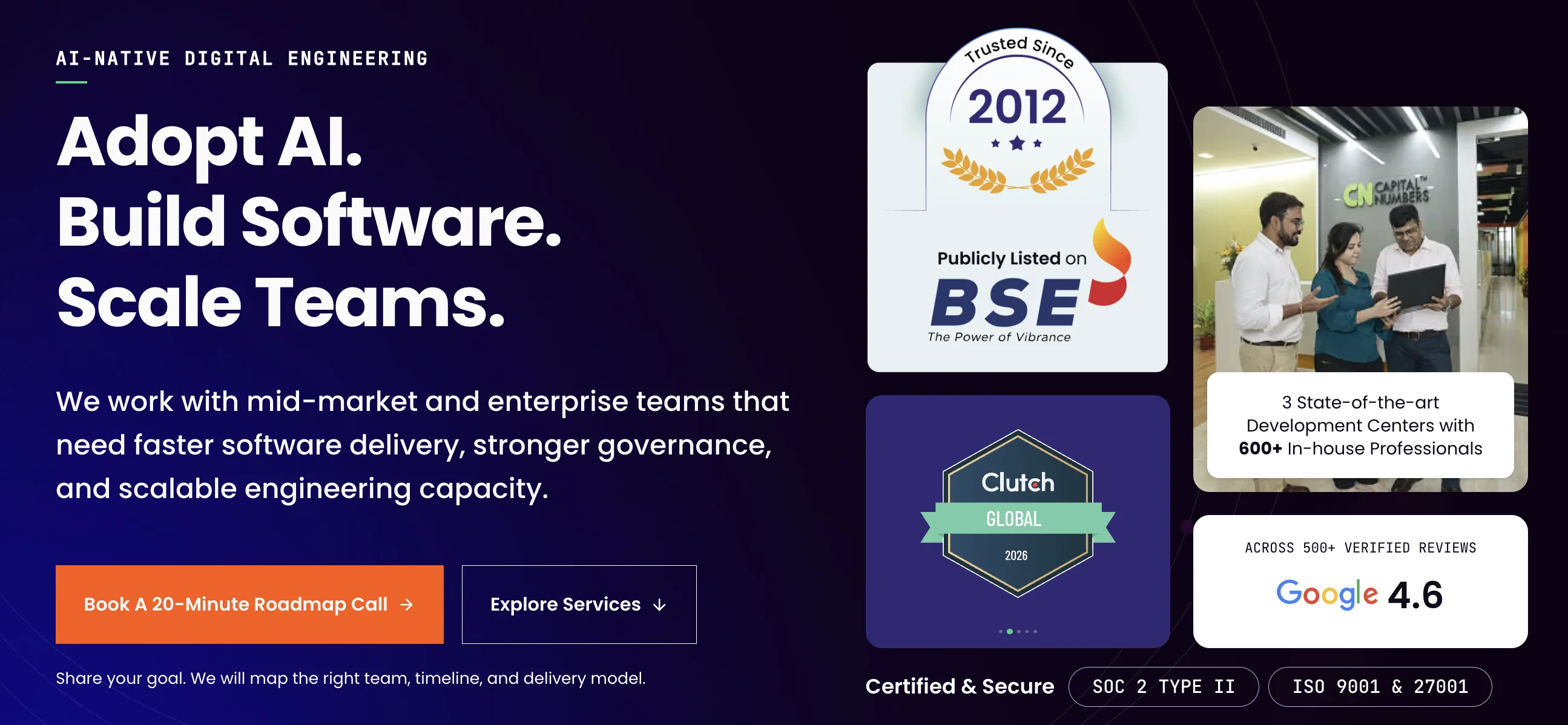
Capital Numbers is one of the offshore WordPress development companies chosen for this list because of review volume most firms never reach: more than 235 verified Clutch reviews at 4.8.
With 600+ in-house professionals it is the largest company on this list, and its client roster includes Consumer Reports, BASF, Savills, and Veolia.
WordPress sits inside a much wider engineering practice that runs from cloud and data work through to AI builds, so it suits a buyer whose website is one piece of a bigger technical program rather than the whole job.
Key features:
- Staff augmentation as a first-class model: Managed teams, dedicated developers, and fixed-cost projects are all on offer, so the engagement can change shape as your scope does.
- Security and compliance certifications: SOC 2 Type II, ISO 9001, and ISO 27001, which is often the gate an enterprise procurement team cares about most.
- Published budget bands: The company frames proposals in $10K to $50K, $50K to $100K, and $100K+ ranges, so you can tell early whether you are in its market.
Best for: Mid-market and enterprise buyers who need WordPress work alongside cloud, data, or AI engineering.
Client perspective: “They were very transparent and highly adjustable to our needs.” — Salesforce Product Owner, Veolia Middle East, via Clutch
Limitations: A generalist engineering firm rather than a WordPress specialist. The $10,000 minimum and enterprise client base mean a single-site project may sit low in the queue.
Pricing: Not publicly listed. Clutch lists an hourly rate of $25 to $49 and a $10,000 minimum project size.
6. Aalpha Information Systems
Website: aalpha.net
Headquarters: Bengaluru, India.
Rating: 4.9/5 on Clutch (215+ reviews) as of September 2026.
Services: WordPress and CMS development, custom web and mobile development, ecommerce, SaaS builds, AI and machine learning, IT consulting, software maintenance.
Focus Regions: United States, United Kingdom, Europe, and the Middle East.
The reason Aalpha Information Systems made this list is the depth of its track record: 18 years in business, 7,000+ completed projects across 45+ countries, and more than 215 verified Clutch reviews averaging 4.9. That’s one of the longest continuous records in this category.
WordPress sits in its CMS practice next to Strapi, and the company takes work from $1,000 upward, which makes it one of the few options here for a small, well-defined job rather than a full program of work.
Key features:
- Low entry point: A $1,000 minimum project size and rates starting around $15 an hour put small fixes and single-page builds within reach.
- Maintenance and system audits: Software maintenance and audits are named services, which helps if you have inherited a site nobody has updated in two years.
- 250+ staff across seven offices: Enough bench in Bengaluru, Mumbai, New Delhi, Hubballi, London, New York, and Dubai to absorb a scope change without pausing.
Best for: Companies with a modest budget that need a specific WordPress job done properly.
Client perspective: “Their team has consistently taken the time to understand those practical needs and suggest workable solutions.” — General Manager, crowdfunding agency, via Clutch
Limitations: A broad services menu rather than a WordPress-only shop. The main delivery team is in India, so live overlap with a US working day is limited.
Pricing: Not publicly listed. Clutch lists rates under $25 an hour and a $1,000 minimum project size.
7. xfive
Website: xfive.co
Headquarters: Kraków, Poland.
Rating: 4.9/5 on Clutch (60+ reviews) as of September 2026.
Services: Front-end and WordPress development, Gutenberg block development, product strategy and discovery, UX/UI design, maintenance, AI integration.
Focus Regions: United States, Europe, and Australia.
xfive caught my attention for its front-end pedigree. The company launched in 2005 in Melbourne as XHTMLized, a side project turning designs into clean markup, and has since worked with X (formerly Twitter), eBay, and Fox.
It holds a 4.9 across 60 verified Clutch reviews and lists a Gutenberg rebuild of the high-traffic Printify site among its recent work.
WordPress here means custom blocks and performance engineering rather than a page-builder theme with a dozen plugins bolted on.
Key features:
- Gutenberg and block-editor work: Custom block development so editorial and marketing teams can publish without pulling a developer into every change.
- European delivery with US and Australian offices: Engineering runs out of Kraków with offices in San Francisco and Hawthorn, which gives a US client live overlap through the US morning.
- Audit as a starting point: The company offers an audit as an entry engagement, a low-commitment way to test the working relationship before a build.
Best for: High-traffic, performance-sensitive WordPress sites where front-end quality is the priority.
Client perspective: “They’re not a conveyor belt-style web development company. They take the time to truly understand your business.” — Marketing Communications Manager, Shamrock Technologies, via Clutch
Limitations: Clutch lists a $25,000 minimum project size and rates of $50 to $99 an hour, the top of this list. A small business with a $5,000 site is out of range.
Pricing: Not publicly listed. Clutch lists an hourly rate of $50 to $99 and a $25,000 minimum project size.
8. Konstant Infosolutions
Website: konstantinfo.com
Headquarters: Jaipur, India.
Rating: 4.9/5 on Clutch (170+ reviews) as of September 2026.
Services: Web and WordPress development, mobile app development (iOS, Android, React Native, Flutter), AI development, cloud, IoT, AR/VR, offshore staffing and maintenance.
Focus Regions: United States, United Kingdom, Europe, the Middle East, and India.
I chose Konstant Infosolutions for its longevity and review consistency: 23 years in business and 173 verified Clutch reviews averaging 4.9, which is uncommon at that volume.
The company employs 180+ technical staff and lists Del Monte, Volkswagen, and the United Nations among its clients.
Its WordPress work usually arrives as part of a wider build, so it fits a company that needs a site and an app from the same team rather than a WordPress specialist alone.
Key features:
- Web and mobile from one team: iOS, Android, React Native, and Flutter development sit alongside the web practice, which removes a handoff when your site and app share a backend.
- Dedicated staffing and maintenance: Offshore staffing and ongoing maintenance are sold as standing services, not just project work.
- $5,000 entry point: The Clutch minimum is low enough for a defined WordPress build without committing to a full program.
Best for: Companies that need WordPress and mobile app work from a single vendor.
Client perspective: “The project was delivered on time.” — Director, Nix Order, via Clutch
Limitations: WordPress is one practice area among many rather than the core business. Delivery is India-based, so real-time collaboration with a US team is limited.
Pricing: Not publicly listed. Clutch lists an hourly rate of $25 to $49 and a $5,000 minimum project size.
9. ambiscale
Website: ambiscale.com
Headquarters: Wrocław, Poland.
Rating: 4.9/5 on Clutch (50+ reviews) as of September 2026.
Services: WordPress and WooCommerce development, custom development (Laravel, Symfony, React, Vue, Go), web performance, SEO, accessibility, DevOps and security, maintenance and migrations.
Focus Regions: Europe and North America.
I chose ambiscale for this list because of its strength on a specific kind of work: WordPress and WooCommerce builds where performance, accessibility, and security are the actual brief.
The company has been running since 2015 out of Wrocław, holds a 4.9 across 54 verified Clutch reviews, and counts Fujitsu, Procter & Gamble, and the retail chains Żabka and Biedronka among its clients.
It publishes a 95% average Google PageSpeed score across its work and builds to WCAG 2.1 AA.
Key features:
- Accessibility as a named practice: WCAG 2.1 AA compliance is a service line, which matters when you have a legal or procurement requirement to meet.
- Custom code over plugin stacking: Clients describe lightweight custom solutions in place of plugin-heavy builds, which is where most WordPress performance problems begin.
- Infrastructure and security: DevOps, cloud security, and web application security round out the offer for teams with no internal ops function.
Best for: WooCommerce stores and content sites where speed, accessibility, and security are non-negotiable.
Client perspective: “They don’t just implement what we request; they actively suggest improvements and challenge our assumptions.” — Content Manager, Fundacja Katarynka, via Clutch
Limitations: The smallest team here, between 10 to 49 people, so a large parallel program would stretch it. Its client base skews European rather than US.
Pricing: Not publicly listed. Clutch lists an hourly rate of $50 to $99 and a $5,000 minimum project size.
10. Tridhya Tech
Website: tridhyatech.com
Headquarters: Ahmedabad, India.
Rating: 5.0/5 on Clutch (100+ reviews) as of September 2026.
Services: WordPress, WooCommerce, Magento, Shopify, BigCommerce, Drupal and Joomla development, B2B and B2C portals, mobile apps, cloud, data engineering, automation.
Focus Regions: United States, United Kingdom, Australia, Canada, the Middle East, and India.
I added Tridhya Tech to this list for its ecommerce range around its WordPress practice.
A perfect 5.0 across 104 verified Clutch reviews is one of the strongest review records here, and the company is publicly listed on India’s NSE Emerge exchange, which brings a level of financial disclosure most vendors this size never offer.
It reports work with 350+ companies, including PUMA, Mahindra, and Tech Mahindra, across retail, logistics, insurance, and manufacturing.
Key features:
- Platform coverage across CMS and ecommerce: WooCommerce, Magento, Shopify, and BigCommerce alongside WordPress, which helps when a replatform decision is still open.
- Portal and B2B builds: B2B and B2C portal work for retail, logistics, and manufacturing clients, well beyond standard marketing sites.
- Low minimum, broad bench: A $5,000 Clutch minimum and rates under $25 an hour keep smaller scopes viable.
Best for: Ecommerce businesses weighing WooCommerce against another platform.
Client perspective: “Their ability to adapt and get up to speed quickly was impressive.” — Owner, All Tech Solutions, via Clutch
Limitations: Founded in 2018, it’s the youngest company on this list. Delivery is India-based, so overlap with a US working day is limited unless the team shifts hours.
Pricing: Not publicly listed. Clutch lists an hourly rate under $25 and a $5,000 minimum project size.
Want the version of this list built around teams in your own time zone? Our roundup of nearshore staffing companies covers the firms that place talent in countries close to the US.
How Much Does It Cost to Hire Offshore WordPress Developers?
Hiring a WordPress developer in Latin America costs $30K to $108K a year depending on seniority, against $80K to $189K for the equivalent US hire, according to our salary data.
Here’s what a WordPress developer costs at each level compared with an equivalent US hire, drawn from Hire With Near’s salary benchmarks:
For the most up-to-date figures, see Hire With Near’s US vs Latin America Salary Guide.
What moves a candidate up a band is specific: production WooCommerce work, custom plugin development written against the WordPress APIs, and real performance and security experience. Those are the three markers to price for, and they’re what separates a developer who can maintain your site from one who can rebuild it.
If you want the wider view, our IT roles salary guide for the US versus Latin America covers what WordPress and other IT roles cost in the region.
Hire With Near’s 2026 State of LatAm Hiring Report puts the annual savings on a software engineering hire in Latin America at $23,000 to $85,000, or 28–59% versus an equivalent US hire. That is the outcome across real placements rather than a list price.
Salary is only part of the number, though:
- A full-service development company bills either a fixed project fee or a monthly retainer, and that figure usually bundles project management, QA, and design alongside development hours.
- Hiring a dedicated developer through a staffing partner means the salary you agree with the developer plus the partner’s fee, charged either once on placement or monthly for an ongoing staffing arrangement.
Before comparing quotes, ask any vendor what the all-in monthly or annual number is, what is included in it, and what triggers an extra charge.
For a broader benchmark across regions, our breakdown of how much offshore developers cost sets the WordPress figures in context.
{{salary-guide-cta}}
Final Thoughts
The best offshore WordPress development company for your business depends on the answer to one question: do you want a finished project delivered, or a developer of your own? Nine of these companies build the work and hand it over. Hire With Near puts a person on your team who stays.
If the second is what you need, we recruit that developer in Latin America, on working hours that overlap yours. Our recruiters cover WordPress developers, PHP, front-end, and full-stack roles, and we also run executive search in Latin America when the hire is a VP of Engineering rather than an individual contributor.
Before making a final decision, select two or three companies for a 20-minute conversation. You can cover what the role costs, who’s available now, and how quickly you could have someone working.
Book a free consultation call today with Hire With Near, and our team will give you straight answers, including the cases where another company on this list is the better fit.
{{consultation}}
Frequently Asked Questions
What’s the difference between paying monthly for a staffed developer and paying a one-time fee to hire them directly?
A monthly staffing fee keeps the developer on the partner’s payroll and keeps your exit costs low, while a one-time placement fee puts the person on your own payroll and costs less over a multi-year horizon.
Three variables decide it: how long the work lasts, how certain you are that you need the role permanently, and whether you want to run international payroll yourself.
Defined project or an unproven need? Go monthly. A role you know you’ll still have in two years? Pay once.
How do offshore WordPress development companies vet developers technically?
Strong vetting uses three concrete methods: a practical task on a real WordPress problem, a review of code or a repository the candidate wrote themselves, and a live walkthrough of a past build.
Portfolios and resumes are the weakest signal, especially now that AI-written CVs are everywhere. Our recruiters put weight on asking a candidate to explain a project to someone who isn’t a developer, because that exposes real ownership and communication in the same answer.
Ask any vendor which of those three they run, and how many candidates they rejected to build your shortlist.
How should I test a WordPress developer’s English before I hire?
English level varies widely by individual and by vendor, so test it rather than trust a rating on a profile. Insist on an unscripted video call with the developer who would do the work, not an account manager, and ask them to explain a past technical decision in plain language. Written English matters as much as spoken for WordPress work, since most of it is tickets, documentation, and client-facing handoffs.
Our roundup of the questions tech leaders ask before hiring developers in Latin America covers what else to probe on that first call.
What happens if the developer doesn’t work out?
Reputable development companies and staffing partners both offer a replacement window, but the terms vary enough that you need them in writing before you sign.
Pin down three things: how long the window runs, whether you get a replacement or a refund, and what counts as the hire not working out.
At Hire With Near, every placement carries a 180-day replacement guarantee, double the industry standard, and if a hire doesn’t work out in the first six months, we find a replacement at no additional cost.
Which countries should I hire WordPress developers from?
The right country depends on whether you’re optimizing for overlap with your working day or for the lowest possible rate. India, Pakistan, and the Philippines offer the lowest rates and a deep WordPress bench, with the tradeoff that their working day sits largely outside yours. Poland and Ukraine bring strong front-end and performance engineering at mid-range rates.
Latin America gives you WordPress, PHP, and WooCommerce depth plus a working day that overlaps most of yours, wherever you are in the US.
Our guide to the best countries to hire remote software engineers and developers breaks the tradeoff down country by country.
How long does it take to get an offshore WordPress developer working?
An established development company with bench capacity can often start a scoped project within days, while hiring a dedicated developer typically takes a few weeks end to end.
A digital product consultancy hired a senior PHP developer through Hire With Near in three weeks, a realistic benchmark for what a direct hire timeline looks like when it’s done right.
Two things stretch that timeline more than anything else: a vague brief, and a slow internal interview loop. Both are on your side of the table, so tighten them first.
What other developer roles can I hire in Latin America?
Beyond WordPress developers, US companies regularly hire nearshore website developers, remote PHP developers, ecommerce developers based in Latin America, and nearshore front-end developers.
These roles cover most of what a WordPress site needs over its life, from the theme build to the checkout to the integrations behind it.
Latin American talent in these roles brings the same technical depth as US-based professionals, at 30–70% lower salary cost and with a working day that overlaps yours.