%203.svg)
Key Takeaways
- An outsourced CFO offers flexible financial leadership at a lower upfront cost; a full-time in-house CFO provides dedicated strategic leadership.
- Hiring one from Latin America makes the in-house option affordable for companies that previously couldn't justify the US price tag.
- Full-time CFOs based in Latin America typically earn less than a US-based equivalent and are accessible to companies that outsource for budget reasons.
- Hire With Near places CFOs and senior finance leaders from Latin America in under 21 days, with Big Four backgrounds, US GAAP and IFRS expertise, and strong English skills.
Whether you're a $15M established company or a high-growth startup preparing for your first IPO, you know you need a CFO. But if the budget is tight and forecasts seem messy, the $250,000 average annual salary may not be something you can absorb.
If you are considering outsourcing, there is another choice: you can hire a full-time CFO in Latin America who works in your time zone, speaks strong English, carries Big Four credentials, and costs a fraction of what a US equivalent would.
An in-house CFO, especially when hired from Latin America, is more than a strategic consideration; it can also be the more compelling financial choice.
One hiring manager recently put it plainly:
"Our financial budget constraints around the position and what we think the position will be able to do for us means it's kind of tailor-made for hiring in LatAm."
This article walks through the real trade-offs between outsourced and in-house CFO models, and explains when the Latin America option changes the decision entirely.
If you're ready to explore hiring finance and accounting professionals in Latin America, the cost is more accessible than most companies expect.
What a CFO Does for Your Business
Every company reaches a point where "I'll figure out the finances myself" stops working, and they need a true expert with deep financial know-how to lead the way.
A chief financial officer takes over the financial architecture of the business, ensuring you meet board, stakeholder, and regulatory demands as you continue to grow.
Core CFO responsibilities span several functions, including:
Financial reporting
- Preparing accurate and timely financial statements (balance sheet, income statement, cash flow statement)
- Analyzing financial data to identify trends and areas for improvement
- Providing insightful reports to management, investors, and the board
Budgeting
- Developing comprehensive budgets aligned with your company's goals
- Monitoring budget performance and identifying variances
- Implementing cost-saving measures and adjusting spending across departments
Cash flow management and monitoring
- Tracking cash inflows and outflows to ensure liquidity
- Forecasting future cash flow needs
- Implementing strategies to improve cash flow and working capital management
Cost evaluation
- Analyzing cost structures to identify inefficiencies
- Implementing cost-reduction initiatives
- Negotiating with vendors and suppliers to secure better terms
Legal liaison
- Collaborating with legal counsel on financial matters
- Making sure the business stays compliant with financial regulations and reporting requirements
- Providing financial expertise during contract negotiations
Risk control
- Identifying and assessing financial risks
- Developing risk mitigation strategies
- Implementing internal controls to safeguard assets and prevent fraud
HR monitoring
- Collaborating with HR on compensation and benefits strategies
- Providing financial analysis for staffing decisions
- Making sure the business stays compliant with labor laws and regulations
Customer contract review
- Analyzing customer contracts to assess financial implications
- Negotiating favorable terms and conditions
- Making sure contracts align with company policies and financial goals
Fundraising and investor relations
- Developing fundraising strategies and identifying potential investors
- Preparing financial projections and pitch decks
- Negotiating funding terms and managing investor relations
These functions must happen whether your CFO sits in a US office or one in Buenos Aires. But each location does come with its own considerations around the structure of the relationship and the cost.
Why Do US Companies Outsource Their CFO Function?
The number one reason companies turn to outsourced CFO services is to save money compared to hiring a full-time CFO.
A full-time CFO in the US costs between $246,000 and $455,000 per year, and that's before benefits, bonuses, or equity. For most small and midmarket companies, that number is considerably more than what they can afford.
One finance manager at a PE-backed company described the bind clearly:
I'm just finding that I need more skill sets than I'm being given the budget to fill.
That's the core tension. Senior finance leadership is expensive in the US, and the gap between what the business needs and what the budget allows forces a compromise.
But there are other reasons for outsourcing or hiring a fractional CFO.
Short-term projects
Audits, due diligence processes, system implementations, or one-time fundraising rounds don't necessarily require permanent full-time leadership. You can bring in a fractional CFO for a defined scope.
Need for specialized expertise
Some financial situations require narrow specialization that isn't practical to keep on staff full-time. M&A advisory, complex restructuring, or regulatory compliance work in niche industries can fit this category.
Seasonal or project-based fluctuations
If your business has variable financial workloads, you can scale CFO involvement up or down. That flexibility is harder to replicate with a full-time hire.
Transition periods
During leadership changes or M&A events, a fractional CFO can provide stability while the company figures out a permanent structure. If you need to find a freelance CFO for a bridge period or want to think through the retained search side of a permanent hire, resources like top CFO executive search firms can help.
If your situation fits one of the above, outsourcing may be the right model. But if what you actually need is a full-time financial leader who knows your business deeply, is always available, and can grow with you, you're in a different conversation. The question then is whether in-house is actually unaffordable, or just unaffordable at US rates. (And we’ll discuss the options available to you later in this article.)
Why Having an In-House CFO Is Valuable
There are advantages to having your own dedicated CFO, and many companies that go this route never go back. The arrangement outperforms fractional support in ways that can be felt across the organization (not just in the finance department).
Deep company knowledge
An in-house CFO builds a thorough understanding of your unique business's financials, culture, and long-term goals over time. That accumulated context means faster decisions, better risk identification, and financial strategies that reflect how your company actually works. The CFO isn’t limited to off-the-shelf playbooks designed for the average client or your competitor.
Immediate availability
During a cash flow crisis, a fundraising sprint, or a board meeting, you want a CFO who picks up the phone. Fractional arrangements often come with scoped availability, such as a set number of hours per week or month.
That works fine in calm periods, but it's limiting when you need someone at the table right now. During some of the most intense periods, it’s important to have your CFO at your side and committed to seeing things through.
Strategic leadership
A full-time CFO can sit in on executive meetings, shape business strategy in real time, and build relationships with the finance team, the board, and external partners. The consistent presence matters and can even help you show up better to your partners and investors.
While a part-time CFO is a vendor who may not identify as part of your core team, a full-time CFO is a leader dedicated to your cause.
Tailored financial solutions
Generic financial guidance may work for a time, but as you scale your company and face new market or regulatory challenges, you need someone who knows you well. With someone inside your business every day, they develop solutions that fit your specific situation. And that specificity compounds over time, so you get better value and more tailored guidance as your CFO does their work.
Stronger relationships
A full-time CFO builds relationships with your banking partners, auditors, investors, and internal team. Those relationships don't scale down well when the CFO is shared across several clients. In fact, your stakeholders may not understand or even appreciate a fractional/part-time arrangement; you show you’re all-in when you invest in a full-time CFO.
Each of these benefits drives companies toward wanting an in-house CFO in the first place. So, the barrier hasn't usually been the desire. What keeps them from the commitment is the price, and that changes significantly when you look at the Latin American market.
How Hiring a Full-Time CFO Based in Latin America Makes In-House Financially Possible
The salary gap between a US-based CFO and a CFO based in Latin America is substantial, but it has nothing to do with quality. In reality, the expertise of candidates in the LatAm market has surprised most of the companies we've helped make this hire.
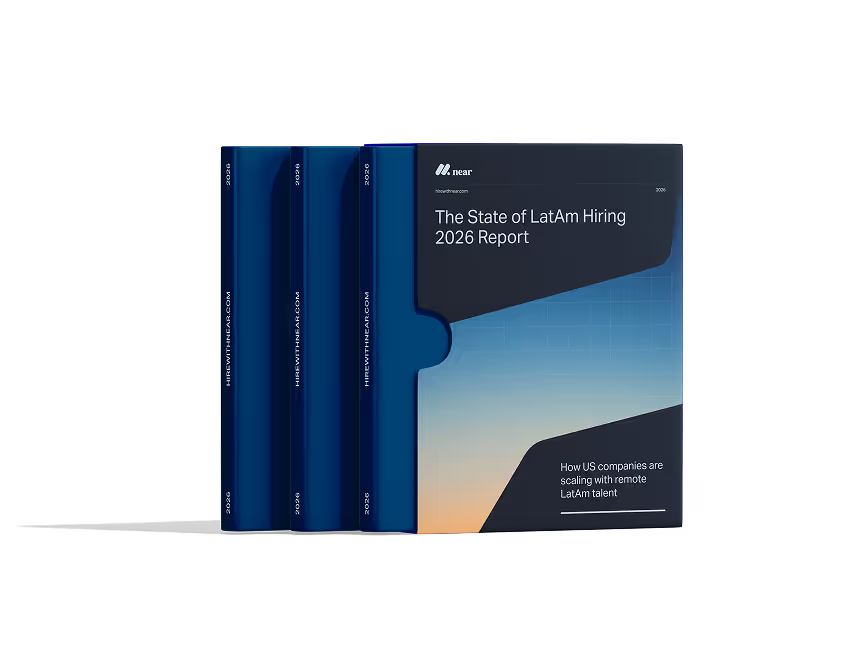
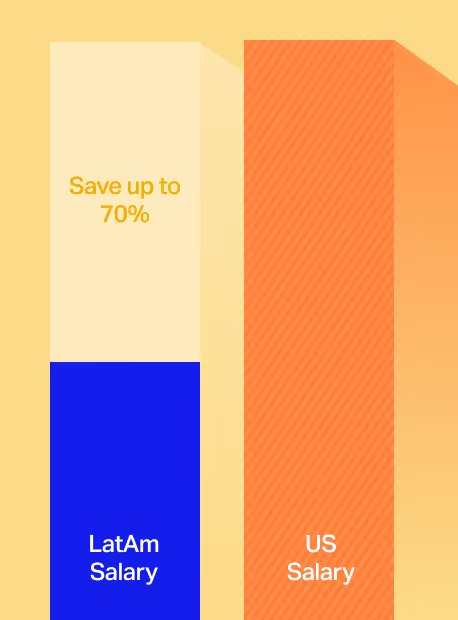
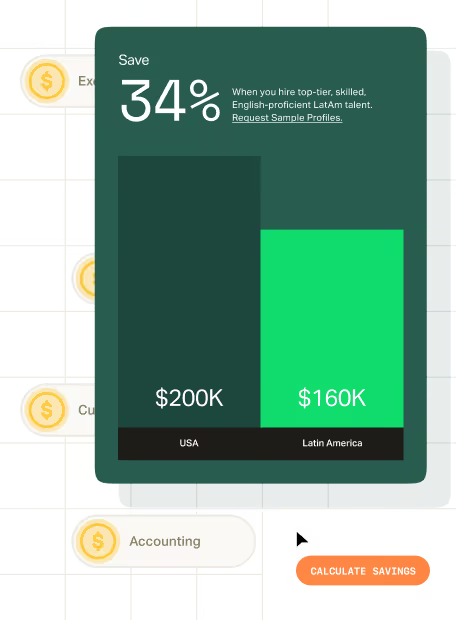
Our compensation benchmarks show that a full-time senior CFO based in Latin America typically earns $120,000-$180,000 per year. According to Hire With Near's 2026 State of LatAm Hiring Report, companies save 47-57% on senior finance leadership when hiring from Latin America versus US-based equivalents.
Note: For smaller companies where a full C-suite CFO hire is more than needed, Financial Analysts and Controllers based in Latin America can handle CFO-level functions at even greater savings, typically 47-79% vs. their US equivalents. More detail is available in the finance roles salary guide: US vs. Latin America, and in our full salary guide for LatAm finance roles.
The credentials question
Let’s address the top concern when we talk to companies about Latin American talent. They wonder if these professionals are actually qualified to handle US-level finance work.
In my five years sourcing finance and consulting talent at Hire With Near, the answer is yes, and the credential argument is stronger than most US hiring managers expect. When I'm screening CFO-level candidates, the signal I look for first is Big Four exposure on the resume. PwC, EY, Deloitte, KPMG, because those firms have trained candidates in US GAAP and IFRS standards from day one.
That's exactly what clients need, and it's common in the LatAm finance talent pool, particularly in Argentina and Brazil.
The academic training is worth understanding as well. Getting a university degree in accounting in a country like Argentina takes five years or more. When you try to get that degree recognized in the United States or Europe, it's generally equivalent to a university degree plus a postgraduate degree.
Consequently, a CPA license may not be the best proxy for competence in LatAm candidates, because their education and credentials follow a different structure.
There's also a broader structural argument for looking at LatAm for senior finance talent. The US finance talent pipeline has been contracting for years. According to Accounting Today, the number of candidates sitting for the CPA exam has fallen 27% over the past decade, and accounting graduates declined by 17% between 2016 and 2022. Finding qualified US finance leadership is getting harder and more expensive. Latin America offers a strong, growing alternative.
Across the LatAm finance market, where roughly 80% of the candidates I place are based in Argentina, the professionals I work with are genuinely motivated to work with US companies. They see it as a career milestone, and that motivation shows up in retention and performance because they are happy to work for our clients.
The time zone and communication advantage
LatAm-based CFOs work in US time zones or with significant overlap. For example, your Buenos Aires-based CFO is never more than two hours ahead of a New York team, and a Mexico City hire is in the same time zone as Central. This is a meaningful distinction from offshore hiring in Asia, where real-time availability for board calls, investor conversations, and urgent decisions is the exception rather than the norm.
Hire With Near's research on why US companies turn to LatAm hiring found that 30% are switching specifically from offshore arrangements, most commonly citing time zone misalignment and inconsistent quality as the trigger. For a role like CFO, where availability and communication clarity are non-negotiable, this difference matters.
The LatAm in-house hire gives you the availability, company depth, and leadership presence of an in-house hire at a cost structure that was previously only achievable through outsourcing.
How Hire With Near Helps US Companies Hire CFOs in Latin America
Hire With Near's nearshore staffing process for senior finance roles is built differently from general job-posting or LinkedIn outreach. We maintain relationships with the LatAm finance talent community directly, which means we're not starting from a cold search when you bring us a CFO brief.
For senior executive roles, our executive search in Latin America process includes:
- Understanding your company's stage, financial complexity, and leadership team structure
- Doing target outreach to passive candidates
- Running assessment interviews that specifically screen for communication clarity with founders, board members, and non-finance leadership
- Presenting a shortlist within days, not months
When I'm sourcing for a senior finance role, the screening question I always return to is, “Can this person explain a complex financial situation to a founder or board member in plain terms?”
The truth is that not every technically excellent CFO can do that. The best ones can, however, and that's the bar we hold LatAm candidates to.
What about the timeline?
- The typical time from brief to shortlist for executive talent is under 10 days.
- The typical time from shortlist to hire is then a few weeks depending on how many interview rounds you want to go through
That's a fraction of the three to six months a US executive search often takes.
The FinanceWithin example
Here’s an example of a company that saw real gains from working with us.
FinanceWithin, a fractional finance services firm based in Austin, Texas, had tried US-based hiring but found it too expensive. They also tried India but experienced high turnover and inconsistent quality. Their internal LinkedIn recruiting was too slow for their needs.
After partnering with Hire With Near, they built a pipeline of pre-vetted LatAm candidates. They started with Senior Bookkeepers, then expanded to Accounting Managers, External Accounting Managers, and Financial Analysts. That pipeline let them onboard 10 new clients at once.
The result: $535,000 in annual savings (a 64% reduction versus US-based hires), with time-to-hire cut from three weeks to seven days.
Sheena Malson, FinanceWithin's Director of Accounting, described the candidate quality this way: "When we saw candidate quality, it became clear these were truly top-tier professionals, better than what we found independently."
Miles Eggart, FinanceWithin's COO, put it plainly: "Partnering with Near has been a major win. The speed, talent pool, and quality have raised our expectations."
What makes FinanceWithin's story relevant to the CFO conversation is that they are a fractional finance services firm. They provide exactly the kind of outsourced CFO and finance services this article is about. And they chose to build their own delivery team with LatAm full-time hires. That's a signal worth paying attention to.
You can read more about what US companies experience when making this shift in this look at results from five companies that hired LatAm finance talent.
Our finance recruiters and accounting recruiting services maintain dedicated sourcing pipelines for the finance and accounting talent pool in Argentina, Brazil, Colombia, and Mexico.
Is an outsourced or in-house CFO right for your business?
This has historically been a budget question for most companies, and if you could afford a full-time US CFO, you would have hired one. If you couldn't, you outsourced.
Latin America changes that calculation because a full-time senior CFO based in Argentina or Colombia gives you the dedicated availability, deep company knowledge, and strategic leadership of an in-house hire, but at a cost that competes with many fractional CFO arrangements.
If you want to explore what hiring a CFO in Latin America would look like for your business, the best next step is to book a free consultation to talk through your requirements with our team. They'll walk you through current salary benchmarks and explain the process so you can see exactly how a LatAm CFO would fit into your budget and org chart.
{{latam-hiring-cta-v2}}
Frequently Asked Questions
What are the pros and cons of an outsourced CFO vs. an in-house CFO?
An outsourced (or fractional) CFO works across multiple clients on a part-time or project basis, giving you access to senior financial expertise at a lower monthly cost. However, they have limited availability and shallower company knowledge. An in-house CFO is a dedicated, full-time employee who builds deep knowledge of your business and is available whenever you need them.
How much does an in-house CFO cost vs. an outsourced CFO?
A US-based in-house CFO typically costs up to $400,000, plus benefits and equity. Outsourced or fractional CFO arrangements vary widely depending on scope, but commonly run $5,000-$15,000 per month. A full-time CFO based in Latin America typically earns $120,000-$180,000 per year: full-time availability at a cost competitive with many fractional arrangements. The right comparison depends on how many hours of CFO engagement you actually need.
Can a CFO based in Latin America handle US GAAP accounting and financial reporting?
Yes. LatAm finance professionals, particularly those with Big Four firm experience, are trained in US GAAP and IFRS standards from early in their careers. PwC, EY, Deloitte, and KPMG all have significant operations in Argentina, Brazil, Colombia, and Mexico, and their training frameworks are consistent globally.
What qualifications do CFOs based in Latin America typically have?
LatAm CFO candidates typically hold a five-year accounting or finance degree. In countries like Argentina, this degree is recognized internationally as equivalent to a university degree plus postgraduate study. They also have Big Four or multinational company experience and are fluent in both English and Spanish.
How long does it take to hire a CFO in Latin America?
Through Hire With Near, the process from initial brief to a shortlist of qualified candidates typically takes under 21 days. A traditional US executive search for a CFO-level role commonly takes three to six months.
Is a fractional CFO the same as an outsourced CFO?
A fractional CFO and an outsourced CFO are similar but not identical. A fractional CFO works part-time across multiple companies, typically as an independent contractor or through a fractional CFO platform.
An outsourced CFO often refers to a firm that provides CFO-level services, with multiple team members supporting the function, not just one individual. Both models give you senior finance expertise without a full-time commitment, but neither gives you the dedicated availability and company-specific knowledge that a full-time in-house hire provides.
When should a growing company move from a fractional CFO to a full-time in-house CFO?
The right time to move from fractional to full-time is usually when the complexity of the financial work, or the strategic importance of the CFO role, outgrows what part-time engagement can support.
Common signals include a fractional CFO that’s consistently maxed out on hours, or you're heading into a fundraising round or M&A process that requires full-time attention. It’s also time if your board wants a permanent financial leader, or your finance function is large enough to need direct management.
At that point, you can decide whether the US talent market or the Latin America market makes more sense for your situation.
What other finance and accounting roles can I hire based in Latin America?
Beyond CFO-level hiring, companies consistently bring in a wide range of senior finance and accounting professionals based in Latin America. Financial Analysts, Controllers, Finance Managers, Bookkeepers, and Accounts Payable Specialists are all commonly placed roles. Many companies start with one or two roles and scale their LatAm finance team as they get comfortable with the model.
You can also compare how US companies have approached this decision in this piece on hiring remote talent in LatAm vs. India.


.webp)







%203.svg)
.avif)





%20(1).avif)

%20(1).png)