%203.svg)
Key Takeaways
- The 10 best offshore Magento development companies in 2026 split into two routes: Magento-first agencies that build and support your storefront, and staffing partners that place dedicated developers who join your team. Rave Digital, Elogic Commerce, Webkul, Absolute Web, Elsner Technologies, Brainvire Infotech, Magneto IT Solutions, and Scandiweb take the agency route; Hire With Near and Toptal take the staffing route.
- Pick an agency when the Magento work is a fixed project with an end date, and build your own offshore Magento team when the releases, extensions, and support never really stop.
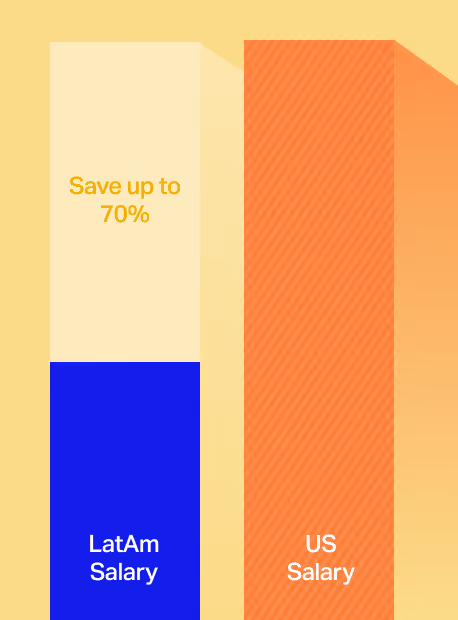
- Hiring an offshore Magento engineer in Latin America costs $3,000 to $7,000 per month across seniority levels, up to 67% less than an equivalent US hire, according to Hire With Near's salary data.
The best offshore Magento development company for most US e-commerce teams is either a Magento-first agency that builds and maintains your storefront or a staffing partner that places a dedicated developer on your team in a Latin American time zone. Which one is right comes down to whether your Magento work ends when the build ships or never really stops.
The pattern is the same across the founders we work with. The build goes fine, then support drags because nobody's online when checkout breaks at 2 p.m. your time. Hire With Near's research on why US companies hire in Latin America, an analysis of 2,000+ hiring conversations, found that 30% of companies are switching from offshore to nearshore to close that time-zone gap.
Below are 10 companies worth a shortlist spot, what each costs, and who each fits. Full disclosure: Hire With Near is one of them, and we'll say where another firm is the better call.
How to Hire Offshore Magento Developers
Start by defining the role the way the market names it. A Magento developer, often listed as an Adobe Commerce developer, is a PHP engineer first. Ask for validated Magento 2 experience, Adobe Commerce certifications where the build calls for them, and a portfolio that covers both storefront and admin customization. A real offshore Magento expert has shipped Adobe Commerce work, not just PHP generally.
Then decide what you're hiring for. A one-time replatform or theme build can run as a fixed project. Ongoing releases, extensions, performance tuning, and support are the case for an embedded hire, or a small offshore Magento team you manage directly.
Set the budget next. Hiring a Magento developer in Latin America, for example, costs $3,000 to $7,000 per month, depending on seniority.
From there, choose one of the hiring models described below.
Which Hiring Model Should You Use to Hire Offshore Magento Developers?
You can hire offshore Magento developers three ways, and the route you pick decides how much say you have over who writes your code and what the work costs.
Development agency
An agency brings you a team it has already assembled, typically a project manager plus a handful of developers who may also work other clients' accounts between sprints.
- You get delivery capacity fast, often within days, since the team already exists.
- You give up direct say over who's assigned to your account, and that mix can shift over time.
- Best fit when you want a finished deliverable (a replatform, a major feature build) and don't need to manage individual developers yourself.
Specialist recruiting partner
A recruiting partner sources an individual developer who joins your team full-time and reports directly to you, the way a direct hire would.
- You pick the person, set their day-to-day priorities, and keep the product knowledge in-house rather than within a vendor's team.
- It takes longer to get someone in seat than an agency's ready-made team, since you're hiring a specific person rather than renting existing capacity.
- Best fit for companies building an ongoing Magento capability rather than buying a one-off deliverable. This is how we place software engineering talent generally, not just Magento.
Freelance marketplace
A freelancer you find on a platform like Upwork works on a project-to-project basis, usually without ongoing accountability once the contract ends.
- Fastest and cheapest way to get a small, well-defined task done.
- Quality and reliability vary from developer to developer, and no vendor or firm is standing behind the work if it goes wrong.
- Best fit for short, self-contained jobs: a bug fix, a small theme tweak, a one-time audit.
The question underneath all three is the same one that separates offshore development companies from freelancers generally: who keeps the context once the engagement ends.
An agency's team knows the code as long as you keep paying them. A freelancer's knowledge usually leaves with the contract. A direct hire through a recruiting partner is the only one of the three where that knowledge stays with your company for good.
Which Region Should You Hire Offshore Magento Developers From?
For most US e-commerce teams, Latin America wins on working-hours overlap and Eastern Europe wins on technical depth; South Asia and Southeast Asia win on price if you can tolerate an overnight handoff. Here's what each region is good at:
- Latin America: The developer pool is large and growing fast. GitHub's Octoverse 2025 report counts 6.89 million developers in Brazil, now the world's fourth-largest developer community. The 2024 edition put Mexico at 1.9 million, Argentina at 1.1 million, and Colombia at over 1 million, each growing more than 20% year over year. The bigger draw for e-commerce teams is working hours. A developer in the region usually overlaps most of your business day, though how much depends on where your team sits in the US and which country you hire in. Our guide to hiring developers in Latin America breaks down costs and hiring models country by country.
- Eastern Europe: Strong engineering education systems and a deep bench of PHP and Magento specialists, at rates below US and Western European levels. Overlap with a US workday is limited to your early morning, which works for planned release cycles and less well for same-day support.
- South Asia: Countries like India have one of the largest Magento talent pools anywhere and some of the lowest published rates on this list. The tradeoff is the working day: an engineer in South Asia is finishing up around the time most US teams start, so questions asked in the afternoon get answered tomorrow. Our comparison of hiring remote talent in LatAm vs. India covers how that plays out on a real project.
- Southeast Asia: The Philippines and Vietnam have a growing base of e-commerce developers at competitive rates. The working-hours gap is similar to South Asia, so plan for asynchronous handoffs rather than live collaboration.
- Africa: An emerging option, with developers in South Africa, Nigeria, and Kenya offering competitive rates. Fewer firms there specialize in Magento specifically, so ask for Adobe Commerce project history rather than general PHP experience.
From there, if you decide to recruit from Latin America, Hire With Near sources and vets candidates so you can hire offshore Magento developers who report to you. Our free guide to hiring remotely in Latin America covers the setup around the hire.
Top 10 Offshore Magento Development Companies to Hire From in 2026
The 10 companies below are split into two groups. Eight are Magento-first agencies that build and support Adobe Commerce storefronts: Rave Digital, Elogic Commerce, Webkul, Absolute Web, Elsner Technologies, Brainvire Infotech, Magneto IT Solutions, and Scandiweb. Two are partners that place developers who work directly for you: Hire With Near and Toptal.
How we chose them: every company here holds a rating of 4.5 or above with at least 50 client reviews on an established review platform, meaning G2, Clutch, Trustpilot, GoodFirms, or ClearlyRated (client ratings only).
From that pool, we compared Magento and Adobe Commerce depth, engagement model, published rates, and where each firm's delivery team sits.
The companies below are in no particular order, and no ranking is implied. The right fit for your business depends on your build, your budget, your timeline, and whether you want an offshore Magento team you employ or an agency that runs itself.
Here's how the 10 compare on location, engagement model, Magento depth, and the rates each firm publishes:
Note 1: Hourly figures are the ranges each firm publishes on its Clutch profile; Hire With Near's figure comes from our own salary data for Latin America.
Note 2: We re-check these third-party review scores regularly and update them as our selection criteria require.
Here's what sets each apart:
1. Hire With Near

Hire With Near is a full-service staffing and recruiting agency that helps US companies hire top-performing remote talent in Latin America across all departments and industries, including e-commerce and Magento development. We source, vet, and place developers who work only for you: the developer joins your team and reports to you, and we handle contracts, payroll, and local compliance.
You end up with an offshore Magento engineer on your team rather than a ticket queue. Rates run $3,000 to $7,000 per month per developer depending on seniority, and we hold a 4.9 rating on G2 across 150+ reviews. Best for e-commerce teams that want a Magento developer working their hours for the long term.
2. Rave Digital

Rave Digital earned a spot for its depth in one platform: Magento accounts for roughly 80% of the agency's work, and Adobe Commerce-certified developers handle builds, migrations, and support.
It runs from Coral Springs, Florida, with delivery staff in India and the UK, publishes project rates of $100 to $149 per hour, and holds 5.0/5 on Clutch across 109 reviews.
Best for merchants who want a Magento-first agency working on a US clock.
3. Elogic Commerce
Elogic Commerce earned a spot for its Adobe Commerce credentials: an Adobe Silver Solution Partner with 200+ certified engineers, running replatforming and migration work for mid-market and enterprise retailers.
The agency is headquartered in Tallinn, Estonia, sells both project delivery and team extension, and charges $50 to $99 per hour. It rates 5.0/5 on Clutch across 60 reviews.
Best for merchants who want a certified offshore Magento expert leading a migration.
4. Webkul
What stood out about Webkul is the product side of its Magento work: the Noida, India, team builds multi-vendor marketplaces, custom extensions, and headless storefronts, and maintains its own open-source commerce tools.
Engagements run hourly or monthly with a dedicated developer at $25 to $49 per hour. Webkul rates 4.9/5 on Clutch across 176 reviews.
Best for stores that need marketplace functionality or custom extension work rather than a full rebuild.
5. Absolute Web

Absolute Web is here because of its design-led builds and its US base: the Miami, Florida agency has run e-commerce projects since 1999, with Magento making up about half of its platform work alongside Adobe Experience Manager and Shopify.
Project rates are $100 to $149 per hour, and it holds 4.9/5 on Clutch across 83 reviews.
Best for US brands that want storefront design and Adobe Commerce development in the same shop.
6. Elsner Technologies

The reason Elsner Technologies made this list is volume at a low rate: 200+ developers in Ahmedabad, India, plus US offices in California and Florida, covering Magento builds, maintenance, and dedicated developer hires.
Published rates sit under $25 per hour, the lowest here, and the firm holds 4.8/5 on Clutch across 85 reviews.
Best for maintenance, extension work, and smaller Magento projects where budget outweighs working-hour overlap.
7. Brainvire Infotech

Brainvire Infotech stands out for enterprise integration work. An Adobe Gold Partner headquartered in Irving, Texas, with delivery teams in India, Dubai, and Singapore, it connects Magento storefronts to ERP, CRM, and Microsoft systems, and counts York University among its clients.
Project rates run $25 to $49 per hour, and it holds 4.8/5 on Clutch across 262 reviews, the largest review base on this list.
Best for multi-system e-commerce programs.
8. Magneto IT Solutions

Magneto IT Solutions caught our attention for its B2B storefront work. The agency runs e-commerce projects exclusively, split roughly evenly between Magento and Shopify, from a head office in Sydney, Australia, with teams in India, the UK, Canada, and the Middle East.
Rates run $25 to $49 per hour, and it holds 4.8/5 on Clutch across 70 reviews.
Best for B2B and industry-specific builds that need support across Australia, India, the UK, Canada, and the Middle East.
9. Scandiweb
Scandiweb belongs on this list for scale inside one ecosystem: 600+ specialists, 894+ Adobe certifications, and Adobe Commerce work making up the bulk of its e-commerce delivery, run out of New York and its original base in Riga, Latvia.
Rates are $50 to $99 per hour, and it holds 4.8/5 on Clutch across 53 reviews.
Best for complex enterprise Adobe Commerce builds that also need CRO and UX in-house.
10. Toptal

Toptal is on this list as the marketplace option. It screens freelance developers hard, accepting under 3% of applicants by its own account, matches most clients within roughly 48 hours, and offers a no-risk trial period.
Talent is fully remote across 155+ countries and engaged hourly, part-time, or full-time; rates aren't publicly listed and are quoted per engagement. Toptal holds 4.7/5 on G2 across 270 reviews.
Best for short-term or interim Magento work.
Check our Hire With Near vs. Toptal comparison to see how the two models differ.
{{consultation}}
How to Choose the Best Offshore Magento Development Partner
Judge an offshore Magento development partner on eight things: proven Magento 2 and Adobe Commerce work, total cost against a US hire, technical English, verifiable client reviews, working-day overlap, security practices, how fast they can scale the team, and post-launch support. Here's what to check in each.
Technical expertise
Magento runs on PHP, so when you hire an offshore Magento engineer, both their platform knowledge and their PHP fundamentals matter. Ask which Magento 2 versions they've shipped, what custom modules they've written, which third-party systems they've integrated, and how they handle upgrades.
Look for certifications or partnerships with Adobe (Magento), which indicate a tested level of technical competence.
If you're hiring rather than contracting, the same checks apply to the individual. Strong PHP developers with real Magento 2 experience cover the backend and admin work, and front-end developers who know Magento theming handle the storefront.
Cost evaluation
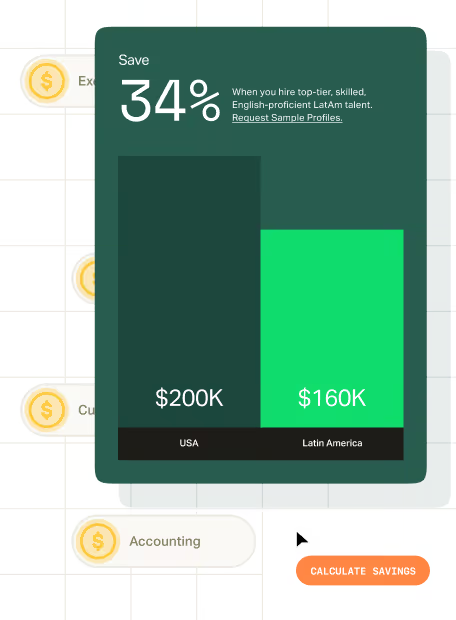
Hiring a Magento developer in Latin America costs $36K to $84K a year depending on seniority, against $80K to $189K for a comparable US hire, according to our salary data. Monthly, that's roughly $3,000 to $7,000 per developer.
A junior developer at the bottom of the band isn’t going to lead a replatform, and a senior developer at the top of it shouldn't be spending their week on theme tweaks. Price the level of work you need, then check any quote against the band for that level.
According to Hire With Near's salary data, here's what hiring a Magento developer in Latin America costs compared with an equivalent US hire:
For the most up-to-date figures, see Hire With Near's US vs Latin America Salary Guide.
At those levels, hiring a senior Magento developer in Latin America usually costs less than hiring a mid-level developer in the US. That's why most of the e-commerce teams we work with hire up a level instead of hiring more people.
Rates outside Latin America run higher or lower depending on the region and the engagement model, and agency hourly rates cover overhead a direct hire doesn't carry.
Our IT roles salary guide shows what developers earn in Latin America versus the US across other engineering roles.
Communication channels
The English bar for a Magento hire is technical English, not conversational English. The developer has to explain why a release broke checkout, write a pull request description your team can review, and hold their own in an architecture discussion. Test for that directly with a live technical conversation, not a written assessment.
It's one of the gaps hiring managers raise with us most. A managing director standing up a Latin American service center for a US company told us what he kept hitting:
We do have specific requirements in terms of the experience for these positions. And when we do find someone with the technical skills, they don't have the English level to communicate with the U.S.-based clients. They either focus on the technical skills or the language. Most of the times the technical skills, and they have challenges with communication. So I believe they're too focused on the technical part. And we haven't found the balance.
Ask any partner how they assess English, at what level, and whether you can talk to the developer before you commit. Then check the working setup around it: which project management tools the team uses, who your day-to-day contact is, and how often you get written updates.
Reputation and reviews
Before you hire an offshore Magento expert, verify their track record on platforms that only publish client-submitted reviews, such as G2, Clutch, Trustpilot, GoodFirms, and ClearlyRated. Look at three things: the rating, the number of reviews behind it, and how recent they are. A 5.0 built on eight reviews from four years ago says less than a 4.8 across 200 current ones.
Then ask for two references from merchants close to your size and catalog complexity, and ask those references what went wrong on the project and how it got resolved.
Bonfire, a US e-commerce platform, hired a senior engineer through us in six weeks and saved roughly $53,000 a year against comparable US pay. Their VP of Product Management put the difference between partners this way:
It was shocking to see the difference between the talent Hire With Near brought versus other firms I worked with. Our hires are extraordinary and a great cultural fit.
— Thomas Elliott, VP of Product Management, Bonfire
Cultural and time zone compatibility
Working-hours overlap decides how much of your day you can collaborate with the team, and it's one of the factors buyers most often underestimate. A developer in Latin America can join your standups. Code review and a Friday-afternoon checkout bug get handled the same day instead of overnight.
A 2024 Harvard Business School and INFORMS study looked at 12,038 employees of a multinational firm across 48 countries. It found that every extra hour of time difference cuts live back-and-forth by about 11%. Teams arranged along a north-south corridor, which is what a US company hiring in Latin America gets, keep close to a full business day of overlap; east-west corridors give most of it up.
That's the mechanism behind a complaint we hear often. One founder we spoke with, running an offshore QA engagement in the Asia-Pacific region, put it this way:
We currently have a senior QA that is focused on both manual testing and automation. She's based in Sri Lanka, and I don't get her enough during my day to actually allow to keep on that high quality and high throughput for my team. So we often release without her. So it's not good, right?
Cultural fit follows from the same thing: teams that share a working day build the informal habits, the quick call instead of the ticket, that make a store team fast.
Before you sign with anyone, ask which hours their team commits to and how much of your own workday that covers. The questions tech leaders ask about hiring developers in Latin America cover what else to raise on those calls.
Security practices
Get specific about your store: ask who has production access, how credentials are stored, whether PCI-relevant work is handled by named people, and what the contract says about IP assignment.
Those four answers tell you more than a page of security policy will. If a partner can't name the people who touch production, or the IP clause only appears in a master services agreement you haven't seen, treat both as findings rather than paperwork.
Scalability and flexibility
Ask what notice period applies in both directions and how quickly they can add a developer with the same platform depth. Those two answers tell you what it costs to add people for a large build, and what it costs to step down after launch.
An agency scales by reassigning people; a staffing partner scales by running another search, which is slower to start and stickier once it's done. Match the mechanism to how your roadmap moves.
Support and maintenance
Post-launch support is where most Magento budgets end up over a store's life. Make sure your provider offers reliable Magento maintenance services, timely security patches, and response times written into the agreement rather than promised on a call.
If you're building the capability in-house instead, the usual shape is a Magento developer plus a QA engineer who regression-tests releases before they reach production.
Final Thoughts
Whichever way you go, you're choosing between two models. An agency owns delivery and hands you a finished storefront. A dedicated hire means you own the developer, and the product knowledge stays on your team when the project ends.
At Hire With Near, we've watched the teams who get this right pick the model first and the vendor second. Over two or three years, a developer you employ usually costs less and drifts less than a string of fixed-scope SOWs, and the experience level backs it up: according to Hire With Near's 2026 State of LatAm Hiring Report, 98% of our engineering placements last year were mid-level or senior.
Talk to a few of these companies, including us. Our guide to the best companies to hire developers in Latin America covers the nearshore field. When you're ready to hire an offshore Magento developer through Hire With Near, request pre-vetted candidates and we'll send profiles with salary benchmarks for the seniority you need.
{{prevetted-banner}}
Frequently Asked Questions
What's the best offshore software development company for Magento ecommerce development?
For most US e-commerce teams it comes down to two routes. Pick Hire With Near if you want a dedicated Magento developer who works only for your team. Pick a Magento-first agency such as Rave Digital or Elogic Commerce if you want a fixed-scope build delivered for you. Agencies own delivery; a staffing partner places a developer you employ.
What are the top Magento development companies?
Rave Digital, Elogic Commerce, Scandiweb, and Webkul are four of the strongest Magento specialists on this list. Rave Digital runs roughly 80% of its work on Magento. Elogic Commerce is an Adobe Silver Solution Partner focused on replatforming and migrations. Scandiweb handles complex enterprise Adobe Commerce builds. Webkul builds multi-vendor marketplaces and custom extensions.
What is a Magento developer salary?
A Magento developer in Latin America earns $36K to $84K a year, or roughly $3,000 to $7,000 a month, depending on seniority, according to Hire With Near's salary data. The equivalent US range runs $80K to $189K. Junior developers sit at the bottom of both bands, and senior developers leading replatforms sit at the top.
What are the top offshore software development companies?
The top offshore software development companies split into two groups. Full-service agencies such as Brainvire Infotech, Elsner Technologies, and Scandiweb deliver projects end to end. Staffing partners such as Hire With Near and Toptal place developers directly onto your team.
Our roundups of offshore web development companies and LatAm outsourcing companies cover the field beyond Magento.
Does anyone still use Magento?
Yes. Magento, now sold as Adobe Commerce, is Adobe's enterprise e-commerce platform and remains a common choice for catalog-heavy, multi-brand, and heavily customized storefronts. Shopify has taken much of the smaller-merchant market, where teams often hire a Shopify developer instead. Magento still wins where a store needs deep customization, headless builds, or ERP and PIM integrations.
How do you hire offshore Magento developers?
Define the role first: a Magento developer is a PHP engineer with Magento 2 and Adobe Commerce experience. Then pick a region (Latin America, for overlap with your workday), choose between a project agency and a dedicated hire, set a rate band, and work with a recruiter in that market. We place Magento developers who work only for you.
How much does it cost to hire an offshore Magento team?
Hiring a three-person offshore Magento team in Latin America (one senior developer, one mid-level developer, and a QA engineer) runs roughly $12,500 to $16,500 per month, based on Hire With Near's salary data. Cost scales with seniority more than headcount.
Our guide to hiring an offshore development team walks through team structures and engagement models.



.webp)
.webp)


.webp)


%203.svg)
.avif)





%20(1).avif)

%20(1).png)