%203.svg)
Key Takeaways
- The main RPO benefits are a lower cost per hire, a faster time to fill, and access to candidates your own team can't reach. You also get a recruiting function that scales up and down without adding permanent headcount.
- RPO fits companies filling several roles at once, hiring in bursts, or hiring for specialized positions with no dedicated recruiter. If you make one or two predictable hires a year, hiring your own recruiter usually costs less.
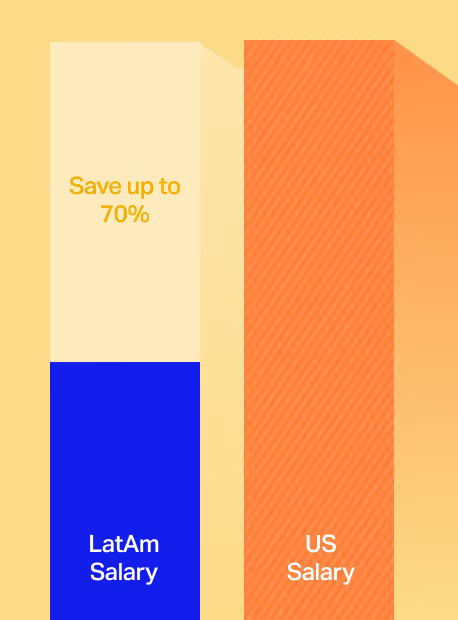
- Where your provider recruits changes the numbers. A partner sourcing in Latin America presents candidates who work during your business hours, at salaries 30 to 70% below comparable US rates.
Recruitment process outsourcing gives you a full recruiting function, sourcing, screening, interviews, and offers run by an outside provider, without hiring a recruiter of your own to carry year-round. That's the draw when you have more open roles than people to fill them: roles close faster, cost less, and the help scales up or down as your hiring does.
Rankings.io, an Inc. 5000 SEO agency, had eleven positions and one HR manager. They filled all eleven through Hire With Near at an average three-week time to hire, without hiring a recruiter first.
If that sounds familiar, you know the cost: roles sit open, your team absorbs the work, and the projects those hires were meant to support slip another quarter. ManpowerGroup's 2026 Global Talent Shortage Survey found 69% of US employers can't find the skills they need, so the pipeline won't fix itself while you wait.
Below are the ten biggest RPO benefits, how RPO compares to building in-house or using a staffing agency, what it costs, and why recruiting in Latin America changes what you pay and how fast you hire.
What Is RPO?
Recruitment process outsourcing (RPO) is an arrangement where a third-party provider runs some or all of your hiring: sourcing candidates, screening them, coordinating interviews, and managing offers and onboarding. The provider uses its own recruiters, tools, and talent networks, and works as an extension of your team rather than as a vendor you brief once and hear from later.
In contrast with traditional in-house recruitment, you hand over the running of the search itself. You still own the decision, the interview panel, the offer, and the culture. The provider owns everything that has to happen before a shortlist reaches your desk.
What RPO recruitment gives you that most internal teams can't is volume and reach. Providers are running searches for the same role types every week, so they already know what the market pays, which candidates are open to a move, and which of your requirements is making the role unfillable. They also recruit in markets your job posts never reach.
You can look at the model in more depth in our complete guide to RPO.
Related reading: 7 Reasons to Work with a Recruitment Partner
What Are the 10 Biggest Benefits of RPO?
The ten advantages of RPO below cover cost, speed, reach, screening quality, and candidate experience, and they are the ones that show up consistently for companies that hand their hiring to an outside partner. Each one changes something measurable about how you hire, not just how hiring feels.
1. A lower cost per hire, with salaries 30 to 70% below US rates
RPO lowers your hiring costs in two places at once: what you spend to run the search, and what you pay the person you hire. That combination is why cost is the reason most companies look at RPO in the first place.
On the search side, you get:
- One consistent process instead of ad-hoc recruiting that restarts from zero with every opening
- Pricing models that flex with hiring volume rather than a fixed recruiting salary you carry all year
- Access to candidates in markets where salary expectations are lower for the same experience
- Better-matched hires, which is where the largest savings sit
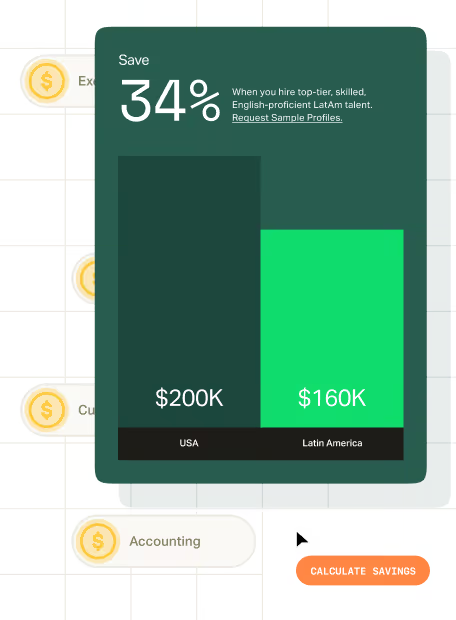
That third point is the one companies underestimate. To put it in concrete terms, here's what hiring five commonly recruited roles costs in Latin America compared to equivalent US hires, according to Hire With Near's salary benchmarks:
For the most up-to-date figures, see Hire With Near's US vs Latin America Salary Guide.
The recruiter row is the decision hiding inside this article: hiring a senior in-house recruiter in the US often costs more than the combined salaries of two or three of the professionals you're asking them to find. Salaries in Latin America are lower because the cost of living is lower, not because the work is worth less, and companies that pay competitively for the local market keep those hires. Hire With Near's placements stay an average of three years. There's more on that in our breakdown of how much US companies save by hiring in Latin America.
The bad-hire cost is the other half. Gallup puts the cost of replacing someone at 40% of annual salary for frontline staff, around 80% for technical and professional roles, and up to 200% for leaders and managers. On a $90,000 professional hire, one mis-hire costs roughly $72,000 in lost productivity, re-recruiting, and ramp time. That's what a better screening process is competing against.
2. Faster time to fill
RPO cuts time to fill because sourcing and screening run continuously instead of starting from scratch every time a role opens. The provider already has a pipeline; you're not waiting for one to be built.
The market baseline has moved, which makes slow hiring more expensive than it was a year ago. SHRM's 2026 recruiting benchmarking research, based on more than 4,600 organizations, puts the median time to fill a nonexecutive role at 39 calendar days, down from 44 days in 2025. SHRM also notes that organizations with the most effective recruiting practices fill roles about five days faster than their peers. If your searches still run three to six months, you're further behind the median now than you were last year.
Hire With Near's 2026 State of LatAm Hiring Report, based on more than 2,000 placements, found that most roles were filled in 7 to 28 days, against the three to six months those same roles commonly take to fill in the US market.
Rankings.io is what that looks like in practice. The agency needed to scale headcount fast, but the entire hiring function sat with one HR manager and earlier attempts with staffing agencies had gone badly. Hire With Near ran sourcing and vetting end to end across six job families: web design, paid ads, project management, SEO, web development, and PPC. Eleven roles were filled at an average three-week time to hire, saving $463,000 a year against US-based equivalents and returning 3 to 5 hours per role to a team that had none to spare.
Their Human Resources Director, Gillian Alvillar, described the difference this way:
The speed, the way they put everything together for us, it's just so clean and easy, and flows really well. It's made the entire hiring process incredibly smooth.
— Gillian Alvillar, Human Resources Director, Rankings.io
3. Improved talent acquisition for specialized roles
A provider widens your candidate pool for one concrete reason: they recruit in markets you aren't recruiting in, and they talk to people who aren't applying to jobs. Specialized professionals rarely respond to job posts, so a search that depends on applicants will keep returning the same thin pool.
For a niche role, that reach is the whole game. Someone who has run revenue operations for two Series B SaaS companies usually isn't browsing job boards; they're being contacted directly by a recruiter who already knows them. Providers working the same function week after week build those relationships as a byproduct of the job.
Geography is the second lever, and the more practical one. Most US companies recruit inside a market where every competitor is bidding for the same shortlist. A provider that also recruits abroad changes the supply side of the problem. That's why hiring remotely in Latin America has become a default move for US teams: the professionals are experienced, they work during your business hours wherever your team sits, and salary expectations reflect a different local market.
4. A wider, less self-selecting candidate pool
A provider-run search reaches people who would never have applied on their own, which is the practical benefit sitting underneath most diversity language in recruiting. When you post a role and wait, you get the candidates who found the post and felt qualified enough to raise their hand: a self-selected group, usually smaller and more uniform than the real market.
Structured sourcing changes who's in the room. Recruiters go out and find people who match the requirements instead of waiting for the requirements to find them, which surfaces candidates from adjacent industries, non-obvious backgrounds, and markets outside your metro area.
Consistent evaluation is the other half. When every candidate goes through the same intake, the same screening questions, and the same scorecard, you're comparing like with like rather than your impressions of six different conversations. That takes the noise out of the decision and makes it far easier to explain later why you hired who you hired.
5. Recruitment technology that verifies what candidates claim
The most useful thing a provider's technology does in 2026 is verification: confirming that a candidate's work history, skills, and English are real. Faster resume processing stopped being the differentiator once resumes stopped being trustworthy.
One 30-year IT industry veteran running a US IT consulting and staffing firm put the problem plainly:
I've been in this industry for thirty years and I have never seen anything like what's happening right now with fake resumes. It's an epidemic. AI is generating entire work histories that never existed.
That's the environment any screening process now operates in, and it's why a claim of having a rigorous process is not an answer. A real one has stages you can name.
Hire With Near's recruiters start with a structured intake on the role, so the search is calibrated to what the job requires rather than to the job description's wish list. Sourcing then goes beyond the applicant pool, because the strongest candidates usually aren't applying. Claimed history gets verified against references and prior employers. Skills get tested functionally, on work resembling the job. English and communication get assessed live, in conversation, not scored off a certificate.
Applicant tracking systems and reporting tools still matter: they keep a multi-role search organized and give you real numbers on time to fill, source of hire, and where candidates drop out. But they're the record-keeping layer. The filter is the process, and the process is what you should be asking about.
6. Compliance and risk management
A provider handles the legal side of hiring so your HR team doesn't have to: background checks, candidate consent and data records, offer documentation, and the employment rules in every market you hire in.
In practice that means three things you can check. The provider tracks changes to employment law in every market it recruits in, keeps candidate records and consent documentation audit-ready, and standardizes interview questions so the same job-related criteria apply to every candidate. What reduces your exposure is a documented, repeatable process, not a hiring manager improvising under time pressure.
7. Enhanced employer branding
A provider improves how your company shows up to candidates: clearer job descriptions, campaigns built for the specific role, and candidates who actually hear back. Those are the three things people judge you on before they ever speak to anyone on your team.
A strong employer brand is what separates the companies whose outreach gets answered from the ones whose messages get ignored. What it comes down to is whether a candidate can tell, before applying, what the job involves, who they'd report to, and how the process will run.
8. Customized recruitment strategies tailored to your business
RPO providers build the search around your business instead of running a generic process. They work with your team on the hiring plan, the sourcing strategy, and the screening criteria before the first candidate is contacted, so the shortlist reflects your goals and your culture rather than a template.
That starts with sourcing aimed at the specific roles you're filling, whether that's creative marketers, skilled engineers, or a support lead. It extends to the method: a search for one senior hire looks nothing like a search for six support reps, and a good provider runs them differently. You can see the same split across the roles US companies most often hire nearshore.
They also screen for more than skills. Whether a hire stays three years or gets replaced in nine months usually comes down to how well they fit the way your team works, and a provider who understands that can filter for it before you spend interview time on it.
9. Scalable solutions for adapting to business needs
RPO scales with your hiring volume: up during a growth push or a seasonal surge, and back down once it passes, without you hiring or laying off recruiters to match. Common approaches to RPO include:
Partial-cycle RPO
Partial-cycle RPO fits you if you already have an in-house recruiting team and only need help with specific stages, such as sourcing, screening, or onboarding.
You keep the stages your team is good at and hand over the ones eating its time.
Full-cycle RPO
The provider runs the whole thing. A dedicated team works alongside yours, uses one process across every role, and commits to service levels you agree on upfront.
Project-based RPO
Project-based RPO covers one defined hiring push: a new office, a funding round, a seasonal surge. It ends when the roles are filled.
You get a recruiting team for the duration without building recruiting infrastructure you won't need in six months, which makes it the model to ask about when the volume is real but temporary.
Which model fits depends on how much of the process you want to keep. If you're weighing engagement models specifically for hiring in the region, our complete guide to outsourcing to Latin America breaks down the costs and structures in more detail.
10. Exceptional candidate experience
A provider assigns someone whose job is to keep candidates informed, so people hear back, know where they stand, and stay engaged through a process that would otherwise lose them. That can turn even rejected candidates into referrals and a stronger pipeline for future roles.
The most common way that experience breaks is not rudeness; it's an interview process that keeps changing. Camila Banchero, Hire With Near's Senior Recruiter for Operations, sees it constantly:
A clear interview process is critical — and it's one of the most common mistakes clients make. If you change the process or make it too long, it tires candidates out and you lose them. We help clients build a solid interview process at the kickoff call, because candidates stay more engaged when they know exactly what to expect.
— Camila Banchero, Senior Recruiter for Operations, Hire With Near
The experience doesn't end once the hiring decision is made. With RPO, onboarding stays organized too, from paperwork through the first weeks of support, so a new hire's first impression of your company matches the one the interview process gave them.
Related reading: How Offshore RPO Services Can Revolutionize Your Recruitment Strategy
Should You Use RPO, Build an In-House Recruiting Team, or Work With a Staffing Agency?
Use RPO when you're filling several roles at once or hiring unpredictably, build in-house when your hiring is steady enough to keep a recruiter busy, and use a contingency staffing agency for one-off searches you don't want to own. The three models differ less in what they deliver than in what they commit you to.
Across the editorial work I do turning Hire With Near's recruiters' expertise into guidance for hiring managers, this is the comparison that comes up more than any other, and a feature list never settles it. What settles it is asking what each option costs you in a quiet quarter.
Build it in-house
You hire your own recruiter, or you run hiring off your HR team's plate. That gives you the most control and the lowest marginal cost once volume is steady: after the salary is committed, each extra hire is close to free.
The commitment is that salary. You carry it whether you're hiring twelve people this quarter or none, along with all the sourcing, screening, and scheduling. For a team hiring in bursts, that's a fixed cost against a variable need. Our comparison of RPO and in-house recruiting goes deeper on where each one wins.
Use a contingency or staffing agency
You pay a fee per hire, usually a percentage of first-year salary, and nothing if nobody is placed. That makes it the easiest option to start and the right call for a single hard-to-fill role.
The trade-off is attention and cost curve. Contingency agencies run your search alongside several others, so the service is transactional, and because the fee repeats with every hire, the model gets more expensive as you scale.
Work with an RPO partner
An RPO partner gives you a recruiting function you didn't have to build. A dedicated recruiter or team learns your roles, runs one consistent process across all of them, and stays with you between searches, so the pipeline doesn't evaporate the moment a role closes.
It fits best when hiring is high, uneven, or specialized, or when you're filling several job families at once and can't hire an expert in each. It's the situation Rankings.io was in: eleven roles, one HR manager, no time to build a recruiting team first. The scalability benefit above covers which shape of engagement fits once you've picked the model.
None of these is a bad choice; they're answers to different questions. What our recruiters flag most often is that companies pick based on this quarter's hiring plan and then keep the model for three years, long after the volume it was chosen for has changed.
What Are the Challenges of Implementing RPO?
RPO has real downsides, and the four below are the ones that surface most often. Recognizing them early is what makes the difference between a partnership that works and one you unwind after six months.
Cultural alignment
A provider who doesn't understand how your team works will send you candidates who read well on paper and land wrong in the interview. Ask how they learn your team before the search starts: who runs the kickoff call, what they ask about how your team makes decisions, and whether the same recruiter stays on your account across searches.
Give them something to work with, too. Handing over your onboarding docs and the reasons your last two hires worked out is faster than correcting three rounds of shortlists.
Quality of hires
It's reasonable to worry about the quality of candidates sourced by someone outside your company. Setting clear expectations helps, but it isn't a filter. Before you sign anything, ask for specifics:
- Who is the named recruiter on your account, and does that person change between searches?
- What does their screening consist of, stage by stage, and how is claimed experience verified?
- What share of the candidates they present typically reach a final interview?
- What happens when the first shortlist misses?
- How long do their placements stay, on average, not just how many roles they fill?
Then check the record independently. Reviews, testimonials, and client success stories tell you whether those answers hold up across other companies, and a provider who can point you to a customer in your exact situation is telling you something a case study page can't.
Loss of control
If you're worried about losing control of your hiring, that worry has evidence behind it. Hire With Near's analysis of why US companies hire in Latin America draws on more than 2,000 hiring conversations. It found that 12% of companies arrived looking to move off an outsourcing arrangement and hire directly. The frustration they described most was the middleman model: no day-to-day control, and workers who never felt like part of the team.
One RevOps leader at a mid-market SaaS company, running a customer support team through a managed-services agency, described what that looks like day to day:
Dealing with a middleman is hard because we don't manage our workers. They're managed by the agency. So if someone's sick, it takes us hours to find out. They have to tell their manager, and the manager has to tell us.
The distinction that matters: RPO outsources the hiring, not the person. The people you hire through an RPO engagement are your team members, reporting to your managers, in your systems. Where control gets lost is when a provider also sits between you and the workers after the hire.
Establish clear roles, responsibilities, and communication protocols with your RPO partner, including regular strategy check-ins, a named point of contact on both sides, and shared visibility into every open search.
Data security and privacy
Handing candidate and employee data to a third party makes their security posture your problem. According to IBM's 2025 Cost of a Data Breach Report, researched by the Ponemon Institute across 600 organizations, the average breach now costs USD 4.44 million globally. The same report found that a high level of unmanaged AI tool use added roughly USD 670,000 to that average.
Confirm your RPO provider complies with data protection regulations and has secure systems in place to safeguard sensitive information. That means regular security audits, data encryption, secure storage, and a clear answer on which AI tools touch candidate data and how.
When Should You Partner With an RPO Provider?
Partner with an RPO provider when your hiring volume is higher, lumpier, or more specialized than your current team can absorb. Deciding to work with a recruitment process outsourcing partner is the right call under specific conditions, and it's worth being honest about which ones apply to you.
The honest counterpoint first: if your hiring is steady and predictable, one or two hires a year, hiring your own recruiter or keeping the work in-house usually costs less than a program you won't keep busy. RPO earns its keep on volume and variability. Here are the situations where it does.
You have high-volume recruitment needs
If your company is experiencing a period of rapid growth or seasonal spikes in hiring, managing the surge can overwhelm a small team. This is where an RPO provider is most clearly worth it: a scalable process that keeps quality consistent across dozens of hires. It comes up most often with functions that hire in cohorts, like sales reps ahead of a new quarter or customer support reps before a product launch. You need eight good people at once, and interviewing them yourself would consume a month.
Your company is expanding into new markets
Entering new geographical markets or industries often requires a fresh pool of candidates with specific expertise or familiarity with a particular region. A provider that already recruits in that market knows what it pays and has candidates it has spoken to recently, which is exactly the gap when you're hiring somewhere your brand means nothing yet.
You need to fill specialized roles
For niche or highly specialized positions, a provider running the same search every week knows who is open to a move and which of your requirements is making the role unfillable. That is the knowledge an internal team hiring for the role once every two years has no way to build.
It also lets your internal team concentrate on strategic work while the provider manages the end-to-end recruitment cycle.
You want to speed up and standardize your hiring
If your hiring process is inconsistent or outdated, an RPO provider can put a standardized process in place. That means fewer bottlenecks, shorter timelines, and a candidate experience that doesn't vary depending on which manager is running the interviews.
You must stay compliant with complex hiring regulations
Employment rules differ in every market you hire in, and they change. A provider recruiting in those markets every week already tracks the rules, so your process isn't the thing that breaks when they shift.
Final Thoughts
RPO works. The question worth sitting with is whether the hiring you have coming over the next year is heavy or uneven enough to justify a recruiting function you don't currently own.
If it is, roles close in weeks instead of quarters, the cost per hire drops, and your team stops spending its best hours on resumes. If it isn't, a recruiter of your own is often the better answer, and any provider worth working with will tell you that.
Either way, check the numbers against your own plan. If you want to explore hiring through RPO services or building a team in Latin America, book a free consultation to talk through your requirements with our team. You'll get salary benchmarks for the roles you're filling and a walkthrough of how the process works, so you can decide whether it fits.
{{latam-hiring-cta-v2}}
Frequently Asked Questions
What are the benefits of using RPO?
The benefits of using RPO are a lower cost per hire, a shorter time to fill, access to candidates outside your own network, consistent screening across every role, and a recruiting capacity that scales without permanent headcount. Providers run the same searches repeatedly, so they carry market salary knowledge, existing candidate relationships, and a process already built. For companies filling several roles at once, that combination usually beats both an ad-hoc internal effort and a per-hire agency fee.
Is RPO a good fit for my company?
RPO is a good fit if you're filling multiple roles at once, your hiring spikes and then goes quiet, you're recruiting for specialized positions, or you have no dedicated recruiter. Those four conditions are what a program-based model is built for.
It's a poor fit if you make one or two predictable hires a year. At that volume, an in-house recruiter or a one-off agency search almost always costs less. The comparison section above walks through all three models and what each commits you to.
How does RPO pricing work?
RPO pricing generally follows one of three structures: a fee per hire (often a percentage of first-year salary), a monthly management fee for a dedicated recruiter or team, or a program-based cost per hire agreed across a set volume of roles. Which one you're offered depends mostly on how many roles you're filling and over what period.
The figure moves with role seniority, how specialized the search is, the number of roles, and the salary market you're recruiting in. Two questions keep the total honest: what is included beyond sourcing and screening, and what triggers any additional charge? Get both answered in writing before you sign.
How do you choose the right RPO provider for your business?
Choose an RPO provider on four things: whether they recruit in the market your talent will come from, what their screening process consists of, what their replacement guarantee covers, and who the named recruiter on your account will be. Those separate providers; a list of services doesn't.
On the guarantee, ask how long the window runs, whether it's a replacement or a refund, and when the clock starts, since a 30-day window has often expired before problems surface.
As a starting point, see our list of the top RPO companies. If you're considering the nearshore route, our roundup of LatAm staffing firms covers providers recruiting in Latin America, and our guide to choosing a nearshore company that fits your business walks through the evaluation.
Can an RPO provider recruit for me in Latin America?
Yes, and it's one of the most common reasons US companies use RPO in the first place. A provider recruiting in Latin America gives you professionals who work during your business hours, whether your team runs on Pacific, Mountain, Central, or Eastern time, so you get live standups, same-day answers, and handoffs that happen while everyone is at their desk.
That's the practical difference from offshore recruiting, where the workday barely overlaps yours, so an afternoon question sits unanswered until your next morning. Salary expectations reflect the local market, which is where the 30 to 70% savings against comparable US rates comes from.
How does RPO differ from BPO?
RPO covers the recruitment process specifically, from sourcing through onboarding, while business process outsourcing (BPO) covers entire business functions such as customer service, accounting, or IT support. RPO helps you hire people who then work for you; BPO hands the work itself to someone else's team.
The two overlap in one place: providers who do both. If you're weighing that route, our list of nearshore BPO companies covers the providers operating in Latin America and what each one handles.
What industries hire through RPO most often?
Marketing and advertising, technology, financial services, accounting, construction, and SaaS hire through RPO most often. Hire With Near works with companies across virtually every industry, so the pattern is driven by hiring volume rather than by sector, but those are the ones that show up most in our placement data.
Marketing and advertising is the largest of them, which is why nearshore marketing recruiting is one of our most requested services, followed closely by technology, where IT and tech recruiting in Latin America covers engineering, support, and product roles. The common factor is teams growing faster than their internal recruiting can keep up.
How do you keep an RPO engagement working over time?
Keep an RPO engagement working by talking to your provider regularly, reviewing performance metrics on a set cadence, and adjusting the strategy as your hiring plan changes.
It's also worth bringing the RPO team into your company culture and keeping them current on shifts in your business strategy and goals. The more they know about where the business is going, the better the shortlists stay as the engagement runs on.



.webp)
.webp)


.webp)


%203.svg)
.avif)





%20(1).avif)

%20(1).png)