.webp)


%203.svg)
Key Takeaways
- When learning how to choose a nearshore company, the most important first decision is the model: outsourcing gives you a managed team that handles a function for you, while direct hiring gives you people who work exclusively as part of your team. Getting this wrong is more expensive than picking the wrong company.
- Latin America offers time zone overlap with US business hours, 30–70% salary savings versus US equivalents, and a deep mid-to-senior talent pool across finance, engineering, marketing, operations, and customer support. These advantages only materialize with the right partner and the right model.
- The cheapest nearshore option is rarely the best one. Pricing models, vetting standards, hidden fees, and long-term retention matter more than the initial rate. Use the 5-step framework in this guide to evaluate total cost, not just line-item pricing.
You posted a job, screened 40 resumes, ran a dozen interviews, and still ended up with a hire who quit after three months. Or maybe you signed with an outsourcing provider and got a team that clocked in on time, but since they were operating 12 hours ahead, by the time your feedback arrived the next day, the work had already moved in the wrong direction. Meanwhile, the project your CEO promised a client is stalling.
These aren't edge cases. Both scenarios share the same root cause: choosing the wrong type of partner. The first is a sourcing and vetting problem. The second is a structural mismatch: You needed real-time collaboration, but the model you chose made that impossible. The right nearshore company solves both.
In this guide, I walk you through how to choose a nearshore company for your business in 2026: the main types, when each one fits, and a 5-step framework to help you make the right decision.
What Is a Nearshore Company?
A nearshore company is a service provider or staffing partner located in a geographically close country or region, typically within the same or similar time zones as its clients. For US businesses, nearshore companies are based in Latin American countries like Argentina, Mexico, Brazil, Colombia, and Costa Rica, and they help US companies hire or access skilled professionals in those markets.
The core appeal is proximity. Unlike offshore providers in Asia or Eastern Europe, nearshore companies in Latin America share overlapping business hours with US teams, making real-time collaboration possible without late-night meetings or 24-hour feedback loops.
Nearshoring has grown as a hiring strategy because it combines the cost efficiency of hiring outside the US with the practical advantages that offshore locations can't match: cultural alignment with US business norms and strong English proficiency across the region.
What Types of Nearshore Companies Exist?
“Nearshore company” is a broad term that covers two fundamentally different approaches. Some of them place dedicated employees who integrate directly into your team, while others manage work delivery on your behalf through their own staff. The right choice depends on how much control you want over the people doing the work.
In dozens of conversations with Hire With Near's recruiting team this year, the pattern that keeps coming up is this: companies that struggled with a nearshore partner usually picked the wrong model, not the wrong region.
Type 1: Traditional outsourcing companies
With a traditional outsourcing company, you hand off an entire function or project to an external team. The outsourcing provider manages the team, the workflow, and the deliverables. You define the requirements and review the output.
This model is more common for software development, customer support call centers, and back-office processing.
When this works well:
- You need to spin up an entire function quickly without hiring a manager
- The work is clearly defined and repeatable (call handling, ticket resolution, QA testing)
- You don't need the team to integrate with your internal culture or attend company meetings
When it breaks down:
- You lose control over who does the work, how they're trained, and how they're managed day to day
- Team members don't feel like part of your company, which affects quality and retention
- Communication goes through an intermediary, adding delays to simple decisions
One RevOps leader at a mid-market SaaS company with a Philippines-based customer support team managed by an outside agency described the friction this way:
It can be as simple as someone's not going to go to work today because they're sick. It takes us a couple of hours because they have to tell their manager, and the manager has to tell us. It just ends up being a bit of a disconnect, and it ends up not feeling like they're part of the team.
If you're exploring this model, our guide to the best LatAm outsourcing companies reviews the top providers.
Type 2: Staffing and recruiting companies
Staffing and recruiting companies take a different approach. Instead of managing a team on your behalf, they find and vet candidates who work directly for you, either as full-time permanent employees or under staffing arrangements like staff augmentation.
With this model, the nearshore partner handles sourcing, screening, and presenting candidates. Once you hire someone, that person reports to you, joins your team meetings, and works as an integrated member of your company.
When this works well:
- You want direct control over your team and how they work
- You're building long-term roles, not short-term projects
- Cultural integration and retention matter to you
- You need people who feel like part of your company, not an external vendor
When it requires more from you:
- You manage the team directly, which means you need onboarding processes and clear expectations
- There's an upfront investment in integrating a new team member, just like any hire
This is the model Hire With Near uses. We're a nearshore staffing and recruiting company: We source, vet, and present pre-screened Latin American professionals who work directly for your company. We don't manage them or sit between you and your team.
The difference between the two models becomes clearest when companies switch from one to the other. When Conversion Logix, an Inc. 5000 digital advertising agency, switched from a Philippines-based outsourcing model to hiring directly through Hire With Near, the impact was immediate.
The communication barriers that had slowed their workflows disappeared, and the Latin American hires integrated with their US team without friction. Conversion Logix went on to hire 15 roles across five departments, saving $781,000 in annual salary costs. Tawnya Morse, their Client Services Manager, described it this way:
I think the main benefit of LatAm talent is the ease of integration. It's been so easy to work together without really noticing any kind of difference from somebody that's in the States.
For a side-by-side comparison of the top options, see our guide to the best LatAm staffing and recruiting firms. If you're filling senior or executive-level roles specifically, the best executive search firms in Latin America guide covers that tier in depth.
{{state-latam-hiring}}
What Are the Benefits of Working With a Nearshore Company?
Nearshore companies in Latin America offer four practical advantages over both domestic hiring and offshore outsourcing: lower cost without quality tradeoffs, real-time collaboration through time zone alignment, strong cultural fit with US business norms, and access to a deep talent pool across multiple functions. Let's see them in detail:
More capability for the same budget
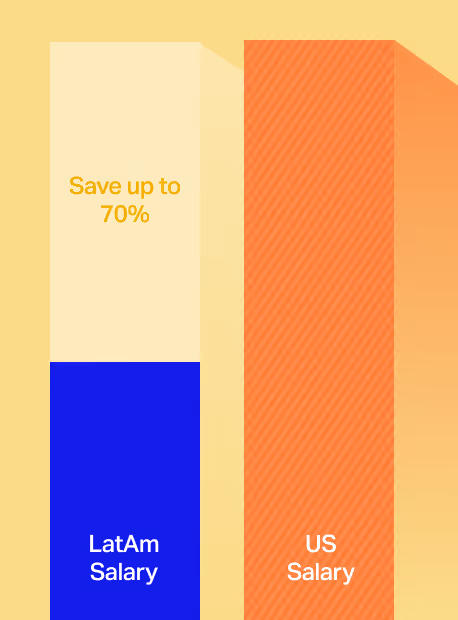
With the same hiring budget, you can bring on a mid-level Latin American professional for 30–70% of what a US equivalent costs. The skills are the same, with educational credentials being comparable or stronger in many cases.
The difference comes down to the cost of living: Latin American professionals earn competitive salaries relative to their local markets, which means the savings are structural, not a sign of lower quality. That's why 84% of Hire With Near's placements are mid-level or senior professionals, not junior talent.
Source: Hire With Near 2026 compensation benchmarks
You can compare specific salary ranges by role on our US vs. LatAm salary guide.
Time zone alignment that makes collaboration real
According to Hire With Near's analysis of 2,000+ hiring conversations, 41% of US companies turn to Latin America because US salary rates make certain roles financially unviable, and 30% are switching from offshore arrangements in Asia to gain time zone overlap.
Latin America spans time zones from UTC-3 to UTC-6, which means your team in São Paulo is never more than two hours ahead of New York, and your team in Mexico City is in the same time zone as Central. Daily standups happen live. Urgent problems get resolved in real time.
A 2023 study from Harvard Business School and INFORMS found that each additional hour of time zone difference reduces real-time communication by 11%, and recommends organizing distributed teams along a north-south axis, like US and Latin America, rather than east-west. That's exactly the alignment nearshore gives you.
The same research found that larger time zone gaps force employees to shift their working hours to maintain communication, creating measurable collaboration friction, increased work-life conflict, and a disproportionate burden on workers in collaborative roles. Over time, that burden shows up in burnout and attrition. Relying on a nearshore company avoids that problem.
Cultural fit with US business norms
Latin American professionals share closer cultural references with US teams than offshore counterparts in Asia or Eastern Europe. Michael Girdley, Co-Founder at Hire With Near, describes it from personal experience:
The great thing about Latin America is it's basically the same time zone, and the cultures are very similar. Living in Texas, I deal with people in Mexico and I'm just like, this is just Texas but a little further south. Pretty much the same thing.
That cultural proximity shows up in how teams work together day-to-day. Franco Pereyra, Co-Founder and COO at Hire With Near, describes what consistently surprises US hiring managers:
What sets Latin American talent apart from other regions is that you'll find people who are proactive and creative, people who come up with ideas and new solutions, who won't just be a yes man. If you're looking for folks who can bring something to the table, who will push back if they think your idea doesn't make sense, that's what you find in LatAm.
Access to a deep, skilled talent pool
Finding the right hire is harder than it used to be. According to ManpowerGroup's 2026 Global Talent Shortage survey, 72% of employers globally report difficulty finding people with the right skills. For US companies competing for the same narrow pool of domestic candidates, that gap is real and expensive.
Latin America expands that pool significantly. Argentina, Brazil, Colombia, and Mexico produce strong mid-to-senior professionals across software engineering, finance and accounting, marketing, operations, and customer support, with US-client experience, English proficiency, and technical depth that matches what US companies expect. When the US market can't deliver the right candidate at the right price, Latin America frequently can.
Further reading: Why Thousands of Leading US Companies Are Hiring Talent in Latin America
Why Is It Hard to Find the Right Nearshore Partner?
The nearshore market has three structural problems that make it hard to evaluate providers fairly: vague service labels, inconsistent vetting standards, and opaque pricing models. Understanding each one helps you ask the right questions before signing.
The market is crowded and the labels are vague
Hundreds of companies call themselves “nearshore” without clarifying whether they offer outsourcing, staff augmentation, direct-hire recruiting, or some combination. Without understanding the difference, you end up comparing unlike options and choosing based on price alone.
The four most common models:
- Outsourcing / managed services: A vendor manages a team or function on your behalf. You pay for output, not headcount. You don't manage the workers directly.
- Staff augmentation: Contractors are added to your team on a flexible basis, typically for a defined period or project. The workers report to you but remain employed by the vendor.
- Direct-hire recruiting: A staffing partner finds, vets, and presents candidates who become your full-time employees. You manage them directly. The staffing partner steps back after placement.
- EOR (Employeof Record): A third party employs the worker on your behalf, handling payroll, compliance, and local employment obligations, while you direct the day-to-day work.
Not every provider vets talent the same way
Some nearshore companies run structured screening processes that assess technical skills, English proficiency, cultural fit, and prior US-client experience before a candidate ever reaches you. Others send resumes with minimal filtering, leaving the hard work of evaluation to your team.
The difference matters more than most buyers realize upfront. A provider that sends volume without vetting shifts the screening burden onto you, which defeats much of the purpose of using a partner in the first place.
Cost models vary widely and hide surprises
Monthly retainers, placement fees, time-and-materials pricing, dedicated team rates: each model has different implications for your budget. Hidden costs like management overhead, compliance fees, or escalating rates after an initial period can change the math significantly.
How To Choose a Nearshore Company That Meets Your Business Needs
This 5-step framework gives you a clear process for selecting a nearshore company and evaluating what to look for in a partner before signing. Work through each step in order.
Step 1: Define what you need
Before you compare providers, decide which model fits your situation. If you need to hand off an entire function with minimal management, you need an outsourcing company. If you want people who work directly for you as part of your team, you need a staffing and recruiting partner.
This decision shapes everything else: the type of company you evaluate, the pricing models you compare, and the way you measure success. Most companies that end up dissatisfied with a nearshore partner made the wrong model choice, not the wrong company choice.
If you're building a team of one to five people in roles where cultural integration is crucial, direct hire is usually the right fit. If you need 20 customer support agents handling tickets around the clock and you want someone else to manage them, outsourcing may make more sense.
Step 2: Evaluate expertise and track record
Once you know the model, look at how well each provider delivers within it.
- Check their track record in your function: A nearshore company that excels at placing engineers may have limited experience with finance or marketing roles. Ask for case studies and client references specific to the department you're hiring for.
- Review portfolios and client results: Success stories should include specific outcomes, like how many roles were filled, what the time-to-hire was, and what cost savings the client achieved. Vague claims like “we provide top talent” tell you nothing.
- Talk to their clients directly: Testimonials on a website are filtered. Ask providers for two or three client references you can call. Ask those references about responsiveness, candidate quality, and what went wrong (every engagement has friction somewhere).
Step 3: Assess cultural compatibility and communication
Technical skills get someone hired. Communication and cultural fit determine whether they stay and succeed.
- Language proficiency is non-negotiable: Argentina ranks 26th globally and 1st in Latin America, and Honduras ranks 32nd globally and 2nd in Latin America in the 2025 EF English Proficiency Index, the only two Latin American countries in the 'High' proficiency band. But proficiency varies widely by country and candidate. Ask your nearshore partner how they screen for English: is it a quick check-box or a structured evaluation with speaking, writing, and comprehension components?
- Time zone alignment should be specific, not assumed: Latin America spans multiple time zones. If you're on Eastern time, a partner placing candidates in Colombia (same time zone) or Argentina (1–2 hours ahead) gives you better real-time overlap than one placing in Chile (1–3 hours ahead, depending on the time of year). Ask which countries the provider sources from and whether they can match your specific overlap needs.
- Cultural fit goes both ways: Latin American professionals generally adapt well to US business practices, but onboarding still matters. Ask your nearshore partner what onboarding support they provide and how they prepare candidates for integration with a US team.
Step 4: Compare cost models and watch for hidden fees
When conducting a nearshore vendor evaluation, the most important question isn't “what's the rate?” It's “What's the total cost of a successful, retained hire?”
Understand the pricing model before starting to compare prices. Outsourcing companies typically charge monthly rates for a managed team (dedicated team model) or scope-based fees (fixed-price projects). Staffing and recruiting companies charge a placement fee or a monthly retainer for the employment relationship.
When talking to a provider, ask about hidden costs upfront. Common surprises include:
- Compliance and payroll fees (especially for direct-hire models where the provider handles employment logistics)
- Management overhead charges
- Rate escalation clauses after the first year
- Additional testing or onboarding fees
- Licensing and tool access costs
The cheapest provider often delivers the weakest vetting, the highest turnover, and the most management overhead. Your goal is the total cost of a successful, retained hire, not the lowest line item.
Step 5: Verify security, compliance, and scalability
- Data security and compliance matter more than you think: If your nearshore team will handle customer data, financial records, or proprietary code, ask about data protection protocols, NDA structures, and compliance with regulations relevant to your industry (HIPAA, SOC 2, GDPR).
- Ask about scalability: If you hire two people now and need ten in six months, can the provider keep up? What's their typical candidate pipeline depth? How long does it take to go from request to offer?
- Check long-term viability: A provider that's growing and investing in their talent network is more likely to support you over multiple hiring cycles. Ask how long they've been operating, how many placements they've made, and what their client retention rate looks like.
Ready to start evaluating? If you're looking for a partner who finds and vets Latin American professionals who work directly on your team, talk to Hire With Near. We place pre-screened candidates in under three weeks, with no upfront payment and a 4.9-star rating on G2.
We ranked No. 118 on the 2026 Inc. 5000, one signal of sustained growth worth checking for in any partner you're evaluating.
How Much Does It Cost To Nearshore?
The cost of nearshoring depends on the model you choose and the seniority of the roles you're filling.
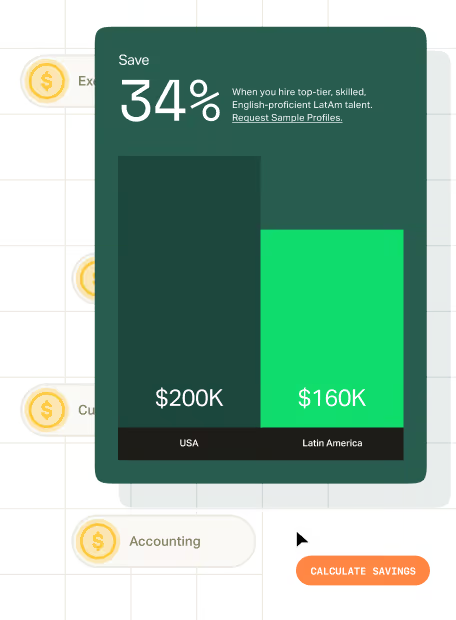
According to Hire With Near's 2026 State of LatAm Hiring Report, companies save 30–70% on salaries compared to US equivalents. The median savings is approximately $50,000 per role.
How that breaks down depends on which model you choose and what seniority level you're hiring for.
Pricing by model
- Outsourcing (managed team): You typically pay a monthly rate per team member that includes salary, management overhead, infrastructure, and the provider's margin. Rates range from $3,000–$8,000/month per person, depending on the role and seniority.
- Staff augmentation: Similar to outsourcing pricing but focused on developers and technical roles. Monthly rates typically run $4,000–$10,000/month for mid-to-senior engineers.
- Staffing and recruiting (direct hire): You pay the candidate's salary directly (or through the provider's payroll service) plus a placement or service fee. Total cost per hire is typically 40–60% of what you'd pay a US employee for the same role.
What the savings look like in practice
These are broad ranges that vary by function, country, and specialization. For role-specific data, see the US vs. LatAm salary guide.
What Are the Risks and Disadvantages of Nearshoring?
No hiring strategy is risk-free. Here are the real challenges of nearshoring, and how to manage each one.
Communication gaps
The risk: Even with strong English proficiency across the region, individual candidates vary. Miscommunication on nuanced topics can slow projects down.
The mitigation: Work with a nearshore partner that runs structured English evaluations, not just a quick conversation check. Ask for writing samples and conduct a live interview before making any offer. The strongest nearshore recruiting firms screen for fluency, not just comprehension.
Legal and compliance complexity
The risk: Hiring across borders introduces payroll, tax, and employment law considerations that don't exist with domestic hires. Getting it wrong can create legal exposure.
The mitigation: Use a provider that offers employer-of-record (EOR) services or works with a local EOR partner to handle contracts, payroll, and compliance. This is standard in the industry. You shouldn't need to set up a legal entity in another country to make your first nearshore hire.
Cultural differences (minor compared to offshore)
The risk: While Latin American professionals share closer cultural alignment with US teams than offshore alternatives, differences still exist in communication styles, feedback norms, and workplace expectations.
The mitigation: Set clear expectations during onboarding. Share your communication norms (how your team gives feedback, how decisions get made, what “urgent” means). Most cultural friction resolves within the first two to three weeks once both sides understand each other's working styles.
Candidate quality variation
The risk: Not every nearshore company vets candidates the same way. Some providers send high volumes of marginally qualified resumes rather than a small number of strong matches.
The mitigation: Ask your provider in detail about their screening process. How many candidates do they interview before presenting one to you? What's their acceptance rate? Do they use technical assessments, behavioral interviews, and reference checks? A strong nearshore recruiting partner presents three to five candidates, not 30.
{{prevetted-banner}}
Choosing the Right Nearshore Company: Your Next Steps
Understanding how to choose a nearshore company comes down to two decisions: which model fits how you want to build your team, and which partner can deliver it. The framework works in five steps: define whether you need outsourcing or direct hiring, evaluate expertise and track record, assess cultural and communication fit, compare cost models honestly, and verify compliance and scalability.
If you're looking to hire Latin American professionals who work as dedicated members of your team, Hire With Near is a nearshore staffing and recruiting specialist focused exclusively on Latin America. We source, vet, and present pre-screened candidates across all industries and departments. Most clients see their first candidates within 3–5 days and complete the hire in under three weeks. There are no upfront costs, and you don't pay until you hire.
Start with a free consultation to talk through your specific roles, get salary benchmarks, and find out whether our model is the right fit for your situation.
Frequently Asked Questions
How much does it cost to nearshore?
You can typically save 30–70% on salaries by hiring in Latin America, depending on the role, seniority, and country. For a mid-level professional, expect to pay $3,000–$5,000/month in LatAm versus $6,000–$10,000/month in the US. In our experience working with 950+ companies, the median savings land around $50,000 per role per year.
Costs also vary by model: outsourcing companies charge a monthly managed-team rate, while staffing firms charge a placement fee or employment service fee alongside the candidate's salary.
What are the disadvantages of nearshoring?
The main disadvantages are communication variance across individual candidates, legal and compliance complexity when hiring across borders, and inconsistent candidate quality from providers that screen lightly. Each of these is manageable with the right nearshore partner.
A strong provider runs structured English evaluations, handles payroll and compliance through EOR services, and presents a curated shortlist of three to five candidates rather than an unfiltered stack of resumes.
What is a key factor in selecting an outsourcing provider?
The single most important factor is choosing the right service model before you compare companies. If you need people managed by the provider, outsourcing is the right model. If you want people who work directly for you, you need a staffing and recruiting partner.
After that, track record in your specific function matters most. Ask for case studies with measurable outcomes, talk to client references directly, and verify how the provider screens candidates.
What are the four types of outsourcing?
The four broad types are: (1) onshore outsourcing, where the provider is in your own country; (2) nearshore outsourcing, where the provider is in a nearby country in a similar time zone; (3) offshore outsourcing, where the provider is in a distant country, often with a significant time zone difference; and (4) hybrid outsourcing, which combines two or more of these models for different functions.
For US companies, nearshore typically means Latin America, while offshore typically means South or Southeast Asia.
How long does it take to onboard a nearshore team?
Onboarding timelines depend on the model and the provider. With a staffing and recruiting partner like Hire With Near, the average time from initial request to a candidate starting work is about three weeks, including sourcing, screening, interviews, and offer.
Outsourcing companies may spin up a managed team in two to four weeks for standard functions, though specialized roles take longer.
What our recruiting team flags consistently is that onboarding speed matters less than onboarding quality: a thorough first two weeks of integration prevents months of communication issues later.
How do you vet a nearshore company before signing?
Start by asking for case studies with specific outcomes: roles filled, time-to-hire, cost savings, and client retention. Then request two to three client references and ask them directly about candidate quality, responsiveness, and what didn't go well. Check third-party review sites like G2 or Clutch for verified ratings.
Ask the provider to walk you through their screening process in detail: how many candidates they evaluate per role, what assessments they use, and what their placement success rate is. A company that can't answer these questions concretely isn't the right partner.
What industries commonly hire nearshore talent from Latin America?
IT and tech companies, SaaS businesses, finance firms, healthcare organizations, and real estate companies are among the most active nearshore hiring sectors, drawn by cost savings and time zone alignment.
The roles span software engineering, accounting, marketing, customer support, and operations. You can expect to save 30–70% on salaries regardless of your sector.
What roles can you hire from a nearshore company?
Nearshore companies in Latin America provide talent across software engineering, finance and accounting, marketing, operations, and customer support.
The most commonly hired roles include software engineers, financial analysts, accountants, marketing managers, customer support representatives, virtual assistants, and operations analysts.
You can discover more in our list of roles US companies are hiring for in nearshore locations. The breadth depends on the provider: some specialize in engineering only, while others cover multiple departments.
What are the best locations to find a nearshore partner?
Argentina, Colombia, Mexico, and Brazil are the strongest nearshore markets for US companies. Argentina leads Latin America in English proficiency and produces strong talent in finance, engineering, and marketing. Colombia and Mexico offer a same-time-zone overlap with US Central and Eastern teams. Brazil has a deep engineering and tech talent pool, though language considerations apply for English-speaking roles.
Our article on the top nearshore locations for US businesses covers each region in detail.







.webp)


%203.svg)
.avif)





%20(1).avif)

%20(1).png)