Key Takeaways
- Hiring offshore Java developers works best in Latin America, where Hire With Near places senior Java engineers who work during your business hours at salaries 41–65% below comparable US hires.
- A Java developer in Latin America earns $48K to $72K a year at mid-level, against $94K to $154K for the same hire in the US, according to Hire With Near's salary data.
- The step that decides the outcome is technical vetting: ask for years of professional experience with your specific framework, then set one small real-world task and review it together on a call.
If you're planning to hire offshore Java developers, the two things that decide whether it works are cost and overlap: what you'll pay compared to a US hire, and how much of your workday the developer shares with you. Hire With Near places offshore Java developers in Latin America specifically because that combination of real savings and a shared working day is hard to get anywhere else.
Java remains one of the most in-demand languages for enterprise systems, and a senior Java engineer who can own that kind of codebase is expensive to find domestically. Going offshore doesn't mean settling for less experience. It means finding that same seniority in a market where it costs less to hire, without losing the ability to run a live code review or a same-day standup.
This guide covers what an offshore Java developer costs by region, how to evaluate a candidate's resume and portfolio before you ever get on a call, and what an interview should actually test for.
What Are the Main Reasons To Hire Offshore Java Developers?
US companies hire offshore Java developers for five reasons that come up again and again: high US salary costs, expertise gaps on the in-house team, the need for extra capacity to ship faster, pressure to keep shipping new things, and the need to add senior engineers early, without a domestic search first.
If you're still weighing it up, here's what drives the decision for the teams that hire offshore Java developers:
Increasing costs
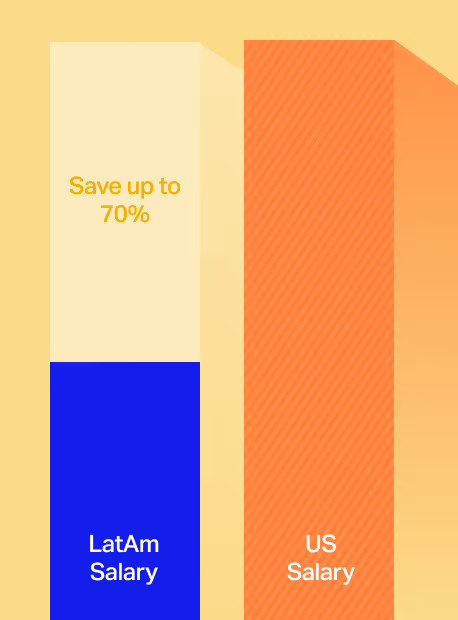
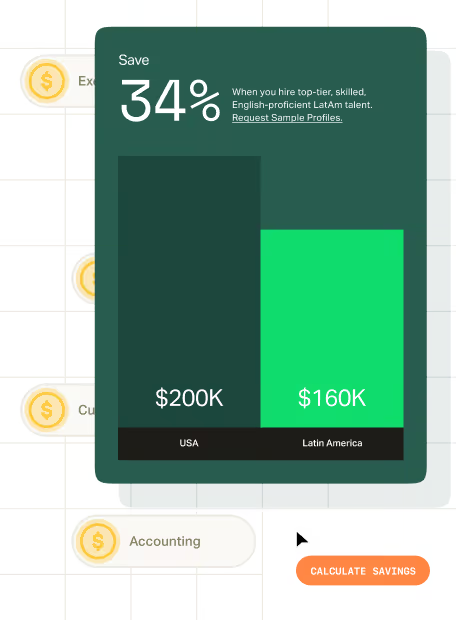
Hiring outside the US is how most teams add Java engineers they couldn't fund at US salary levels. A US mid-level engineer earns from $94K to $154K, while salary levels for Java developers in Latin America, for example, run 41–65% lower for comparable experience, because of the lower living costs in the region.
We cover specific rates for Java developers in a later section, but our comparison of IT salaries in the US and Latin America covers other roles.
In-house developers lacking the necessary expertise
Hiring outside your team is how most companies get a skill nobody in-house has yet, like Kafka event pipelines or a migration off an unsupported Java version.
You're hiring for work someone has already shipped, not paying your own team to learn it.
Additional capacity required to speed up project delivery
Offshore hiring expands your team's total bandwidth without burning out your existing engineers.
Adding headcount in a region that shares your working day doubles down on that speed: new engineers take on sprint tasks immediately without waiting an entire cycle, and blocked tickets get resolved in the same hour instead of slipping into the next day.
Access to patterns your team hasn't used yet
An engineer who has already run a Spring Boot monolith-to-services migration brings a pattern your team hasn't used yet. That's usually why teams hire outside their own stack experience: for a decision someone has already made once.
Limited budget and headcount at an early stage
If you're a startup or a small team, one US mid-level engineer can absorb most of a year's hiring budget. Hiring offshore Java developers early gives you senior engineering capacity without a US payroll commitment.
What Services Can an Offshore Java Developer Provide?
An offshore Java developer can take on any workload a US-based Java hire would. That covers back-end services and APIs, legacy Java modernization, microservices and cloud deployment, Android apps, data pipelines and integrations, test automation, and full-stack delivery.
From the editorial work I do interviewing Hire With Near's engineering recruiters, what trips up most searches is that the job title says almost nothing about the work. Two candidates whose resumes both say Java developer can be doing completely different jobs, and the teams that get burned usually screened for the title instead of the workload.
Hire With Near's nearshore IT and tech recruiting team sees these seven services come up most often.
Back-end application and API development
Most Java work is back-end work: services built with Spring Boot or Spring MVC, REST and GraphQL endpoints, authentication, business logic, and the database layer underneath.
If that's the bulk of your roadmap, what you're hiring is closer to back-end developers or API developers, with Java as the stack rather than the job.
Enterprise system modernization and legacy Java migration
Plenty of offshore Java hires exist to move old code forward. That means breaking a monolith into services, upgrading from an unsupported Java version to a current LTS release, or moving off a legacy application server.
Ask candidates which migration they ran and what broke.
Microservices, containerization, and cloud deployment
Java services rarely ship without Docker, Kubernetes, and a cloud target like AWS or GCP behind them. Some candidates own that pipeline end to end, while others expect a platform team to hand them a deployment path.
Ask about it specifically, because that gap is where projects stall. If nobody on your side owns it, you should hire DevOps engineers.
Android and JVM mobile development
Android apps are written in Java and Kotlin, which share the same runtime environment (JVM), so many candidates move between the two.
That matters if your roadmap covers both a back-end and a mobile client: hiring for that surface means Android app developers and Kotlin developers.
Data-heavy and integration work
Java is the default language for event pipelines and batch processing in a lot of enterprises. That means Kafka producers and consumers, scheduled jobs, integrations between systems, and data modeling across SQL and NoSQL stores.
This is a different skill from CRUD API work, and a strong candidate will tell you which of the two they have shipped.
Test automation for Java codebases
Java teams hire for coverage as much as for features: JUnit suites, Selenium end-to-end runs, and CI pipelines that block a bad merge. Offshore Java experts who write tests as a habit rather than a chore are the ones who keep a growing codebase releasable.
That's why many teams add QA engineers alongside their first Java hire.
Full-stack delivery when Java pairs with a front end
When the team is small, a Java hire often carries the front-end too, usually React or Angular against their own APIs. The tradeoff is depth: one person covering both layers moves fast on a small product and gets stretched thin on a large one.
Before you write the job description, decide which of these seven is 80% of the job. That single decision is what our recruiters use to tell a matching shortlist from a plausible-looking one. It's also what saves you four interview cycles with candidates whose Java experience is real but not exactly what your business needs.
What Are the Top Locations for Offshore Java Development?
Latin America is the strongest offshore region for US companies hiring Java developers, because it's the only one with meaningful working-day overlap across every US time zone. That overlap is what most often decides the outcome.
Studying 12,038 employees of one large multinational, researchers at Harvard Business School, Georgetown University, and Rice University found that each additional hour of time-zone difference cut synchronous communication by 11% and the larger the time-zone gap between two colleagues, the more of their work gets pushed outside normal business hours for one side of the pair.
They suggest that companies whose projects depend on synchronous collaboration might benefit from aligning teams along a north-south axis, such as the US and Latin America, rather than east-west.
Here's how the four main offshore regions compare for a Java hire:
Latin America
Latin America is the strongest fit for most US teams. The engineer is at their desk during your business hours, whether your team runs on Pacific, Mountain, Central, or Eastern time. They can be in your daily stand-up instead of reading the notes.
São Paulo, Buenos Aires, and Mexico City all host engineering offices for global companies, which is where most of the region's senior Java experience was built.
The differences between countries are real, if smaller than most teams expect:
- Brazil has the deepest talent pool and the largest enterprise Java market, so it's where to look for scale; our guide to hiring developers in Brazil covers it.
- Mexico offers the closest overlap with a US working day, per hiring developers in Mexico.
- Argentina ranks highest in the region on the 2025 EF English Proficiency Index, above Switzerland, Spain, and France. See our hiring developers in Argentina guide.
Weighing the region as a whole? Our guide to hiring Latin American developers compares costs and hiring models, and our free guide to hiring remotely in Latin America covers the process across all departments and industries.
Central and Eastern Europe
Central and Eastern Europe has a deep tech workforce, particularly in Poland, Ukraine, and Romania, with long experience serving international clients.
Cost-wise, Eastern Europe sits in the middle: it’s cheaper than hiring in the US, but it won’t match the ultra-low rates of Asia. According to 2024 Eurostat data, hiring tech workers in countries like Poland, Romania, Bulgaria, Hungary, and Czechia costs about half as much as the Western European average.
The working day is the real tradeoff. Java programmers based in Warsaw or Bucharest share your morning at best, and less of it the further west your team sits.
Our comparison of hiring in Latin America versus Eastern Europe breaks that down.
Southeast Asia
Vietnam and the Philippines are among the lowest-cost of the four regions, with large developer populations serving international clients. No statistical authority publishes rates for Java developers on a basis that lines up with the other three, so treat the cost gap as directional.
What does line up is the clock. With little overlap during your working day, a question you send in the afternoon gets answered while you sleep.
Our comparison of hiring in Latin America vs. the Philippines covers how teams handle that.
South Asia
India has one of the largest Java developer populations in the world, with a deep enterprise services industry behind it and long familiarity with Agile methodologies and mainstream Java frameworks.
On the figures that exist, South Asia is the lowest-cost of the four. In the Stack Overflow 2025 Developer Survey, median total annual compensation for back-end developers in India was $22,086, against $175,000 in the United States. Back-end developer is the closest role that survey publishes to a Java hire, and both figures are self-reported, so read them as a market level rather than a quote.
What the salary gap doesn't solve is the calendar. Teams hiring Java programmers 10 or more hours from their own working day lose most of their real-time collaboration, the effect the Organization Science study measured.
Our comparison of hiring in Latin America vs. India works through that tradeoff.
How Much Does It Cost To Hire an Offshore Java Developer?
Hiring a Java developer in Latin America costs $30K to $108K a year, depending on seniority, compared to $82K to $183K for an equivalent US hire, according to Hire With Near's own salary figures.
To put it in concrete terms, here's what hiring at each seniority level costs compared with an equivalent US hire:
For the most up-to-date figures, see Hire With Near's US vs Latin America Salary Guide.
Hire With Near's 2026 State of LatAm Hiring Report uncovers that 98% of the engineering roles we placed last year went to mid-level or senior professionals: 47% mid-level and 51% senior.
As I mentioned earlier, these lower figures in Latin America are a result of the lower cost of living in the region, not lower candidate quality.
Three things move your total hiring cost: the country you hire in, how senior the role needs to be, and whether you hire directly or through a partner.
Related reading: How Much Do Offshore Developers Cost? A Breakdown for US Companies
{{salary-guide-cta}}
What Are the 8 Steps To Hire Offshore Java Developers?
Hiring offshore Java developers takes eight steps: define the workload, choose a region that overlaps your working day, pick a hiring partner, screen resumes, run a structured technical interview, check references, agree on contract terms, and manage the first 90 days.
Step 1: Define your project requirements
Outline the skills and experience level the work needs. Detailed requirements speed up the search and keep the shortlist to candidates who have done the work you truly need.
Step 2: Choose the right offshore location
Where you hire decides how much of your working day you share with the engineer, which is what breaks offshore arrangements most often.
Weigh time-zone overlap, the size of the Java talent pool, and cost.
Step 3: Identify a reputable offshore recruitment partner
Research software development recruitment firms that specialize in helping companies hire offshore talent. They source and screen candidates, so your team only needs to handle the technical interview and the final call.
You have four realistic paths:
- You can source and hire on your own, using an employer of record for payroll, benefits, and compliance abroad. An EOR handles employment logistics, not recruiting, so you still find, screen, and vet every candidate yourself.
- Freelance and contractor platforms are faster and built for project work, with the engineer's attention split across clients.
- Nearshore staff augmentation places a pre-vetted engineer on your team who works under your direction, while the firm stays the legal employer and handles payroll and compliance.
- A specialist staffing and recruiting partner does both: finding and vetting the engineer, then handling employment, payroll, and compliance. That's how Hire With Near helps companies hire software engineers in Latin America, and it's the model behind our LatAm staffing firms list.
ParkMobile, the parking app used in more than 4,200 cities, had let agency developers own its backend work for years, which its engineering leadership saw as a business risk. US rates of $148K to $214K per role ruled out hiring domestically.
Working with Hire With Near, ParkMobile replaced them with nine senior in-house engineers in Colombia, saving $1,066,085 a year at a 24-day average time-to-hire. Their TA lead described the result:
Collaboration with Hire With Near is solving the problem of entering a completely new market for us. They have been an invaluable partner in this expansion, helping to successfully close roles quickly. Their deep understanding of the local talent landscape is what allows them to source and vet top-tier candidates efficiently.
— Akshay Gokarnakar, TA Lead, ParkMobile
He also praised the partnership with Hire With Near in the video below, where he detailed the experience:
That 24-day average is a realistic timeline, with the fastest placement in 18 days and first shortlists within a week. Short notice periods in Latin America are a large part of why.
Step 4: Review resumes and portfolios
Evaluate resumes for experience with Java and the frameworks your roadmap needs, plus shipped work that looks like the work you're hiring for.
Resumes are also where the fake-senior problem lives, and it got worse once AI made polishing one trivial. Federico Bilello, Recruiter for Software Engineering at Hire With Near, has a standard move for it:
I always ask for years of professional experience with a specific tool, not total experience. Some candidates count their university thesis work or barely-touched freelance projects. A client doesn't care about that. They want to know how many years of real, professional, on-the-job experience you have with this tool.
— Federico Bilello, Software Engineering Recruiter, Hire With Near
Two other red flags our recruiters watch for:
- A candidate who can't say what their actual role was on a past project.
- A claimed skill set so broad it can't be real. Nobody has six years of professional experience with six different languages.
Our guide to how to spot a fake senior developer covers the rest.
Step 5: Conduct interviews
A structured technical assessment plus a live conversation is the only reliable way to know whether an offshore Java hire can code in production. The interview tests how they write code, how they explain a past decision, and how clearly they write.
In practice, that means one small real-world task: debug a piece of code, refactor for scalability, or build a basic API with tests. Review it together on a call, and keep the loop short, because strong offshore Java experts drop out of four-stage marathons.
Ask how they handle data modeling and whether they've used both SQL and NoSQL, then ask about microservices and Docker, CI/CD pipelines, and framework choice.
On English skills, separate fluency from accent. What matters is whether the engineer can explain an architectural tradeoff or a production incident to a non-developer, unprompted. Ask for a written sample too, because pull requests and documentation are where the problem shows up.
Step 6: Check references
Contact references to validate the candidate's experience. References are where you find out whether they hit deadlines and how their code held up after they left.
Step 7: Negotiate and finalize contracts
Define clear terms for scope, timelines, deliverables, and international payment.
Then, ask any provider four questions about what happens if the hire doesn't work out:
- How long does the guarantee period run?
- Is it a replacement search or a refund?
- Who pays for the second search?
- What triggers it: a resignation, a performance issue, or both? Get the answers in writing; a provider that has thought it through will answer in specifics.
Step 8: Monitor work and provide feedback
After onboarding the Java developer, keep a regular rhythm: a weekly one-on-one, a sprint review, and written feedback on the first pull requests. That catches problems in week two instead of month three.
5 Tips for Hiring Offshore Java Programmers
Five tactics widen an offshore Java search beyond job boards: referrals, tech conferences, freelance portals, LinkedIn and developer communities, and review sites like Clutch and GoodFirms. They matter most if you're sourcing on your own rather than working with a software engineer recruitment partner.
1. Ask your contacts for referrals
Colleagues and industry peers who have hired offshore developers can tell you who delivered and who didn't, which is the one reference you can't get anywhere else.
2. Participate in conferences
Tech conferences are a good place to meet Java engineers in person before there's a job to fill. Use them to:
- Meet potential developers face-to-face
- Understand the latest trends in Java development
- Hear how candidates explain their own work
- Connect with development firms specializing in offshore talent
3. Hire from freelance portals
Freelance portals host thousands of profiles where you can find talented offshore freelancers or development firms, with client reviews to sort them by.
4. Use social media
LinkedIn and developer communities let you filter by framework and years of experience, and reach engineers who aren't applying to job posts.
5. Read reviews online
Clutch and GoodFirms carry client reviews of offshore development companies, which is the fastest way to rule one out before you spend an hour on a call.

Final Thoughts
Hiring offshore Java developers works when you hire in a region that shares your working day and vet for professional experience with your actual framework. Demand for skilled Java developers and other engineering roles keeps rising. Offshore hiring is how many US companies now fill senior roles they can't fill at US salary levels.
The partner you pick decides most of the rest. Hire With Near connects US companies with senior Java engineers who have shipped production Spring and microservices work, and helps them hire remote software engineering talent in Latin America across the wider team.
We also handle executive search in Latin America for VP of Engineering, CTO, and engineering manager roles.
The best next step is to book a free consultation and talk through your requirements with our team. You'll get salary benchmarks for the roles you're filling and a walkthrough of how the process works.
{{latam-hiring-cta-v2}}
Frequently Asked Questions
Is Java still in demand in 2026?
Yes, Java remains one of the most widely used languages in professional software development. In GitHub's 2025 Octoverse report, Java was the fourth most-used language on the platform, adding roughly 174,700 new contributors, up 20.73% year over year. GitHub attributes that to steady enterprise-driven growth.
That activity sits exactly where offshore hiring happens: backend services, financial systems, and large enterprise codebases nobody is rewriting. Demand for Java programmers follows the code that already exists.
How much does it cost to hire an offshore Java developer?
Hiring a Java developer in Latin America costs $30K to $108K a year depending on seniority, according to Hire With Near's salary data, compared to $82K to $183K for the equivalent US hire.
Three things move your number: how senior the role really needs to be, the country you hire in, and whether you hire directly or through a partner.
Our breakdown of offshore developer rates compares those paths.
How do you hire an offshore development team?
Hire an offshore development team one role at a time, starting with the most senior engineer, rather than buying a pre-assembled squad. That way each person is yours, reports to you, and can be replaced without renegotiating a contract.
Define the workloads first, keep the whole team in one region so they share a working day, and vet every hire with a small real-world task.
Our guide to hiring an offshore development team and the questions tech leaders ask about hiring developers in Latin America go deeper on both.
Is AI replacing Java developers?
No. AI coding tools are changing what Java engineers spend their day on, not removing the need for them. GitHub's Octoverse data shows Java contributor activity growing more than 20% in 2025, which GitHub puts down to steady enterprise demand.
What engineering leaders tell our recruiters is that AI raises the bar on the human part of the job. That means reviewing generated code, designing services that hold up under load, and owning production incidents. Those are senior skills, and they're what to vet for.
Where can I hire offshore Java engineers?
Latin America is the best place for a US company to hire offshore Java engineers, because it's the only offshore region with meaningful working-day overlap across every US time zone. Brazil, Mexico, Argentina, and Colombia all have deep pools of Java experts already serving US clients.
Central and Eastern Europe, Southeast Asia, and South Asia are viable if your work is asynchronous, but you give up the live stand-up and the same-day answer.
What other engineering roles can I hire from Latin America?
Beyond Java developers, US companies hire the full range of engineering roles from Latin America, including remote software engineers, full-stack developers, full-time QA engineers, and nearshore DevOps engineers. Teams adding offshore Java capacity most often pair it with QA and DevOps.
The working-hours overlap that makes a Java hire work makes code review, releases, and incident response work too. Latin American engineers in these roles bring comparable technical depth to US-based hires at 30–70% lower salary cost.