%203.svg)
Key Takeaways
- Offshore mobile app development means building your iOS or Android app with a team based outside the US, and the first decision is whether to hand a one-off build to a development agency or build your own offshore team for an app that stays central to your product.
- The three most common regions to offshore to are Latin America, Asia, and Eastern Europe, and how much real-time, same-workday overlap your build needs is usually what decides between them.
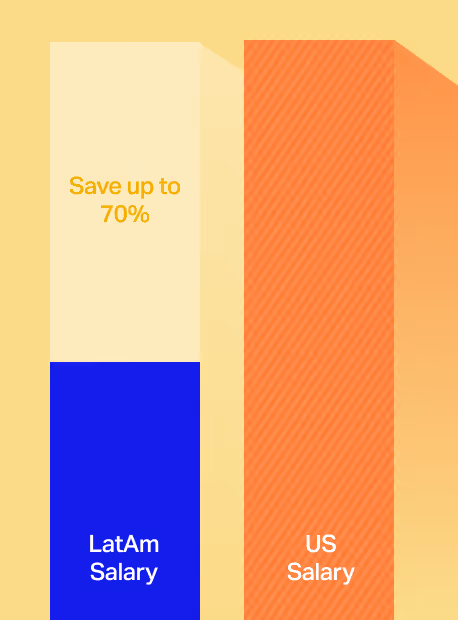
- Hiring mobile developers in Latin America typically costs 30 to 70% less than comparable US salaries, which is the main reason most US companies offshore in the first place.
Offshore mobile app development is how a growing number of US companies ship an iOS or Android app without paying US engineering rates. The first real decision is how you staff it: hand the whole build to a development agency, or build your own offshore team that you employ and direct.
A one-time app usually points to an agency. An app that sits at the core of your product and needs ongoing maintenance points to your own team. In Latin America, you can build your own offshore development team that shares your workday, not one you hand off to overnight.
This guide covers both paths, where to offshore, what it costs, and the companies to consider for each. Full disclosure: Hire With Near is one of them, and I'll be clear about where it fits and where another company is the better call.
Why Should You Offshore Mobile App Development?
Offshore mobile app development gives you access to experienced iOS and Android developers at 30 to 70% lower cost than comparable US hires, with the flexibility to scale a team as your product grows.
The market rewards moving fast: there were nearly 150 billion app downloads across the App Store and Google Play in 2025, and competition for mobile talent in the US stays steep and expensive.
Offshoring means hiring talent from other countries to handle your mobile app development. It gives you a strategic alternative to building an in-office team at US salaries or working with a domestic agency. Here is what makes it a smart move for US businesses:
Cost savings
Hiring mobile developers offshore costs far less than hiring locally in the US, where developer salaries are among the highest in the world. In regions like Latin America, a lower cost of living means you can hire experienced developers for 30 to 70% less than comparable US salaries, without compromising on quality.
Extended talent pool
Offshoring connects you with experienced developers well beyond your local market. Different regions bring different strengths: Latin America for real-time collaboration during your workday, Asia for cost efficiency at scale, and Eastern Europe for deep technical specialization. Choosing between them is one of the most important calls you will make, and we cover it in detail below.
Focus on core business
Sending your mobile app development offshore lets your in-house team focus on marketing, operations, and scaling the business while your offshore team handles the app. This division of labor keeps your core team channeling its energy into growth instead of being stretched too thin.
Scalability
Whether your project is growing fast or you need a specialized skill for one phase of work, you can scale your offshore team up or down without the lengthy process of hiring full-time staff or laying workers off. That flexibility is valuable for startups and any business with fluctuating demand or tight timelines.
Faster time-to-market
If shortening development timelines is critical, the right offshore setup keeps work moving without the overnight lag. A team that shares your working hours can pick up tasks, ask questions, and hand work back the same day, so progress does not stall waiting on a reply. That real-time pace is one reason US companies lean toward Latin America over more distant regions.
Beyond overlapping schedules, offshoring speeds up delivery by giving you specialists who can address specific project needs quickly, reducing the delays of upskilling your internal team. Experienced offshore teams also tend to work with established, agile processes that help them ship quality work on shorter timelines.
When Should You Offshore Mobile App Development?
Offshore mobile development makes the most sense when you need specialized skills, want to scale quickly, or are working to a tight budget. There are a few situations where it is clearly the right call:
- When you want to bring on different levels of expertise quickly: The best software engineer staffing agencies can connect you with expert developers, from junior to senior roles.
- When your in-house team lacks a specific skill: Offshoring connects you with specialists who can fill the gaps.
- When you have a tight budget: Offshoring is often the most cost-efficient way to get quality development without exceeding your financial limits.
- When you need a quick turnaround: With continuous development cycles, offshore teams can speed up the process considerably.
- When you are scaling your app: An offshore team can grow alongside your project as your needs evolve.
In some cases, keeping development in-house is the better choice, especially when you are handling highly sensitive data or need full control over the process. Weigh the pros and cons for your specific project first.
Once you have decided offshore is right for you, the next question is how to staff it.
Should You Offshore to a Development Agency or Build Your Own Offshore Team?
The deciding factor is whether your app is a one-time build or part of your core product. A one-off or well-defined app is usually a good fit for a development agency that plans, builds, and ships it. An app that stays central to your business and needs ongoing maintenance, new features, and someone who still knows the codebase a year from now is a reason to build your own offshore team.
Getting this decision wrong shows up later. One two-person software team behind a US tax-industry app learned it the hard way after the offshore contractors who built their product delivered an MVP and then went quiet:
The app we’re really talking about was developed by some people in Ukraine, and they’ve since kind of disappeared or fell off the map to us. So we were looking for either a direct hire, a team, or an agency we could work with to put more development into the application. It’s really kind of an MVP right now.
They had treated a core, evolving product like a one-off build. Once an app is live and needs continued work, you need people who stay.
There are a few ways to staff offshore mobile work. Here is how they compare, from handing off the most control to keeping the team in-house.
Hand the build to a development agency
A development agency is the right call for a one-off or well-defined app. The agency plans, builds, and ships the product with its own developers and project managers, and you get a finished app without managing the day-to-day. It works best when you have a clear spec and do not expect heavy maintenance afterward, because the agency's developers move on to the next client once the build is done.
If this is your situation, the best LatAm outsourcing companies are a strong starting point, and it's worth thinking through whether to hire in-house or hand the work to an agency before you commit.
Hire freelancers from a marketplace
A freelance marketplace gives you the fastest access to individual developers for a specific, short-term gap. You engage vetted freelancers directly and manage the work yourself, which suits a narrow need or a specialized skill you need for one phase.
The trade-off is that you own quality control and continuity, and freelancers usually split their attention across several clients at once. It is a reasonable option for a small, contained piece of work, and a risky one for an app you plan to keep building.
Add capacity with staff augmentation
Staff augmentation places pre-vetted developers onto your team to work under your direction, while the firm stays their legal employer and handles payroll, benefits, and compliance. It sits between a freelance marketplace and a permanent team: more accountable and vetted than a marketplace, more flexible than a full-time hire.
It fits companies that want to scale a team up or down or staff a defined project without committing to permanent headcount. For technical builds, nearshore staff augmentation adds an embedded developer to your team quickly, and it's a way to add capacity, never a build-it-yourself shortcut.
Build your own offshore team
When your app is core to the business and needs a team that stays, building your own offshore team is the strongest path. You hire developers who work only for you, and a staffing and recruiting partner like Hire With Near sources, vets, and handles payroll and compliance, so you get both jobs, finding the talent and employing it, in one relationship.
That is what makes it the simplest option when your app needs continuity: an employer of record can handle payroll and local compliance, but it does not source or vet anyone, so a partner that does both closes the gap.
You can start with one developer to test the model and scale to a full team with the same partner, and for senior technical leadership, Hire With Near also handles executive search in Latin America for roles like VP of Engineering or CTO.
A US healthtech startup we worked with shows how this path scales. Growing fast with only two internal recruiters, the company refused to lower its rigorous eight-step technical hiring process.
Hire With Near took over sourcing, screening, and coordination while the internal team stayed focused on evaluation. The company built its own team of seven senior engineers, including a senior React Native mobile engineer, at a 14-day average time to hire and $323,000 in annual savings versus US salaries, a 33% reduction, with the full eight-step bar intact.
The best LatAm staffing firms work this way, and there is more on the mechanics in this guide to how to hire an offshore development team.
The short version: a one-off or well-defined build points to an agency, or a freelancer for a narrow gap; a core product that needs continuity points to your own team, with staff augmentation as the middle path when you want flexible capacity before you commit to permanent hires.
Here’s why the strongest developers often prefer joining your team directly rather than working through a dev shop:
[Video: “Why Top Developers Prefer Direct Hire Over Dev Shops” (Long video, IT & Engineering) URL: https://youtu.be/cHk43fICBi8]
Where Should You Offshore Your Mobile App Development?
The three most popular regions for offshore mobile development are Latin America, Asia, and Eastern Europe, and the right one usually comes down to how much real-time overlap your build needs, alongside cost, talent depth, and English fluency. For collaboration-heavy mobile products, time-zone overlap tends to be the deciding factor.
The wider your team's daily overlap, the more you can run live standups, get same-day answers, and hand off work while everyone is at their desk. For a well-specified build you can hand off and check on weekly, a distant region can work fine.
For an evolving product with a lot of back-and-forth, a region that shares your workday saves you from losing days to overnight feedback loops. If you want to compare specific countries, our guide to the 22 best countries to hire remote software engineers and developers is a good place to start.
Latin America
Latin America's biggest advantage for US companies is overlap: a developer in the region works during your business hours, whoever and wherever you are in the US, so collaboration happens in real time instead of on a next-day delay. That holds whether your team runs on Pacific, Mountain, Central, or Eastern time, and most of Latin America shares nearly your whole workday.
The research backs this up. A peer-reviewed study from Harvard Business School and INFORMS researchers found that when work depends on real-time collaboration, distributed teams do best organized along a north-south axis, such as the US and Latin America, so colleagues share working hours instead of spreading east-west across the globe.
The talent pool is deep and growing. According to GitHub’s 2025 Octoverse report, Brazil now has approximately 6.9 million developer accounts on GitHub. Country-level figures for the rest of Latin America weren’t released in the 2025 edition, but the 2024 report counted Mexico at 1.9 million, Argentina at 1.1 million, and Colombia at 1 million, all with double-digit year-over-year growth.
Latin America has become a top choice for US companies building remote teams, one of the reasons US companies increasingly hire in Latin America. For most US teams, nearshore IT and tech recruiting increasingly centers on the region for exactly these reasons: shared hours, cultural alignment, and proximity that makes a quick call easy.
In my nearly four years recruiting technical talent at Hire With Near, the difference that matters most between hiring in Latin America and hiring further offshore is the time zone: when the working day lines up, questions get answered the same day instead of the next. Across the engineers and app developers I have placed for US clients, Brazil and Argentina tend to offer the deepest mobile talent pools, and candidates who have worked with US clients before are already used to US communication norms.
Franco Pereyra, Co-Founder and COO at Hire With Near, puts the regional difference this way:
What sets Latin American talent apart from other regions is that you'll find people who are proactive and creative. People who come up with ideas and new solutions. If you're looking for folks who can bring something to the table, who will push back if they think your idea doesn't make sense, that's what you find in Latin America.
— Franco Pereyra, Co-Founder and COO, Hire With Near
One US manufacturing and technology company that had struggled with an agency-managed offshore model described how it landed on the region:
We kicked off a project to say, where could we look outside the US that might have maybe a 50% cut in payroll costs? We quickly focused on Latin America because of the overlap in time zones. Given the high bar of expectations, there’s a lot of hands-on interaction expected, and a lot of need for overlapping hours.
Asia
Asia, including India, Vietnam, and the Philippines, offers large talent pools and the strongest cost efficiency of the three regions. The trade-off is the working-hours gap. By the time a US team starts the day, much of the Asia workday has already wrapped, so an afternoon question usually waits until the next morning for a reply.
For a well-defined build with clear specs and asynchronous handoffs, that model can work well. For a collaboration-heavy product, the overnight gap adds up.
Asia is a strong fit for cost-sensitive, well-specified projects where real-time collaboration matters less. If you are weighing it against a nearshore option, this comparison of hiring remote talent in Latin America versus India breaks down the differences.
Eastern Europe
Eastern Europe, with hubs in Poland, Ukraine, and neighboring countries, is known for deep technical specialization, which makes it a fit for complex, enterprise-grade, or highly customized builds. Developers there share part of the US morning, so East Coast teams get a few hours of daily overlap, though less than a nearshore option gives you, and West Coast teams get very little.
It is a good choice when technical depth on a specialized stack matters more than a full day of overlap. For a closer look at the trade-offs, see this guide to hiring remote talent in Latin America versus Eastern Europe.
How to Offshore Mobile App Development in 7 Steps
Offshoring app development goes smoothly when you follow a clear process. Here are seven steps to get from an idea to a working offshore team.
Step 1: Have a solid outline for your app
Clearly define your app's purpose, features, and target audience. Aligning the app with your broader business goals makes sure the final product supports your growth and customer engagement, and it gives both you and your offshore team a shared foundation for the whole build.
Step 2: Set your budget
Set a realistic budget that covers development, maintenance, and contingencies. Offshoring saves money, but a clear financial plan keeps you from being caught unprepared later.
Step 3: Choose your offshore region and model
Decide where your developers will sit and how you will engage them. Onshore developers work in your own country and cost the most. Offshore developers are usually in distant countries, which lowers cost but can add real-time communication gaps. Nearshore is a type of offshoring where developers work in nearby countries that share your business hours, such as hiring remotely in Latin America. As covered above, the region you pick shapes both your cost and how much of your workday you share, so match it to how collaborative your build is.
Step 4: Assess and vet developers
Evaluate developers on their portfolios, references, technical skills, and experience with projects like yours. A thorough assessment is what separates a team that fits your vision from one that does not.
When I'm assessing an offshore developer, the most reliable signal is whether they can walk me through a project they built, explain their role, and describe it clearly without hiding behind jargon. I also tell clients not to make a four-year degree a hard requirement, because many strong Latin American engineers started shipping production code before they finished school. If someone claims to be holding down three separate roles at once, that is worth probing, and most rejections I see come down to a failed technical assessment or communication gaps in the interview.
Step 5: Choose the right engagement model
Pick an engagement model that suits your project:
- Fixed price for clear, defined requirements
- Time and materials for flexibility on evolving projects
- Dedicated team for long-term collaboration on a core product
Each option offers a different balance of control, cost efficiency, and adaptability.
Step 6: Set up a strong legal and IP foundation
Draft contracts that cover confidentiality, intellectual property rights, and clear deliverables. A clear understanding of the legal side protects your project and keeps the collaboration running smoothly.
Step 7: Set clear communication with your team
Establish clear communication protocols from day one. Regular check-ins, progress reports, and shared project management tools keep everyone on the same page and the project on course. Understanding and working with cultural differences also builds stronger collaboration and heads off misunderstandings.
How Much Does Offshore Mobile App Development Cost?
Hiring a mobile developer offshore in Latin America typically costs $48,000 to $120,000 a year, compared with $83,000 to $188,000 for a comparable US hire, based on our salary data. Rates vary by platform, seniority, and region, but the savings are consistent.
To see how the main mobile roles compare, here are Latin America and US salary ranges from Hire With Near's salary benchmarks:
For the most up-to-date figures, see Hire With Near's US vs Latin America Salary Guide.
The gap means a company can hire a more experienced mobile developer in Latin America for what a mid-level US developer would cost, and you can put real numbers on the difference with our hiring cost savings calculator. Those savings come from the region's lower cost of living, not from paying developers less than their work is worth. The ranges shift by seniority and specialization, which our IT roles salary guide for Latin America breaks down in more detail.
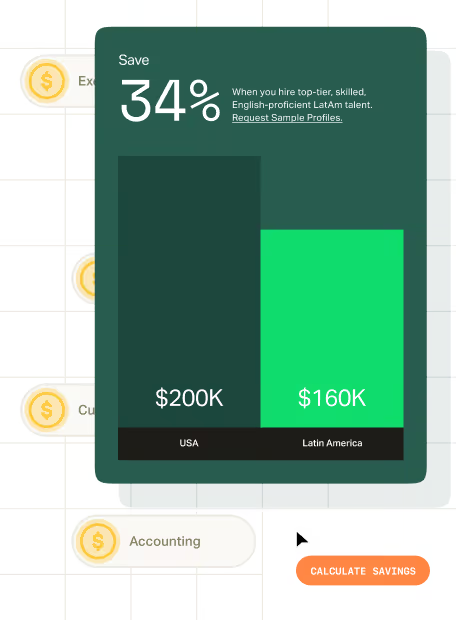
The savings add up across a team. According to Hire With Near's 2026 State of LatAm Hiring Report, companies save an average of $35,000 to $64,000 per hire compared with equivalent US salaries.
A few factors move the total cost:
- App complexity: Simple apps cost less, while advanced features, integrations, and custom design raise the price.
- Developer seniority: Senior and specialized developers command higher rates than junior ones.
- Region: Different offshore regions carry different rates based on local cost of living.
- Project scope: Longer builds with ongoing updates and maintenance need more hours.
Whichever route fits your budget, working with an established partner or agency, such as the best companies to hire top LatAm developers, keeps quality high as your costs come down.
Where to Hire Offshore Mobile App Developers
The offshore mobile app development companies below map to the two paths in this guide. To build your own dedicated offshore mobile team, Hire With Near sources and vets it for you in Latin America.
For an agency that owns the build, Cheesecake Labs, BairesDev, Innowise, Netguru, STX Next, Hyperlink InfoSystem, Appinventiv, and MindInventory each ship apps end to end. Toptal sits between the two: a network where you engage vetted developers directly.
These offshore mobile app development reviews use client ratings only: I included companies with at least 50 client reviews and a 4.5 or higher rating on an established platform, whether G2, Clutch, Trustpilot, GoodFirms, or ClearlyRated. From there, I compared mobile track record, platform coverage, region and time-zone fit, and pricing signals on each company's own site.
The list is in no particular order. There is no single best option for everyone; the right fit depends on your app, your budget, your timeline, and how hands-on you want to be. Treat this as a shortlist to start from, then talk to a few.
Before the specifics, the obvious. Every company here can build a working mobile app with offshore talent for less than a US in-house team, on both iOS and Android, backed by experienced developers and a real portfolio. Those are table stakes.
What separates them:
- whether you build your own team or rent theirs
- where their developers sit, and how much your workday overlaps
- how much of the build, and the maintenance after launch, they take on
Here is where each one fits.
Note: To keep the list up to date with our selection criteria, we regularly check ratings on third-party review sites and update the article as required.
Build your own offshore team (staffing and recruiting model)
When your app is core to the business and needs a team that stays, this is the path. You hire developers who work only for you, and a nearshore staffing and recruiting partner sources, vets, and runs payroll and compliance.
Hire With Near

Website: hirewithnear.com
Headquarters: United States, with recruiting across Latin America
Rating: 4.9/5 on G2 (140+ reviews) as of July 2026
Services: Nearshore staffing and recruiting, direct hire, staff augmentation, and executive search
Focus Regions: Latin America only
Hire With Near is a full-service staffing and recruiting agency that helps US companies hire top-performing remote talent in Latin America across all departments and industries, including mobile and app developers.
We handle the whole hire end to end: sourcing, vetting, candidate presentation, payroll, compliance, and onboarding, so a developer is working on your app, not managing an agency relationship.
We are the one option here that helps you build your own offshore team rather than rent one. You employ the developers, you direct their work, and they stay on your app as it grows, which is what you want when mobile is part of your core product.
Every candidate is matched to your stack and your culture from a pre-vetted pool of 160,000+ Latin American professionals, and we have placed talent for 950+ US companies, including Expensify and Deel. Hire With Near is also named to the Clutch 100 list of the fastest-growing B2B providers globally.
Key features:
- Elite talent for mobile and app development: We place iOS, Android, React Native, Flutter, and full-stack mobile developers, with specialist tech recruiters who screen beyond the resume for real-world impact. We ask developers to walk through what they built and why, so you see how they think before they touch your codebase.
- Quality-first approach: Our 97% placement rate and 9.1+ client satisfaction come from obsessing over fit: skills plus the drive, readiness, and cultural match to contribute from day one and stay for the long term.
- One partner, one process: Scale across functions, not just mobile, with one dedicated team and a repeatable hiring cadence. First candidates in three to five days with video introductions, most hires in under three weeks. We remember what worked last time and adapt to your feedback so hiring gets easier over time.
- Long-term retention: 80% of our hires stay 2+ years, so the people who learn your codebase are still there to maintain and extend it, not hopping between contract gigs.
Best for: Companies whose mobile app is part of their core product and who want a dedicated Latin American team they employ and keep, hired fast without lowering the technical bar.
Client perspective: "The entire process from initial conversation to hire was remarkably fast: just two weeks to have multiple strong options." (Verified client review, G2)
Limitations: Latin America only, so this isn't the path for a purely one-time build you never plan to maintain, or for teams that specifically want an agency to own delivery and project management.
Pricing: Transparent benchmarks and fees shared up front; you set salaries; no upfront cost until you hire. Two models: direct hire (one-time fee) or monthly staffing (payroll and compliance included).
Development agencies (they own the build)
Best for a one-time or well-defined app: the agency plans, builds, and ships it with its own team and project managers. You get a finished product, and the agency's developers move on to the next client afterward.
Cheesecake Labs
Website: cheesecakelabs.com
Headquarters: Brazil (US office in San Francisco)
Rating: 4.9/5 on Clutch (60+ reviews) as of July 2026
Services: Mobile and web app development, product strategy, UI/UX design, staff augmentation
Focus Regions: Latin America (Brazil)
I included Cheesecake Labs for the combination many US teams want and rarely get from an agency: strong mobile engineering with nearshore time-zone overlap in one place. The Brazil-based studio has shipped 300+ digital products since 2013, with deep work in iOS, Android, and React Native alongside product strategy and design. Because delivery sits in Latin America, its developers work close to US hours, and its portfolio leans toward polished, design-led consumer and fintech apps rather than high-volume outsourcing.
Key features:
- Dedicated squads that stay with a product from strategy through launch and iteration.
- Named among Clutch's top global mobile and web app developers.
- Comfortable with blockchain, IoT, and AR when a build calls for it, beyond standard mobile.
Best for: Funded startups and product teams that want a design-forward mobile build with nearshore overlap.
Limitations: A boutique studio rather than a staffing partner, so it is built for projects, not for placing a developer you employ directly.
Pricing: Not publicly listed; project-based quotes.
BairesDev

Website: bairesdev.com
Headquarters: United States (founded in Argentina)
Rating: 4.9/5 on Clutch (60+ reviews) as of July 2026
Services: Custom software and mobile/web development, staff augmentation, dedicated teams, QA, AI, and data
Focus Regions: Latin America (Americas)
BairesDev earned a spot for scale. Founded in Buenos Aires in 2009 and now run from San Francisco, it fields 4,000+ engineers across Latin America and has delivered for enterprises including Google and Johnson & Johnson. For a US company that needs to stand up a large mobile and backend effort quickly, or add senior engineers to an existing team, its bench depth and nearshore footprint are the draw. It works through dedicated teams, outsourced projects, and staff augmentation.
Key features:
- Markets a highly selective, top-1% hiring process aimed at senior engineering.
- Broad service range beyond mobile: AI, data science, QA, and UI/UX under one roof.
- Nearshore time-zone alignment with US teams despite enterprise scale.
Best for: Enterprises and scale-ups that need a large nearshore engineering effort, not just a single app.
Limitations: Built for mid-market and enterprise scale, so it can be more than a small team with one app needs.
Pricing: Not publicly listed; contact for a quote.
Innowise

Website: innowise.com
Headquarters: Poland (offices worldwide)
Rating: 4.9/5 on Clutch (70+ reviews) as of July 2026
Services: Custom software development, mobile app development, IT consulting
Focus Regions: Eastern Europe (global delivery)
Innowise brings serious enterprise-grade custom development depth. Founded in Poland in 2007, it has grown to more than 2,000 specialists serving both IT and non-IT sectors worldwide, and builds custom mobile solutions end to end. It is a fit for companies that want a large European partner with a long track record and broad domain coverage, and its scale suits complex, regulated, or highly customized builds.
Key features:
- Deep bench across mobile, web, cloud, data, and emerging tech for complex builds.
- Comfortable in regulated and enterprise domains, from healthcare to finance.
- Global delivery centers, useful for large or multi-region programs.
Best for: Companies wanting a large European partner for complex or highly customized mobile builds.
Limitations: Eastern European time zones mean less real-time overlap with US teams than a nearshore option.
Pricing: Not publicly listed; contact for a quote.
Netguru
Website: netguru.com
Headquarters: Poland
Rating: 4.8/5 on Clutch (70+ reviews) as of July 2026
Services: Mobile and web app development, product design, AI, consulting
Focus Regions: Eastern Europe
What stood out about Netguru is how it treats an app as a product rather than a spec to implement. The Poznań-based agency has spent over 15 years pairing engineering with strong product and UX design, which shows in polished, user-facing apps. It is a fit for venture-backed startups and enterprises that want design and build handled together by an established European team.
Key features:
- Native (Swift, Kotlin) and cross-platform (React Native, Flutter) mobile development.
- 600+ specialists with 1,000+ delivered projects behind their process.
- A growing AI and product-consulting practice for teams modernizing an existing app.
Best for: Startups and enterprises that want design-forward digital products, not just code.
Limitations: Eastern European hours reduce real-time overlap with US teams, and it carries a premium positioning.
Pricing: Not publicly listed; contact for a quote.
STX Next

Website: stxnext.com
Headquarters: Poland (delivery centers in Poland and Mexico)
Rating: 4.7/5 on Clutch (100+ reviews) as of July 2026
Services: Software development, mobile and multi-platform apps, data, AI, DevOps, QA
Focus Regions: Eastern Europe (with Mexico nearshore delivery)
I added STX Next for teams whose mobile app leans on a serious backend, data, or AI layer. Founded in Poland in 2005, it is one of Europe's largest Python-focused engineering firms, and that backend depth is the reason to pick it over a pure app shop. It is a strong fit for data-heavy or ML-driven products that also need a polished mobile front end.
Key features:
- Around 500 engineers with 1,000+ projects, strongest in Python, data, and AI.
- React Native and full-stack mobile for the client-facing side of a product.
- Delivery from both Poland and a Mexico nearshore center, which improves US overlap.
Best for: Data-heavy or AI-driven apps that need a strong backend under the mobile layer.
Limitations: Less of a pure design studio, and Poland hours unless you use the Mexico center.
Pricing: Not publicly listed; contact for a quote.
Hyperlink InfoSystem

Website: hyperlinkinfosystem.com
Headquarters: India (offices in the US, UK, and UAE)
Rating: 4.8/5 on Clutch (170+ reviews) as of July 2026
Services: Mobile app development (iOS, Android), web, UI/UX, blockchain, AI
Focus Regions: Asia (India)
Hyperlink InfoSystem is the high-volume option here. Founded in Ahmedabad in 2011, it reports 4,500+ apps delivered for 2,700+ clients across 85+ countries. For a straightforward app on a tight budget, or a business that wants a lot built quickly, its scale is the appeal, and it carries the largest verified review count of any development agency on this list.
Key features:
- Broad platform coverage across iOS, Android, web, blockchain, and AR/VR.
- High delivery throughput, suited to cost-sensitive or fast-turnaround builds.
- Global offices (US, UK, UAE) supporting the India delivery base.
Best for: Cost-sensitive teams wanting a lot built quickly across many platforms.
Limitations: India time zones give little real-time overlap with US teams, and it fits well-specified builds better than evolving, collaboration-heavy products.
Pricing: Not publicly listed; positions itself as budget-friendly.
Appinventiv
Website: appinventiv.com
Headquarters: India (offices across North America, Europe, and Asia)
Rating: 4.6/5 on Clutch (90+ reviews) as of July 2026
Services: Mobile app development, digital transformation, AI, cloud, blockchain
Focus Regions: Asia (India)
Appinventiv is worth a look for the caliber of brand it builds for. Founded in Noida in 2015, it has delivered for globally recognized names including Adidas, American Express, KFC, and IKEA. For an enterprise or well-funded startup that treats the app as one piece of a larger digital initiative, its enterprise experience is the reason to look.
Key features:
- 3,000+ digital products delivered across startups and Fortune 500 companies.
- Core strength in AI, cloud, and digital-transformation programs around an app.
- Large team able to support complex, multi-year engagements.
Best for: Enterprises and funded startups building an app inside a larger digital strategy.
Limitations: India time zones limit real-time US overlap, and it sits at a premium relative to other India-based shops.
Pricing: Not publicly listed; contact for a quote.
MindInventory

Website: mindinventory.com
Headquarters: India (offices in the US and Europe)
Rating: 4.7/5 on Clutch (55+ reviews) as of July 2026
Services: Mobile and web app development, UI/UX design, full-stack, IoT
Focus Regions: Asia (India)
MindInventory rounds out the list as a full-stack option with unusually strong compliance credentials for its price point. Founded in Ahmedabad in 2011, it serves clients from seed-stage startups to Fortune 500s and has a reputation for solid design work. For a regulated or data-sensitive app on a mid-market budget, its certifications are the reason it earns a place here.
Key features:
- Native and cross-platform mobile (Android, iOS, Flutter, React Native) plus web and UI/UX.
- Security and compliance credentials: ISO 27001, HIPAA, GDPR, and PCI-DSS.
- Full-stack and IoT capability for connected or hardware-linked products.
Best for: Regulated or data-sensitive apps that need compliance without an enterprise budget.
Limitations: India time zones limit US overlap, and it is smaller than the largest firms on this list.
Pricing: Not publicly listed; contact for a quote.
Talent networks (you engage individual developers)
A middle path: you hire vetted freelancers directly and manage them yourself, rather than building a team or hiring an agency. Fast and flexible for a specialized or short-term need, though continuity depends on the individual's availability.
Toptal

Website: toptal.com
Headquarters: Remote (US-based)
Rating: 4.7/5 on G2 (270+ reviews) as of July 2026
Services: Freelance and contract developers, designers, and product talent
Focus Regions: Global
Toptal is the outlier here: a talent network rather than an agency or staffing partner. You engage vetted freelancers directly and manage the work yourself, which suits a specific gap or a short-term push more than a long build. It also carries the highest verified review count of any company on this list.
Key features:
- Markets access to roughly the top 3% of applicants, aimed at senior freelance developers.
- Fast onboarding, often within days, with a no-risk trial period.
- Global pool spanning iOS, Android, and cross-platform, plus design and product roles.
Best for: A specialized or short-term developer need you will manage yourself.
Limitations: You manage the freelancer and the risk of split attention, so it is less suited to building a permanent, dedicated team.
Pricing: Not publicly listed; hourly or weekly freelancer rates, with a trial period.
Final Thoughts
The right choice comes down to one question: is this app a one-time project, or is it part of your core product? A one-time or well-defined build is a good fit for a development agency that ships it and moves on. An app that has to keep evolving, with maintenance, new features, and someone who still knows the codebase a year from now, is a reason to build your own offshore team.
If that's your situation, hiring in Latin America gives you developers who work your hours and stay with the product. Hire With Near sources and vets that team for you, keeps your technical bar intact, and handles payroll and compliance so you can focus on the roadmap.
No article can tell you which path is right for your business, but a short call can. In 20 minutes we can share salary benchmarks for the mobile roles you need and walk through how the process works, with no sales pitch.
When you are ready, hire offshore mobile app developers in Latin America and start building your team.
{{latam-hiring-cta-v2}}
Frequently Asked Questions
What is offshore mobile app development?
Offshore mobile app development is the practice of building your iOS or Android app with developers based outside your own country, usually to lower costs and reach a wider talent pool. You can do it two main ways: hand the whole build to a development agency, or build your own offshore team of developers you employ and direct. The right choice depends on whether your app is a one-time project or a core part of your product that needs ongoing work.
Offshore vs. nearshore vs. onshore mobile app development: what's the difference?
The difference is distance and time-zone overlap: onshore means developers in your own country, offshore means developers in distant countries, and nearshore is offshoring to nearby countries that share your business hours. Nearshore, such as a US company hiring in Latin America, gives you the cost advantage of offshoring with the real-time collaboration of a shared workday. Onshore costs the most, while distant offshore saves the most on rate but overlaps your day the least.
Is offshore mobile app development worth it?
Offshore mobile app development is worth it for most US companies when you pick the right path and region, with typical savings of 30 to 70% versus US salaries. The companies that get the most from it match the model to their app: an agency for a one-off build, or their own offshore team for a core product. Choosing a region that overlaps your workday, like Latin America, keeps collaboration fast and protects quality as costs come down.
How do you vet offshore mobile app developers before hiring?
You vet offshore mobile developers with a technical assessment, a project walk-through, and a communication screen, so you see how someone works before they touch your codebase. A coding task or take-home assessment is where most weak candidates get filtered out, and asking a developer to explain a project they built in plain language shows both technical depth and communication. For more on what to look for, see the common questions tech leaders ask about hiring developers in Latin America.
How do I hire an offshore mobile app development team, and how fast can someone start?
To hire an offshore mobile app development team, define your app, choose your path (an agency or your own team), source and vet developers, agree on an engagement model, and onboard, which often takes only a few weeks with the right partner.
Timelines vary by region: with a nearshore staffing and recruiting partner in Latin America, you can get first candidates in three to five days and make a hire in under three weeks. The healthtech startup above averaged 14 days per hire across seven roles, while distant-offshore regions can move more slowly, with notice periods that stretch to 60 or 90 days in parts of Asia.
What roles can you hire for offshore mobile app development?
You can hire the full range of mobile roles offshore, including mobile app developers and platform and framework specialists. US companies commonly hire app developers, iOS developers, Android app developers, React Native developers, Flutter developers, and Swift developers from Latin America, all working during US business hours at a fraction of US salaries.







.webp)


%203.svg)
.avif)




%20(1).avif)

%20(1).png)