%203.svg)
Key Takeaways
- The eight strongest offshore Dynamics 365 partners are Hire With Near, Innowise, Itransition, Simform, Hyperlink InfoSystem, Toptal, Appinventiv, and Intech Systems, split across staffing partners, full-service implementation firms, and freelance marketplaces.
- Hiring a Dynamics 365 developer in Latin America costs $24K to $108K a year, against $80K to $189K for an equivalent US hire, with savings improving toward the senior end of the range.
- Offshore Dynamics 365 work comes in three shapes: a development company for a bounded project, a contractor for a narrow scope, or a dedicated hire through a staffing partner for ongoing platform ownership. The right one depends on whether the work has an end date.
Dynamics 365 offshore development means hiring engineers outside your own country to customize, integrate, and maintain Microsoft Dynamics 365 (formerly Dynamics CRM). It fits teams already running the platform who need capacity they can’t hire locally at their budget.
Done well, it gives you access to specialists at a lower cost to hire, and faster timelines. Hire With Near's research into why US companies hire in Latin America found that 30% came looking to move off far-offshore arrangements, with the time zone gap as the deciding factor.
This guide covers the benefits, the strategies that make offshore Dynamics CRM development work, what it costs, and the partners worth a conversation.
What is Offshore Dynamics CRM Development?
Offshore Dynamics CRM development is the practice of hiring engineers outside your own country to customize, integrate, and support Microsoft Dynamics 365 (formerly Dynamics CRM).
The work covers plugins and custom workflows, data migration, third-party integrations, reporting, optimization, and day-to-day platform administration, delivered by a remote vendor team, a contractor, or a full-time developer on your own team.
Offshore development is a collaborative approach that lets you delegate CRM development to skilled professionals across borders, so projects are completed effectively and according to your business requirements and within a cost-effective budget.
Dynamics CRM vs. Dynamics 365: What Changed?
Microsoft renamed Dynamics CRM to Dynamics 365 in 2016, and the last release to carry the CRM name reached end of support in January 2026. Any Dynamics CRM development work you scope today is Dynamics 365 work.
The customer relationship side of the product is now the Dynamics 365 customer engagement apps: Sales, Customer Service, Field Service, and Customer Insights. Those apps store their data in Microsoft Dataverse, the same data layer the Power Platform runs on, which is why Power Apps and Power Automate skills now sit at the center of most D365 customization work.
From the intake calls our development recruiters walk me through, the job description is usually the last thing to catch up. Companies still write “Dynamics CRM” in the title, then describe Dataverse tables, Power Platform automations, and Azure integrations in the requirements.
For hiring, the rename means two practical things. Screen for Dynamics 365 and Power Platform experience rather than for the CRM label.
Treat the naming gap as a filter when you evaluate providers, too: a firm whose Dynamics page still centers on supporting a 2016 on-premises deployment is telling you where its practice stopped. Ask which modules a provider has implemented, and when.
That mix of platform, data, and integration skills is what our IT and tech recruiting in Latin America work covers most often for teams running Dynamics 365.
What Are the Benefits of Offshore Development for Dynamics 365?
Offshore Dynamics CRM development is more than just a cost-saving strategy; it’s also a powerful way to access expertise, speed up timelines, and tailor CRM solutions to your unique needs.
Here are seven key benefits you get when offshoring your CRM development:
1. Access to the full Dynamics 365 skill set
“Dynamics CRM specialist” isn’t one skill set. A Microsoft Dynamics 365 (formerly Dynamics CRM) project usually needs five: plugins, custom workflows, and server-side extensions are C#/.NET work, which is why .NET developers are the most common hire on a Dynamics 365 build.
Power Apps developers handle the Power Platform layer: model-driven and canvas apps, Power Automate flows, and the extensions your users see. Dataverse and SQL skills cover data migration, reporting, and cleanup.
Azure covers the integrations to the rest of your stack. And because Dynamics 365 spans CRM and ERP, work in Business Central or Finance and Operations usually calls for ERP developers.
When you ask a provider whether they can handle your stack, make the question specific. Which of those five do they staff in-house? Which Dynamics 365 modules have they shipped? And who on the team has done the integration work rather than the configuration work?
2. Cost cutting without cutting corners
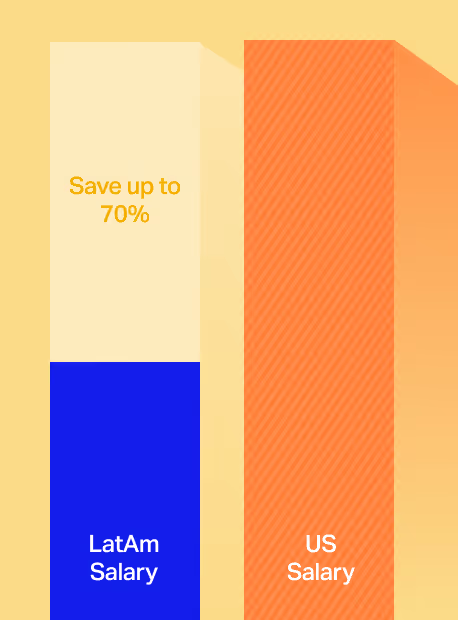
Offshore development delivers the same quality of work at 30–70% lower cost, because developer salaries in Latin America and other offshore regions sit well below US levels.
In Deloitte's 2025 Global Business Services Survey, 61% of global business services and shared-services organizations named reducing cost as a current objective, second only to standardizing and improving processes at 72%.
3. Around-the-clock productivity
Time zone differences mean offshore developers are often working while your team is offline, moving certain tasks forward overnight.
That overnight handoff works for some work and breaks others. Queue-based tasks move fine while you sleep: test execution, monitoring, data loads, bug triage, anything that doesn't need a decision from you.
But a CRM customization usually needs one. A single open question about how a sales stage should behave can hold a build for a full day when the person who can answer it is offline.
The cost of that gap is measurable. Peer-reviewed research published in Organization Science by researchers at Harvard Business School, Georgetown University, and Rice University found that each additional hour of time zone separation reduced real-time communication between colleagues by 11%.
The authors also note that north-south corridors, such as New York and São Paulo, carry effectively no temporal distance, which is exactly the position the US and Latin America are in.
So split the work by what it needs. Keep the 24/7 cycle for queue-based tasks, and keep decision-heavy customization in overlapping hours. A developer based in Latin America is at their desk during your business day, whether your team runs on Pacific, Mountain, Central, or Eastern time, so a blocked decision gets resolved the same afternoon rather than the next day.
4. Custom solutions tailored to your industry
Offshore Dynamics 365 developers bring niche expertise to the table, allowing for industry-specific solutions.
Whether you’re in healthcare, retail, or finance, they can design and customize CRM software to match your operational needs so the software aligns with your industry and business goals.
5. Scalability and flexibility
Offshore teams give you the flexibility to scale up or down as needed. Whether you’re ramping up for a major CRM project or downsizing after launch, this adaptability makes sure your development efforts remain efficient and aligned with business demands.
6. Quality assurance
Many offshore providers prioritize rigorous quality assurance practices. They run detailed testing procedures so your CRM system ships reliably and is built to perform, which is what gives you confidence over the long run.
7. Focus on what matters most
By outsourcing CRM development, your in-house team can concentrate on core business priorities. Offshore partners handle the technical heavy lifting, freeing your internal resources to focus on strategy, customer engagement, and scaling your business.
Get these benefits right and you improve your CRM while staying focused on your core goals.
What Strategies Lead to Success in Offshoring Your Dynamics CRM Development?
Six things decide whether offshore Dynamics 365 development works: clear deliverables and success metrics, one shared communication channel, a project-tracking tool, enforced security protocols, direct control over who you hire, and treating the developers as part of your team.
Here’s an actionable list to help you succeed:
- Set clear expectations upfront by defining deliverables, timelines, and success metrics to keep the project on track and aligned with your goals.
- Use tools like Slack or Microsoft Teams to facilitate consistent updates and resolve issues.
- Use project management tools like Jira or Trello to streamline workflows, track progress, and provide transparency for all stakeholders.
- Prioritize security by making sure your offshore team follows strict data protection protocols and complies with relevant regulations to safeguard sensitive information.
- Consider working with individual developers as part of your extended team, which will give you direct and complete control over the project and allow you to choose the best talent for your specific needs.
- Treat offshore developers as an extension of your in-house team, fostering collaboration and trust to build long-term relationships that can support future projects.
The screen that matters most comes earlier, when you pick the developer. Recruitment Consultant Natasha Tarapow asks every candidate to walk through a real project: not which languages they used, but what their own role was and what they built. What she listens for is simple:
It's important that they can explain their work to someone who isn't a developer. If they can do that, that tells me a lot.
— Natasha Tarapow, Recruitment Consultant, Hire With Near
That test matters more on a CRM project than on most builds, because the people who know how the sales process should work are rarely engineers.
Top 8 Partners for Finding Offshore Dynamics CRM Developers
The eight strongest options for offshore Dynamics CRM development split into three models: staffing partners that place a dedicated developer on your team (Hire With Near, Toptal), full-service Microsoft implementation firms that deliver Dynamics 365 and Power Platform projects end to end (Innowise, Itransition, Simform, Hyperlink InfoSystem, Appinventiv, Intech Systems), and marketplaces for contracting a specialist directly.
Which one fits depends on whether you need a teammate or a finished project.
Dynamics 365 offshore development comes in those same three shapes, and the list below covers all three. It isn't ranked in any specific order, so focus on the best match for your needs rather than the order it appears in.
If your search runs broader than CRM specifically, we compare LatAm outsourcing companies separately, and if you're sourcing developers rather than a firm, our list of recruitment and staffing companies covers that angle too.
How this list was built: every company here meets at least one of three criteria: at least 50 client reviews on an established review platform (G2, Clutch, Trustpilot, GoodFirms, or ClearlyRated, client ratings only) with an overall rating of 4.5 or above; a long-established firm with a documented Microsoft Dynamics practice going back a decade or more; or a verifiable track record delivering Microsoft Dynamics 365 work for large, recognizable enterprises.
From the companies that qualified, we compared Dynamics 365 and Power Platform capability, delivery model, geographic coverage, and what each firm publishes about engagement terms on its own website. The goal is to help you build a shortlist, not crown a winner.
The table below summarizes what each provider does, who it fits, and its strongest public review rating:
Note: To keep this list current with our selection criteria, we regularly re-check ratings on third-party review sites and update them as needed.
Here's each one in more detail.
1. Hire With Near

Hire With Near is a full-service staffing and recruiting agency that helps US companies of all sizes hire top-performing remote talent in Latin America across all industries and departments, including software engineering. We handle the entire hiring process: sourcing, vetting, candidate presentation, payroll, and compliance.
We're the only company on this list that finds and places full-time Latin American developers who join your team rather than delivering a project for you.
When you need CRM developers who understand both Microsoft Dynamics and your business priorities, we connect you with professionals who work during your business hours, which removes the overnight wait that comes with a workday gap.
More than 950 companies have hired through us. We hold a 4.9 rating on G2 across 150+ reviews as of August 2026. We were ranked No. 118 on the 2026 Inc. 5000 list of the fastest-growing private companies in America.
Key features:
- The five skill sets a Dynamics 365 build needs: We place backend, .NET, Power Platform, data, and integration engineers every week, with specialist tech recruiters screening beyond keywords for real-world impact. Every search draws on a pre-vetted pool of 160,000+ LatAm professionals plus fresh sourcing until we find someone who matches your stack.
- Quality-first approach: We fill 97% of the roles we take on and hold a client satisfaction score of 9.1, because we screen for skills plus the drive, readiness, and cultural match to contribute from day one.
- One partner, one process: Scale across functions, not just engineering, with one dedicated team and a repeatable hiring cadence. First candidates in 3 to 5 days with video introductions, and most clients make a hire in under three weeks. We remember what worked last time and adapt based on your feedback, so hiring gets easier each round.
- Transparent pricing: We show you benchmarks and fees up front, and you set salaries for your hires. No hidden markups, and no upfront costs: you never pay anything until you make a hire.
As Thomas Elliott, Vice President of Product Management at Bonfire, shared:
It was shocking to see the difference between the talent Hire With Near brought versus other firms I worked with. Our hires are extraordinary and a great cultural fit.
— Thomas Elliott, Vice President of Product Management, Bonfire
2. Innowise
Innowise earned a spot on this list for the depth of its Microsoft practice inside a full-cycle development firm. Founded in 2007 and headquartered in Warsaw, Poland, it has grown to more than 3,500 IT professionals and runs a dedicated Dynamics 365 service line spanning consulting, implementation, configuration, customization, integration, migration, and ongoing support. It also publishes work on Dynamics 365 Customer Insights, the piece most CRM teams find hardest to configure well.
Rating: Innowise holds a 4.9 out of 5 rating on Clutch across 73 reviews as of August 2026.
Best for: The firm suits companies running a larger custom development program around Dynamics 365, where CRM work sits alongside data, cloud, and integration engineering. If what you need is one developer for ongoing administration, a firm this size is more capacity than the job calls for.
3. Itransition
What stood out about Itransition is the length of its record with the product. The company was founded in 1998, has more than 3,000 engineers, and has been a Microsoft partner since 2008, with a dedicated Dynamics 365 implementation and support practice built up across that period.
Its Dynamics services run end to end: consulting, implementation, customization, integration, modernization, and managed support, delivered from locations across Europe, the Americas, and the Middle East.
Rating: Itransition holds a 4.9 out of 5 rating on Clutch across 42 reviews as of August 2026.
Best for: Itransition fits enterprise Dynamics 365 implementations and modernization programs that need governance, documentation, and a defined support arrangement once the build is done.
4. Simform
Simform is on this list for its Microsoft engineering bench rather than a Dynamics-only focus. Simform is a digital product engineering firm, and its Microsoft practice covers Dynamics 365 implementation, Sales, Customer Service, Field Service, Business Central, and the Power Platform, with Copilot integration and managed support alongside.
The company reports 250+ Microsoft developers and 75+ Azure-certified engineers across solution architecture, DevOps, and cloud.
Rating: Simform holds a 4.8 out of 5 rating on Clutch across 86 reviews as of August 2026.
Best for: Simform fits product-led builds and modernization work where Dynamics 365 is one part of a wider Azure and application estate. If your project is a straight CRM configuration with no surrounding engineering, a firm positioned around product development is broader than you need.
5. Hyperlink InfoSystem
Hyperlink InfoSystem is here because of its delivery volume at a lower rate. Founded in 2011 in Ahmedabad, India, the company employs more than 1,200 developers and has shipped thousands of mobile and web builds for clients across roughly 100 countries.
Its CRM work sits inside that broader app and enterprise development practice, and the CRM platform it publishes most about is Salesforce rather than Dynamics 365.
Rating: Hyperlink InfoSystem holds a 4.8 out of 5 rating on Clutch across 174 reviews, the largest review base on this list, as of August 2026.
Best for: The company fits Dynamics 365 work that is mostly integration and surrounding application development, at a lower blended rate. If the job is deep Dynamics configuration or a customer engagement rollout, ask for specific Dynamics 365 project history before you scope it.
6. Toptal

The reason Toptal made this list is access speed. Toptal is a freelance talent marketplace that screens applicants before they reach you and publishes a Microsoft Dynamics CRM developer category, with engagements available hourly, part-time, or full-time on contract. You choose from a matched shortlist instead of running a search yourself.
Rating: Toptal holds a 4.7 out of 5 rating on G2 across 270 reviews as of August 2026.
Best for: A marketplace is built for bounded engagements, like a defined piece of work, a fixed window, a specialist you need for a specific stretch. Toptal fits that shape well. It’s a different arrangement from a permanent team member who owns your Dynamics 365 environment year after year.
7. Appinventiv
Appinventiv is here for its custom build capability. Founded in 2015 and headquartered in Noida, India, with offices in the US, UK, Australia, and the UAE, the firm has grown to more than 1,600 technologists and publishes a dedicated custom CRM development service covering data migration, integrations, and user adoption.
Its CRM work is custom-built rather than Dynamics-specific, so treat Dynamics 365 as one platform it can deliver against rather than its center of gravity.
Rating: Appinventiv holds a 4.6 out of 5 rating on Clutch across 90 reviews as of August 2026.
Best for: Appinventiv fits greenfield product work and CRM builds where you want something designed around your process instead of configured inside a platform. Ask directly about Dynamics 365 project history if the platform is already fixed.
8. Intech Systems
Intech Systems provides certified Microsoft Dynamics experts through its offshore development services.
It’s a Microsoft Solutions Partner working across Microsoft 365, Dynamics 365, and Azure, and it delivers Dynamics 365 Sales, Customer Service, Customer Insights, Field Service, and Contact Center, with offshore development and third-party integrations attached to its implementations. The company operates from India, the United States, and Singapore.
Rating: Intech Systems is not rated on the major review platforms. It’s on this list because of its enterprise client roster, which includes Nestlé, Adani, TRL Krosaki, JK Fenner, Shree Digvijay Cement, and Baker's Dozen.
Best for: Intech Systems fits module-specific Dynamics 365 rollouts where you want the same partner to implement the modules and then support the environment afterward.
How Much Does It Cost to Hire Offshore Dynamics CRM Development?
Offshore Microsoft Dynamics 365 (formerly Dynamics CRM) development is priced in three different ways:
- A project-based build with an offshore development company runs $20,000 to $100,000 and up.
- An individual contractor quotes hourly or per sprint.
- A dedicated developer in Latin America who joins your team earns $24,000 to $108,000 a year.
The cost of hiring Dynamics CRM development varies depending on whether you’re outsourcing to a development company or working directly with individual contractors.
These options have distinct cost structures, so let’s break it down. Here’s how the three models compare on cost, fit, and the trade-off each one carries:
Working with development companies
When outsourcing to a development company, costs are typically project-based and can range from $20,000 to $100,000+ depending on the scope and complexity of the CRM solution.
This includes everything from design and development to testing and post-launch support. It’s an all-inclusive option, which increases the cost.
Hiring individual contractors
Working with individual contractors or freelancers offers more flexibility and cost savings.
Hiring nearshore developers is especially cost-efficient. According to Hire With Near's US vs. Latin America Salary Guide, hiring Dynamics CRM developers based in Latin America (LatAm) costs 30–70% less than hiring the same role in the US, and for the most junior Power Platform roles the gap in the table below runs higher still.
- How contractors quote: LatAm developers working as contractors usually quote by the hour or by the sprint, and the number moves with seniority, how scarce the specific Dynamics 365 module skill is, and how much of the project management you hand over. Published hourly rate cards for the region come almost entirely from firms selling the service, so treat the annual benchmarks below as the reliable comparison.
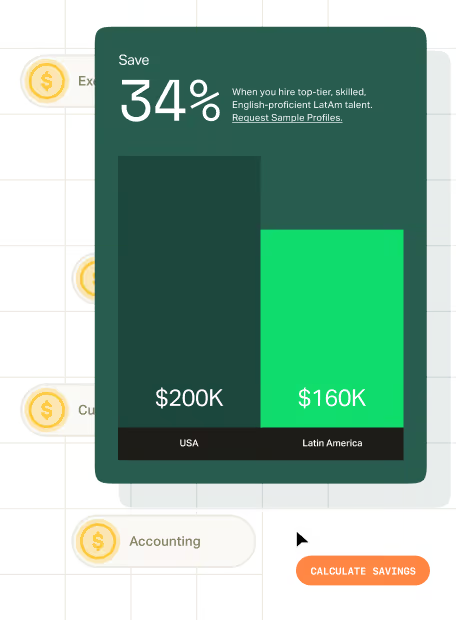
- What an annual budget looks like: For continuous work, hiring LatAm developers as full-time team members runs $24,000 to $108,000 a year across the roles that staff a Dynamics 365 project. The same roles cost $80,000 to $189,000 in the US, according to our salary data.
Those are market ranges. What companies save in practice is narrower and better evidenced: across the placements in Hire With Near's 2026 State of LatAm Hiring Report, software engineering roles saved US companies $23,000 to $85,000 a year per hire, a 28% to 59% reduction.
To put that in concrete terms, here’s what the five roles that typically staff a Dynamics 365 project cost in Latin America compared with equivalent US hires, according to Hire With Near's salary benchmarks:
For the most up-to-date figures, see Hire With Near's US vs Latin America Salary Guide.
For the rest of the department, our IT roles salary guide for the US vs. Latin America covers engineering, data, and infrastructure roles beyond the five above.
The comparison is simple. Hiring a senior developer plus ongoing platform and reporting support in Latin America often costs less than hiring one developer at US rates. For the US side of the comparison, the Bureau of Labor Statistics puts the median annual wage for software developers at $134,040 as of May 2025.
The savings aren’t theoretical. A US healthtech startup came to Hire With Near needing to scale engineering fast, with two internal recruiters and an 8-step interview process it refused to shorten.
It hired 7 senior engineers across backend, DevOps, QA, mobile, and frontend roles at a 14-day average time-to-hire, with every evaluation step intact, and saved $323,000 a year against equivalent US salaries, a 33% reduction.
{{salary-guide-cta}}
Which option should you choose?
Whether you choose a development company or an individual contractor depends on your project’s complexity, budget, and level of involvement.
Here’s a quick side-by-side comparison to help you decide:
- Development companies: Ideal for large, end-to-end projects where you need a one-stop solution. Expect higher costs but comprehensive service.
- Individual contractors: Best for teams that need specific expertise or more control over the development process. You get cost savings and flexibility, and you keep the CRM tailored to your own process.
- A dedicated hire through a staffing partner: Best when Dynamics 365 is a permanent part of how you operate rather than a project with an end date. You get one person who learns your data model and your process, works during your business hours, and still owns the environment after the current piece of work ships. The partner handles sourcing, vetting, payroll, and compliance, so the only decision left with you is who to hire.
These are three different products. A marketplace or contractor arrangement is built for bounded engagements, a development company is built to deliver a defined scope, and a staffing partner is built to put a permanent team member in the seat. We look at the first two in more depth in our comparison of freelance developers vs. offshore development companies.
Price is often not what decides it. One founder on the US West Coast, moving a live production app off an outsourced development firm, described the deciding factor this way:
We're migrating from an outsourced firm out of Pakistan. We've worked with them on other projects, and I think we're just getting to the point now where we need somebody in our time zones, because that's been becoming more and more of a challenge, and it's making it hard for me to work with somebody because I'm on the Pacific Coast.
Bounded project work can absorb a workday gap. Ongoing ownership of a live CRM rarely can. This is the trade-off that decides most offshore Dynamics 365 hires. Here's why developers themselves tend to prefer joining a team over cycling through a dev shop:
Final Thoughts
Offshore Microsoft Dynamics 365 (formerly Dynamics CRM) development gives you access to Dataverse and Power Platform specialists, salary costs 30–70% below US equivalents, and the flexibility to build around your own process.
The key to success lies in choosing the right approach for your specific needs. While a project handed to an outsourcing vendor can work for a bounded scope, building your own dedicated team in Latin America often delivers more, because the person stays with the work, learns your process, and is online when you are.
Our guide to hiring remotely in Latin America walks through how that works in practice.
At Hire With Near, we connect US companies with CRM developers based in Latin America. Our process helps you build dedicated teams that work your hours and slot into your existing operations, with the cost efficiency and technical depth your roadmap needs.
Ready to add a Dynamics 365 developer who works during your business hours? Schedule a free, no-commitment consultation call and we'll walk you through what the role costs and how Hire With Near builds your development team.
{{consultation}}
Frequently Asked Questions
What's the best offshore firm for CRM development and customization?
The best offshore firm for CRM development and customization is the one that can name the Dynamics 365 modules it has already implemented, show you how it screens engineers technically, and hand you a shortlist rather than a stack of resumes.
Ask who runs the technical screen, how many candidates you will see per role, and which named implementations the assigned engineers worked on. Speed and a high bar are not a trade-off: one healthtech startup we worked with kept its full 8-step interview process and still averaged 14 days to hire.
What is the best agency to hire an offshore CRM manager?
The best agency to hire an offshore CRM manager is a staffing partner that recruits for the underlying platform roles rather than the job title, because “CRM manager” covers everything from daily administration to reporting, integrations, and vendor management. Decide which of those the role owns, then hire for that skill set.
For a genuinely management-level hire, such as a Head of Business Applications, executive search in Latin America is the right route, and our guide to why you might need an offshore development project manager covers the delivery-ownership version of the role.
What is offshore development?
Offshore development is hiring software engineers in another country, usually one far enough away that their working day barely overlaps yours, to build or maintain your systems. Nearshore development is the same arrangement in a country close to your own time zone, and that is the practical difference: with nearshore, a question sent in the afternoon gets answered the same afternoon.
Our comparison of nearshore vs. offshore software development covers where each model fits.
Is Dynamics 365 in demand?
Yes, and the current driver is migration and modernization work. Microsoft ended support for the last Dynamics CRM-named release in January 2026, so organizations still on older deployments are moving onto the current customer engagement apps, and everyone already on the platform needs ongoing customization, integration, and reporting work.
On the talent side, our own placement data shows software engineering was the fastest-growing category we hired for last year, with demand up 250% year over year and Software Engineer climbing 12 places to the sixth most-requested role.
What are the top offshore software development companies?
The top offshore software development companies fall into three groups: full-cycle development firms, Microsoft implementation partners, and freelance marketplaces, alongside staffing partners that place a full-time developer directly on your team
Among the eight compared earlier in this article, Innowise, Itransition, and Simform are full-service Dynamics 365 implementation firms; Hire With Near places a dedicated developer on your team; and Toptal works as a freelance marketplace.
Which group belongs on your shortlist depends on whether you need a project delivered, a module implemented, or a permanent team member.
How do you vet offshore Dynamics 365 developers before they touch our CRM?
Vet them with a small piece of real work, not a quiz. The most reliable screen is a short task, debugging something broken, refactoring a messy function, or building a basic API with tests, reviewed together on a call so you hear how the person made their decisions.
Then, ask the candidate to explain a past project to someone who is not a developer.
For Dynamics 365 specifically, require named implementations and named modules instead of a list of acronyms.
Can offshore Dynamics 365 developers communicate technically in English with my team?
Yes, and the bar worth testing is not accent. It is whether the person can walk a non-technical colleague through a CRM design decision, explain why a change broke a workflow, and write documentation your team can follow. Developers based in Latin America work during your business hours, wherever your team sits in the US, so those conversations happen live instead of in overnight comment threads.
Test it in the interview: ask a candidate to explain a technical trade-off to your sales or operations lead.
What other engineering roles can I hire in Latin America?
Beyond Dynamics 365 and Power Platform specialists, US companies hire the full range of engineering roles in Latin America, including nearshore software engineers, remote SQL developers, and nearshore Azure developers.
Those three cover most of the work that surrounds a CRM implementation: application development, data migration and reporting, and the cloud integrations that connect Dynamics 365 to the rest of your stack. The cost and working-hours advantages are the same across all of them.
For more on how technical leaders evaluate this decision, see the questions tech leaders ask about hiring developers in Latin America.







.webp)


%203.svg)
.avif)




%20(1).avif)

%20(1).png)