%203.svg)
Key Takeaways
- Outsourced bookkeeping costs $300–$2,500/month, while a U.S. in-house hire runs $55,000–$75,000/year; a dedicated LatAm bookkeeper offers a middle ground at $22,000–$36,000/year.
- Hiring in-house provides oversight and continuity, and those benefits largely carry over with a dedicated remote hire in your time zone.
- If outsourcing still leaves you doing too much, or offshore hiring created communication gaps, a LatAm bookkeeper is a strong third option.
Maybe you’re familiar with this situation: You've been handling your own books or coordinating with an accounting firm that keeps sending you expense lists to track down yourself.
In this second scenario, agency outsourcing offloads the bookkeeping, but it doesn't give you someone who actually knows your business. Hiring a US-based bookkeeper gives you that familiarity, but at a cost that makes it hard to justify.
But there's a third model, hiring a dedicated bookkeeper based in Latin America, that’s worth considering. It gives you the cost savings of outsourcing and the direct oversight of an in-house hire, or the best of both worlds.
Key Differences Between Outsourcing and In-House Bookkeeping
Choosing between outsourcing and in-house bookkeeping comes down to three core tradeoffs: cost, control, and access to expertise.
Here's how the three main models compare at a glance:
Cost implications
The cost gap between in-house and outsourced bookkeeping is substantial. Hiring an in-house bookkeeping team involves direct and indirect costs. The most obvious expenses are salaries and benefits, including health insurance, retirement contributions, and paid time off. The not-so-obvious are office space, software subscriptions, and training.
Outsourcing bookkeeping can often be more cost-effective, particularly for small to medium-sized businesses. Service providers typically offer two common pricing models: hourly rates or fixed monthly fees. These can be easier to manage, more predictable, and almost always lower than maintaining full-time employees.
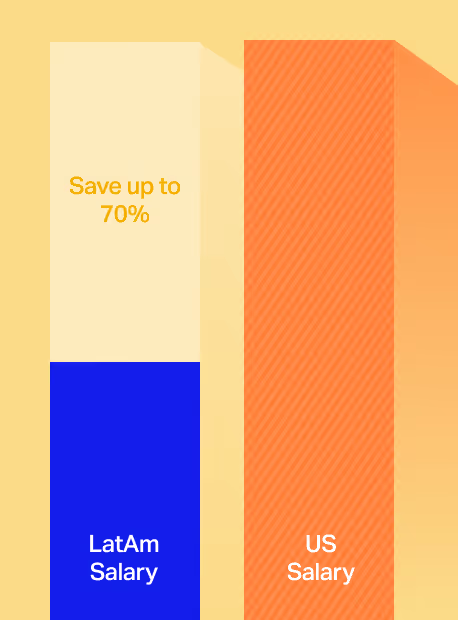
A third option, hiring a dedicated bookkeeper based in Latin America, sits between the two. Rather than paying for a service contract, you're hiring a full-time employee who works exclusively for your business at 40–60% of US salary rates.
(See the cost breakdown below for specific figures. For a more detailed look at outsourced bookkeeping by scope and provider type, see our guide on outsourced bookkeeping cost.)
Quality control measures
Maintaining quality works differently depending on which model you choose. For example, high-quality bookkeeping within your organization requires rigorous internal controls and ongoing oversight. At the same time, you have direct control over who you hire, making it easier to make sure they align with your company's standards and culture.
Outsourced firms have established controls and standardized processes to ensure accuracy and compliance, but you’ll still need your own checks in place. Since you’ll have different bookkeepers handling your account, institutional knowledge can also be thin.
Training and expertise
Training works very differently for agency outsourcing versus in-house hiring. With an internal team, you need to invest in their professional development so they stay updated with the latest accounting standards and tech.
With outsourcing, you tap into a team that already works with current accounting standards and tools every day. These firms invest in ongoing training to stay competitive. You benefit from that updated knowledge without carrying the training costs yourself.
How much does in-house vs. outsourced bookkeeping cost?
Here's a concrete cost comparison across all three models:
- US-based in-house bookkeeper: $55,000–$75,000/year fully loaded (salary + benefits + overhead)
- Agency outsourcing: $300–$2,500/month ($3,600–$30,000/year depending on scope and transaction volume)
- Dedicated Latin American bookkeeper: $22,000–$36,000/year (junior-to-mid level)
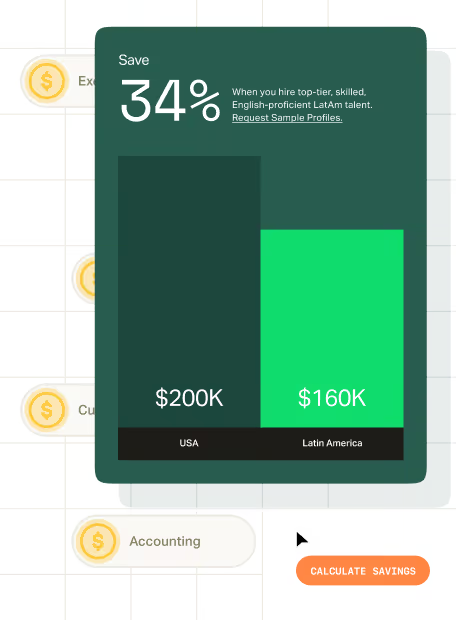
Hire With Near's analysis of 2,000+ placements found that companies hiring dedicated bookkeepers in Latin America save $27,000–$66,400 annually compared to US-based equivalents, according to Hire With Near's 2026 State of LatAm Hiring Report. These savings hold across seniority levels:
For full compensation benchmarks across finance and accounting roles, see the Hire With Near salary guide for US vs. Latin America and our accounting roles salary guide.
Pros of Outsourcing Bookkeeping
When you outsource bookkeeping to an agency, three advantages typically stand out over in-house arrangements. They include lower cost, immediate access to specialized expertise, and the ability to scale service up or down without a new hiring cycle.
Cost savings
Outsourcing converts your bookkeeping from a fixed personnel cost into a variable service cost. Unlike in-house bookkeeping, which involves fixed expenses such as annual salary, benefits, and office space, outsourcing allows you to pay only for the services you need when you need them. Agency outsourcing typically runs $300–$2,500/month, depending on transaction volume and scope.
This can be particularly beneficial for small businesses or startups with limited budgets, as it frees up capital that can be reinvested into other vital business areas.
For a breakdown of how different outsourcing bookkeeping services structure their pricing, see our comparison guide.
Access to specialized skills
Outsourcing to an established bookkeeping firm gives you immediate access to a team with broad expertise that you wouldn’t be able to hire full-time. These professionals often have more experience with specific industries, accounting software, or regulatory requirements than a single in-house hire would.
Service providers typically invest heavily in training and professional development, so the staff is up-to-date with industry standards and best practices.
Scalability and flexibility
As your transaction volume grows or shrinks, an outsourced provider can adjust their service tier quickly without you needing to hire again.
They scale their services to match your evolving requirements. This means that, with larger providers, you can often add accounting services to support your in-house accounting team, such as tax preparation or financial planning.
Cons of Outsourcing Bookkeeping
Outsourcing bookkeeping isn’t perfect, and you’ll trade cost savings for some control. For some businesses, the coordination burden of an external provider may even undercut the savings.
Communication challenges
Effective communication with an outsourced bookkeeping firm is often harder than it looks, and not choosing your provider carefully can result in persistent friction.
Working with an external team in different time zones can lead to delays in response times. This is especially true with offshore providers in the Philippines or India, where the time zone gap can mean waiting a full business day for answers to routine questions. And if the team doesn't have a high level of English proficiency, misunderstandings may affect the accuracy of your financial reports.
If time zone gaps and communication overhead are your primary concern, see our guide on key considerations for effective offshore bookkeeping. It covers what to look for in any remote bookkeeping arrangement.
Less control over processes
Unlike an in-house team you can directly supervise and manage, an outsourced bookkeeper operates based on predefined contracts and service level agreements. They're managing other clients at the same time.
You may find it difficult to enforce your company's specific standards and requirements. It’s essential to choose a provider that’s responsive to customization and transparent in how they work, but that’s harder to guarantee in practice.
Potential security risks
Outsourcing bookkeeping to a third-party agency means your financial data goes to an external organization. You're relying on their security practices to protect against data breaches, fraud, and unauthorized access.
Before signing any outsourcing agreement, verify the provider's data security practices, NDA terms, and access controls. Ask specifically who on their team will have access to your accounts, and how access is revoked if that person leaves.
Pros of In-House Bookkeeping
Keeping bookkeeping in-house gives you advantages that are closely tailored to your business. Many of these advantages carry over when you hire a dedicated remote bookkeeper who works your hours.
Improved communication
Having a dedicated bookkeeper means you can quickly address questions, provide feedback, and make adjustments without the delays common with outsourced teams. The ability to quickly clarify issues and respond to changing needs can significantly improve the accuracy and timeliness of your financial reporting.
You enjoy these benefits whether the bookkeeper works on-site or remotely in your time zone.
Greater control over workflow
In-house bookkeeping gives you complete control over your financial processes, so you can implement and adjust workflows as needed.
You’ll get adherence to your specific protocols, compliance policies, and company best practices. This is true for both on-site and off-site talent.
Familiarity with business operations
A dedicated bookkeeper develops an understanding of your business's financial nuances that’s not usually possible with an outsourced agency.
This close alignment with business operations means financial data is not only accurately recorded but interpreted in the context of your specific business environment. That contextual knowledge builds over months and years, and it drives better financial decisions.
It's the biggest thing you give up when you outsource to an agency whose staff rotates across accounts.
Cons of In-House Bookkeeping
While in-house bookkeeping provides significant advantages, you shouldn’t ignore these notable drawbacks.
Higher overhead costs
Employing an in-house bookkeeper in the US involves a financial commitment well above the base salary. The costs extend beyond wages to employee benefits such as health insurance, retirement contributions, paid time off, and payroll taxes.
A mid-level US bookkeeper typically earns $47,000–$72,000 per year in base salary alone. Add benefits, office space, equipment, and accounting software, and the fully-loaded annual cost reaches $55,000–$75,000. (Compare that to $22,000–$36,000 for a junior-to-mid bookkeeper based in Latin America, or $300–$2,500/month for an outsourced agency.)
Recruitment, onboarding, and training further add to the overhead.
See our accounting roles salary guide for a full breakdown of US vs. LatAm compensation across finance and accounting roles.
Resource limitations
A single in-house bookkeeper can become a bottleneck during high-volume periods, which leads to delays, errors, and, over time, employee burnout.
Limited staffing may also stretch your bookkeepers thin, affecting their ability to manage peak periods or sudden increases in workload. The in-house team's capabilities can also be restricted by the absence of specialized skills because a single hire can't cover every accounting function in depth.
Challenges in maintaining expertise
Bookkeeping standards and tools change constantly, and keeping an in-house hire current requires ongoing training that many small businesses struggle to fund.
According to Accounting Today, the number of candidates sitting for the CPA exam has fallen 27% over the past decade, and accounting graduates declined by nearly 17% between 2016 and 2020. The domestic talent pipeline is shrinking, which makes US-based bookkeeping hires harder to find and more expensive to retain.
That mix of higher costs, a shrinking talent pool, and ongoing training needs is what pushes many companies toward outsourcing or exploring LatAm hires.
Why You Should Consider Hiring Bookkeepers in Latin America
When companies outsource bookkeeping to an agency, they typically gain cost savings but give up direct oversight and institutional knowledge. When they hire in-house in the US, they gain control but pay significantly more. Hiring a dedicated bookkeeper based in Latin America resolves both problems at once.
In my five years sourcing finance and consulting talent at Hire With Near, I've seen a consistent pattern with clients who had previously tried both models. The companies that burn out on agency outsourcing typically feel that too much burden still falls on them. The ones who can't afford US rates but want dedicated help find LatAm hiring fills that gap cleanly.
There are other benefits, too. Latin American finance professionals have strong academic training and significant exposure to Big Four firms. That gives them experience with international markets and familiarizes them with key accounting standards like US GAAP and IFRS. Lower cost does not mean lower quality here.
A health and beauty supplement e-commerce company based in Nevada had tried outsourcing through Upwork and Philippines-based firms with poor results. Candidates juggled multiple part-time projects, resumes were inflated, and the QuickBooks expertise they needed was hard to verify. After connecting with Hire With Near, they received pre-vetted candidates who were fully committed to the role.
Within one month, they hired a bookkeeping assistant with two years of QuickBooks experience, fully dedicated and English-fluent, saving $26,000 per year compared to a US-based hire. This was a 60% reduction in costs, and the hire was 5 times faster than their previous attempts.
Their Operations Manager put it plainly:
Once a candidate comes from Hire With Near, we know they're definitely worth looking at. This is generally not the case with all agencies.
According to Hire With Near's research on 2,000+ hiring conversations, 30% of US companies switching to LatAm hiring are making the move specifically from offshore outsourcing, frustrated with time zone gaps and lack of team integration.
Hire With Near's nearshore staffing model connects you with dedicated full-time bookkeepers in Latin America who work in US time zones, go through a rigorous pre-vetting process, and are ready to integrate with your existing team.
Top Countries to Hire Remote Bookkeepers in Latin America
Latin America has strong accounting talent across several countries, but it’s not evenly distributed—and those differences matter when you decide where to recruit. The reasons behind that distribution matter when you're choosing where to source.
Across the Latin American finance market, roughly 80% of the bookkeeping and accounting candidates I place are based in Argentina. Here's why that dominance exists, and what the other top countries offer.
1. Argentina
Argentina produces some of the strongest accounting talent in Latin America, driven by its rigorous university system. To earn an accounting degree in Argentina, students typically study for five or six years, a significantly longer program than most countries require.
This extended academic training, combined with high exposure to Big Four firms like PwC and EY, produces professionals who know both US and international accounting standards. English proficiency is also strong among finance graduates. Argentina consistently dominates finance placements at Hire With Near for exactly these reasons.
2. Mexico
Mexico has emerged as a top destination for US companies hiring remote bookkeepers, primarily because of its geographic proximity and time zone alignment. Mexican professionals in the Central and Eastern time zones work fully in sync with US teams, so real-time collaboration is as easy as any on-site hire.
Strong English proficiency in the business and finance community, combined with growing exposure to US GAAP through multinational operations, makes Mexico a reliable source for bookkeeping talent.
3. Brazil
Brazil offers a large and well-educated accounting workforce, backed by the sixth-largest economy in the world. Brazilian accounting professionals typically have deep training in international accounting standards, and the country produces a strong pipeline of finance graduates annually.
English proficiency varies more widely than in Argentina, so language assessment during vetting is especially important for US-facing roles.
4. Colombia
Colombia has grown rapidly as a sourcing market for finance and bookkeeping roles, with competitive labor costs and a strong professional services culture. Business English proficiency is improving quickly, particularly among university-educated professionals in Bogotá and Medellín.
The country's expanding presence in international finance and accounting makes it an increasingly reliable option for US companies.
What about the Philippines?
If you're researching bookkeeping services in the Philippines as an alternative, be aware that the primary tradeoffs with Asian offshore locations tend to be time zone gaps (a 12–14-hour difference for US companies) and reduced real-time availability.
However, LatAm eliminates both. For companies weighing the full range of offshore options, our guide to the benefits of offshore bookkeepers covers what to evaluate regardless of region.
Once you've decided to explore nearshore or offshore hiring, see our guide on how to hire offshore bookkeeping talent for a step-by-step approach to the process.
When to Outsource, When to Hire In-House, and When to Hire in Latin America
The right model depends on how much control you need, how embedded you want your bookkeeper to be in your business, and what budget you're working with.
If you're still deciding whether you should outsource bookkeeping or hire someone directly, the framework below gives you a clear answer based on your situation.
Outsource to an agency if:
- Your transaction volume is low and doesn't justify a dedicated hire
- You need bookkeeping handled quickly without a hiring process
- You don't need ongoing daily financial involvement or deep business knowledge
- Cost predictability matters more than continuity
Keep bookkeeping in-house (US-based) if:
- Your financial operations are complex enough to require full-time dedicated oversight
- You have compliance requirements that demand an on-site presence
- Budget is not a primary constraint, and you want full control over the hiring process
Hire a dedicated bookkeeper in Latin America if:
- You want cost savings comparable to outsourcing, but need someone who works exclusively for you
- You've tried agency outsourcing and still found yourself doing too much coordination work
- You've tried offshore hiring in the Philippines or India and ran into time zone or communication problems
- You want a bookkeeper who learns your systems, knows your business, and answers directly to you
- You're ready for a dedicated hire, but can't justify or find the right US-based candidate at US rates
If you're ready to explore this model, our complete guide on how to hire a bookkeeper walks through what to look for, how to assess candidates, and what to expect from the process.
For a real example of what this looks like in practice, read about how the e-commerce company above saved $26,000 annually by hiring a bookkeeper from Latin America.
Or to get an idea of the finance and accounting talent in Latin America you can hire, request sample profiles of pre-vetted talent. It’s the easiest way to get a sense of what’s possible.
{{prevetted-banner}}
Frequently Asked Questions
What is the difference between outsourcing and in-house bookkeeping?
Outsourcing bookkeeping means paying a third-party agency or freelancer to handle your books. You manage the service contract, not the person. In-house bookkeeping means hiring a dedicated employee who works exclusively for your company and answers directly to you.
How much does outsourced bookkeeping cost compared to hiring in-house?
Outsourced bookkeeping typically costs $300–$2,500/month ($3,600–$30,000/year), while a U.S. in-house hire runs $55,000–$75,000/year. A dedicated LatAm bookkeeper costs $22,000–$36,000/year, offering similar savings to outsourcing with full-time support.
For a detailed breakdown by provider type, see our guide on outsourced bookkeeping cost.
When should I outsource my bookkeeping?
Outsource to an agency when your transaction volume is low, you don't need daily financial involvement, and you want to avoid the overhead of a hiring process. Consider a dedicated remote hire instead if you need someone who knows your business deeply, works your hours, and can grow with your company.
Is outsourced bookkeeping safe? Who has access to my financials?
Outsourced bookkeeping carries inherent access risk because your financial data goes to an external party. Always verify any provider's data security practices, access controls, and NDA terms before signing. Ask specifically who on their team has access to your accounts, and confirm how that access is revoked if a staff member leaves.
Can I switch from outsourced to in-house bookkeeping mid-year?
Yes, but it requires a structured handoff period to make sure records are complete, and your new bookkeeper is up to speed before the next month-end close. Plan for at least two to four weeks of overlap between the outgoing provider and the incoming hire. Many companies make this switch as they grow and need more direct control over their financial processes. The transition is manageable with proper planning.
What types of businesses typically hire remote bookkeepers in Latin America?
All business types hire remote bookkeepers in Latin America, but demand is concentrated in SMBs that have outgrown manual bookkeeping but can't justify a full US-based finance team. Fintech companies and SaaS businesses are among the most active, followed by manufacturing companies, real estate firms, and healthcare practices managing multi-entity books.
If you want to explore this approach, our guide to the best staffing firms for hiring bookkeepers in LatAm covers what to look for in a LatAm recruiting partner.
How does hiring a bookkeeper in Latin America compare to outsourcing to an agency?
A dedicated hire works exclusively for your company, learns your systems, works in your time zone, and reports to you directly. The agency model offers cost savings but gives you a rotating staff pool with no continuity and a service contract instead of an employee relationship. For companies that have tried outsourcing bookkeeping and found the coordination burden too high, the dedicated LatAm hire model resolves the core problem.
What other finance and accounting roles can I hire in Latin America?
Beyond bookkeepers, US companies hiring in Latin America commonly fill roles including accountants, controllers, financial analysts, accounts payable specialists, and QuickBooks experts, all through the same dedicated-hire model.
Latin American finance professionals typically have strong academic training: in Argentina, accounting degrees take five or more years, producing candidates who are well-versed in US GAAP and common accounting software.
You can explore the full Finance & Accounting department page to see the range of roles available. If you're looking for a recruiting partner that specializes in these roles, our guide to finance staffing agencies covers what to evaluate.










%203.svg)
.avif)





%20(1).avif)

%20(1).png)