


%203.svg)
Key Takeaways
- How to outsource app development, in four decisions: define your project scope, vet developers against real shipped work, choose a pricing model that fits your budget, and sign a contract that protects your code and IP.
- Skip the structure and outsourcing goes wrong in predictable ways: rushed vetting, a vague contract, and no plan for who maintains the app after launch.
- Latin America is where most US teams land: senior developers who work your hours, at 30 to 70% below US salaries.
Learning how to outsource app development is mostly about getting a few early decisions right, because most of what goes wrong is set in motion before a line of code gets written. Companies come to Hire With Near after exactly that has happened: the contractors who built their MVP have gone dark, and nobody left knows the codebase.
Done well, outsourcing gets your app shipped without building an in-house team. Done carelessly, you pay for the same app twice.
Cost pressure is usually what starts the search. Research from Hire With Near on why US companies are hiring in Latin America found that 41% cite budget constraints as their main driver: they want to hire without expanding what they already spend.
This guide covers how to outsource app development in six steps, what it really costs, and why so many US teams end up hiring a dedicated app developer in Latin America.
Why Should You Outsource App Development?
You should outsource app development when you need skills, speed, or capacity your own team can't cover, and the work is scoped clearly enough for an outside team to own it.
Bringing in outside developers can lower your build cost, shorten your timeline, and free your own team for the product decisions only they can make.
Here are the main reasons you'd outsource your app development:
Cost-efficiency
You pay for the build itself rather than the salaries, benefits, and training a permanent in-house team requires.
Access to specialized skills and expertise
You get developers with deep experience in specific stacks and app categories, so the build isn't limited to the skills you have in-house or can find locally.
Faster time-to-market
An outsourcing partner can put a team on your project in days rather than the months a local hiring cycle takes, so your first release lands sooner.
Enhanced focus on core business
Your own people stay on strategy, customers, and product decisions instead of splitting attention between running the business and shipping code.
Scalability and flexibility
You can scale the team up for a release push and back down for maintenance, without committing to permanent headcount.
Quality assurance and testing
Established outsourcing firms have dedicated QA teams that hold your app to a defined standard, and testing that catches issues early usually means a smoother release.
Ongoing support and maintenance
Apps need work long after launch: OS releases break things, users report bugs, features need extending. Most partners sell ongoing maintenance alongside the build, so someone is still responsible when the project ends.
Risk mitigation
A team that has shipped comparable apps flags the problems you'd otherwise hit yourself, like an integration that won't scale or a store review that will bounce.
Global collaboration and access to new markets
An international team gives you perspective on how your app would need to work outside the US: which local payment methods matter, how the interface copy should be localized, and what users there expect.
Intellectual property protection
Reputable firms build IP protection into their contracts, with assignment clauses and access controls that keep your app's code and ideas yours throughout the build.
How to Outsource App Development: 6 Steps
Outsourcing app development works best as a six-step process: decide what stays in-house, plan the build, research developers, compare portfolios, choose a pricing model, and sign a contract that protects you.
Whatever type of app you need, following a structured approach is what separates a smooth engagement from an expensive lesson.
Here are the six steps in detail:
1. Consider what to do in-house
Identify the tasks your in-house development team can manage versus those that would benefit from external expertise. Retain core strategic activities and use outsourcing for technical execution where external specialists can provide fresh skills and perspectives.
As you map out what to hand off, it helps to know the full menu of options for getting development done:
- Sourcing developers on your own through job boards or LinkedIn: the lowest sticker price, but you handle all the vetting and employment logistics yourself.
- Freelance platforms: fast access to contractors for project-based work, but you own the quality risk, and the talent is splitting attention across clients.
- Dev shops and outsourcing agencies: an external team delivers the build end to end. This is the model most of this article covers.
- Nearshore staff augmentation: a specialist agency embeds a pre-vetted developer who works under your direction while the agency remains the employer, handling payroll, benefits, and compliance. Good for adding capacity without permanent headcount.
- A direct-hire staffing partner: the partner sources and vets a developer who joins your team permanently as your own hire, and handles the hiring logistics. The simplest path when you want the work and the product knowledge to stay in-house. Our comparison of hiring an in-house developer versus outsourcing walks through when each one wins.
2. Create a plan
Write a plan that covers your app's objectives, target audience, features, and technical requirements.
Include things like whether agile methodologies for project management are important or any other specific preferences you have.
A detailed plan helps you identify the skills you need and makes communication with your outsourced team clearer once you get started.
3. Research app developers
Conduct thorough research to find developers who align with your project requirements.
Start with where to look. Our guide to where to outsource app development compares the main platforms and locations, and if you're focusing on the region most US teams choose, we've also reviewed the best LatAm outsourcing companies working with US clients.
Look for firms with a strong reputation in app development, examining reviews and testimonials from previous clients.
4. Compare portfolios
Review potential app developers' portfolios to gauge their experience and expertise.
Focus on their previous projects, particularly similar apps they have developed, paying attention to the functionality they implemented. A proven track record in your industry could translate into a smoother development process for your app. Shortlisting from established application development outsourcing companies makes this comparison easier, since their track records are public.
Don't stop at the portfolio, though. Resumes and case studies can be polished; a live technical conversation can't be. Federico Bilello, a Software Engineering Recruiter at Hire With Near, explains:
Even though I do everything I can to verify a candidate's skill set before they get to the client, there's always a small percentage who make it through to the technical interview. The only way to truly find out if someone is proficient is that technical interview. That's where the truth comes out.
— Federico Bilello, Software Engineering Recruiter, Hire With Near
The same principle applies whether you're vetting an agency's team or an individual developer: ask them to walk you through a real project they shipped, and run your own technical assessment before you sign anything.
5. Choose a pricing model and payment method
While considering different providers, take into account their different pricing models.
Common models include fixed prices, hourly rates, or dedicated team arrangements. You want to choose one that aligns with your budget and project goals.
Discuss payment schedules, making sure they are flexible yet provide financial security for both parties.
6. Sign a contract
Once you've chosen your outsourcing partner, it's time to get a contract in place.
A formal contract or SLA should detail the scope of work, delivery timelines, payment terms, and intellectual property rights. A well-drafted contract protects your interests and lays the groundwork for a successful collaboration.
How Much Does Outsourcing App Development Cost?
Outsourcing app development costs anywhere from a few thousand dollars for a simple app to hundreds of thousands for a complex, multi-platform build. Hiring a dedicated app developer in Latin America instead runs $30K to $108K a year depending on seniority, according to our salary data.
Where your project lands within that range comes down to a handful of factors:
- Development complexity: the biggest single driver. A simple app with basic features costs far less than one with AI integration, secure payment gateways, or bespoke animations, and more complex builds need more senior developers.
- Geographic location: labor markets differ, and regions with lower living costs offer more competitive rates.
- Team size: a larger team, or specialists with niche skills, raises the total; a small generalist team keeps it down.
- Pricing model: fixed-price gives you clear budgeting but limits scope changes, while time-and-materials gives you flexibility and a less predictable invoice.
- Technology and tools: some stacks carry licensing fees or require scarcer skills.
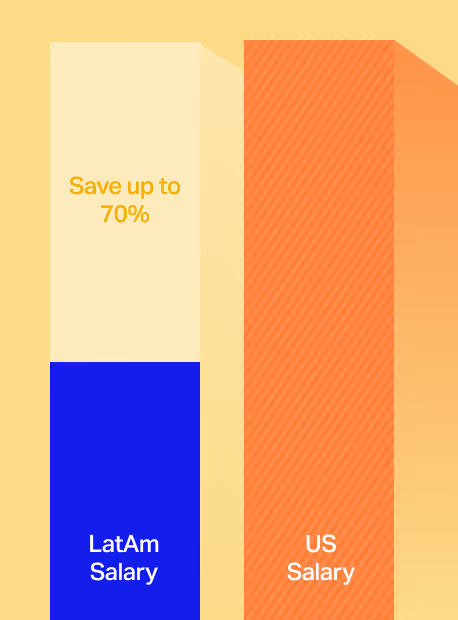
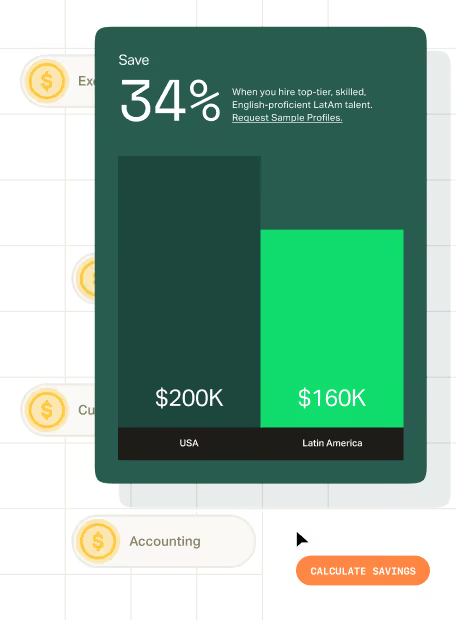
Location is the factor with the widest swing. According to Hire With Near's 2026 State of LatAm Hiring Report, companies hiring in Latin America save 30 to 70% on salaries compared with US equivalents, an average of $35,000 to $64,000 per hire.
For many companies, the most predictable option is a dedicated app developer who works only on your product, at a single annual salary you can budget against.
According to our salary data, the average salary for an app developer in Latin America ranges from $30K to $108K a year depending on seniority, compared with $73K to $189K in the US. For the agency route, our breakdown of how much offshore developers cost is a useful comparison point.
Here's what a dedicated app developer costs in Latin America compared with the US, according to Hire With Near's salary benchmarks:
For the most up-to-date figures, see Hire With Near's US vs Latin America Salary Guide.
Even at the senior end, an app developer in Latin America tops out at $108K, below where the US mid-level range ends at $147K. That gap is a consequence of lower living costs, not lower standards. Companies that hire this way often put the difference toward another engineer, a longer runway, or more of the roadmap.
The choice between a dev shop and a dedicated hire is the one most teams get stuck on. This short video walks through when each one makes sense:
Why Outsource App Development Services to Latin America?
Latin America pairs competitive rates with something most outsourcing destinations can't offer: developers who are online and working during your business day.
Three reasons Latin America is the region most US teams choose for app development:
1. Cost-effectiveness (without compromising quality)
LatAm offers competitive pricing for software development outsourcing services compared to the US or Western Europe.
These competitive rates come from lower living costs and favorable economic conditions in the region, a dynamic our free guide to hiring remotely in Latin America breaks down in detail.
Hiring in the region costs 30-70% less on salaries than hiring US equivalents, and the engineering standard holds up: plenty of developers in LatAm have spent years building production software for US companies.
Clients hiring at a high bar tend to say the same thing. Ashley Black, founder of Candid Consulting, spent a decade at Google before hiring through Hire With Near:
The talent Hire With Near provided is incredibly high quality. I worked at Google for 10 years, where the bar for talent is very high, and I would say the people I placed through Hire With Near are comparable to the people I worked with at Google.
— Ashley Black, Founder, Candid Consulting
You can read more client reviews on Hire With Near's reviews page.
2. Geographical proximity and time zone compatibility
Developers in Latin America are at their desks during your own working day, wherever your team sits in the US, so questions and code review get handled in real time instead of overnight.
With a team in Latin America, that overnight lag disappears. Stand-ups happen live, code review comments get answered the same morning, and a blocker raised in your afternoon is usually resolved before everyone logs off.
Most Latin American countries fall within or close to the US time zone band, so whether your office runs on Pacific, Mountain, Central, or Eastern time, you share most of the working day with your developers.
3. Rich talent pool and language proficiency
Latin America's developer community is large and growing fast. According to GitHub's Octoverse 2024 report, Brazil has more than 5.4 million developer accounts on GitHub, Mexico more than 1.9 million, Argentina more than 1.1 million, and Colombia more than 1 million, all growing at double-digit rates year over year.
Many professionals in the region are fluent in English, reducing communication barriers and making day-to-day work with US-based teams smoother.
Combined with strong educational systems and increasing investment in tech training, the region has become a deep source of engineering talent. Specialist firms focused on IT and tech recruiting in Latin America draw on that pool daily, and companies also use executive search in the region to fill engineering leadership roles like engineering managers and VPs of Engineering.
Final Thoughts
Outsourcing app development in 2026 makes the most sense when the build is bounded: a defined scope, a clear budget, an end date.
But if the app is your product, development never really ends. Before you sign an outsourcing contract, it's worth asking what your roadmap looks like after launch. If there's always a next release, the stronger long-term move is to hire Latin American developers as full-time members of your team.
They work your hours, and the product knowledge compounds inside your company instead of leaving when a contract ends.
One fast-growing US healthtech startup made exactly that call. Rather than outsourcing its roadmap, it hired its own senior engineers through Hire With Near. Its success story records the results:
- 7 senior engineers hired across backend, DevOps, QA, mobile, and frontend
- 14 days average time-to-hire per role
- $323K a year saved compared with US salaries, with its 8-step interview process kept intact
Still weighing the two paths? Our look at why the Latin American software industry is thriving explains the region's engineering depth, and the questions tech leaders ask about hiring developers in Latin America cover the practical concerns that come up next.
If you're ready to hire dedicated software engineering talent, book a free consultation to talk through your requirements with our team. You'll get salary benchmarks and a clear view of the process, so you have what you need to decide if it's right for you.
{{consultation}}
Frequently Asked Questions
Can I hire offshore developers for both mobile apps and web development?
Yes, many companies simultaneously hire offshore developers for both mobile app development and web development needs. Since mobile apps often require web-based backends, admin dashboards, or companion websites, it's common to build teams with expertise in both areas. Latin American developers, for example, often have cross-functional experience across mobile and web platforms, making them versatile additions to your development team.
What other development roles can I outsource to Latin America besides app developers?
Beyond app developers, you can outsource a wide range of technical roles including front-end developers, back-end developers, full-stack developers, DevOps engineers, and QA engineers. Latin America's tech talent pool spans virtually every modern programming language and framework, from React and Node.js to Python and cloud infrastructure. This makes it easy to build complete development teams offshore while maintaining the same quality standards you'd expect from US-based talent.
Should I hire separate developers for iOS and Android, or look for cross-platform specialists?
Go cross-platform unless your app needs platform-specific features or performance-critical functionality; in that case, hire native specialists. For those platform-specific or performance-critical builds, dedicated iOS developers and Android app developers may be best.
However, if you're building a simpler app or want faster time-to-market, cross-platform specialists using frameworks like React Native or Flutter can build for both platforms simultaneously. Many Latin American developers have expertise in both native and cross-platform development, giving you flexibility in your hiring approach.
How long does it take to outsource app development?
A simple app usually takes 2 to 4 months to build once development starts, while complex or multi-platform apps run 6 to 12 months or longer. Budget another 2 to 4 weeks up front for researching, vetting, and contracting the right partner. Hiring a dedicated developer moves faster than most companies expect: at Hire With Near, we typically send a shortlist of candidates in 3 to 5 days, and most of our clients make a hire in under three weeks.
What are the risks of outsourcing app development?
The biggest risks of outsourcing app development are contractors going dark mid-project, hidden agency fees, misrepresented skills or seniority, and losing control of your intellectual property. Each has a direct mitigation: milestone-based contracts, transparent pricing models, your own technical vetting, and IP-assignment clauses with code kept in repositories you own. Contractor abandonment is the failure we hear about most.
A contract that ties payment to milestones, plus code that lives in your own repositories from day one, turns a vanished vendor into a setback instead of a restart.
How do I protect my intellectual property when outsourcing app development?
Protect your IP with a contract that includes both an NDA and an explicit IP-assignment clause, code stored in repositories your company owns, and access controls with a clear offboarding procedure.
The assignment clause matters more than the NDA: it makes the work legally yours the moment it's created. Cross-border enforcement is harder than domestic enforcement, which is exactly why the contract and the infrastructure controls need to do the heavy lifting. Reputable outsourcing partners and staffing firms build these protections into every engagement; if a provider pushes back on an IP-assignment clause, that tells you what you need to know.







.webp)


%203.svg)
.avif)




%20(1).avif)

%20(1).png)