.avif)


%203.svg)
Key Takeaways
- For US companies, the best countries to outsource app development are Brazil, Argentina, and Mexico. They combine a near-full overlap with your own working day, deep developer populations, and mid-level app developer salaries of $48,000 to $72,000 a year against $81,000 to $147,000 for the same role in the US.
- India posts the lowest headline rate of the 11 countries, at a self-reported median of $10,462 a year for a mobile developer, but that figure isn’t directly comparable to the range for a mid-level app developer in Latin America or the US median for software developers broadly, since each reflects a different role scope.
- Workday overlap is the criterion most teams under-weight: research from Harvard Business School and INFORMS found that each additional hour of time-zone difference cuts real-time communication by 11%, based on a study of 12,038 employees.
Your app roadmap is stalling because your engineering team can’t keep up, and hiring locally would blow through a budget you don’t have. That’s usually when companies start looking for outside help to build their app, and once they do, they’re sitting with an important decision: where to outsource app development.
The three regions companies weigh most are Latin America, Europe, and Asia, and each pulls you toward a different setting. Latin America gives you real-time overlap with US business hours, so your team and theirs are online together. Eastern Europe offers strong technical depth, often at a partial overlap with the US workday. Asia typically offers the lowest salaries in absolute terms, with the least working-hour overlap of the three.
To help you make the best decision for your business, I put together this guide. It compares 11 countries on cost, English proficiency, workday overlap, and talent depth, so you can shortlist the right one for your app build.
If you already know you want to hire app developers directly rather than outsource a project, Hire With Near’s nearshore staffing and recruiting services can help you build that team.
How Do You Choose Where To Outsource App Development?
When weighing where to outsource app development, choose a country based on six things: overlap with your own working hours, technical English, talent pool depth for your specific stack, how cost maps to the seniority you can hire, business-norm alignment, and practical risk.
From the editorial work I do interviewing Hire With Near’s recruiters, almost every disappointing engagement traces back to the first two.
Overlap with your own working hours
Start here, because it’s the only criterion that’s expensive to fix later. What matters is how much of your working day the team shares, wherever your office is.
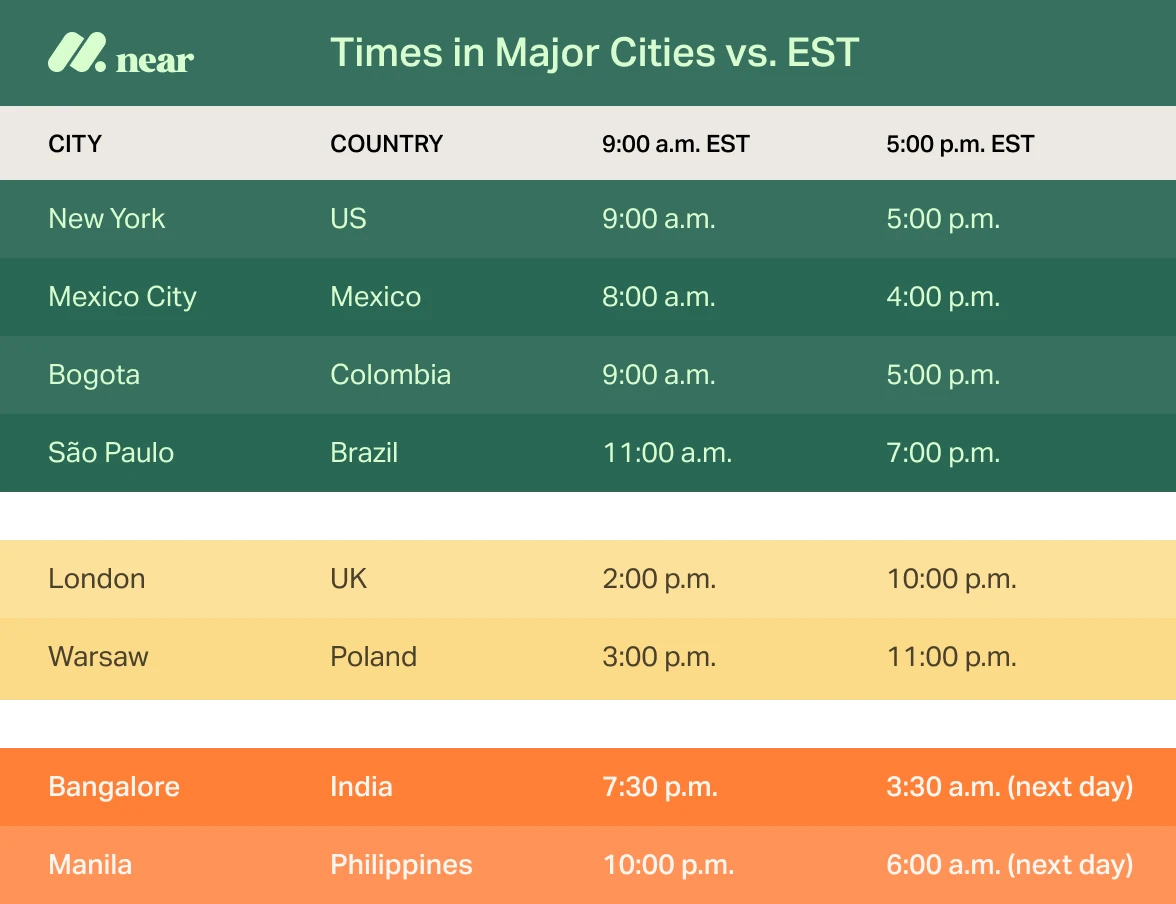
Countries in Latin America, like Brazil, Argentina, and Mexico, give most US teams a near-full shared day and don’t shift their clocks, so the only thing that moves the overlap is your own daylight saving change.
Portugal and countries in Eastern Europe, like Poland, Romania, and Ukraine, give you the front end of your day. India, Vietnam, China, and the Philippines give you almost none of it.
English proficiency, especially technical English
An engineer who chats easily but can’t explain why a pull request broke production, write documentation another engineer can follow, or hold their own in an architecture review is a problem.
The test our recruiters use is simple, and you can run it yourself: ask the candidate to walk through a real project and explain it, and the trade-offs they made, to someone who isn’t a developer. If they can do that unprompted, technical English isn’t your risk.
We usually use the EF English Proficiency Index as a guide, but read it carefully: it measures adult test-takers nationally, not engineers, and developer populations typically score well above their national average.
That’s why Brazil at #75 and Mexico at #103 still produce engineers who work comfortably with US teams every day: a national average isn’t a hiring pool. It does mean English has to be assessed candidate by candidate in those two markets, which is one of the things a recruiting partner is for.
Talent pool depth for your stack
Depth only matters at the level of your actual stack. A country with two million developers may still be thin on Swift or Flutter specialists, while a smaller market might have a dense React Native community because a few large employers built one. Ask for the count of candidates in the specific stack, not the national total.
Companies doing IT and tech recruiting in Latin America tend to find the region’s depth sits in cross-platform mobile and backend work rather than in niche native stacks.
How cost maps to the seniority you can hire
Compare the same seniority level across countries, not headline day rates. A country’s lower cost of living is a legitimate reason salaries run lower there, not a sign of weaker talent.
But within that, if one quote comes in noticeably lower than others for the same country, ask why: it may reflect a less senior engineer rather than a better deal, and on an app build, a junior engineer costs you rework rather than salary.
Use the annual ranges in the cost section provided later in this article as your benchmark for each seniority level, and treat any figure without a stated seniority level as incomplete.
Business-norm alignment
This is about working practices rather than culture in the abstract: how quickly a team escalates a blocker, whether they flag a slipping estimate before the deadline, how much written context they leave behind. Escalating early and leaving written context behind are standard practice for most Latin American professionals who work with US teams, and many have done it inside a US company already.
That same instinct shows up in how they handle disagreement, not just deadlines. Franco Pereyra, COO of Hire With Near, describes what he sees consistently:
What sets Latin American talent apart from other regions is that you’ll find people who are proactive and creative. People who come up with ideas and new solutions. If you’re looking for folks who can bring something to the table, who will push back if they think your idea doesn’t make sense, that’s what you find in Latin America.
Ask, in the interview, for a specific example of a time the candidate raised a problem to a manager early, or pushed back on a decision they didn’t agree with.
Stability and practical risk
Practical risk is the set of things that change how a team operates day to day, and how confident you can be that the arrangement still works a year from now.
Political and economic stability matter directly: currency volatility can push a country’s cost advantage to shift faster than you’d expect, and unstable labor law or tax policy can complicate compliance for a partner handling payroll on your behalf.
Infrastructure reliability is worth checking too, since inconsistent internet or frequent power outages in a given region show up as missed standups and delayed deliverables, not abstract risk.
Local conditions change, so verify them at the time you hire, and prefer a country where you can talk to companies already hiring there.
Where Should You Outsource App Development? The 11 Best Countries
The best countries to outsource app development are Brazil, Argentina, and Mexico if you want real-time collaboration with your team, India or Vietnam if headline rate is your binding constraint, and Poland, Romania, or Portugal if you need an EU base with very strong English.
In Hire With Near’s 2026 State of LatAm Hiring Report, Brazil leads for IT and engineering placements, while Colombia is the top nearshore destination overall at 23% of all placements, ahead of Argentina at 21% and Brazil at 14%. Together, those three account for 58% of all nearshore hiring.
In the table below, you’ll find an at-a-glance comparison between the best countries for app development outsourcing on the four things that change how an app gets built.
English proficiency figures are ranks and scores from the EF English Proficiency Index 2025, which tested 2.2 million adults across 123 countries. Read it like this: level, position in the index and, in parentheses, the score.
One honest note on the salary column. Credible, methodologically transparent salary data for a mid-level app developer only exists for a handful of large markets. The Latin American figures are Hire With Near’s own placement data; India’s comes from Stack Overflow’s 2025 developer survey and is a self-reported median.
For the other seven countries, published figures vary widely depending on the source, methodology, and whether they reflect local salaries or remote contract rates. Hence, those cells note that rather than repeat a single number you can’t verify against your own hiring.
1. Brazil
Brazil has the largest developer population in the Americas: 6.89 million GitHub accounts, fourth most in the world, according to GitHub’s 2025 Octoverse report, after growing 27% year over year in 2024.
That scale comes with real depth for app work specifically. Brazil’s fintech hiring and e-commerce sectors, home to companies like Nubank and iFood, have produced a large pool of engineers experienced in mobile-first product development, payment integrations, and high-traffic backend systems, the exact skills most app builds actually need.
It sits at UTC-3 and doesn’t shift for daylight saving, so the only thing that moves the overlap is your own clock change: the gap widens or narrows by one hour twice a year. National English scores are low, so screen for it directly instead of assuming it.
Our guide to how to hire developers in Brazil covers salaries and hiring models in more depth.

2. Argentina
Argentina has the strongest English of any Latin American country on this list: #26 of 123 countries in the EF English Proficiency Index 2025, with a score of 575 in the High band, up 13 points in a year. GitHub’s 2024 Octoverse report counted more than 1.1 million Argentine developers, representing growth of 22%.
Beyond the language advantage, Argentina’s talent pool skews senior, with a strong pipeline of engineers who’ve come up through companies like Mercado Libre, a regional quality signal recruiters watch for specifically, and global outsourcing firms like Globant that have built substantial local operations.
That combination is why US teams reach for Argentina when the engineer has to survive a Zoom architecture review or talk to a client.
For more information, see our Hire developers in Argentina guide.
3. Mexico
Mexico gives most US teams the closest thing to a shared workday of any country here, and it stopped observing daylight saving in 2022, so the only thing that shifts the overlap is your own clock change. GitHub counted more than 1.9 million Mexican developers in 2024, growing 21%.
Decades of nearshore manufacturing and, more recently, nearshore tech operations have built a workforce genuinely used to US business practices and direct client collaboration.
Mexico’s national English score is the lowest of the 11 countries at #103 of 123. It means English has to be a screening criterion, not an assumption.
Start with our Hire developers in Mexico guide.
Those three share more than geography. They’re the countries where the engineers you hire are online while your team is, where the hiring models are well established, and where a low national English average tells you almost nothing about the engineers you’d interview.
Our breakdown of hiring models and costs for LatAm developers goes deeper on all three, and the guide to hiring remotely in Latin America covers the practical setup.

4. Ukraine
Ukraine’s Ministry of Digital Transformation counts more than 305,000 IT specialists in the country, across 2,200 active companies and a $7.85 billion IT market as of 2025.
Ukrainian engineers have a strong reputation for technical depth, particularly in complex backend systems, fintech, and gaming, built over years of serving Western European and US clients even through wartime disruption. That resilience and continuity is itself a signal many companies weigh when hiring there.
English sits in the Moderate band at #45 of 123, which is above the global average of 488 but below what the ranking alone suggests. Overlap with a US workday is limited to the very start of your day, and Ukraine does shift its clocks for daylight saving.
5. Poland
Eurostat counts 778,800 employed ICT specialists in Poland for 2025, or 4.5% of total employment, the largest such workforce of the three EU countries here.
Poland has built a genuine reputation for senior engineering talent, especially in enterprise software, cybersecurity, and increasingly AI and machine learning, backed by a strong university system and years of serving demanding Western European clients who expect polished delivery.
English is classified as Very High, at #15 of 123, so technical communication is rarely the constraint. What is a constraint is the clock: a Polish team’s day overlaps only the beginning of yours.

6. Romania
Romania has the second-highest English score on this list at #11 of 123, up 12 points year over year, and Eurostat counts 207,800 employed ICT specialists there in 2025.
Romanian engineering talent has a strong reputation in cybersecurity and backend development, with Bucharest and Cluj-Napoca producing a steady pipeline of graduates from technical universities that have built close ties with Western European tech companies over the past two decades. It’s inside the EU, which simplifies data-protection questions for some products.
The overlap picture is the same as Poland’s: strong English, almost no shared afternoon.
Our comparison of hiring remote talent in LatAm vs. Eastern Europe covers Poland, Ukraine, and Romania as a bloc.
7. Portugal
Portugal has the strongest English of all 11 countries, #6 of 123 globally with a score of 612. Eurostat counts 283,900 employed ICT specialists there, which is 5.4% of total employment, the highest share of any country on this list.
Lisbon and Porto have built a genuinely international tech scene, with Portugal attracting significant remote-work talent and startup activity in recent years, which shows up in a workforce comfortable working with clients across multiple time zones and cultures, not just a domestic market.
Portugal is also the only European option where a US East Coast team gets a genuine block of shared afternoon, since it sits at UTC±0 in winter and UTC+1 in summer. For a European build, it’s the closest thing to nearshore.

8. India
India is the biggest developer market in the world after the US, with 21.9 million GitHub accounts and more than 5.2 million added in 2025 alone. It also carries the lowest headline cost on this best countries to outsource app development list.
India’s talent base is especially deep in enterprise software, QA and testing, and IT services broadly, reflecting decades of large-scale outsourcing operations run by global firms like Infosys, TCS, and Wipro.
For app development specifically, that depth means a large pool of engineers with production experience, though the market’s sheer size also means more variance in individual skill, which makes vetting more important here than in smaller markets.
The trade-off is the time zone difference: at UTC+5:30, the Indian workday is largely over before a US afternoon starts.
Our side-by-side on hiring remote talent in LatAm vs. India prices that gap out.
9. The Philippines
The Philippines has the fifth-strongest English on this list at #28 of 123, in the High band. IBPAP, the country’s IT and business process association, puts the IT-BPM workforce at 1.9 million as of 2025, up from 1.82 million the year before, though that figure covers support and back-office work as well as software.
Decades of BPO and IT outsourcing have given Filipino engineers deep experience with US business practices and client-facing work specifically, which shows up as strong customer communication and process discipline, traits that matter as much as raw technical depth on many app projects.
At UTC+8, there’s effectively no shared workday with a US team.
If you’re interested in outsourcing there, see our LatAm vs. the Philippines comparison.

10. Vietnam
Vietnam’s Ministry of Science and Technology reported 73,788 digital technology companies and nearly 1.26 million ICT workers at the end of 2024, a 10.1% increase in company count year over year.
Vietnamese engineering talent has built a strong reputation specifically in mobile app development, with companies and outsourcing firms there producing a steady stream of iOS and Android specialists, alongside a growing presence in AI and machine learning as the government has pushed digital transformation as a national priority.
English improved more than any country on this list in the latest EF index, up 22 points, but still sits in the Moderate band at #64. Like the Philippines, its workday runs opposite a US team’s, so Vietnam suits builds you can manage asynchronously.
11. China
China’s engineering depth is real, particularly in AI and in hardware-adjacent app work, but it’s the hardest country here to compare on evidence. Neither GitHub’s Octoverse reports nor an accessible government source publishes a current developer or software-workforce count for China, so treat any tidy figure you see with suspicion.
That AI and hardware strength comes from a mature ecosystem of companies like Alibaba, Tencent, and ByteDance, which has produced engineers with deep experience building apps that integrate closely with hardware, payments infrastructure, and large-scale consumer platforms, skills that transfer well to complex app builds even outside China.
English sits in the Low band at #86 of 123, and at UTC+8 nationwide there is no meaningful overlap with a US workday.
Picked a region and now need a partner rather than a country? That’s a different decision, and two pages cover it: the leading application development outsourcing companies if you want a firm to own the whole build, and the best companies to hire developers in Latin America if you’d rather hire your own team in the region.
If your build is broader than an app, we keep a separate list of the best countries for software development outsourcing.
What Does It Cost To Outsource App Development?
Latin America is where Hire With Near’s own salary data comes from, so that’s the region we can speak to with real numbers rather than secondhand estimates.
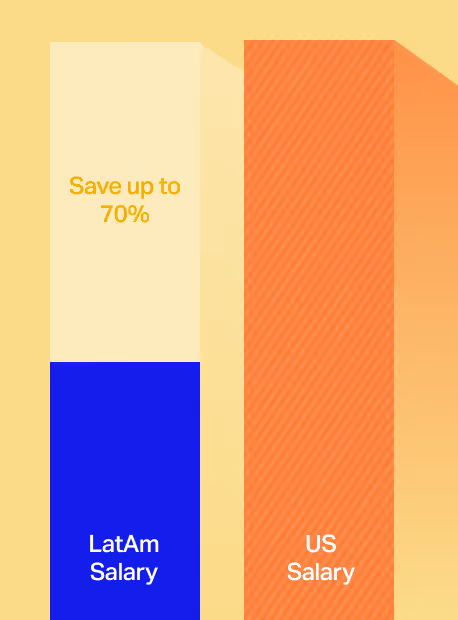
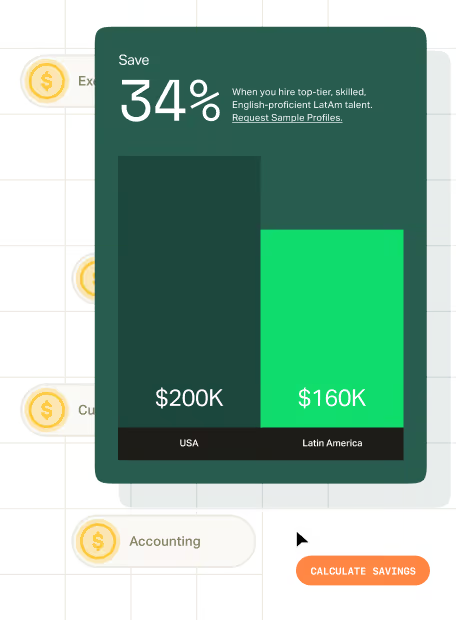
Hiring a mid-level app developer there costs $48,000 to $72,000 a year, against $81,000 to $147,000 for the same role in the US, according to our salary data.
For a wider anchor, the US Bureau of Labor Statistics puts the median annual wage for US software developers at $133,080 as of May 2024, with the top 10% above $211,450.
Here’s what hiring app development roles professionals costs across Latin America compared with equivalent US hires, according to Hire With Near’s salary benchmarks:
For the most up-to-date figures, see Hire With Near’s US vs Latin America Salary Guide.
The real advantage isn’t simply cheaper labor: the budget that covers a mid-level developer in the US often covers a senior developer in Latin America. Companies that come to the region for cost reasons usually end up upgrading the seniority of the hire instead of pocketing the difference.
Pay at the very bottom of these ranges, and you’ll compete for the same candidates as everyone else doing that, and you’ll be rehiring within a year.
I have a real example to share with you: scaling fast with only two internal recruiters, a US healthtech startup refused to shorten an eight-step interview process that included deep technical screens and coding assessments.
Working with Hire With Near, it hired seven senior engineers across backend, DevOps, QA, mobile, frontend, and staff-level roles. One was a senior mobile engineer with more than 10 years in React Native, who had led a team shipping an app used by tens of thousands of people and cut its crash rate by 30%.
The company saved $323,000 a year against US salaries, a 33% reduction, and averaged 14 days to hire with all eight steps intact.
If you’d like to compare Latin American rates against a far-offshore quote, but for general developer roles, our article about offshore developer rates is the closest like-for-like.
{{salary-guide-cta}}
Nearshore or Offshore: Does Time Zone Overlap Really Change the Outcome?
Yes, time zone overlap really changes performance and alignment, and the effect has been measured. Research from Harvard Business School and INFORMS found that each additional hour of time-zone difference reduces real-time communication between colleagues by roughly 11%, based on a study of 12,038 employees.
That same research found that larger time-zone gaps force employees to work outside their own normal business hours just to stay in sync with a distant team. That pattern creates real strain and contributes to burnout and turnover on the offshore side, a hidden cost that surfaces later, when the engineer you’ve spent months onboarding leaves.
The researchers also found distributed teams perform best when organized along a north-south axis, like the US and Latin America, rather than east-west.
In Hire With Near’s research on why US companies are hiring in Latin America, 30% of the companies exploring the region were switching from offshore to nearshore for exactly that reason.
How does time zone misalignment affect app development?
On an app build, the work moves through a queue of small synchronous decisions: a design question, a code review, a decision about whether a build is safe to ship.
When the overlap is wide, those resolve inside a day. When it’s narrow, each one becomes a message that waits for the other side to wake up, and a two-day feature becomes a two-week feature without anyone doing anything wrong.
The founder of an early-stage startup whose app was being built by an offshore team in India put the cost in the plainest terms: “You lose a day. You lose a day every single time just from a message.”
Another founder, this time of a small web3 and entertainment startup, described what happens when the person who signs off on releases isn’t around during the workday:
We currently have a senior QA that is focused on both manual testing and automation. She’s based in Sri Lanka, and I don’t get her enough during my day to actually allow us to keep on that high quality and high throughput for my team. We often release without her. It’s not good, right?
None of that is a comment on the engineers. There are excellent app developers in every country in the table above. It’s a comment on the model: a team whose workday sits opposite yours can’t be in your stand-up, can’t review a pull request the afternoon you open it, and can’t be pulled into a release call at short notice.
In dozens of conversations with Hire With Near’s engineering recruiters this year, the pattern that comes up most is that cost gets all the attention in the first call and overlap decides the outcome six months later.
If the distinction between the models is still fuzzy, nearshoring vs. offshoring vs. onshoring draws the lines, and if you’re specifically deciding where to outsource mobile app development, our guide to offshore mobile app development covers the far-offshore version of that build in detail.
What Are Your Options for Hiring App Developers Abroad?
You have four ways to get an app developer onto your team once you’ve chosen a country: source and hire on your own, use freelance and contractor platforms, nearshore staff augmentation, or rely on a specialist staffing and recruiting firm. They differ in who finds the person and who employs them.
We’ll go through them from most work on your side to least.
Option 1: Source and hire on your own
You run the search yourself through a job board for hiring in Latin America, LinkedIn, or referrals, then solve employment separately. For a cross-border hire, you have two options:
- Register a legal entity in the country: Gives you full control, but it takes months to set up, needs ongoing legal and accounting support, and only pays off at real scale.
- Use an employer of record (EOR): Handles contracts, payroll, tax withholdings, local benefits, and compliance, while the person works as part of your team under your day-to-day management.
The gap to plan around: an employer of record company handles employment logistics, not recruiting. You still source, screen, and technically vet every candidate yourself.
Option 2: Freelance and contractor platforms
Platforms like Upwork, Toptal, and Fiverr let you bring in a contractor quickly, and for a defined, short-term piece of work, they do the job.
They’re built for project work, though, which shapes everything about them: you carry vetting, quality control, and retention on your own, and the person is usually splitting attention across several clients.
For a full-time app developer, specialist staffing gives you very different results.
Option 3: Nearshore staff augmentation
A staff augmentation firm places pre-vetted engineers onto your team to work under your direction while the firm remains the legal employer and handles payroll, benefits, and compliance.
It sits between a marketplace and a permanent hire: far more vetting and accountability than a platform, more flexibility than building a permanent team. It fits a defined project, a scaling push, or added capacity you don’t yet want as permanent headcount.
Option 4: A specialist staffing and recruiting partner
This is the simplest path for most US companies, because it combines both jobs into one relationship: finding and vetting the talent, and handling everything that comes after you hire.
You describe the role and the stack you need. The partner runs a search built specifically around that brief, screens candidates for technical depth and communication, and presents you with a shortlist of people who’ve already cleared that bar. You interview the ones you like and make the decision.
Once you hire, the partner takes over payroll, benefits, and local compliance, so the developer becomes a full-time member of your team rather than a contractor on loan.
A recruitment and staffing company that helps you build or expand your team with full-time developers runs exactly this model. Hire With Near does it through our nearshore staffing and recruiting services.
Most companies hiring a full-time app developer abroad end up here.
If you’re weighing this decision now, the questions tech leaders ask about hiring developers in Latin America cover the ground beyond geography: stand-ups, seniority, and what the first 90 days look like.
Final Thoughts
When outsourcing app development, the most important aspect is whether the developer is at their desk while you’re at yours, because that single variable decides how fast a decision moves and how often you ship without the review you wanted.
That’s why, for most US companies, Latin America is the answer to where to outsource app development: comparable engineering depth, a shared working day, and salaries 30% to 70% lower than comparable US rates. Those are the same reasons thousands of US companies now hire Latin American talent.
If you’d rather hand the whole build to a firm, the best LatAm outsourcing companies is the place to start. If you want the engineers on your own team, Hire With Near can help you hire an Android app developer in Latin America or a nearshore iOS developer and handle payroll and compliance from there.
Book a free consultation call with our team. We’ll walk you through salary benchmarks for the roles you’re considering and explain how the process works.
{{latam-hiring-cta-v2}}
Frequently Asked Questions
Which country is best to outsource app development?
For a US company, Brazil, Argentina, and Mexico are the best countries to outsource app development, because they’re the only countries on this list that share most of your business day.
Brazil has the deepest developer population in the Americas, Argentina has the region’s strongest English at #26 of 123 on the EF index, and Mexico gives most US teams the closest thing to a shared workday.
Portugal comes closest of the European options.
If overlap doesn’t matter for your build, India and Vietnam have lower headline rates.
Is it cheaper to outsource app development to India or Latin America?
India has the lower headline number: Stack Overflow’s 2025 developer survey puts the median mobile developer salary there at $10,462 a year, against $48,000 to $72,000 for a mid-level app developer in Latin America in our placement data.
What that number doesn’t price is the overlap gap. A study of 12,038 employees found each extra hour of time zone difference cuts real-time communication by 11%, which on an app build shows up as slower reviews and later releases.
Our LatAm vs. India comparison works the trade-off through.
Where should US companies outsource app development?
US companies should outsource app development to Latin America, and specifically to Brazil, Argentina, or Mexico of the 11 countries compared here. The region shares most of the US working day, so stand-ups, code reviews, and release decisions happen live instead of overnight.
Colombia belongs in that group too, even though it sits outside the 11-country table above.
It’s also the region the Harvard and INFORMS research on distributed teams points US companies toward, because its authors recommend organizing distributed teams along a north-south axis rather than east-west.
How much does it cost to outsource app development in 2026?
Hiring an app developer in Latin America costs $30,000 to $108,000 a year depending on seniority, against $73,000 to $189,000 for the same range of seniority in the US, according to Hire With Near’s 2026 salary data.
A mid-level developer typically lands between $48,000 and $72,000 in Latin America, versus $81,000 to $147,000 for a mid-level hire in the US. The overall US median wage for software developers is $133,080 per the Bureau of Labor Statistics.
Far-offshore markets can be lower still, though credible per-country salary data outside the largest markets is scarce.
What app development roles can I hire in Latin America?
US companies hire the full range of app development roles in Latin America, including mobile developers in Latin America, nearshore iOS developers, remote Android app developers, and React Native specialists, alongside generalist app developers and the QA and DevOps engineers who ship alongside them.
Cross-platform work is the region’s deepest pocket of mobile talent. Match on the stack rather than the job title, since an app developer who has only shipped native iOS is a different hire from a React Native specialist.
Can I build my whole app development team in one country?
Yes, and concentrating a team in one country has real advantages: one labor market to learn, shared public holidays, one set of local norms, and a team that can meet in person if you want that. The healthtech startup mentioned in the article hired seven senior engineers this way.
The limit is stack depth. If your roadmap needs a niche native specialist, insisting on one country can narrow the pool sharply, so treat single-country as the default rather than a rule.
For engineering leadership hires, executive search in Latin America covers VP of Engineering and CTO roles in the same markets.
How are app developers vetted before I interview them?
Hire With Near’s engineering recruiters screen in stages, so every candidate who reaches your interview has already cleared four filters. They verify the stack and the depth of experience rather than the job title. They run a live conversation in which the candidate walks through a real project and its trade-offs for someone who isn’t a developer. They assess English directly, and they look for the traits that predict success on a small team, such as ownership.
Your own technical interview is still the final filter. The point of the screen is that you only spend interview time on people who can already do the work.







.webp)


%203.svg)
.avif)





%20(1).avif)

%20(1).png)