%203.svg)
Key Takeaways
- Outsource Ruby on Rails development when the work is bounded and temporary, such as a rebuild, a migration, or a fixed-scope feature build, and hire your own Rails developer when the application is the product itself.
- Vet any Rails provider with a small real-world task reviewed together on a call, not a resume scan or a portfolio link, and ask their references what handover looked like after the engagement ended.
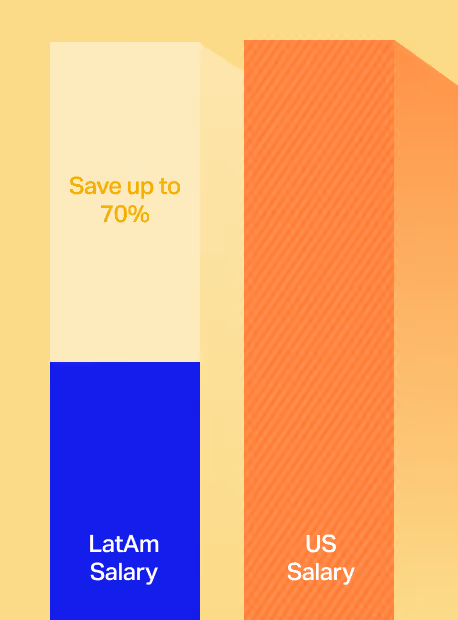
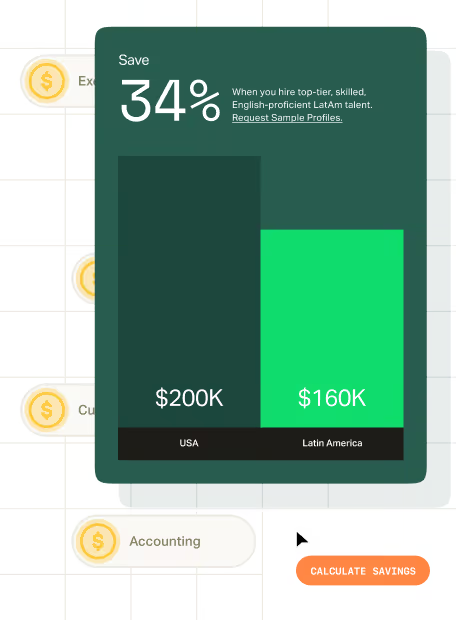
- Hiring your own Ruby on Rails developer in Latin America costs $66K to $84K a year at senior level, up to 56% less than a comparable US hire, with overlap across your working day.
Companies outsource Ruby on Rails development for bounded work: an integration, a version upgrade, a feature that has to ship by a date. A defined scope, a start point, and an end point are what make a project a good fit for outsourcing.
Because Ruby on Rails emphasizes convention over configuration, a well-structured Rails codebase is easier for external developers to pick up quickly than most frameworks. However, finding the right agency or contractor requires separating genuine Rails experts from generalist shops that treat the framework like any other tech stack.
This guide covers both paths: when outsourcing Rails work is the right call, what skills to look for, and how to run the selection process so you don’t get burned. We also present an alternative strategy that makes sense for some companies: hiring your own Ruby on Rails developer.
What Are the Benefits of Outsourcing Ruby on Rails Development?
Companies that outsource Ruby on Rails development get access to three things that are genuinely hard to get another way: a team that can start in weeks instead of a quarter, Rails-specific experience you don’t have to build in-house, and an engagement you can size to the work.
Here are the benefits of outsourcing Ruby on Rails development in detail:
Overhead cost savings
By engaging external developers, you skip the recruiting cycle, the equipment, the payroll administration, and the cost of paying for engineering capacity between projects. For a three-month build, that’s usually the difference between spending on the work and spending on the infrastructure around the work.
The limit: vendor rates carry the vendor’s margin, so the hourly cost is often higher than an in-house salary. The savings come from not paying for capacity you aren’t using, not from the rate itself.
Access to specialized expertise
Outsourcing gives you developers who have already solved the specific problem you’re facing. Rails work rewards that kind of pattern recognition: version upgrades on an app that’s three releases behind, ActiveRecord queries that are melting the database, background job architecture, or rescuing an application whose original team is long gone.
The limit: that expertise belongs to the vendor. When the engagement ends, it leaves with them, along with most of the context about why your code looks the way it does.
Enhanced focus on core business activities
Handing development to an external team frees your internal people to work on the tasks only they can do: customers, product decisions, and the parts of the roadmap that depend on knowing your business.
The limit: outsourcing moves the work, but it doesn’t remove the management. Someone on your side still has to write specs, answer questions, and review what comes back. Budget three to five hours a week for it.
Scalability and flexibility
You can add three developers for a push and drop back to one when it’s over, without a hiring process or a layoff. For seasonal workloads and project-shaped work, that flexibility is the main reason to outsource.
The limit: contracts usually carry notice periods, and every new engineer needs a ramp-up period on your codebase before their output is worth what you’re paying for it.
Faster time to market
An experienced Ruby on Rails developer can start within weeks, where an in-house search for the same skill set typically runs months. When you’re trying to get a product in front of users, that gap is often the whole business case.
The limit: the first couple of weeks go to context, not features. Plan your dates from the point the team is productive, not the point the contract is signed.
Risk mitigation
A vendor that has shipped dozens of Rails applications has already hit the problems ahead of you, and a good contract puts delivery commitments in writing.
The limit: contracts transfer risk, but they don’t erase it. If the project fails, the vendor loses an account and you lose the quarter. Keep enough technical oversight on your side to see trouble early.
When Should You Consider Outsourcing Ruby on Rails Development?
Outsource Ruby on Rails development when the work has an end date and your team doesn’t have the skill or the hours to do it. Four situations make the case clearly:
Limited in-house expertise
If your team can’t safely change the Rails app you already run, that gap doesn’t close on its own. SignalFire’s State of Tech Talent Report 2025 found that hiring rebounded for mid- and senior-level roles while new-grad hiring kept falling, with new grads now making up just 7% of hires at large tech companies and under 6% at startups.
That shift matters here because an engineer who can take over an existing Rails codebase is experienced by definition, and experienced talent is exactly what’s gotten harder to find. Outsourcing sidesteps that scarcity entirely: you get access to that expertise on demand, without needing to compete for it in the market yourself.
Budget constraints
Cost is still one of the main reasons companies outsource, but it’s no longer the only one. Deloitte’s 2024 Global Outsourcing Survey, which polled more than 500 executives, found that skilled talent and agility now sit alongside cost reduction as key drivers, and that 80% of executives plan to maintain or increase their investment in third-party outsourcing.
Outsourcing partners often work with developers based in Latin America and Southeast Asia, where salary expectations are lower than US rates, and price their services accordingly.
If you’re comparing regions on price alone, it’s worth understanding how much offshore developers cost once coordination time is included.
{{latam-hiring-calculator}}
Rapid development needs
External teams can usually start immediately. They already have the people, so there’s no search, no notice period, and no onboarding of a first engineer into an empty function. When an opportunity has a window, that speed is often worth more than the rate difference.
Need to scale quickly
Outsourced teams expand and contract on contract terms rather than headcount decisions. If you need four developers for one quarter and one for the next three, that shape is much easier to find through outsourcing than hiring.
What Are Your Options for Getting Ruby on Rails Work Done?
You have four realistic options for getting Rails work done, and they differ mainly in how much of the relationship you own. They run here from most mediated to least.
A Ruby on Rails development company or outsourcing vendor
With a Ruby on Rails development company, you describe the project, the vendor assigns engineers, and the work comes back through a project manager or account lead. This is the right shape for bounded work with a clear specification: a rebuild, a migration, an integration.
Understand what you’re buying, though. A vendor’s engineers are shared across multiple clients by design; that’s how the agency keeps its pricing flexible and its bench full.
In practice, that means the two or three developers who ramped up on your codebase this quarter may be staffed on someone else’s project next quarter, and a different set of engineers picks up where they left off. The knowledge they built about your specific application doesn’t transfer with them.
Freelance and contractor platforms
Platforms like Upwork and Toptal give you fast access to individual contractors, which works for short, well-defined tasks. For anything ongoing, you’re managing quality, availability, and continuity yourself, and the person is usually splitting their week across several clients.
That split is what companies notice first. One US agency operator described what happened after hiring an offshore development agency to keep costs down:
We hired an agency a couple of months back based out of India. I went the cheap route and paid for it. The time zone killed us, and obviously they have a bunch of other clients, so they just dragged out what could have been done in a week, and it took them quite some time.
Nearshore staff augmentation
With nearshore staff augmentation, a firm places one of its own vetted engineers onto your team to work under your direction, while remaining the legal employer and handling payroll, benefits, and compliance.
It sits between a platform and a permanent hire: far more vetting and accountability than a marketplace, without committing to permanent headcount.
This is the most common shape for nearshore Ruby on Rails development. For a US company, that typically means an engineer based in Latin America who works during your business day, takes direction from your team rather than an account manager, and stays on the payroll of the firm that placed them.
It fits a defined project, a capacity gap, or a team you expect to size up and down. It is not a do-it-yourself route, and the choice between staff augmentation and outsourcing usually comes down to how much day-to-day direction you want to give.
Hiring your own developer through a specialist staffing partner
Instead of outsourcing, you can also hire your own Ruby on Rails developer. This way, the professional joins your team and stays with it.
You can use a specialist partner to do the sourcing and vetting, present candidates, and then handle payroll, benefits, and local compliance once you hire, so you get the recruiting help and the administrative side in one relationship rather than stitching them together.
Choosing well matters more than the model does, and the criteria for picking a recruitment agency are worth reading before you shortlist anyone.
This is also the only one of the four options where the developer works for you and nobody else. You get context and continuity: someone who remembers why the model got refactored last spring and can turn around a change in an afternoon because they don’t need the background explained again.
In the video below, Hayden Cohen, Hire With Near’s CEO and Co-founder, explains why top developers prefer direct hire over dev shops:
9 Skills To Look For in an Ruby on Rails Developer
What separates a strong Rails developer from an average one is rarely framework knowledge. It’s whether they can own a problem end to end and explain their reasoning to someone who doesn’t write code.
That’s exactly what Hire With Near’s engineering recruiters describe as their main screening filters: whether the candidate can describe their own role in a past project rather than the team’s and whether they can make a technical decision understandable to a non-engineer.
Candidates who avoid discussing mistakes, or who turn out to be holding two or three parallel jobs, are the ones our recruiters flag first.
Treat the nine skills below as interview material rather than a checklist to tick off against a resume. If you want more depth on the hiring side of this, our guide to hiring top Ruby on Rails developers covers the full process.
1. Full-stack development
Rails is a back-end development framework, but most Rails work touches the view layer too, whether that’s Hotwire, Turbo, or a React front end talking to your API.
A developer with full-stack range means one person can carry a feature from the database migration through to what the user sees. That matters most on small teams, where nobody is waiting to pick up the front end.
Ask which parts of the stack they wrote themselves on their last project, not which ones they have listed.
2. Code quality and maintenance
Rails gives you a lot of rope. The same application can be written with fat models and thin controllers, with service objects, or with business logic scattered through callbacks, and all three ship. What you want is a developer with a consistent opinion about where logic lives and tests to back it up.
Ask what their test coverage looked like on their last project and what they left untested on purpose. A developer who can defend the gaps has thought about it. One who claims full coverage usually hasn’t written much of it.
3. Agile development practices
If your team runs sprints, stand-ups, and retros, the developer has to work inside that rhythm rather than disappear for three weeks and come back with a branch.
Familiarity with agile methodologies matters less than the habits underneath it: breaking work into pieces you can review, flagging a slipping estimate early, and taking feedback on a pull request without treating it as a verdict.
The question that gets you there is about a failure, not a process. Ask how they handled the last time an estimate turned out to be wrong by a week.
4. Database management
Rails work runs on PostgreSQL or MySQL in almost every case, so look for real depth in one of those, plus working familiarity with Redis for caching and background jobs.
The specific thing to probe is whether they can read a slow query and explain what they would change, not whether they can name the technologies.
Most of the Rails performance problems our recruiters hear about from clients trace back to the database, usually an N+1 query nobody noticed until traffic grew. A developer who has fixed one can describe it in detail.
5. API development and integration
Your Rails app almost certainly talks to something else: a payments provider, a CRM, a mobile client, an internal service. Skills in API development and integration decide how much of that plumbing you can hand over.
Look for someone who has versioned an API other teams depended on, and who talks about what happens when the other side goes down, rate-limits them, or changes a field without warning.
Handling the failure cases is the difference between an integration that runs for years and one that pages someone every month.
6. Problem-solving skills
The developers who work out are the ones who take a vague problem, break it down, and come back with a proposal rather than a question. That’s crucial on a Rails app someone else built, where half the job is working out why the previous team did something before you change it.
This is the trait our recruiters weigh most heavily, especially on small teams where nobody is available to hand out instructions. Federico Bilello, Software Engineering Recruiter at Hire With Near, explains what he screens for:
The main thing I look for is ownership. I always look for developers who have worked in startups or smaller companies, because those are the people who probably have ownership. If you bring them a problem, they won’t ask how to solve it. They’ll try their own ideas, they’ll be creative.
— Federico Bilello, Software Engineering Recruiter, Hire With Near
7. Version control proficiency
Git proficiency is table stakes. How someone works with other people in Git is not.
Ask how they handle a bad merge and what their branching model looked like on a team of five. The answer tells you whether they have worked alongside other engineers or only on their own.
8. Communication skills
Choose remote developers who can explain a technical decision to the people who have to live with it: your product manager, your founder, the person answering customer emails. Written updates matter too, because the work is invisible on a remote team until someone describes it.
There’s a specific test for this, and it’s the one our recruiters use most. When a senior developer describes a project they worked on, they should explain it in plain language without being asked to.
A candidate who can’t make a technical decision understandable to someone outside engineering is often repeating terminology rather than describing work they owned, and they’ll struggle in an architecture review or a client call for the same reason.
9. Continuous learning and adaptability
Rails ships a major version roughly every two to three years, and the developers worth hiring track what changed and why. Rails 8 is the current major version, and the line has continued to move since, so look for someone who follows it.
One caution from our recruiters: don’t make a specific framework version a hard requirement. Overweighting a niche version is a common client mistake, and experienced developers pick up the differences quickly when they understand core principles. The same goes for degrees. Many of the strongest engineers in Latin America started working before finishing theirs.
How To Outsource Ruby on Rails Development: A Simple Process
Outsourcing Ruby on Rails development runs in nine steps, from defining the scope through to reviewing what comes back: define requirements, shortlist providers, evaluate their vetting, interview the engineers who will do the work, agree terms, set up communication, monitor progress, review deliverables, and decide whether to keep the relationship going.
Step 1: Define your project requirements
Start by clearly defining the goals and scope of your project. Outline the specific functionalities you need and the timeline and budget constraints. This clarity will guide your search for the right outsourcing partner and help you set expectations from the outset.
Before you write the brief, be honest about what’s truly driving the decision. Companies outsource Rails work for one of three reasons: they can’t find the right skill locally, the talent they need is too expensive, or they need to move faster than a traditional hiring process allows.
Knowing your real driver changes what you should be optimizing for. A team that needs raw speed screens differently than one that needs a narrow, hard-to-find specialization.
Step 2: Research and shortlist providers
Build a shortlist of five or six providers before you talk to any of them, so you’re comparing rather than reacting to whoever answers first. Curated lists are a reasonable starting point: our roundups of the best LatAm outsourcing companies and the top nearshore software development companies both cover providers that work with US teams.
When you look at a portfolio, look past the logos. You want at least one Rails application of comparable size and age to yours, ideally one they inherited rather than built from scratch, since maintaining someone else’s Rails code is a different job from starting fresh.
Then check references properly. Ask how many engineers rotated through the account, how long onboarding took before the first useful commit, what the handover looked like when the engagement ended, and whether anyone on the client side could maintain the code afterward.
Step 3: Evaluate expertise and capabilities
Assess the technical expertise of your shortlisted providers. Look for a track record in Ruby on Rails projects and the presence of developers with relevant skills. Ask for case studies or samples of past work to verify their capabilities.
Then ask a harder question: how do they vet the engineers who will touch your code? A resume review and a portfolio link aren’t vetting. A serious provider can describe a specific technical filter and tell you which of their people passed it. If they can’t, assume there isn’t one.
Step 4: Conduct interviews
Arrange interviews with providers to evaluate their communication skills, problem-solving, and understanding of your needs. Ask interview questions related to how they handle challenges, their approach to agile development, and how they protect code quality.
Insist on meeting the engineers, not just the account team, and give them a small real-world task: debug a snippet, refactor something for scalability, or build a basic API with tests. Keep it short, and review it together on a call rather than grading it in isolation. What you’re watching for is how they explain their choices, what they’d do differently with more time, and whether the reasoning holds up under a follow-up question.
That conversation tells you more than a multi-round gauntlet, and it doesn’t drive off the strongest candidates, who tend to drop out of long processes.
Step 5: Discuss terms and set expectations
Before anything is signed, pin down four things in writing: the timeline, the budget and what triggers a change order, who on their side you talk to day to day, and what counts as done for each deliverable.
Settle who owns the code and where it lives at the same time, because a repository you don’t control is the most expensive thing to unwind later. Getting all of this in writing is what you point back to when the first disagreement about scope arrives.
Step 6: Establish communication channels
Agree on a rhythm before the work starts: a weekly call, a shared channel for day-to-day questions, and one place where the current state of the project is written down.
The failure mode is a vendor who reports progress only when you ask, which means you hear about a problem a week after it happened. Ask for access to their tracker rather than a summary of it, and set the weekly call at a time that sits inside both teams’ working day.
Step 7: Monitor progress and provide feedback
Read the pull requests even if you only skim them, run what they’ve built at the end of each week, and give feedback while it’s still cheap to act on.
Staying that close to the work is how you catch a wrong turn in week two instead of week eight. Waiting for the end-of-phase demo is how a small misunderstanding turns into a rebuild.
Step 8: Review and test deliverables
Test against what you agreed, not against the demo they walk you through. Run the test suite yourself and check that it covers the paths that matter to your business, not just the happy one.
Have someone on your side read the code, even if that means paying an outside engineer for a few hours. The point isn’t distrust. It’s that whoever maintains this code after the contract ends should see it before the contract ends.
Step 9: Build long-term partnerships
If the engagement goes well, keeping the same team for the next piece of work saves you the ramp-up you already paid for once. Ask whether they can hold the same engineers for you, and get the answer in writing, because a good relationship with a vendor isn’t the same thing as continuity of people.
If they can’t commit to that, and many can’t, the work you keep sending them will be done by someone new each time. That’s usually the point where hiring your own developer starts to look better.
Why You Should Consider Hiring Your Own Ruby on Rails Developer in Latin America
When your Rails application is the product rather than a project, hiring your own developer in Latin America beats relying on a vendor. The person learns your codebase and stays with it, they work during your business day, and the salary sits well below a comparable US hire.
Hire With Near’s research into why US companies are hiring in Latin America found that 12% made the move specifically to get off outsourcing and hire directly. IT and engineering accounts for 16% of that group.
A founder of a small US e-commerce holding company, who had used a staffing agency for a prior remote developer hire, described what pushed him toward owning the hire:
Everything goes through the other company and there was too much back and forth. That was a big issue that I had with them. I also like the idea of us being able to onboard them as our own.
That’s the pattern our recruiters hear most often from companies switching off a development vendor. The complaint is rarely about code quality. It’s about the relay: a question that should take ten minutes goes through an account manager, comes back the next day, and arrives slightly wrong.
What do you get by hiring your own Latin America-based Ruby on Rails developer?
Continuity, first. Your developer builds up knowledge of your application that nobody bills you to rediscover: why that model was denormalized, which background job is fragile, what broke the last time someone touched the payments flow.
Vendors rotate engineers between accounts, and every rotation resets that clock.
And third, working hours you can use. Your developer is online during your business hours, wherever your team sits in the US. Code gets reviewed the same day it’s raised, standups happen live instead of through a written status update, and a production issue gets debugged together in real time rather than handed off overnight.
You can check how time zones in Latin America overlap with the US in the table below:
Note: Most Latin American countries don’t observe Daylight Saving Time, so these times shift by one hour outside of March–November, when the US reverts to standard time.
If you’re weighing what this involves in practice, our guide to hiring remotely in Latin America walks through the mechanics, and how to hire Latin American developers covers costs, countries, and hiring models for engineering specifically.
It’s the pattern behind most of our nearshore IT and tech recruiting work: companies running a product on Rails with an engineering team of five to twenty, who need one person to own it properly.
What does it cost to hire a Ruby on Rails developer in Latin America?
Here’s what hiring a Ruby on Rails developer costs compared to equivalent US hires, according to Hire With Near’s salary benchmarks:
For the most up-to-date figures, see Hire With Near’s US vs Latin America Salary Guide.
Seniority is the part people get wrong. According to Hire With Near’s 2026 State of LatAm Hiring Report, 98% of our engineering placements last year were mid-level or senior, split 47% mid and 51% senior, while demand for software engineers grew 250% year over year.
The salary difference exists because salary markets and living costs differ by country, not because anyone is being underpaid. The companies that pay competitively for the local market are the ones whose hires stay.
That means instead of one mid-level person you’ll need to supervise closely, you can hire someone who makes architectural calls on their own, and still stay inside the US number you were budgeting.
It doesn’t have to be slower than calling a vendor
The usual objection to hiring your own developer is that it must take months. One US healthtech startup tested that directly. The company was scaling fast with only two internal recruiters and refused to shorten an 8-step interview process that included deep technical screens, coding assessments, and culture-fit interviews.
Working with Hire With Near, it kept every one of those steps and still averaged 14 days to hire. It brought on 7 senior engineers across backend, DevOps, QA, mobile, and frontend roles, at $323K less per year than equivalent US salaries.
Bonfire is another example: the company hired a UX engineer twice as fast as their own benchmark, closing the role in six weeks instead of the 12 they'd budgeted for, while saving $53,000 a year against a comparable US hire.
You can build your own engineering team role by role, and executive search covers the leadership layer when you need a VP of Engineering or a CTO to run it.
Final Thoughts
Outsource Ruby on Rails development work when you need a rebuild, a migration, an integration, or a burst of capacity you won’t need next quarter. A good vendor gets that work done faster than you could staff it, and you can walk away cleanly when it ships.
If that’s your situation, our list of the top software engineer staffing agencies is a reasonable place to start comparing.
Hire your own Ruby on Rails developer if the Rails app is the product, the knowledge of how it works is worth more than the flexibility of renting it, and Latin America is where most US companies now find that person without paying US salaries.
If you want to work out which side of that line you’re on, book a free consultation to talk through your requirements with our team. We’ll give you salary benchmarks for the role and explain how the process works.
{{latam-hiring-cta-v2}}
Frequently Asked Questions
Is Ruby on Rails still relevant in 2026?
Yes. Rails is actively maintained and still runs major production applications: Rails 8.1 shipped in October 2025 with more than 500 contributors and 2,500 commits behind it, and Shopify and HEY both run Rails in production.
It remains one of the fastest ways to get a database-backed web application from idea to launch with a small team, which is why product companies with lean engineering groups keep choosing it.
Is Ruby on Rails in decline?
Rails didn’t fail, but it stopped being the default. The framework lost the “everyone starts here” position it held in the early 2010s as JavaScript frameworks took over the front end and new languages picked up backend share.
What that produced is a large installed base of Rails applications that still make money and still need maintaining, with fewer developers entering the ecosystem than when Rails was the obvious first choice.
How do you hire Ruby on Rails developers?
Start by deciding whether you’re hiring for a defined project or a permanent team member, since that shapes everything after it. From there, run one technical filter that matters: a small real-world task reviewed together on a call. Then it’s sourcing, a structured interview, and a decision, which most companies can complete in weeks rather than months when someone else handles the pipeline.
For more on what to expect from the process, see the most common questions tech leaders ask about hiring developers in Latin America.
How good is the English of Latin American developers?
Strong enough for technical conversation at the seniority level most US companies hire at, though it varies by candidate and should be tested rather than assumed.
Don’t test for accent. Test for whether the candidate can explain a technical decision to someone who doesn’t code.
Ask them to walk you through why they chose one approach over another, then ask a follow-up. Engineers who can hold that conversation will hold up in an architecture review and on a client call.
What happens if the developer we hire doesn’t work out?
A serious staffing partner has a replacement policy for hires that don't work out, and it's worth getting the specifics in writing before you sign anything rather than assuming what's standard.
Ask any provider three things: what their replacement process covers, how it's triggered, and who handles sourcing the replacement.
It's also worth asking what happens outside that process, since a partner that stays in contact with your hire is often the one who sees a resignation coming before you do.
How long do Latin American developers typically stay?
Longer than most US companies expect, provided they’re treated as part of the team rather than as vendor staff. According to Hire With Near’s 2026 State of LatAm Hiring Report, Latin American hires stay 66% longer than comparable US hires.
Three things drive it: pay that’s competitive for the developer’s own market rather than the floor of it, real growth opportunities and visibility into the roadmap, and inclusion in the same rituals as everyone else. Where those are missing, engineers leave for the next US company that offers them, which is the same thing that happens in the US.
What other engineering roles can I hire in Latin America?
Beyond Rails developers, US companies hire the full range of engineering roles in Latin America, including software engineers in Latin America, remote QA engineers, nearshore DevOps engineers, and front-end developers in Latin America, along with full-stack developers and back-end developers.
Most teams that start with one Rails hire add a second engineer within a year, usually on the testing or infrastructure side. The same time zone overlap and salary comparison apply across all of them.







.webp)


%203.svg)
.avif)





%20(1).avif)

%20(1).png)