%20(2).avif)


%203.svg)
Key Takeaways
- You can find skilled Ruby on Rails developers through job boards (Stack Overflow, RubyNow), developer communities, freelance platforms, or specialist recruitment partners.
- The strongest Ruby developers pair core technical skills (Ruby, Rails, PostgreSQL, RSpec) with problem-solving, clear communication, and accountability.
- If you’re hiring for the first time outside the US, a recruitment partner experienced in offshore technical roles speeds up hiring, reduces risk, and secures stronger candidates without tying up your own engineers in screening.
A Ruby on Rails developer, often shortened to RoR or just a Rails developer, builds and maintains the server side of a web application: the Ruby code, the data models, the APIs, and the background jobs behind the product.
You can hire Ruby on Rails developers anywhere the work can be done remotely, and hiring one in Latin America through Hire With Near costs 30 to 70% less than the same hire in the US.
This guide covers what Rails developers cost, what to screen for, and where to find them.
What Does a Ruby on Rails Developer Do?
Ruby on Rails developers build and maintain the back-end of web applications: the data models, APIs, background jobs, and authentication behind a product, written in Ruby on the Rails framework.
They write the logic that connects user interfaces to databases and services, which is what makes your app work behind the scenes.
Some Rails developers are full-stack and contribute to the user interface, but most RoR developers focus strictly on the back-end. Companies hiring Ruby developers, Rails developers, or a Ruby on Rails programmer are all hiring for this same role; in hiring, the terms are used interchangeably.
Rails is popular with startups because small teams can ship quickly without sacrificing maintainability. For a SaaS product or internal platform, a good Rails developer turns requirements into secure user accounts, data models, admin controls, and APIs with fewer moving parts than other stacks.
Hundreds of thousands of live websites use Ruby on Rails, including e-commerce, healthcare, and B2B SaaS platforms that demand stability. That's why recruiters who specialize in tech and software roles still see Rails on requisitions every month.
Is Ruby on Rails Still Worth Building On in 2026?
Yes, with one qualification: Rails is actively maintained and still runs large production applications, but the developer pool is smaller than it is for JavaScript or Python.
Hire With Near's 2026 State of LatAm Hiring Report shows Ruby on Rails among the most-requested frameworks in client requisitions, alongside React, Django, Vue.js, and .NET. Companies rarely open requisitions for a framework they're migrating off.
The maintenance signal is just as concrete. The Rails team shipped security releases as recently as July 2026, and the framework is funded by a foundation whose core members include GitHub, Shopify, 1Password, Procore, and 37signals. Those companies pay to keep Rails healthy because their own products run on it.
The real constraint is the hiring pool. Far fewer developers work in Rails than in JavaScript or Python, so a Rails search starts with a thinner top of the funnel and strong candidates come off the market fast. That argues for a tight process and a search that reaches past your own city.
How Much Does It Cost to Hire Ruby on Rails Developers (RoR)?
Salaries for Ruby on Rails developers vary widely by experience and location. In the US, a full-time Rails developer typically earns $80,000 to $189,000 a year, according to our salary data.
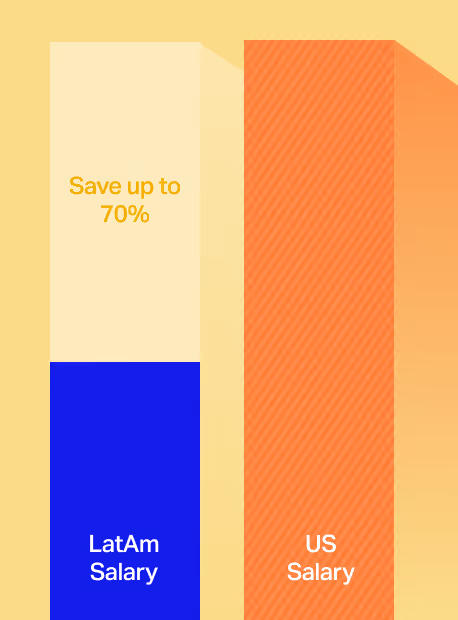
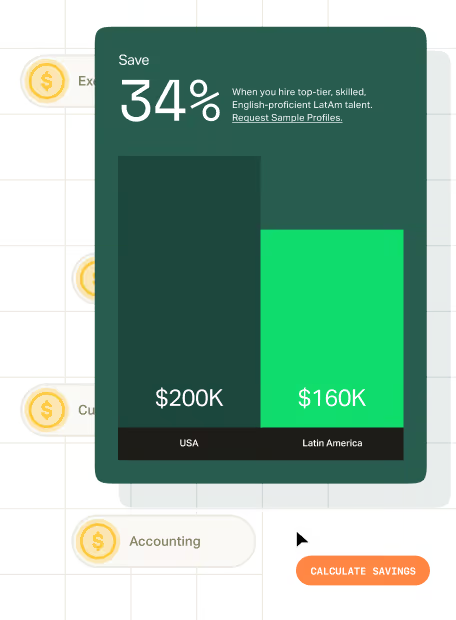
Hiring internationally can cut that by 30 to 70%, and Latin America is one example: the same hire there runs roughly $36,000 to $84,000 a year.
Here's what hiring Ruby on Rails developers in Latin America costs next to equivalent US hires, according to Hire With Near's salary benchmarks:
For the most up-to-date figures, see Hire With Near's US vs Latin America Salary Guide.
Our salary benchmarks across IT roles cover the rest of the stack; these ranges track what we see placing back-end developers in Latin America generally.
These savings reflect local economic conditions and cost of living, not lower skills. In practice, hiring a senior Rails developer in Latin America often costs less than hiring a mid-level developer in the US.
In Hire With Near's analysis of 2,000+ conversations about why US companies are hiring in Latin America, 41% named budget as their primary driver. For many of those roles the alternative wasn't a US hire: it was no hire at all.
We've also broken down how much US companies save by hiring in Latin America and what hiring offshore involves in practice.
What Skills Should You Look for in a Ruby on Rails Developer?
Look for Ruby and Rails fluency, database and API skill, and consistent testing habits, then judge how the candidate debugs and how they explain their work to people who don't code.
In my nearly four years recruiting technical talent at Hire With Near, the Ruby developers who work out are rarely the ones with the longest tool list. Don't screen on niche framework versions: someone who understands core principles picks up your version of Rails quickly.
Must-have technical skills
These are the technical skills a Rails developer needs from day one.
- Ruby language mastery: A strong grasp of Ruby syntax and object-oriented design. Set a short challenge that requires writing efficient Ruby.
- Rails framework proficiency: Using ActiveRecord, routing, and templating well is what makes Rails fast. Look for candidates who can walk through past Rails projects and explain MVC architecture.
- Database knowledge (PostgreSQL, MySQL): Rails developers own the data layer. Ask about schema design, indexing, and query optimization.
- RESTful APIs: Ask how they build and consume APIs in Rails, including versioning and error handling.
- Familiarity with testing frameworks (RSpec, Minitest): A great Rails developer writes tests as part of the work, not after it. Ask which tests caught real regressions.
- Git/version control: Real experience managing repositories, handling branches, and resolving conflicts. Ask which workflow their last team used and why.
Critical soft skills
For a Rails developer, soft skills matter just as much:
- Clear communication: When I'm evaluating a candidate, I ask them to walk me through a project and explain it to someone who isn't a developer, without prompting them to simplify. If they can't, they're usually repeating terminology rather than describing work they owned.
- Problem-solving mindset: Ask a Rails developer about a difficult bug they solved, and listen for how they narrowed it down.
- Attention to detail: Rails work demands precision around database queries, security, and authentication, like getting a role based access control example that gets permissions right.
- Accountability: Listen for how they describe their role in past projects and whether they take responsibility for what went wrong.
- Collaboration with product and design teams: Look for a Rails developer who can describe their own part in a multidisciplinary team.
Nice-to-have strengths
These aren't required, but they give candidates an edge:
- Experience with JavaScript front-end (React, Vue): One person can cover both ends on a small team.
- DevOps exposure (Docker, CI/CD): Faster releases, fewer manual steps.
- Familiarity with Agile/Scrum: Developers with experience in Agile or Scrum adapt faster to changing requirements.
- Prior work on scalable SaaS platforms: Judgment on multi-tenancy, caching, and complex data models, a common requirement in nearshore SaaS recruiting.
Where Can You Find and Hire Skilled Ruby on Rails Developers?
You can find Ruby on Rails developers on niche job boards like RubyNow and Stack Overflow, in Rails communities, on freelance platforms, or through a specialist staffing and recruiting partner. Which route fits depends on where they'll be based and how you'll find them.
Choosing the right location (local, remote, or international)
Ruby on Rails development doesn’t require in-person work. In the 2025 Stack Overflow Developer Survey, 45% of US developers reported working remotely, the highest share among the survey's top-reporting countries, while only 16.2% worked fully in person.
- In-office, local hires: Easiest for onboarding and payroll, but your pool is your metro area and salaries track local benchmarks, high in hubs like New York or San Francisco.
- Remote US-based developers: A wider pool with no relocation, and US-based Rails developers know local business norms and security rules. Compensation still tracks US rates, so scaling stays expensive.
- International hiring: Going global opens access to skilled developers at more sustainable rates, and Latin America (LatAm) is often the best choice over more distant regions. A developer there is online through your workday, in your time zone or an hour or two off depending on where you are and the time of year, so standups and code review happen live. Our guide to hiring remotely in Latin America covers the day to day.
Eastern Europe and the Philippines also have deep pools of skilled developers. The trade-off is the clock: less overlap with your workday means slower feedback loops, which works only if your team already runs async.
Choosing the right sourcing channel
The next decision is how you find qualified candidates.
Four routes cover almost every Rails hire, and they differ on which of two jobs they handle: finding the person, and employing them. That's the real difference between hiring a developer in house and outsourcing the work.
Nearshore staff augmentation suits a defined project better than a permanent seat.
If you're hiring offshore for the first time, a specialized recruitment partner saves weeks of sourcing and screening. Comparing a few nearshore staffing companies on how they screen is worth an hour before you commit.
How to Hire the Best Ruby on Rails Developers: A Step-by-Step Process
Hiring a Ruby on Rails developer runs in three stages: scope the role and write a spec naming your real stack, screen with a short technical task you review on a call, then move fast on the offer. Across all three, screen for someone who solves real problems and works well with your product team.
Stage 1: Before and during sourcing
Clarify what the role demands
Rails developers focus on the server side, so don't spec one developer to own your back end, your infrastructure, and your front end too.
Be specific about the skills and tech stack your team needs. If you expect React, PostgreSQL, or AWS, list them. Overloading the role with unrelated requirements is how a good spec turns unfillable.
Write a job description that attracts the right kind of developer
Rails developers want to know what they’re walking into. Be upfront about your stack, your team structure, and whether this is a greenfield build or an existing app. Set clear expectations around ownership and performance review.
Stage 2: Screening and evaluatio
Go beyond the resume
Rails developers who look average on paper are often excellent in practice. A GitHub profile or short trial project gives you more signal than a resume: ask candidates to optimize a slow query or refactor a poorly structured controller.
Then review the work together on a call and ask why they made those choices. Most companies skip that step, and it's where you learn the most.
Look for people who think like builders, not just coders
Great Rails developers can explain how they’ve scaled applications or handled sensitive data. Ask how they’ve solved problems around load times, background job queues, or authorization logic, the common challenges in production Rails apps.
Assess autonomy and collaboration
Developers used to working with product managers, designers, and QA ship faster and catch issues earlier. For remote roles, ask how they’ve handled time zone differences; candidates from distributed teams will have practical answers.
Stage 3: Making the offer and closing the deal
Move quickly and be decisive
Rails is a specialist skill. Just 5.9% of the 23,678 developers who answered Stack Overflow's 2025 web-frameworks question reported using Ruby on Rails, against 44.7% for React. Strong Rails developers usually don’t stay available long.
Spend two weeks deciding, or wait for your CTO, the hiring manager, and finance to weigh in, and someone else makes the offer first. Line up internal sign-off so you can move when the right person appears.
Put together a competitive offer that speaks to what developers value
Salary isn’t the whole offer. Developers care about impact, flexibility, and room to grow. Treat your offer like a sales pitch, and ask:
- Will they work on meaningful features or just maintenance tasks?
- Is there flexibility around work hours or location?
- Are we providing a clear path for growth or advancement?
Strong candidates often hold more than one offer; there's more in our guide to making strong offers to hire and retaining top talent.
What Are the Top Interview Questions for Hiring Ruby on Rails Developers That Reveal the Right Fit?
You’re interviewing for two things: how a Ruby on Rails developer solves problems, and whether they’ll thrive on your team. Across the engineers and DevOps candidates I've placed for US clients, most rejections come down to one of two things: how the candidate communicated in the interview, or the take-home assessment.
Here are six questions worth asking. Our list of tech interview questions you can ask technical talent goes wider than Rails.
“Walk me through a time you improved the performance of a Rails app.”
This tests a developer’s ability to identify and fix real bottlenecks. You want to hear about specific strategies like profiling slow queries, using background jobs, caching views or data, and reducing N+1 queries.
What to look for: Clear thinking, performance awareness, and real metrics or outcomes.
Red flag: Vague answers with no reference to tools like Bullet, New Relic, or PgHero.
“How do you approach building an API for a new feature?”
This question reveals how the candidate plans architecture and considers usability, consistency, and scalability.
What to look for: A structured process that includes identifying endpoints, versioning, authentication, and working with product requirements.
Red flag: Overly simplistic responses or skipping steps like error handling or documentation.
“Tell me about a bug you spent too long fixing. What happened?”
Everyone hits walls. This question reveals a problem-solving mindset and humility.
What to look for: A clear breakdown of the debugging process and lessons learned.
Red flag: Blaming teammates or not being able to explain the bug clearly.
“How do you stay up to date with changes in Rails?”
Rails moves fast. Developers who care about their craft make time to keep learning.
What to look for: Mention of reading release notes, following Rails contributors, subscribing to newsletters, or contributing to open source.
Red flag: “I don’t really follow updates,” or only learning on the job.
“How do you handle situations where you disagree with a product or design decision?”
This tests how the candidate communicates across functions.
What to look for: A thoughtful, diplomatic approach that shows they can balance technical concerns with business goals.
Red flag: Dismissiveness or combative responses.
“Rails is known for its ‘convention over configuration’ approach. How do you decide when to follow convention, and when to break it?”
This question helps you assess architectural maturity and independence of thought.
What to look for: Can articulate why Rails defaults are great for 80% of use cases, but describes a scenario where deviation improved clarity or scalability.
Red flag: “I always follow convention,” which can indicate rigidity or limited experience with edge cases.
Bonus: “How do you build trust quickly when working with a team you haven’t met in person?”
This matters most if you’re hiring internationally or working with distributed teams. When hiring offshore developers, you need people who communicate clearly, show initiative, and don’t wait to be told what to do.
What to look for: Examples of proactive communication, sharing early drafts of work, and establishing reliability through responsiveness.
Red flag: Waiting on instructions or needing constant follow-up to stay on track.
What Are the Mistakes to Avoid When Hiring Ruby on Rails Developers?
Four mistakes derail Rails hires more than any others: screening on degrees, expecting one developer to own the front end, skipping a technical evaluation, and ignoring how the person collaborates. All four show up when hiring developers.
Focusing too much on credentials or degrees
I usually tell clients not to make a college degree a must-have for engineering roles. A lot of the strongest Ruby developers in Latin America started working before they graduated and never went back, and they are not weaker candidates for it. Screen on a degree and you filter out people who have already shipped production code.
What to do instead: Focus on skills, project contributions, GitHub activity, and hands-on experience. Ask candidates to walk through their work, not their credentials.
Assuming Rails developers will also own the front end
Rails developers specialize in back-end work: business logic, databases, APIs, and performance. Rails can render views, but many modern apps pair it with JavaScript frameworks like React or Vue. Expecting one developer to own both stacks plus DevOps leads to slow progress or poor UI.
What to do instead: Hire for depth. If your front end is JavaScript-heavy, add a dedicated front-end engineer alongside your Rails developer. If you’re sticking with Rails views like ERB, find a Rails developer comfortable with UI basics, not React-level proficiency.
Skipping a technical evaluation
Resumes don’t prove someone can write clean, maintainable code, yet some companies hire Rails developers with no code sample, GitHub review, or test project. As one talent acquisition leader at a mid-market SaaS company put it:
Right now, [our current vendor] is sending us candidates, and their resumes do look good, but when they do make it to our technical assessment and our interview rounds, our hiring team is finding that they're maybe not as senior as we're hoping for.
Senior is the most abused title in engineering. On a Rails codebase the gap is specific: how someone handles N+1 queries and background jobs, how they reason about authorization logic, and whether they can say when breaking Rails convention was the right call.
What to do instead: Assign a short task that mirrors your environment, such as a CRUD endpoint with tests, then review it together on a call. For a faster filter, these are the five questions that expose a fake senior engineer
Here's how we pressure-test whether a developer is as senior as the resume claims before a client ever sees them.
Ignoring cultural fit and team collaboration
Rails development rarely happens in isolation. Your developer will work with product managers, designers, and often your support lead. If they’re working offshore, asynchronous communication and responsiveness matter even more.
What to do instead: During interviews, pay attention to how they write emails, ask clarifying questions, and share progress. Those behaviors matter as much as code.
Why Does Working With a Recruiting Partner Make a Difference?
A recruiting partner changes a Rails hire in three ways: pre-vetted candidates instead of an open funnel, local salary benchmarks you can take to your CFO, and payroll and compliance handled once you hire. Doing it yourself is possible if you’ve hired for technical roles before.
Many companies don’t. If you’re hiring outside the US for the first time or need to move fast, working with a partner saves time and stress. The right one brings structure to the search, tells you what compensation looks like locally, and flags remote-readiness problems before you interview.
A recruiter who knows the Ruby on Rails market can also:
- Surface stronger candidates faster.
- Filter out unqualified applicants before they hit your inbox.
- Support cross-border hiring, including compliance and payroll issues.
- Open up markets where salaries for the same seniority run 30 to 70% below US rates.
Bringing in a partner doesn't have to mean lowering the technical bar. One US healthtech startup of 101 to 250 employees came to us with two internal recruiters and an 8-step interview process, including deep technical screens and coding assessments, it refused to shorten.
We took over sourcing and screening; it kept all eight steps and its own hiring decisions, hired 7 senior engineers across backend, DevOps, QA, mobile, and frontend, averaged 14 days to hire, and saved $323,000 a year against US salaries.
We also run executive search in Latin America when the gap is leadership rather than a build: VP of Engineering, CTO, and similar.
Hiring the wrong developer for a core back-end role can set a project back by months. Every placement we make is backed by a 180-day replacement guarantee, double the industry standard.
Before you commit either way, check your own list against the questions tech leaders ask about hiring developers remotely.
Final Thoughts
The right Ruby on Rails developer does more than write code: they own the data models, the APIs, and the background jobs your product runs on. Screening for that means judging how someone debugs and how they explain their work, not just the stack on their resume.
If you're considering hiring offshore to widen the pool, a recruitment partner cuts steps out: they know local salary markets, handle compliance and payroll, and send you matched candidates.
At Hire With Near, we help you hire pre-vetted LatAm Ruby on Rails developers who work during your business hours and have salary expectations below their US-based peers.
We know many companies don’t have a clear picture of the caliber of engineering talent they could hire in Latin America.
That’s why we recommend starting with sample profiles.
We’ll send you profiles of 2–3 pre-vetted candidates. You'll see their experience, education, skills, and English proficiency level. No meeting required. No commitment. Just real examples of the talent available.
This gives you a baseline. Most companies find that the talent exceeds their expectations, but seeing it firsthand makes the difference. If you then decide to hire with us, we’ll find out exactly what you are looking for and do a custom search.
To explore the caliber of talent we can find for you, get a list of pre-vetted candidates. See what the possibilities are. With Hire With Near, you can interview candidates for free and only pay once you make a hire.
{{prevetted-banner}}
Frequently Asked Questions
How to hire Ruby on Rails developers?
Define what the role owns, set your budget by seniority, source candidates, screen them with a real technical task, then decide fast. Working with a recruiting partner, most companies see a shortlist in 3 to 5 days and make a hire in under three weeks.
Is Ruby on Rails still relevant in 2026?
Yes. Companies are still hiring Rails developers in 2026, and plenty of those searches are for new products rather than legacy maintenance. Rails remains a practical choice for a small team that needs to ship a data-backed web application quickly, which is why it became popular.
Is Ruby on Rails obsolete?
No. Ruby on Rails is not obsolete: the framework shipped security releases as recently as July 2026, its foundation is funded by companies including GitHub, Shopify, and 1Password, and hundreds of thousands of live websites run on it. The real constraint for a hiring manager is candidate supply, not maintenance.
How much does it cost to hire a Ruby on Rails developer?
Expect $36,000 to $84,000 a year in Latin America, against $80,000 to $189,000 in the US, according to our salary data. The table above splits both ranges by junior, mid-level, and senior, so you can budget against the seniority the role really needs.
What is the difference between a Ruby developer and a Rails developer?
In hiring there is no practical difference: both titles describe someone who builds web applications in Ruby using the Rails framework. Ruby is the language, Rails is the framework built on it, and a posting that names only Ruby almost always means Rails work.
How much does it cost to hire RoR developers offshore?
Hiring RoR developers in Latin America costs 30 to 70% less than the same hire in the US, with senior salaries typically running $66,000 to $84,000 a year. Most US teams pick Latin America over more distant regions because the developer is online through their workday, wherever the team sits.
What other engineering roles can I hire alongside a Rails developer?
Most companies hiring a Rails developer also hire around them: full-stack developers and software engineers to share feature work, DevOps engineers to own deployment and reliability, and QA engineers to test what ships. All four are commonly filled in Latin America.







.webp)


%203.svg)
.avif)





%20(1).avif)

%20(1).png)