.webp)


%203.svg)
Key Takeaways
- The nine best partners to outsource Python development services are STX Next, Sunscrapers (dedicated Python and Django shops in Poland), BairesDev, AgileEngine, Cheesecake Labs (Latin America-based engineering firms), Intellectsoft, DICEUS (broad custom software firms with compliance coverage), Django Stars (Django product specialist), and Hire With Near as the alternative model to outsourcing altogether.
- When you outsource Python development services, you buy a scoped build delivered end to end by an outside firm's engineers. Published rates run roughly $25 to $99 an hour, depending on where the delivery team sits. The cost is continuity: the people who learned your codebase leave when the engagement does.
- Before you shortlist a vendor, check whether outsourcing fits at all. If the product is core to your business model or if you'll need the same people maintaining it in 18 months, hiring usually makes more sense. If it's a one-off build with little upkeep, outsource it.
The best partners to outsource Python development services have shipped your kind of build before, and they can tell you who will look after the code once it's live. I compared nine of them on where their engineers sit, how they structure the work, and what they charge.
Most shortlists skip that second part. A small US software team we spoke with had an MVP built by two contractors in Ukraine who, in their words, “kind of disappeared.” The app was in production with a limited feature set, and nobody on their side had written it.
So before this list helps you pick a vendor, ask yourself whether you should outsource the build at all. I included Hire With Near on this list as an alternative to outsourcing. It's the one company here that doesn't take projects. We help you hire your own Python developers in Latin America, who work US hours, for builds you'll depend on for years.
What Are the Top 9 Providers to Outsource Python Development Services?
The nine companies below all take on and deliver whole Python projects. They fall into three groups: dedicated Python and Django shops in Poland (STX Next, Sunscrapers), Latin America-based engineering firms whose working day overlaps the US day (BairesDev, AgileEngine, Cheesecake Labs), and broad custom software firms with compliance coverage (Intellectsoft, DICEUS).
Django Stars sits in between as a Django product specialist, and Hire With Near is on the list as an alternative to outsourcing altogether.
They're in no particular order, and no ranking is implied. There's no single best option for everyone, since the right fit depends on your stack, budget, timeline, and how much of the work you want to own afterwards.
If you want a wider view of the region first, we also have a list of the best LatAm outsourcing companies.
Here's how the nine compare before the details.
How we chose these Python outsourcing companies
Every project firm here takes on and delivers a whole Python project. That was the first gate, and it removed some names you'd expect to see. Freelance and contract-talent marketplaces like Toptal and Codementor match you with an individual developer who works under your direction, which suits a different need than handing over a build, so they're not on this list.
From the companies that cleared that gate, I only included firms rated 4.5 or higher with more than 30 verified client reviews on an established review platform: G2, Clutch, Trustpilot, GoodFirms, or ClearlyRated (client ratings only). I recheck each company's rating on its review platform regularly and update this list when scores or review counts change.
After that, I looked at the Python work each firm has shipped, its engagement models, its published rate bands, and where its engineers sit, using company websites and review profiles.
If you want the same exercise run on region rather than language, we keep a separate list of nearshore software development companies.
Hire With Near is on this list too, and we put ourselves here. We don't take on projects. We're included because many people comparing Python outsourcing companies end up needing their own developers instead, and this list should show that option. Read our listing with that in mind, and judge the other eight on their own merits.
All nine can put senior Python engineers on your work, and all have client reviews you can read yourself. What separates them is where the engineers sit, how the engagement is structured, and what happens to the codebase after launch.
BairesDev

Website: bairesdev.com
Headquarters: San Francisco, US
Rating: 4.9/5 on Clutch (60+ reviews)
Services: Custom Python web and backend builds, API development, data engineering, ML applications, modernization
Focus Regions: Latin America (Argentina, Brazil, and Colombia)
I put BairesDev on this list because it's the largest nearshore option here and the one most set up to take a Python build end to end. Its engineers are based in Latin America and work hours that overlap the US day.
Its client list runs to Google, Adobe, eBay, and Johnson & Johnson.
Scale is also the trade-off: a firm of 4,000-plus engineers is built for sustained programs more than for small, single-sprint projects.
Key features:
- Three ways to engage: staff augmentation, a dedicated pod with BairesDev project management, or full project lifecycle ownership.
- Projects typically start within two to four weeks of signature.
- The company says its engineers are drawn from the top 1% of applicants across more than 100 technologies.
Best for: Companies commissioning a multi-quarter Python program who want time zone overlap without managing the team themselves.
Client perspective: “They always had something solid and impressive to show.” (Co-Founder and CTO, Freeplay, via Clutch)
Limitations: Minimum engagement sizes suit funded builds rather than small projects. The breadth of technologies means Python is one practice among many.
Pricing: $50,000+ minimum project size, $50 to $99 per hour (Clutch).
STX Next
Website: stxnext.com
Headquarters: Poznań, Poland
Rating: 4.7/5 on Clutch (100+ reviews)
Services: Django, Flask, and FastAPI development, machine learning, data science, API work, cloud microservices, legacy migration
Focus Regions: Europe, with a delivery center in Mérida, Mexico
What got STX Next on my list is the depth of its Python bench. The firm has specialized in Python for two decades and puts more than 500 Python engineers behind web, ML, and data work, which is unusual among generalist software houses. Its Mexico delivery center helps if you want European Python depth with working hours closer to yours.
The 103 client reviews behind its 4.7/5 are the most of any Clutch profile on this list, and its site names Canon, Decathlon, and Mastercard among 300-plus clients.
Key features:
- ISO 27001 certified for information security.
- The company says developers can join a project in under two weeks.
- Coverage runs from consulting and MVP prototyping through full project delivery, including IoT work.
Best for: Technically complex Python builds where you want a large specialist bench rather than a generalist team learning your framework.
Client perspective: “Their attention to detail and commitment to delivering a polished product stood out throughout the project.” (Head of Product, Software Company, via Clutch)
Limitations: Most of the team sits in Europe, so real-time overlap depends on which delivery location you're assigned. Python specialization means less depth if your project needs a large non-Python component.
Pricing: $50,000+ minimum project size, $50 to $99 per hour (Clutch).
Hire With Near

Website: hirewithnear.com
Headquarters: United States, with recruiters and talent across Latin America
Rating: 4.9/5 on G2 (160+ reviews)
Services: Direct hire recruiting and monthly staffing for Python and engineering roles, including payroll and compliance
Focus Regions: Latin America only
Hire With Near is the alternative model on this list: you don't hand us the project. You hire your own Python developers in Latin America, who work US hours and only for you.
We're a full-service staffing and recruiting agency that handles sourcing, screening, candidate presentation, payroll, and compliance, so the code and the people who know it stay with you.
We help you hire Python developers in Latin America who join your standups, and our placements stay an average of three years, which matters when the work doesn't stop at launch.
We've hired for 950+ companies, including Expensify and Deel, hold a 4.9/5 rating on G2 across 160 reviews, and are ranked No. 118 on the 2026 Inc. 5000 list of the fastest-growing private companies in America.
Key features:
- Specialist tech recruiters for Python and engineering roles: We hire software engineers in Latin America every week, including backend, data, and ML engineers. Our recruiters know the difference between Django, Flask, and FastAPI experience and why it matters for your build.
- Fill rate and speed: We fill 97% of the roles we take on, with a client satisfaction score of 9.1. You get first candidates in 3 to 5 days with video introductions, and most hires are made in under 3 weeks.
- 180-day replacement guarantee: Double the industry standard. If a hire doesn't work out in the first six months, we find a replacement at no additional cost to you.
Best for: Companies whose Python work is core to the product and will keep going after launch, and who want the people who build it to stay within the company for years.
Client perspective: “The engineers we hired are performing exceptionally well. They show up, they take accountability, and they take a genuine interest in the team.” (Akshay Gokarnakar, TA Lead, ParkMobile, via the ParkMobile case study)
Limitations: We don't take project ownership. There's no fixed-price delivery, no vendor project manager, and nobody to hand a spec to and walk away from. If your build is a one-off with little upkeep after launch, one of the other companies on this list is the better call. We also only recruit in Latin America.
Pricing: No upfront cost. Choose a one-time placement fee or a monthly staffing fee that includes payroll and compliance. You set the salary, and we show benchmarks and fees before you commit.
Django Stars
Website: djangostars.com
Headquarters: Kyiv, Ukraine, with a US entity in Delaware
Rating: 4.8/5 on Clutch (60+ reviews)
Services: Django and Python web development, API development, Python migration, data analysis, ML and AI, legacy refactoring
Focus Regions: Europe and the US
What stood out to me about Django Stars is how specific its work is. The firm has spent 17 years on Python and Django with a team of about 130 and roughly 100 delivered projects concentrated in fintech, insurtech, travel, logistics, and proptech.
Its portfolio includes MoneyPark, GLASfunds, and Numerade as some of its clients.
If your build is a Django platform with real domain complexity behind it, this is a shop that has shipped one before rather than a generalist agency adding Python to a services list.
Key features:
- Three engagement structures: fixed price for scoped work, a dedicated long-term team, or staff augmentation into your team.
- Dedicated practice in Python migration and refactoring of legacy systems.
- Hybrid builds combining Python with JavaScript, Java, or .NET where a project needs it.
Best for: Domain-heavy Django platforms in regulated or transaction-driven industries.
Client perspective: “Django Stars excels at crafting solutions tailored to specific industries.” (CEO, iCANS, via Clutch)
Limitations: Team sits in Eastern Europe, so overlap with US afternoons is limited. Smaller than the enterprise firms here, which constrains how fast a project can scale up.
Pricing: $10,000+ minimum project size, $50 to $99 per hour (per Clutch).
Sunscrapers
Website: sunscrapers.com
Headquarters: Warsaw, Poland
Rating: 4.9/5 on Clutch (30+ reviews)
Services: Full-stack Python development, data engineering and processing, MVP development, machine learning and AI, DevOps, technical consulting
Focus Regions: Europe and the US
Sunscrapers is here because of its focus. The Warsaw consultancy has built Python software and data platforms since 2010, mostly for finance and healthcare clients, with 15Five, Codility, and The Wonderful Company among the names on its site.
It has the smallest review base on this list at 32 reviews, and it's a smaller consultancy, so it has less spare capacity if the scope grows mid-build.
Key features:
- Data engineering and processing sit alongside application development rather than being bolted on.
- MVP development aimed at venture-backed teams that need a first version in production.
- DevOps, agile project management, and technical consulting available as standalone engagements.
Best for: Data-heavy Python builds and MVPs for finance or healthcare companies that want senior engineers on a small team.
Client perspective: “Their engineers were self-managed, responsible, mature, and creative.” (Head of Engineering, Financial Services Company, via Clutch)
Limitations: Smallest team and smallest review base here, so large parallel workstreams are a stretch. European hours mean limited afternoon overlap with US teams.
Pricing: $25,000+ minimum project size, $50 to $99 per hour (per Clutch).
Intellectsoft
Website: intellectsoft.net
Headquarters: United States, with 9 offices across 7 countries
Rating: 4.9/5 on Clutch (45+ reviews)
Services: Custom software and mobile development, web applications, AI development, data engineering and BI, QA, dedicated teams
Focus Regions: Global
The reason Intellectsoft made this list is its compliance coverage. It holds ISO 9001:2015 and ISO/IEC 27001:2022 certifications and aligns with GDPR, HIPAA, PCI DSS, and SOC 2, which is what regulated buyers ask about before they question frameworks.
It's a broad custom software firm rather than a Python specialist. Its named clients include Guinness, Eurostar, Audi, and Ernst & Young, and Python work there usually sits inside a larger build.
Key features:
- Four ways to engage: dedicated teams, team extension, fully managed outsourced development, or MVP development.
- AI development, data engineering, and business intelligence practices in-house.
- Industry coverage spanning fintech, healthcare, construction, logistics, insurance, and retail.
Best for: Regulated or enterprise builds where certification and audit posture matter as much as the code.
Client perspective: “We felt like they truly were a part of our team, not an outsourced group.” (COO, Electragram, via Clutch)
Limitations: Python is one capability among many rather than the core specialty. Enterprise positioning and project sizes may be more than a small team needs.
Pricing: Most projects fall between $50,000 and $199,999, $50 to $99 per hour (per Clutch).
DICEUS
Website: diceus.com
Headquarters: Wilmington, Delaware, US
Rating: 4.9/5 on Clutch (45+ reviews)
Services: Python solution development, software optimization, staff augmentation, ML and AI, data analytics, IoT
Focus Regions: Europe and the Middle East (Poland, Lithuania, Denmark, Austria, UAE, and Jordan)
DICEUS stands out for its insurance and banking track record. It builds Python applications for insurers and banks alongside fintech, logistics, retail, and healthcare clients, with case studies covering compliance systems and insurance platforms.
Its $25 to $49 hourly band ties with our next company, AgileEngine, as the lowest published rate on this list, roughly half what most of the other firms here charge, so a multi-month build lands in a different price range.
For a regulated back-office system where domain knowledge counts more than framework fashion, that combination is worth a conversation.
Key features:
- Two engagement structures: time and materials with monitored stages, or a dedicated team working only on your project.
- Takes on both greenfield Python builds and optimization of systems someone else wrote.
- Certifications include ISO 9001:2015 and Google Cloud credentials.
Best for: Insurance, banking, and back-office Python systems where the domain is the hard part.
Client perspective: “Their professionalism in all aspects is impressive.” (CPSO, Fadata EAD, via Clutch)
Limitations: Delivery teams sit in Europe and the Middle East, so US real-time overlap is limited. Industry depth is concentrated in insurance and banking rather than consumer products.
Pricing: $10,000+ minimum project size, $25 to $49 per hour (per Clutch).
AgileEngine
Website: agileengine.com
Headquarters: Boca Raton, Florida, US
Rating: 5.0/5 on Clutch (60+ reviews)
Services: Custom software development, AI development, IT staff augmentation, mobile and web development, UX/UI design
Focus Regions: Latin America (Argentina and Colombia), Europe (Poland, Portugal, and Ukraine), and India
When I lined up the ratings, AgileEngine came out on top: 5.0/5 across 64 client reviews. The company staffs from seven locations, including Argentina and Colombia, so you can ask for a delivery team that shares your working day.
About a quarter of its work is AI development, with custom software, mobile, and web making up most of the rest, and 80% of its clients are mid-market companies between $10M and $1B in revenue.
Key features:
- Offers staff augmentation alongside full builds, so the same firm can extend your team or own a project.
- In-house UX/UI design practice rather than engineering only.
- Industry concentration in financial services, ecommerce, medical, media, and logistics.
Best for: Mid-market companies commissioning an AI-heavy Python build who want to choose the delivery region.
Client perspective: “The team members work as part of our internal workflow and have adapted to our style of work and project management.” (Director of Application Development, Fix.com, via Clutch)
Limitations: Delivery locations span three continents, so time zone overlap depends entirely on which team you're assigned to. Positioned around mid-market budgets rather than small projects.
Pricing: $25,000+ minimum project size, $25 to $49 per hour (per Clutch).
Cheesecake Labs
Website: cheesecakelabs.com
Headquarters: San Francisco, US, with delivery from Florianópolis, Brazil
Rating: 4.9/5 on Clutch (65+ reviews)
Services: Application modernization, data and analytics, AI implementation, product engineering, embedded engineering teams
Focus Regions: United States and Brazil
I included Cheesecake Labs for its Brazil-based engineering teams, whose working day overlaps with the US, paired with a US-based product lead.
The company has 13 years and more than 300 shipped products behind it, with a current focus on modernizing legacy systems, managing data infrastructure, and putting AI agents into production.
Its cloud and data partnerships span AWS, Google Cloud, Databricks, and Snowflake. Named clients include MoneyGram, AES Corporation, and Bemis Manufacturing, and it holds SOC 2 and HIPAA certifications, which matters if your Python project touches health or payments data.
Key features:
- Fixed-scope assessments that run in weeks, useful when the project needs defining before it needs building.
- Agentic workflow implementations scoped to 8 to 12 weeks.
- Embedded engineering teams available nearshore, on-site, or US-based.
Best for: Modernizing an existing Python system or moving AI work from prototype into production, with Brazil-based engineers whose working day overlaps yours.
Client perspective: “What sets Cheesecake Labs apart is their ability to operate as a true engineering partner, not just a vendor.” (CEO, Knapsack, via Clutch)
Limitations: Smaller team than the enterprise firms here. The current emphasis on AI and modernization means a greenfield web build isn't where the company concentrates.
Pricing: $50,000+ minimum project size, $50 to $99 per hour (per Clutch).
What Are the Advantages of Outsourcing Python Development Services?
Python software outsourcing gets you senior engineering capacity without the lead time or the fixed cost of building a team. Most firms on the list above can have people on your project in two to four weeks, for which you stop paying when the build ships.
Cost effectiveness
You pay for delivered work, not for headcount. There's no recruiting cycle, no onboarding, no payroll, benefits, equipment, or bench time between projects, and the cost stops when the scope does.
The vendor rate isn't the only number that matters, though. A firm billing $50 to $99 an hour doesn't obviously cost less than a full-time engineer once the project runs past a few months, so price the two models against each other.
Hire With Near's US vs Latin America Salary Guide gives you the salary side of that comparison, and our breakdown of how offshore developer rates work covers what the hourly bands include and what they don't.
Access to specialized expertise
A specialist firm puts engineers on your project who have already shipped what you're about to build, like running a Django platform through a compliance review or moving a Pandas pipeline into production on someone else's infrastructure.
You also get breadth you wouldn't hire for permanently. Most of the firms above keep data engineering, ML, and DevOps practices alongside application development, so a project that needs all three doesn't need three separate hires.
Faster project delivery
Outsourced projects usually start faster than in-house builds because the team already exists. BairesDev says projects typically start within two to four weeks of signature, and STX Next says developers can join a project in under two weeks.
The delivery speed after kickoff comes from the same place: an existing team with its own tooling, review process, and deployment pipeline doesn't spend the first sprint agreeing on how to work.
Scalability and flexibility
You can size the team to the project instead of the other way around. Add two engineers for a heavy quarter, drop back to one for maintenance, and pause entirely between phases, without the logistics of hiring or letting people go.
This is the strongest argument for the project-outsourcing model, and it applies most when your Python workload is lumpy: a migration, a seasonal analytics push, an MVP you need in front of investors. It applies least when the work is steady, because a steady workload is what a permanent hire is for.
Which Areas of Python Development Can You Outsource?
Five areas account for most of the Python work companies hand to an outside firm: web and backend development, data science and analytics, machine learning, API integration, and cloud deployment.
Those five are also where Python demand concentrates. Across the 2,000+ placements in Hire With Near's 2026 State of LatAm Hiring Report, Python was the most requested programming language, showing up in back-end roles (often with Django), data engineering, and AI and ML work.
Python web development
Django and Flask cover most of what gets outsourced here: admin-heavy platforms, customer portals, internal tools, and the backend services behind them.
Python's readability also makes handover easier, which matters more than it sounds when the people who wrote the code are leaving at the end of the engagement.
This is the same work back-end developers do in-house, so it's a useful place to test the two models against each other.
If you want the broader version of this decision, we've written about how to outsource web development without sacrificing quality.
Data science and analytics
Data pipelines and analysis are among the most commonly outsourced Python projects, because the work is often a defined build rather than an ongoing function. With Pandas, NumPy, and SciPy, an outside team can take raw data, build the transformation layer, and hand you a working pipeline and a set of models.
The equivalent in-house roles are data engineers and data scientists. The practical difference is who maintains the pipeline when the source schema changes, which it will.
Machine-learning applications
Python's library ecosystem is why almost all outsourced ML work runs on it. Firms with a real ML practice can take a model from prototype to deployment, including the parts that usually stall in-house: feature pipelines, monitoring, and retraining.
The ML work that outsources cleanly is project-shaped: a fraud-scoring model, or a recommendation engine with a defined success metric.
Ask whether the machine learning engineers assigned to you have put a model into production, not just trained one.
API integration
API work is the most straightforward on this list to outsource, because the contract is clear: the integration works or it doesn't. Payment processors, CRMs, logistics providers, and internal services all need connecting, and a specialist team has usually done your specific integration before.
Ask how errors, retries, and rate limits are handled, and who’s on the hook when the third party changes its API. That's the part API developers spend most of their time on, and it's the part a fixed-scope engagement tends to under-budget.
Cloud-based applications
Deploying Python services on AWS, Azure, or Google Cloud is a common outsourcing target, particularly for teams moving off a single server or containerizing an older application. Python works well across all three platforms, and the firms above generally hold cloud partner credentials you can verify.
Be clear about who owns the cloud account. Keep the account, the billing, and the deployment pipeline in your name from day one, and ask which of the vendor's cloud developers will hold the credentials.
Which Industries Outsource Python Development Most?
Four sectors send the most Python work to outside firms: healthcare, fintech, SaaS, and AI and machine learning. In all four, the workload is data-heavy, regulated, or both, which is where Python's library ecosystem earns its place.
The companies commissioning this work are usually technology companies first, whatever vertical they sell into, which is why IT and tech recruiting in Latin America covers a lot of the same roles a Python vendor would staff.
In all four, the system rarely stops being important after launch. Keep that in mind when you reach the partner-selection tests below.
Healthcare sector
Healthcare buyers outsource Python for data-heavy builds that carry compliance requirements: patient record systems, medical imaging pipelines, remote monitoring, and the analytics layers on top of them.
Compliance is the gate here: ask about HIPAA and SOC 2 posture before you ask about Django, and confirm where patient data will physically sit during development.
For companies that decide the work belongs in-house, healthcare recruiting in Latin America is how most of them staff it.
Financial technology (fintech)
Fintech companies use Python for risk models, fraud detection, reconciliation engines, and trading logic, which is why Django Stars, DICEUS, and Sunscrapers are all built around financial services.
The work is rarely finite, though. A fraud model needs retraining, a reconciliation engine changes every time a payment partner does, and an auditor will eventually ask who wrote it. That combination is why fintech is one of the sectors most likely to bring Python work back in-house, and why fintech recruiters see steady demand for the same skills the vendors sell.
SaaS platforms
SaaS companies run a lot of Python behind the product: Django and Flask backends, internal APIs, billing and metering services, usage analytics, and the data services that feed reporting.
What gets outsourced is usually the discrete piece: a new billing integration, an analytics rebuild, or a migration off a legacy service. Scope vendor work around the core application because the roadmap never stops.
Our page on nearshore SaaS recruiting covers the roles SaaS teams staff around those projects.
AI and machine learning
Python is the default language of AI work, so almost any company building AI features is commissioning Python whether it frames it that way or not: model training, inference services, retrieval pipelines, and the agent workflows Cheesecake Labs now scopes as fixed 8- to 12-week engagements.
Outsourcing works well for the first version, while you're testing whether the feature is worth having. Once it ships, the maintenance load is continuous, so price the support window into the contract rather than the renewal. AI and machine learning recruiting in Latin America is the route teams take when that load stays.
How Do You Choose the Right Python Development Partner?
Pick a Python development partner on four things: production experience in your framework, overlap with your working day, what past clients say about how the work went, and what happens to the code when the engagement ends.
There's one question that comes before all four, though, and shortlists usually skip it.
Should you outsource this project or hire your own Python developers?
Outsource when the build is defined and finite. Hire when the system will keep running part of your business after launch. Three tests will tell you which one you have, and you can run all three in about five minutes.
The first test is whether the software is core to your business model. If your company makes money because this system works, what you need to protect is the knowledge of how and why it works that way. That knowledge lives in the people who built it, and it leaves when a vendor team rolls off.
I've been talking to our engineering recruiters while putting this list together, and they keep describing the same pattern: companies rarely regret outsourcing a discrete build. They regret outsourcing the system their business runs on.
The usual objection is whether you could staff that in-house at all. I asked one of our senior tech recruiters at Hire With Near, Julia Guillen, about that the other day, and she said clients tend to be surprised here:
Clients are consistently surprised with the caliber of talent that's available in LatAm. They don't expect to find senior engineers who've worked with major U.S. companies, understand modern development practices, and often have more hands-on experience with specific frameworks than candidates they'd find locally.
— Julia Guillen, Senior Tech Recruiter, Hire With Near
If that's your situation, you're making a hiring decision rather than a vendor decision, and you can hire Python developers in Latin America whose working day overlaps yours and who stay with the codebase.
The second test is continuity: who owns this codebase in 18 months? Answer that out loud before you sign anything. A vendor team rotates, engagements end, and agencies close. One two-person software team in the US tax industry described exactly how that plays out. Their MVP had been built by contractors:
One of them, the one that we're really talking about — was developed by some people in Ukraine, and they've since kind of disappeared or fell off the map to us. So we were looking for either a direct hire or a team or an agency that we could work with to put more production into or to put more development into the application. It's really kind of an MVP right now. There's limited feature sets.
ParkMobile, part of the global mobility platform Arrive, ran into the same problem at a much larger scale. Third-party agency developers had handled its back-end and platform work for years, and its Head of Engineering for Mobile Payments and Billing came to see that dependency as a business risk.
ParkMobile replaced those agency developers with nine senior engineers hired in Colombia, saving $1,066,085 a year against US rates (a 73% reduction) at a 24-day average time to hire.
Its conclusion was narrow: the platform work it would depend on for years belonged to its own engineers.
I found the same pattern in Hire With Near's research on why US companies hire in Latin America, which analyzed 2,000+ conversations with US companies. Of those, 12% were switching away from outsourcing to direct hiring, and IT and engineering accounted for 16% of that group.
What they described was consistent: a lack of control, a revolving door of people, and workers who never felt part of the team.
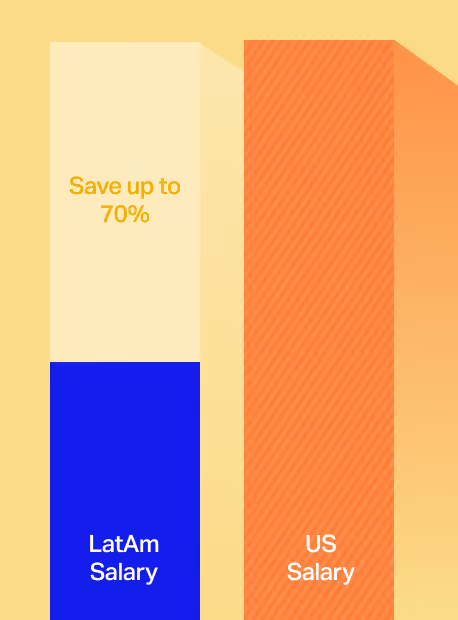
If you're pricing the two models against each other, compare the vendor's hourly band to a real salary. According to our salary data, a senior Python developer in Latin America sits at $72K to $108K a year against $102K to $177K in the US, and our guide to what developers cost in Latin America covers the rest of the engineering roles.
If you've never hired outside the US, our free guide to hiring remotely in Latin America explains how the employment and payroll side works.
The third test is the simplest: is this a one-off? If you need something built once and it will need little upkeep after launch, outsourcing is the right call. A scoped internal tool, a data migration, a prototype you need in front of investors: hand those over. Carrying full-time salaries for work that ends in four months costs more than outsourcing it.
Most projects aren't purely one thing, so weigh the three tests together.
If you want the same decision written up from a different angle, we cover it for the general case in in-house developer or outsource, and for early-stage teams in when a startup should outsource software development. If you land on building your own team, start with hiring developers in Latin America.
If you'd rather hear this decision talked through, this video covers when a dev shop makes sense and when hiring developers directly does:
If you land on outsourcing, the rest of this section is how to choose between the nine.
Can they handle your tech stack?
Ask whether the specific engineers assigned to you have shipped production systems in your framework and on your deployment target. A company calling itself a Python shop tells you nothing on its own. That's a far narrower question than whether the company lists Python on its services page.
Get specific. Name your stack (Django, Flask, FastAPI, Pandas, your cloud) and ask which of their case studies used it, who led that build, and whether that person is available. Ask for a technical conversation with the engineer who would lead your project rather than the account manager or the solutions architect who wrote the proposal.
Then get the answer into the contract. A named team roster in the statement of work is the difference between the team you were shown and the team you get, and it's also what makes it obvious if someone is swapped out later.
Industry experience is worth weighing alongside the stack, particularly in regulated sectors where a firm that has been through a HIPAA or SOC 2 review before will save you weeks. Just don't let it substitute for framework evidence. A firm that knows your industry but is learning your framework is learning it on your budget.
Will their working hours overlap with yours?
Communication on an outsourced project depends mostly on overlapping working hours, much more than on how responsive the sales team felt during the pitch.
The most useful research I found on this was published in Organization Science: when time zones pull teams apart, people keep collaborating by shifting their work outside normal hours, and that time comes out of their personal lives. The researchers recommend aligning collaborative teams along a north-south axis, which is how the US and Latin America line up.
The practical test isn't where the vendor is headquartered. BairesDev, Intellectsoft, DICEUS, AgileEngine, and Cheesecake Labs are all registered in the US and staff projects from Latin America, Eastern Europe, or the Middle East. So ask which country the assigned engineers work from, and how many hours of your working day that gives you.
A team that overlaps your afternoon can join your standup and answer a question before you log off. A team whose day ends as yours starts turns every question into a 24-hour round trip.
Then ask about the mechanics: who you talk to day to day, whether you get direct access to engineers or everything routes through a project manager, how status is reported, and how a disagreement about scope gets resolved.
If you're still weighing locations, our guide to the best countries for software development outsourcing compares the main options on cost, talent depth, and overlap.
What do past clients say about working with them?
A portfolio shows you what a firm has built; reference calls tell you what it was like to work with them. You need both, and the second one is the one most buyers skip.
Look for detailed project write-ups rather than logo walls: what the problem was, what was built, what went wrong, and how it was handled. When I read through the Clutch reviews for this list, the ones that told me the most described a problem and how the firm dealt with it. Case studies work the same way.
Then ask for two or three reference calls with clients on a comparable stack and a comparable project size, and ask those clients the questions the vendor can't answer for you. Did the timeline hold? Did the team change? What did the handover look like?
Our rundown of common nearshore outsourcing mistakes covers the patterns that show up most often in those conversations.
What happens to your code when the engagement ends?
Settle who owns the code, what the handover includes, and who maintains the system after go-live before you sign, not in the final month. This is the criterion buyers most often leave until it's expensive.
Four things to get in writing:
- Repository and credentials in your name from day one: Your GitHub organization, your cloud account, your CI pipeline, with the vendor added as a collaborator. Migrating out of a vendor's infrastructure at the end of a project is slow and avoidable.
- IP assignment that reaches every individual: The clause has to flow down to each engineer and any subcontractor the firm uses, not just to the company you signed with. Ask directly whether they subcontract.
- Documentation as a deliverable: Architecture notes, runbooks, environment setup, and a written handover session, all listed in the statement of work with the same weight as the code.
- A named maintenance arrangement: Either a defined post-launch support window with response times, or an explicit plan for who picks the system up internally. “We're always here if you need us” isn't an arrangement.
If you want a fuller view of how these engagements are structured and run, our guide to building and managing an outsourced development team goes through the models in detail.
Final Thoughts
Here's the question I'd ask myself before booking a single vendor call: will this Python system still be running part of the business in 18 months?
If it won't, outsource it. A scoped internal tool, a data migration, or an investor prototype is a deliverable, and any of the eight project firms above can take it on. Ask each one who specifically would work on your build and what happens to the code when they roll off. Those two answers usually narrow the list to one or two.
If it will, you're making a hiring decision. That's where ParkMobile landed when it replaced its agency developers with nine senior engineers of its own, and it's where Hire With Near fits. We help you hire Python developers in Latin America who work US hours and stay with the codebase.
If you're leaning that way, read our guide to hiring developers in Latin America next. It covers costs, countries, and hiring models in one place.
When you’re ready, book a free consultation to talk through your specific requirements with our team.
{{consultation}}
Frequently Asked Questions
How much does it cost to outsource Python development services?
Published rates from the firms on this list run from $25 to $99 an hour, with minimum project sizes between $10,000 and $50,000 depending on the vendor. The band you land in depends mostly on where the delivery team sits and how senior the assigned engineers are.
Beyond the rate, four line items move the final number more than anything else: whether discovery is billed separately, how change requests are priced, who pays for rework, and what happens commercially if a developer is swapped mid-project. Get all four in writing before you sign, whichever pricing model you choose.
What's the difference between outsourcing Python development and hiring your own Python developers?
With outsourcing, you buy a finished project from a vendor's team; with hiring, you build a team that stays. The practical difference is who holds the context afterwards. An outsourced build hands you working code, but the reasoning behind it leaves with the engineers when the engagement closes.
An in-house team keeps that knowledge, absorbs the maintenance, and can change direction without a new statement of work. If you're leaning that way, our guide on how to hire Python developers compares the companies and platforms that help you do it.
How do you vet a Python development partner before signing?
Meet the specific engineers who would be assigned to your project, and review production code they've shipped in your framework. Portfolios are marketing; the assigned team is what you're paying for.
Three checks do most of the work: a named team roster written into the contract, a technical conversation with the engineer who would lead the build, and two reference calls with clients on a comparable stack. Also ask what happens if that lead engineer is reassigned.
Will an outsourced Python team work in my time zone?
Only if the assigned engineers sit in a country that overlaps your working day, and that often isn't where the company is headquartered. Several firms on this list have US headquarters and staff projects from Latin America, Eastern Europe, or the Middle East.
Ask which country your engineers work from and how many of your working hours they share. Teams in Latin America usually share most of a US working day, depending on the country and where your own team sits.
Our roundup of questions tech leaders ask about hiring developers in Latin America covers the standup and oversight side of this.
Who owns the code and the intellectual property when you outsource Python development?
You own it only if the contract assigns it to you, and that assignment has to reach every engineer and subcontractor who touches the work. A signed agreement with the vendor isn't automatically an agreement with the developer who wrote the code.
Three protections help: keep the repository, cloud account, and credentials in your own name from day one; use IP assignment or work-for-hire language that explicitly covers subcontractors; and ask directly whether the firm subcontracts any part of your build.
What other developer roles can I hire in Latin America instead of outsourcing the project?
US companies hire the full range of Python-adjacent engineering roles directly in Latin America, not just Python specialists. The most common are full-stack developers for product teams that need one person across the stack, software engineers for broader backend and platform work, and DevOps engineers to own the deployment pipeline a vendor built.
All three work hours that overlap most of a US working day, at salaries 30 to 70% below comparable US rates, which is the combination that makes the in-house option viable in the first place.






.webp)


%203.svg)
.avif)




%20(1).avif)

%20(1).png)