Key Takeaways
- The eight strongest BairesDev alternatives for hiring developers in Latin America are Hire With Near, CloudDevs, AgileEngine, BEON.tech, Lemon.io, Revelo, Andela, and Toptal, split across four models: recruiting agencies, staff augmentation firms, managed development partners, and contract marketplaces.
- The right alternative depends on what you want to own when the work is done, a permanent hire, an embedded team member, a managed deliverable, or a contractor, not on which company has the best reviews. Compare companies inside that model, not across all four.
- Two things separate a real alternative from a repackaged version of the same problem: whether you can verify seniority yourself instead of trusting a vendor's screen, and whether pricing is transparent enough that you know what the engineer is actually paid.
If you're looking at alternatives to BairesDev, it's probably because their site makes it hard to tell what you're signing up for: staff augmentation, a dedicated team, and project-based delivery all sit under the same brand, and it's not always clear before a sales call which one you'd land in.
BairesDev is a Latin America-focused staffing and outsourcing company that's built a dominant search presence around hiring developers in the region, with a bench it markets as the top 1% of Latin American tech talent spread across more than 40 countries.
The strongest alternatives are the ones that make that answer obvious upfront: does the developer become yours, or does BairesDev (or whichever company you're evaluating) keep the right to reassign them mid-project? Eight companies that answer that question clearly are below, with what their own reviewers say about them and who each one fits.
Eight companies that answer that question clearly are below, with what their own reviewers say about them and who each one fits, so you can shortlist the right partner for hiring developers in Latin America before you get on a call.
One thing to be upfront about: Hire With Near publishes this guide, and we've put ourselves at the top of the list. We think we're the strongest option for a company that wants to hire its own developers in Latin America, and the Hire With Near entry lays out exactly why, including the cases where another firm is the better call.
Every company on the list, us included, had to clear the same bar: at least 4.5 out of 5 across 50 or more client reviews on an independent platform.
What Is BairesDev?
BairesDev is a Latin American software development outsourcing firm that supplies delivery teams. You describe the work and BairesDev's own project managers run the team against it: they set priorities, assign tasks, and answer to BairesDev, not to you directly. The engineers stay BairesDev's employees throughout.
In a nutshell, you get the finished work, but don't get to manage the people who built it. Companies hire it for exactly that: a large nearshore engineering bench they never have to recruit, screen, or manage themselves.
Like many of the best software development outsourcing firms and staff augmentation companies, BairesDev screens hard. Candidates go through multiple rounds of testing before they reach a client project.
Why Do Companies Hire BairesDev?
Companies hire BairesDev to get a large nearshore engineering bench they never have to recruit, screen, or manage themselves, plus predictable invoices for a defined scope of work.
It was founded in Argentina, which is part of why its bench leans toward the region's deepest markets.
The country, and Latin America as a whole, is now one of the fastest-growing developer regions in the world, and hiring developers in Argentina has become a routine move for US teams rather than an experiment.
The lower cost of living translates into lower salaries, with that gap reflecting where the developer lives, not the quality of the work.
GitHub's Innovation Graph puts Brazil's developer community at 8.3 million as of the first quarter of 2026, with Argentina at 1.6 million, Mexico at 2.9 million, and Colombia at 1.7 million. The region also shares the US working day, so engineers based there are online while your team is, wherever in the US you sit.
If you already know why US companies rely on Latin American talent and just want software development, AI, or data science work handled without building the team internally, BairesDev is a reasonable place to start.
Why Do Companies Look for a BairesDev Alternative?
Companies look for alternatives to BairesDev when the delivery-team model stops matching what they want to end up with. The vendor's engineers are good and the invoices are predictable, but the client still doesn't get to direct the work day-to-day or bring the developer onto their own team.
That frustration shows up in the data. In Hire With Near's analysis of 2,000+ conversations with US businesses exploring Latin American hiring, 12% were moving away from outsourcing toward hiring directly, and IT and engineering made up 16% of that group.
The reasons they gave were consistent: no control, a revolving door of people, and workers who never felt like part of the team. That’s the pattern behind why US companies hire in Latin America rather than buying delivery capacity.
An engineering leader at a US manufacturing and technology company described the arc exactly:
We've had experience with contracted labor where we go to an agency. They provide us with talent, but they are the supervisors. They run everything. And it's been a bad experience. They haven't met our expectations on quality.
Four things drive the switch from outsourcing the development work to hiring the developers:
You want engineers who stay on your team
What matters most is who the engineer belongs to once the work is done.
With a development partner, the team disbands and the institutional knowledge leaves with it. When you hire software engineers in Latin America through a recruiting agency, the person is your employee from day one.
Neither option is wrong. They're just different models that work for different situations.
Your developers join your stand-ups
With a delivery-team vendor, you can ask for overlap with your working day, but you don't control who ends up on the team or whether that person stays on it. Engineers get reassigned between accounts, and the overlap you negotiated at the start of the contract isn't guaranteed six months in.
Hiring your own developer removes that uncertainty. You know exactly who's on your team, and you can make working-day overlap a condition of the hire itself, not something a vendor promises and might not deliver.
Latin American engineers work during US business hours, so a question you ask at 10 a.m. gets answered at 10 a.m., whether your team runs on Pacific, Mountain, Central, or Eastern time, and that person is still there next quarter to answer it.
Our guide to hiring remotely in Latin America covers how teams set core collaboration hours once the hire is in place.
Seniority you can check yourself
Senior is the most abused title in engineering, and it's abused hardest where the buyer never meets the candidate. Some models put you in the interview loop; others hand you a profile and a rate. If the engineer will own part of your architecture, you want to be in the room.
Hayden Cohen, Hire With Near's CEO and Co-founder, has seen this exact problem play out across hundreds of client conversations. Watch him explain how to catch a fake senior in the video below:
Pricing you can see
A margin you can't see is a margin you can't compare. Two quotes for the same engineer can differ by a third, and you would have no way of knowing which one is the vendor's cut. Hourly rates, monthly staffing fees, and one-time placement fees are all legitimate structures; the problem is a structure that won't tell you what the engineer is paid.
What Are the 8 Alternatives to BairesDev for Hiring Developers in Latin America?
The eight best alternatives to BairesDev for hiring developers in Latin America are Hire With Near, CloudDevs, AgileEngine, BEON.tech, Lemon.io, Revelo, Andela, and Toptal. They split into four models:
- Hire With Near is a recruiting agency that places the developer as your own permanent employee.
- Revelo and BEON.tech run staff augmentation, embedding a vetted engineer on your team while the vendor stays the employer.
- AgileEngine and Andela work as development partners, running a managed or dedicated team on your behalf, or dedicated engineers who join your team directly, depending on which model you choose with them. That flexibility puts them closer to BairesDev's own model than the others on this list.
- CloudDevs, Toptal, and Lemon.io are marketplaces that offer fast access to individual contractors, with less structure and less vetting depth than the other three categories.
Every company on this list holds at least 4.5 out of 5 across 50 or more client reviews on an independent review platform (G2, Clutch, Trustpilot, GoodFirms, and ClearlyRated).
Companies that sell software, run job boards, or no longer trade under their own brand were left out regardless of score, and so were platforms where you end up with a finished project rather than a person on your team.
The companies below are in no particular order and the list implies no ranking. There’s no single best option for everyone, because the right fit depends on your roles, budget, timeline, and how you like to work. My goal is to help you build a shortlist worth calling.
How do the 8 BairesDev alternatives compare?
This first table sets each company's model against BairesDev, which is the reference row rather than a list entry, and shows where the talent sits.
Note: To keep this list current against our selection criteria, we re-check each company's rating on its third-party review platform periodically and update the figures as they move.
This second table is the part most comparison pages skip: what the companies that hired these providers say in their reviews, and the buyer each one fits.
1. Hire With Near

Website: hirewithnear.com
Model: Staffing and recruiting agency; the hire is yours.
Where the talent is: Latin America only.
Rating: 4.9/5 on G2 (155+ reviews), as of September 2026.
Hire With Near is a full-service staffing and recruiting agency that helps US companies hire top-performing remote talent in Latin America across all departments and industries, including software engineering roles.
We run sourcing, screening, technical vetting, offer guidance, payroll, and compliance, so the engineer you choose reports to you. You interview the candidates, set the salary, and decide the hire who joins your team.
I put us on this list because we’re the only company here that recruits across every function a US company hires for while placing exclusively in Latin America, with our entire recruiting team living in the region.
We have helped 950+ companies hire, and we keep a pre-vetted pool of 160,000+ Latin American professionals, including full-time developers across every major stack.
We were recently ranked No. 118 on the 2026 Inc. 5000 list of the fastest-growing private companies in America.
Hire With Near isn't a marketplace and we don't supply temps.
Key features:
- Quality-first approach: Our 97% placement rate and 9.1+ client satisfaction come from obsessing over fit: the drive, readiness, and cultural match to contribute from day one. We screen for real-world impact rather than keywords, and for engineers who raise the bar for everyone around them.
- Deep coverage of technical roles: We place full-stack developers, back-end developers, front-end developers, QA engineers, and mobile developers every week, with specialist tech recruiters who know the difference between framework familiarity and production experience.
- One partner, one process: Scale across functions when you hire software engineers in Latin America, with one dedicated team and a repeatable hiring cadence. Most companies receive the first batch of candidates in 3 to 5 days with video introductions, and hire in under 3 weeks. We remember what worked last time and adapt based on your feedback, so hiring gets easier and more effective over time.
- Transparent pricing: We show you benchmarks and fees up front. You set salaries for your hires. No hidden markups, no upfront costs, and you never pay anything until you make a hire.
What clients say in reviews: Reviewers single out candidate quality measured against other agencies they had used, and speed: several describe getting a shortlist in about a week where previous firms took three to four.
Best for: US companies that want to employ their own senior Latin American engineers and expect to hire in other functions later. On one recent senior engineering build for a US mobility platform, the client saves $1,066,085 a year against US rates.
Limitations: If you want a delivery team that someone else staffs, manages, and holds accountable for an outcome, that's not us. If you need a developer for a short, scoped piece of work rather than a full-time team member, we're also the wrong fit.
For a deeper comparison, see: Hire With Near vs. BairesDev: Which Nearshore Hiring Partner Fits Your Needs?
2. CloudDevs

Website: clouddevs.com
Model: Contractor platform; the developer stays a CloudDevs contractor unless you pay for the direct-hire option.
Where the talent is: Latin America, with hubs in Mexico, Brazil, Argentina, Colombia, and Peru.
Rating: 4.9/5 on G2 (160+ reviews), as of September 2026.
I included CloudDevs on this list of alternatives to BairesDev for their speed. The platform matches from a network of 500,000+ Latin American developers and offers to place someone in your time zone within 24 hours, with no minimum commitment and a rolling weekly contract.
That suits a team that needs senior capacity now and doesn't yet know how long the work will run. Coverage spans full-stack, frontend, backend, mobile, AI and machine learning, and design, with payroll, compliance, and benefits folded into the hourly rate.
Key features:
- A $500 deposit activates a 7-day, up-to-40-hour trial; it's refunded if you pass, credited to your first invoice if you hire.
- If the developer isn't right during the trial, CloudDevs replaces them and restarts the 7-day trial at no extra cost, rather than ending at a refund.
- Hourly rates are published at $45–$75, with monthly full-time contracts and direct hire as the other two engagement options.
What clients say in reviews: On G2, reviewers consistently point to the pre-vetting as the thing that removes weeks of their own screening, and several specifically credit the platform's onboarding for being clear about defining requirements upfront.
On Clutch, where CloudDevs holds a perfect 5.0 across nine reviews, a media company founder said the platform's “top technology... and very affordable prices impressed us," and the CMO at a digital transformation firm said, "They really put effort into bringing us value as a customer.”
The recurring criticism on both platforms is the same: pricing is set for senior work, and reviewers on G2 specifically call it out as expensive for startups or smaller projects.
Best for: Teams that need a senior developer working this week, want a real trial before they commit, and don't need a long-term contract to get it.
Limitations: The engineer stays a CloudDevs contractor, not your direct hire, and the pricing model isn't built for junior roles or short, low-budget engagements (several reviewers say so directly).
3. AgileEngine
Website: agileengine.com
Model: Development partner; engineers stay AgileEngine's employees under both its dedicated-engineer and managed-team options.
Where their talent is: Latin America (Mexico, Argentina, Colombia, Brazil, Guatemala), plus Europe and Asia.
Rating: 5.0/5 on Clutch (60+ reviews), as of September 2026.
AgileEngine earned a spot because of how long their client relationships run: it's worked with 300+ companies, and some of those partnerships have lasted more than a decade.
It offers two things: dedicated engineers who work inside your team, and fully managed cross-functional teams that own delivery end to end.
The work spans mobile, web, backend, cloud, and DevOps, with separate practices for AI, data, design, and QA, which tells you the size of the engagement the company is built around.
Key features:
- Both staffing-style dedicated engineers and fully managed delivery teams, so the model changes depending on whether you want to run the work or hand it off.
- Specialist practices for AI and machine learning, data, design, and QA, not just general software development.
- Engineers across Mexico, Argentina, Colombia, Brazil, and Guatemala, with further delivery centers in Ukraine, Poland, Portugal, and India.
What clients say in reviews: On Clutch, a Director of Application Development at Fix.com said the team “adapted to our style of work and project management,” and Pull Systems' CTO put it more simply: “AgileEngine is very engaged in our success.”
The recurring theme across both Clutch and G2 is communication and pace: daily syncs, fast turnaround on feedback, and reliable delivery.
The most common criticism, on both platforms, is that initial time estimates run optimistic and need adjusting once a project is underway. A smaller number of reviewers also mention early friction during onboarding and team setup that AgileEngine typically resolves within the first few weeks.
Best for: Long-running product work where you want a partner to own delivery rather than a person to manage, especially if the roadmap includes AI, data, or design work alongside engineering.
Limitations: The talent pool spans three continents, so ask about time zone overlap directly. With AgileEngine's managed-team model, the engineers stay AgileEngine's employees, not yours.
That's the same question worth asking about every company on this list: does the developer become yours, or does the vendor keep them? Budget in some estimate drift on the front end; reviewers say it evens out, but it's not instant.
4. BEON.tech
Website: beon.tech
Model: Staff augmentation and contract-to-hire.
Where their talent is: Latin America, sourcing across 23 countries.
Rating: 4.9/5 on Clutch (70+ reviews), as of September 2026.
BEON.tech was founded in 2018 as a staff augmentation and employer-of-record platform built exclusively around Latin American engineers, with offices in Buenos Aires and South Florida.
Their model is easy to pin down: staff augmentation is the flagship offering, and the developer stays employed by BEON.tech throughout, not by you.
On top of that, it offers a genuine contract-to-hire path if you want to start that way and move the person onto your own payroll later, and a direct-hire option if you'd rather skip the management layer entirely and hire straight from their network.
Key features:
- A named contract-to-hire path, not just a marketing mention: you can start under staff augmentation and convert the engineer later if the fit is right.
- A direct-hire option that removes BEON.tech's management layer entirely, for companies that want to hire straight from the network.
- Onboarding that includes equipment provisioning and payroll setup on their side, with engagements typically running 6 to 24+ months full-time.
What clients say in reviews: BEON.tech was named a 2025 Clutch Global Leader in Staff Augmentation, a distinction given to only 15 companies worldwide.
Clients with recognizable names back that up: a manager at Dropbox said “BEON.tech's communication has been impressive,” a VP of Engineering at SimplePractice called their “professionalism and flexibility... unmatched,” and Stagwell Marketing Cloud's VP of Engineering specifically credited their “exceptional ability to attract and retain top talent.”
Best for: Companies that want staff augmentation with a real path to converting the engineer to a full-time hire later, rather than staying a contractor indefinitely.
Limitations: Under the default staff augmentation model, the engineer is BEON.tech's employee, not yours, unless you specifically move to the contract-to-hire or direct-hire path.
Reviewers point to a thinner bench for highly specialized or niche technical roles compared to the mainstream stacks.
5. Lemon.io
Website: lemon.io
Model: Marketplace for vetted contract developers.
Where their talent is: Latin America, Europe, and North America.
Rating: 4.8/5 on Trustpilot (360+ reviews), as of September 2026.
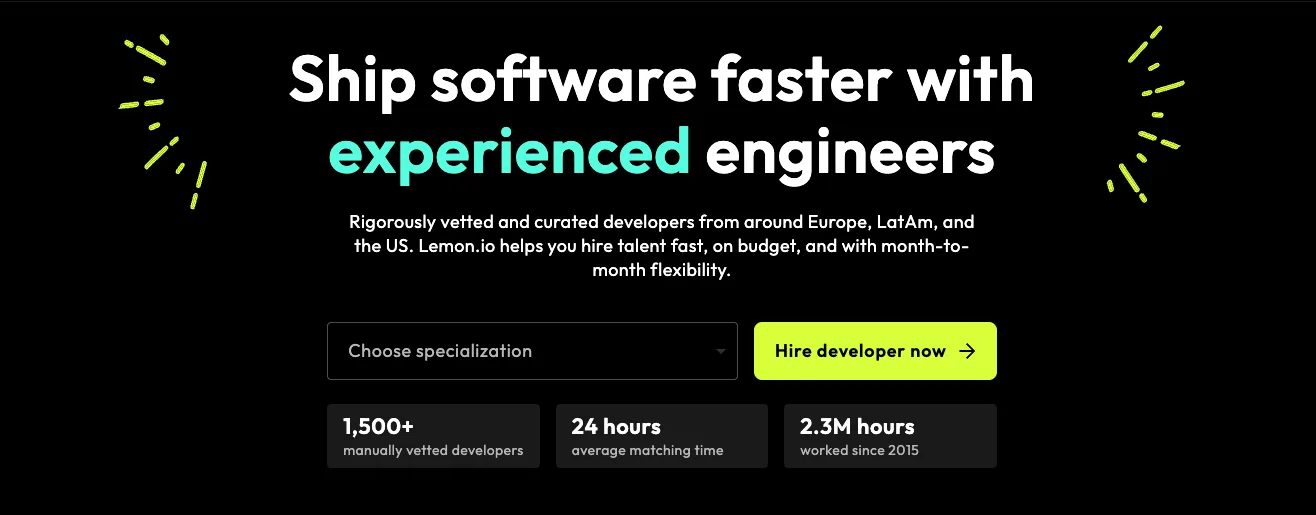
Lemon.io is here because of how fast a scoped engagement can start. Matching typically comes back in about 24 hours, and over 80% of requests close the same day, some in under 10.
There’s no minimum project length or hours commitment, and you pay for work delivered rather than a retainer.
Coverage runs across full-stack, frontend, backend, mobile, DevOps, cloud, AI, data, blockchain, and QA in more than 50 technologies, and the client keeps the intellectual property produced. Placements are contract-first, with a direct-hire path for teams that want to keep someone, at a flat $14,000 conversion fee.
Key features:
- Over 80% of matches close the same day, some in under 10 hours, well inside the “roughly 24-hour” window.
- Rates published upfront at $45–$85/hour by skill level, rather than a quote-only process.
- Lemon.io handles NDAs directly and can execute a separate MSA if your legal team requires one.
What clients say in reviews: Across review platforms, hiring companies point to fast, accurate technical matching, responsive support that stays available through the whole engagement, and transparency about how the vetting process works.
Best for: Scoped contract work that needs to start in days, with the option to convert later if it turns into something longer-term.
Limitations: The most common criticism across review platforms is that the talent is global and skews Eastern European, so a Latin American match is one option rather than the default. A contract engagement doesn't give you an employee unless you pay the direct-hire fee, and even then, the developer was never sourced with LatAm-specific overlap or bilingual coverage in mind.
6. Revelo

Website: revelo.com
Model: Staff augmentation; the engineer stays Revelo's employee, with payroll, benefits, and compliance handled on their side.
Where their talent is: Latin America.
Rating: 4.7/5 on G2 (160+ reviews), as of September 2026.
The reason Revelo made this list is the administrative load it takes off a hiring manager. Their network runs to 400,000+ pre-screened engineers across 18 countries, with the deepest benches in Brazil, Mexico, Argentina, and Colombia.
The platform handles candidate browsing, interviews, payroll, benefits, PTO, and cross-border compliance in one interface.
It even extends that admin layer to hardware: Revelo runs a unified procurement system that ships preconfigured laptops directly to engineers, so equipment isn't a separate problem you manage yourself.
Roles are technical only: full-stack, frontend, backend, mobile, and DevOps.
Revelo's own terms put it plainly: “Risk-free. Try for 2 weeks, pay only if you're happy,” and the pay-as-you-go structure suits teams whose project demand moves month to month.
If you're weighing Revelo, read our Hire With Near vs. Revelo comparison page.
Key features:
- Payroll, benefits, PTO, and cross-border compliance handled in one platform.
- A 14-day risk-free trial, by Revelo's own terms, with no cost if it's not a fit.
- Preconfigured hardware shipped and managed for you, not left as a separate logistics problem.
What clients say in reviews: Revelo has been named a G2 Leader for connecting US companies with Latin American tech talent. Client reviewers consistently point to speed, Revelo's average time-to-hire runs around 14 days against an industry standard closer to 3 to 6 months, plus a dedicated account team that stays reachable over Slack after the placement.
Best for: Teams that want month-to-month flexibility with the engagement admin, hardware included, in one place.
Limitations: Technical roles only, and the platform relationship sits between you and the engineer rather than putting them on your payroll. Pricing isn't published. You get a quote per role, stack, and seniority rather than a rate card upfront.
7. Andela
Website: andela.com
Model: Contractor network; both individual placements and managed teams stay structured as contractor engagements, not direct hires.
Where their talent is: Latin America, Africa, and other regions.
Rating: 4.7/5 on G2 (1535+ reviews), as of September 2026.
I chose Andela for the breadth of its network: 150,000+ vetted technologists across 135+ countries, roughly 60% of them based in Africa and Latin America.
It started in Lagos, Nigeria, in 2014, and now matches companies with software developers, engineers, and application specialists across web, mobile, and cloud-based applications.
Matching works off assessed skills rather than resumes, and the selection process filters for communication as well as technical depth, which is what makes it workable for distributed teams that span more than one continent.
Key features:
- Both individual engineer placements and managed team delivery, structured as contractor engagements either way.
- Named enterprise clients including GitHub, Cloudflare, Coursera, and Mastercard, alongside far smaller teams.
- Monthly rates that scale from about $6,000 to $14,000 depending on seniority and role.
What clients say in reviews: Reviews written by hiring companies credit responsive support, straightforward setup and integration with existing tools and teams, and matching that lines up with the skills requested. The recurring complaints are pricing, with several reviewers flagging that the 12-month minimum commitment is hard to justify for smaller teams, and inconsistency: developer quality and time-to-hire both swing more than reviewers expect, and a handful mention invoicing errors that needed manual follow-up to resolve.
Best for: Companies running a global search rather than a Latin America-specific one, with the budget and timeline to commit to a full year.
Limitations: Latin America is one region inside a much larger network, so time zone overlap and regional depth depend on the individual match. The standard engagement carries a 12-month commitment, which is a longer lock-in than most others on this list.
8. Toptal

Website: toptal.com
Model: Global marketplace for vetted freelance specialists.
Where their talent is: Worldwide.
Rating: 4.7/5 on G2 (270+ reviews), as of September 2026.
Toptal belongs on this best alternatives to BairesDev list for high-stakes, short-duration work. It’s a marketplace for freelance developers, engineers, and architects worldwide, and its screening process is narrow by design: Toptal accepts fewer than 3% of the 200,000+ people who apply each year.
A two-week trial lets you confirm fit before committing, with no billing if it doesn't work out.
For a mission-critical piece of work with a defined end date, that combination is hard to beat, which is a different job from building a permanent team.
Key features:
- A five-stage screening process: language and communication, a skill review, a live technical screening, a test project, and a final review, that runs 3 to 8 weeks before a candidate ever reaches a client.
- A free replacement expert and a new trial period if the first match isn't right, at no extra charge.
- Specialist coverage beyond engineering, including design and finance talent.
What clients say in reviews: Client reviewers credit the vetting for removing long interview cycles, with one calling out an “uncanny ability to know what I'm looking for.” The recurring criticism in those same reviews is cost: Toptal builds a markup, reviewers cite figures as high as 50%, into the freelancer's hourly rate without disclosing it, so clients can't tell how much of what they're paying is going to the developer.
Best for: Short, high-stakes specialist engagements with a clear end date.
Limitations: Priced at a premium, the margin isn't visible to the client, and the freelance model is a poor fit for a permanent team member.
Related reading: 14 Best Toptal Alternatives for Hiring Remote Talent in Latin America
How Do You Choose the Right BairesDev Alternative?
Choose the right BairesDev alternative by deciding what you want to own at the end: a permanent hire, an embedded team member, a managed deliverable, or a contractor. Then, compare the companies inside that model rather than across all four.
In the conversations our engineering recruiters have with US hiring managers, the question underneath “Which company should I call?” is almost always a question about structure: Will I be paying a monthly fee for as long as this person works on my product, or a one-time fee for someone who might leave in three months?
Both structures are legitimate, but they solve different problems.
Decide what you want to own
The alternatives to BairesDev on this list split into four models, and each one leaves you holding something different.
- A recruiting agency finds the person, you employ them, and you pay a one-time fee. The relationship with the agency ends, but the relationship with the engineer is yours, including the salary, the career path, and the loyalty that comes with both. You carry the management.
- Staff augmentation embeds an engineer in your team while they stay on the provider's payroll. You direct the work day to day, the provider handles employment, and you pay monthly for as long as the engineer is with you. It’s the fastest way to add capacity you can release again, and some providers offer a conversion path if you decide to keep someone.
- A development partner runs a managed team against your backlog. You buy an outcome rather than a headcount, and when the engagement ends, the team and its knowledge go back to the partner. This is BairesDev's own model, and it’s the right one when you have scope to deliver and no appetite to manage engineers.
- A marketplace matches you with a contractor for scoped work, usually in days. It is the least committal option and the least durable, which is why teams that start on a marketplace and then decide they want someone permanent often end up looking at the alternatives to freelance platforms in Latin America.
The monthly models win when the work is short, the duration is uncertain, or you don't want a hire on your books. The one-time model wins when the work is permanent and you want the person invested in your product rather than passing through it.
AgileEngine and Andela both offer a managed-team option alongside individual placements, which puts them closer to BairesDev's development-partner model than to the recruiting agencies and staff-aug providers on this list.
That's not disqualifying. Both have the delivery track record to back it up, but it means the ownership question this guide keeps coming back to doesn't resolve the same way for them. If you're evaluating either one, ask directly which of their two models you'd be signing up for, the same way you'd ask it of BairesDev itself.
Verify seniority instead of taking it on trust
Every model on this list will tell you their engineers are senior. Not all of them let you check. Some vendors run their own technical screen and hand you a profile with a title on it, while others put you directly in the interview loop so you can judge the person yourself.
Ask what was tested, who tested it, and whether you can watch. A title on a profile isn't evidence; a live technical conversation with your own engineer is.
Latin America has the seniority to back the claim. Hire With Near's 2026 State of LatAm Hiring Report, drawn from our own placement data, found that 98% of our engineering placements were mid-level or senior, so a Latin American roster isn't a junior pool with a nearshore label on it. The question is whether the company in front of you can show its work.
One of our software engineering recruiters, Federico Bilello, puts the screen this way:
The main thing I look for is ownership. I always look for developers who have worked in startups or smaller companies, because those are the people who probably have ownership. If you bring them a problem, they won't ask how to solve it, they'll try their own ideas, they'll be creative.
— Federico Bilello, Software Engineering Recruiter, Hire With Near
That is the kind of signal a resume can't carry and an automated score will miss.
Check where the engineers sit
Half the companies on this list place only in Latin America. The rest run global networks where a Latin American match is possible rather than promised.
For a team that wants daily stand-ups and same-day review, that distinction is crucial.
If you are still weighing the region itself, our breakdown of nearshore versus offshore software development walks through where each one holds up.
Ask what the company keeps
Ask every company on your shortlist what the engineer is paid and what the company keeps. A founder at a US e-commerce holding company told us what happens when they won't say:
Our issue with the other company was they wouldn't tell us how much we were paying them. And one of the people that I interviewed said that the job was listed at like 50% less than what they told us we'd be paying. So that means that their fee was super high. And yeah, that's something that just really didn't sit right with me.
An undisclosed margin is the single thing that makes two quotes incomparable.
Anchor the conversation in market data instead: our IT Roles Salary Guide gives you the salary bands by role and seniority, so you can see how much of a quoted rate is the engineer and how much is the company.
{{salary-guide-cta}}
Final Thoughts
If you've made it this far, you already know the real question is what you want to own when the work is done: a person on your own team, an embedded engineer who stays someone else's employee, a finished deliverable, or a contractor for a defined piece of work.
ParkMobile made that decision in the open. Its back-end and platform work had run through third-party agency developers for years, and its Head of Engineering for Mobile Payments and Billing had come to see that dependence as a business risk. The company wanted its own senior engineers, in a country it had never recruited in.
We guided it on seniority, availability, and pay, ran sourcing and English screening inside ParkMobile's own ATS, and handled references and compliance. It hired nine senior platform, backend, and iOS engineers at a 24-day average time-to-hire, with $1,066,085 in annual savings against US rates. Colombia went from its riskiest market to its strongest new hiring hub.
Akshay Gokarnakar, ParkMobile's Talent Acquisition Lead, put it this way:
Collaboration with Hire With Near is solving the problem of entering a completely new market for us. They have been an invaluable partner in this expansion, helping to successfully close roles quickly. Their deep understanding of the local talent landscape is what allows them to source and vet top-tier candidates efficiently.
— Akshay Gokarnakar, Talent Acquisition Lead, ParkMobile
That's the work we're built for: permanent hires who become your team's own people, not a rotating bench. Our recruiting team lives in Latin America and knows who's looking for quick contract work and who wants to build something with a US company, which is what keeps people in the seat past year two.
We hire across every other function too, from marketing to finance to operations, and run executive search when the gap is engineering leadership rather than another engineer.
If you've decided a permanent hire is the model you want, book a free consultation and we'll walk through the roles you're filling, share salary rates, and answer all your questions.
If you're still comparing models, our roster of the best companies to hire developers in Latin America and the questions tech leaders ask before hiring in Latin America are worth reading next.
{{consultation}}
Frequently Asked Questions
Is BairesDev a staffing agency?
No. BairesDev is a software development outsourcing firm: it staffs and manages its own delivery teams against a scope you define, and the engineers remain their employees.
A staffing or recruiting agency works the other way around, finding the person so you can employ them directly, then stepping out of the relationship.
That difference in what you own at the end is why most teams comparing options here are really comparing two models rather than two vendors.
How do these companies vet developers technically?
Vetting depth varies sharply across this list, from fully automated screens to a company simply asking you to judge the candidate yourself.
Toptal runs the most quantified version, with a five-stage screen: language and communication, a skill review, a live technical interview, a test project, and a final review, that takes 3 to 8 weeks and accepts fewer than 3% of applicants.
CloudDevs and Revelo both run their own multi-stage technical screens before a candidate reaches you, while Andela and BEON.tech filter for communication alongside technical depth as part of matching.
Hire With Near doesn't run a technical assessment by default. Recruiters screen for whether a candidate can explain their own work to a non-developer, and the actual technical bar (live coding, a take-home, whatever your hiring manager would run internally) is yours to set. If you want us to administer it on your behalf, we can build that into the process at your request.
Whichever company you're evaluating, the question to ask is what specifically was tested and who tested it. Demand a live technical interview rather than an automated score, evidence that the candidate has shipped and maintained code in production, English assessed in a real technical conversation rather than a written test, and references that were called.
How much does it cost to hire a software engineer in Latin America?
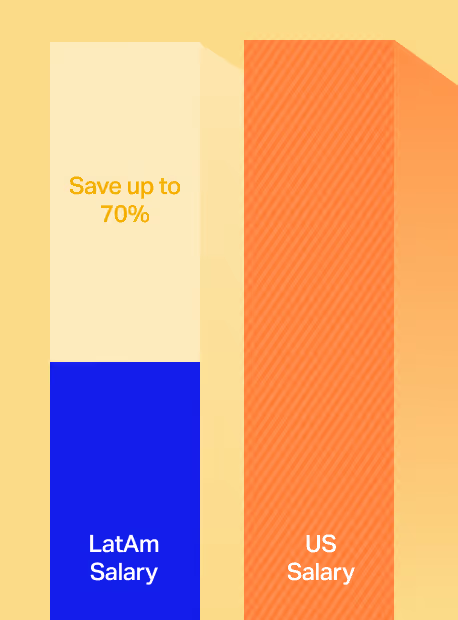
Hiring a software engineer in Latin America generally runs from about $36,000 a year at junior level to roughly $108,000 for a senior engineer, against $100,000 to $238,000 for comparable US hires, according to our salary data.
The salary isn't the whole cost, though: depending on the model, you’re also paying an ongoing monthly margin, a one-time placement fee, or a bundled rate that covers payroll and compliance.
The margin is the part providers disclose least often, and an undisclosed one makes two quotes impossible to compare.
How long does it take to hire a developer in Latin America?
Most Latin American engineering hires close in under a month, with first shortlists landing in three to five days. Two things move that date: how quickly a provider puts real candidates in front of you rather than a database export and the candidate's own notice period, which in Latin America typically runs two to four weeks.
On ParkMobile's nine-engineer build in Colombia, our average was 24 days from kickoff to accepted offer, and the fastest close was 18.
How long do developers hired this way typically stay?
Retention tracks the hiring model more closely than the region. An engineer who’s on your team, reports to you, and has a career path inside your company behaves very differently from one rotating through a provider's bench between clients.
If you want people to stay, the levers are yours: pay to the local market rather than the floor, give the engineer ownership of a real part of the product, and include them in planning rather than handing down tickets.
Teams that do those three things keep Latin American engineers for years.