Key Takeaways
- The 12 best IT recruitment outsourcing companies are Hire With Near, SecureVision, Peterson Technology Partners, Hirewell, OnHires, Cielo Talent, WilsonHCG, Hudson Talent Solutions, Randstad Sourceright, Allegis Global Solutions, AMS, and Pierpoint, split across three models: embedded tech-specialist recruiting, enterprise-wide RPO, and regional specialists.
- Judge providers on the depth of the technical screen rather than the size of the pipeline: ask what the screen consists of, who runs it, and what a candidate has to demonstrate to pass.
- Hiring engineers in Latin America through a recruiting partner keeps a full working day of overlap with your team and puts salary costs 30–70% below comparable US rates.
IT recruitment outsourcing means handing the search for engineers, developers, and other technical hires to an outside firm instead of running it with your own recruiting team. For a role you're filling once or twice a year, or a skill set your internal recruiters don't know how to screen, that's often faster and cheaper than building the expertise in-house.
What's harder to tell from a company's homepage is what you get at the end of the search: some firms hand you a candidate who becomes your employee, others place someone who stays on the firm's own payroll working under your direction, and a few deliver a project team you never manage directly.
The question worth asking before you sign with any of them is simple: once this person is placed, whose employee are they?
This guide compares 12 IT recruitment outsourcing companies built specifically for filling software engineering roles, what each one is good at, how they structure the engagement, and who each one fits.
Once you've narrowed it down, hiring a software engineer directly through a recruiting partner is how that decision plays out.
How Does IT Recruitment Outsourcing Work?
IT recruitment outsourcing works in six stages: the provider calibrates the role with your team, sources candidates, screens and technically vets them, coordinates your interviews, supports the offer and onboarding, and then stands behind the hire for a guarantee period.
You keep the hiring decision and your own interview loop while the recruitment company keeps the work that happens before a candidate reaches you.
Here's what each stage involves, and what you should have at the end of it:
- Intake and role calibration: A recruiter sits with your hiring manager and turns the job description into something searchable.
That means agreeing on what's truly required (not just preferred), which specific skills are deal-breakers versus nice-to-haves, the salary range, and what a strong answer looks like at each interview stage. Most calibrations also produce a list of target companies to source candidates from.
- Sourcing: This is outbound work. Recruiters search their own candidate database, then headhunt fresh, looking for people who are employed, not applying, and not on the boards you've already checked. Ask how many profiles were reviewed, how many were contacted, and what the response rate was.
- Screening and technical vetting: Every candidate gets a recruiter conversation first, covering English skills, motivation, salary expectations, and notice period. Then, a technical screen, run by someone who knows the role, to ask what the candidate has built and maintained, not the tools listed on their resume. What you receive is a shortlist with written notes on each person.
- Interview coordination: The provider schedules your loop, chases candidates between stages, collects feedback, and keeps a shared tracker so you can see who to advance, pass on, or revisit. In Hire With Near's searches, a first shortlist with video introductions lands in 3 to 5 days, and most of our clients make a hire in under three weeks.
- Offer and onboarding: Salary benchmarking for the market you're hiring in, offer presentation, counter-offer handling, and start-date coordination. Notice periods are where ship dates slip.
A good provider asks for a candidate's earliest realistic start date in the first screen rather than at offer stage, then manages the resignation and the counter-offer so a signed offer turns into a date on your calendar. Where the provider also manages employment, this stage covers contracts, payroll, local benefits, and compliance.
- The guarantee period: A good provider is on the hook after the start date. Ours is a 180-day replacement guarantee, double the industry standard, and we run the replacement search at no additional cost if a hire doesn't work out.
What Are the Benefits of IT Recruitment Outsourcing?
IT recruitment outsourcing gives you dedicated recruiting capacity for engineering roles without adding headcount. That usually shows up as a shorter time to fill, a lower cost per hire, and a screen your hiring managers can trust.
It's also a mainstream choice rather than a niche one: according to ManpowerGroup's 2026 US Talent Shortage Survey, 13% of US employers name recruitment process outsourcing as one of the actions they're taking on hiring.
A shorter time to fill, without lowering your bar
Handing the recruiting work to a partner cuts the calendar time a role sits open, from the three to six months a US technical search typically runs down to a matter of weeks. In our own searches, most clients make a hire in under three weeks.
Providers also spread the fixed costs of recruiting, sourcing tools, job advertising, and recruiter time across many searches at once, which is what brings your cost per hire down.
The part that matters more to an engineering team is that the speed doesn't have to cost you the bar. A US healthtech startup reached out to Hire With Near with two internal recruiters and an eight-step interview process that included deep technical screens, coding assessments, and culture-fit interviews. They weren't willing to drop a single step to hire faster.
We took on sourcing, screening, and candidate coordination across every role, and ran a shared tracker so their two recruiters could spend their time evaluating people instead of chasing pipeline.
They hired seven senior engineers across backend, DevOps, QA, mobile, frontend, and staff-level roles at a 14-day average time to hire, kept all eight steps intact, and saved $323,000 a year against US salaries.
Access to candidates who aren’t applying
RPO companies across all functions keep candidate databases and sourcing networks that reach well beyond whoever is applying to your job posts. On engineering reqs, that matters most where the applicant pool is thin: SREs, platform engineers, senior mobile developers, anyone who's employed and not looking.
Bonfire came to us when they couldn't find a US-based UX engineer at the salary they could pay. LinkedIn and job boards weren't working, so they partnered with us to hire in Latin America instead. Bonfire hired 2x faster than their normal process and saved $53,000 a year against US salary expectations.
Recruiters who fill these roles every week
A recruiter who works engineering reqs every week asks different questions than a generalist. They know which job titles mean the same thing at different companies, which lines in a job description are negotiable and which aren't, and what a candidate has to describe in detail before you can believe a claim on their resume.
That knowledge also shows up in what they tell you. A specialist will push back when your salary band and your requirements don't match, which is more useful than a pipeline of people who'll never accept your offer.
Scaling up and down without hiring recruiters
Hiring plans move. You may need two remote back-end engineers and a QA engineer this quarter and nothing the next, and an internal recruiter you hired for the peak is still on payroll in the trough.
An outside partner lets you turn capacity up for a burst of hiring and back down afterwards without that commitment.
A better experience for the candidates you want
Strong engineers have their pick of job offers, and the way a company runs its process is part of how they choose between them. A provider that replies within a day, tells candidates where they stand, and doesn't leave people waiting two weeks between stages protects your employer brand.
When you're competing for the same people everyone else wants, that's a distinct competitive advantage.
Numbers you can manage against
An outside partner reports on the search in a way most internal teams don't have time to: how many candidates entered each stage, where they dropped out, how long each stage took, and what the offer acceptance rate looks like.
The two figures that usually get reported upward are cost per hire and time to fill, and both become manageable once you can see which stage is slowing the search down.
For a deeper rundown of all the advantages, check our guide on the benefits of RPO.
RPO vs. Staffing Agency: What's the Difference for IT Roles?
An RPO provider takes over your hiring process for a defined period and works as an extension of your team. A staffing agency fills individual roles one at a time and is paid per placement.
For technical hiring, that difference decides who owns your candidate experience, how predictable your pipeline is, and what you pay for.
There's also a third model worth weighing: IT staff augmentation places a pre-vetted engineer onto your team to work under your direction while the provider handles payroll, benefits, and compliance. It fits project work and flexible capacity rather than a permanent addition to the org chart.
When is a staffing agency the right call?
A staffing agency is the better choice when you have one or two open reqs, no hiring plan behind them, and an internal process that already works. You're buying a candidate rather than a process, and the per-placement fee reflects that.
Plenty of the IT staffing agencies worth using are excellent at exactly that.
When is outsourcing the process worth more?
Outsourcing the process pays off when the volume or the duration is there: four or more technical roles in a year, a hiring plan you can see 12 months out, or an internal team of one or two recruiters carrying more reqs than they can screen properly.
The provider learns your stack, your interview loop, and what a pass looks like, so the second search costs less effort than the first. That learning curve is the thing a per-placement model never gives you.
Whichever model you pick, the fee is the smaller number. The salary is the bigger one, so it's worth knowing what IT roles cost in Latin America before you compare quotes.
What Are the 12 Best IT Recruitment Outsourcing Companies?
The 12 best IT recruitment outsourcing companies are Hire With Near, SecureVision, Peterson Technology Partners, Hirewell, OnHires, Cielo Talent, WilsonHCG, Hudson Talent Solutions, Randstad Sourceright, Allegis Global Solutions, AMS, and Pierpoint.
They fall into three groups: tech-specialist recruiting firms that embed into your process (SecureVision, Hirewell, Peterson Technology Partners), enterprise RPO providers built to run a whole talent function (Cielo Talent, WilsonHCG, Hudson Talent Solutions, Randstad Sourceright, Allegis Global Solutions, AMS), and regional specialists like Hire With Near that hire deeply in one talent market.
Every company on this list clears one of two bars:
- At least 50 client reviews on an established review platform (G2, Clutch, Trustpilot, GoodFirms, or ClearlyRated, client ratings only) with an overall rating of 4.5 or above.
- A verifiable track record with large, recognizable enterprise clients, the kind of roster that includes Amazon, Nike, and Microsoft.
The second bar earns its place because enterprise procurement validates delivery quality in a way review platforms often miss. Large enterprises rarely re-engage vendors that underdeliver. The second bar also covers the long-established RPO firms whose market standing is independently verifiable even where client review data is thin.
The order below isn't a ranking. There's no single best provider here: the right fit depends on the roles you're filling, your budget, your timeline, and how much of the process you want to keep in-house.
Full disclosure: Hire With Near is one of the twelve. I've done my best to keep this list and the information in it unbiased, and I'll be straight about where a different provider fits you better.
In conversations I have with Hire With Near's recruiting team, the question that separates one provider from another is always the same, and it isn't about pipeline size. It's “what does your screen consist of?”
Here's what sets each company apart. The table gives you the shape of the list at a glance:
1. Hire With Near

Website: hirewithnear.com
Headquarters: United States, with recruiting teams across Latin America.
Rating: 4.9/5 on G2 (155+ reviews).
Services: Full-service nearshore staffing and recruiting, RPO, staff augmentation, executive search.
Focus Regions: Latin America only.
Hire With Near is a full-service staffing and recruiting agency that helps US companies hire top-performing remote talent in Latin America across all departments and industries, including IT and engineering.
We run the whole search: sourcing, screening, technical vetting, interview coordination, offer support, and payroll and compliance when you want us to carry them.
We're the only firm on this list that hires technical talent exclusively in Latin America for US clients, which is the reason to talk to us if overlapping working hours matter to how your team ships.
Hire With Near has hired for more than 950 companies, including Expensify and Deel, and we source from a talent pool of 160,000+ pre-vetted candidates. We're ranked No. 118 on the 2026 Inc. 5000 list of the fastest-growing private companies in America.
We're not a platform and we don't supply temps.
Key features:
• Senior engineers screened by tech recruiters: We place senior backend, frontend, mobile, QA, DevOps, and data/ML engineers every week, with specialist tech recruiters screening for real-world impact. They ask what a candidate built and maintained, and how they made it reliable at scale, rather than reading tools off a resume.
• Quality-first approach: Our 97% placement rate and 9.1+ client satisfaction score come from screening for fit as hard as we screen for skills: whether someone can contribute from day one and grow with your team. Your own technical interview is still the final filter, and we build the process around that instead of pretending our screen replaces it.
• One partner, one process: Scale across functions, not just engineering, with one dedicated team and a repeatable hiring cadence. You get a shortlist of candidates in 3 to 5 days with video introductions, and most of our clients make a hire in under three weeks. We remember what worked last time and adapt to your feedback, so the second search is easier than the first.
• 180-day replacement guarantee: Double the industry standard. If a hire doesn't work out in the first six months, we find a replacement at no additional cost to you.
Best for: US companies hiring engineers who want the search run end to end without lowering their own technical bar.
Limitations: We hire in Latin America only. If you need sourcing in Europe or Asia, or a managed service program covering thousands of contingent workers, other firms on this list fit that better.
Pricing: Two models: a one-time recruiting fee for direct hire, or a monthly rate that includes payroll and compliance. No upfront cost, and you pay nothing until you make a hire.
2. SecureVision
Website: securevision.io
Headquarters: United States.
Rating: 4.8/5 on G2 (495+ reviews).
Services: Embedded recruiting and RPO for technology companies.
Focus Regions: United States.
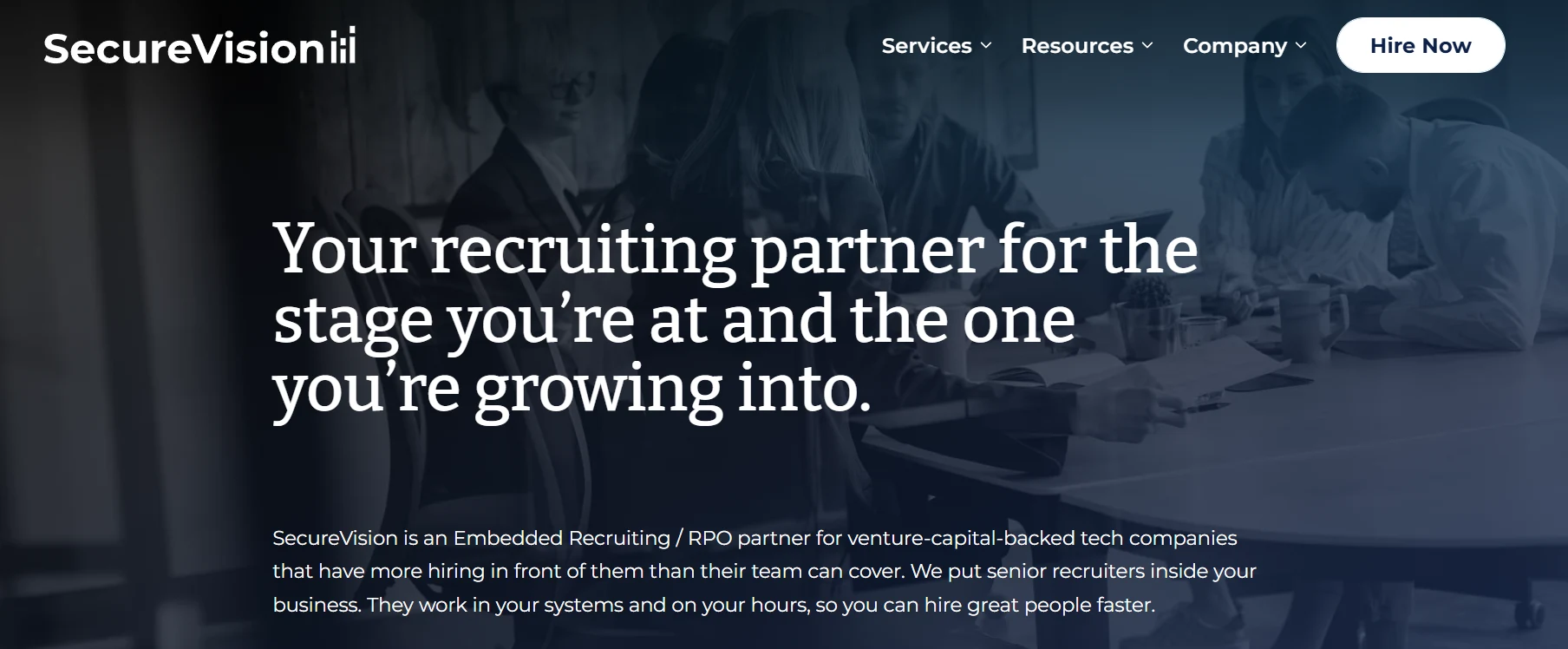
SecureVision earned a spot on this list because it's built for one buyer: the technology company that needs recruiting capacity now and can't afford a generalist screen.
It's an embedded RPO, which means its recruiters work inside your hiring process rather than sending candidates in from the outside.
Of every firm here, it's the closest match to what most readers mean by IT recruitment outsourcing, and it carries the largest verified client review base on this list.
Key features:
• Recruiters organized by discipline: Dedicated teams for Machine Learning, Engineering, Product, Revenue and go-to-market, and G&A roles, so the person screening your backend req isn't also filling an office manager role.
• Embedded delivery model: Recruiters operate as part of your team, in your process and your systems, which keeps candidate experience and employer brand consistent.
• Built for venture-backed growth: The model is aimed at high-growth and VC-backed technology companies scaling headcount in bursts.
Best for: Technology companies with an internal hiring process that need dedicated recruiting capacity plugged into it.
Limitations: The embedded model assumes you have a process for recruiters to work inside. If you want a partner to own the search end to end with minimal involvement from your side, that's a different shape of engagement.
3. Peterson Technology Partners

Website: ptechpartners.com
Headquarters: United States.
Rating: No verified client reviews.
Services: IT staffing, AI recruiting, technology consulting; contract, contract-to-hire, and direct hire.
Focus Regions: United States, with onshore, nearshore, and offshore hiring models.
Peterson Technology Partners (PTP) is an IT staffing, AI recruiting, and technology consulting firm. With nearly three decades of experience, PTP helps organizations identify and hire specialized technology talent, strategize and safely implement AI solutions, and undergo end-to-end digital transformations.
A trusted partner for Fortune 500 companies, PTP provides flexible solutions that combine patent-pending AI technology with experienced technical recruiters to validate, source, screen, and assess candidates across artificial intelligence, data science, cloud computing, cybersecurity, DevOps, software engineering, Salesforce, and other emerging technologies. PTP supports contract, contract-to-hire, and direct-hire needs through nationwide onshore, nearshore, and offshore hiring models.
PTP also provides scalable solutions and access to a pre-vetted talent network for businesses looking to expand rapidly or address specialized skill gaps. With an extensive global network, PTP helps organizations tackle complex hiring and technology challenges with safety, speed, and quality.
Key features:
• Patent-pending AI plus technical recruiters: PTP combines patent-pending AI technology with experienced technical recruiters to validate, source, screen, and assess candidates.
• Specialized technology coverage: AI, data science, cloud computing, cybersecurity, DevOps, software engineering, Salesforce, and other emerging technologies.
• Pre-vetted talent network with global reach: Scalable access to a pre-vetted talent network for businesses expanding rapidly or addressing specialized skill gaps, backed by an international network.
Best for: Companies hiring specialized technology talent, particularly where an AI implementation or a digital transformation program sits alongside the hiring.
Limitations: PTP sells outsourced and augmented IT recruiting rather than a packaged RPO product, so engagements are scoped to roles and projects instead of a multi-year process contract. There's no client rating published on the review platforms used for this list.
4. Hirewell

Website: hirewell.com
Headquarters: United States.
Rating: 5.0/5 on G2 (325+ reviews).
Services: Recruitment process outsourcing, recruiting augmentation, direct hire search.
Focus Regions: United States.
I chose Hirewell because of how clearly its RPO is defined. Where most firms on this list treat outsourced recruiting as one service among many, Hirewell sells a named RPO offering with a stated engagement shape, and technology is one of its core practice areas.
That combination suits a hiring plan you can already see 12 months out, where the question isn't whether you’ll keep hiring engineers but how many and how fast.
Key features:
• Engagements with a defined horizon: RPO contracts typically run 12–36 months or longer, which suits a sustained hiring plan rather than a single req.
• Outsourced or augmented: You can hand over recruiting entirely or add their recruiters alongside your internal team.
• Practice areas beyond technology: Technology is one practice among several, which helps when your hiring plan includes engineering and adjacent functions and you'd rather not manage two vendors.
Best for: Companies committing to a longer engagement with predictable hiring volume.
Limitations: Technology is one practice area inside a broader firm, not the entire business, so the depth of the tech bench matters more here than the firm's overall size. Longer contracts also mean less flexibility if your hiring plan changes mid-year.
5. OnHires
Website: onhires.com
Headquarters: United States, with offices across Europe and Israel.
Rating: 5.0/5 on Clutch (120+ reviews).
Services: Tech recruitment, RPO, executive search.
Focus Regions: Global, 50 locations.
The reason OnHires made this IT recruitment outsourcing list is the specificity of what they recruit for. Emerging-tech roles are where generalist recruiters most often miss, because the vocabulary moves faster than the job boards do, and OnHires focuses on exactly those areas.
They run tech recruitment, RPO, and executive search across 50 global locations, which gives a US company hiring a niche engineering skill set a wider net than a single-market firm can offer.
Key features:
• Emerging-tech specialisms: Web3, artificial intelligence, fintech, cybersecurity, and IoT, including roles most firms won't have filled before.
• Three engagement types: Contingent tech recruitment, RPO, and executive search, so the model can change as the seniority of the role changes.
• Sourcing across 50 locations: Searches can run in multiple markets at once when a skill set is rare.
Best for: Teams hiring for niche or emerging technologies where the shortlist has to come from a global pool.
Limitations: Global coverage rather than a single-region specialism, so working-hours overlap with your team depends on where a given search runs.
6. Cielo Talent
Website: cielotalent.com
Headquarters: United States.
Rating: No verified client reviews.
Services: Enterprise RPO, total talent acquisition, talent consulting.
Focus Regions: Global.
Cielo Talent is here because of what “pure-play” means in practice: recruitment outsourcing is the business, not a service line bolted onto a staffing firm.
Analysts have put Cielo at the top of that category consistently. For an enterprise talent-acquisition leader handing over a function rather than a handful of technical reqs, that track record is what gets a vendor through procurement.
Key features:
• Everest Group RPO PEAK Matrix Leader for 14 consecutive years: Analyst recognition sustained over more than a decade.
• Ranked No. 1 on HRO Today's Baker's Dozen: The industry's buyer-rated RPO ranking.
• Programs that span industries and regions: Technology hiring runs inside a wider talent-acquisition program rather than as a standalone service.
Best for: Enterprises outsourcing an entire talent-acquisition function, technology hiring included.
Limitations: The engagement model is built for enterprise-scale programs, so a handful of engineering roles will likely sit below the typical deal size. No client ratings are published on the review platforms used for this list.
7. WilsonHCG

Website: wilsonhcg.com
Headquarters: United States.
Rating: No verified client reviews.
Services: RPO, executive search, talent consulting.
Focus Regions: Global.
WilsonHCG stands out for longevity in a category with high churn. Founded in 2002, the firm has run outsourced recruiting through more than two decades of hiring swings, including the 2022–2023 tech layoffs and the slower rehiring that followed.
That history is the reason they're on the list: a partner who has managed a hiring slowdown before will handle yours differently than one who has only ever scaled up.
Buyers and analysts have both recognized them, which is a useful signal when a firm carries no client ratings on the public review platforms.
Key features:
• HRO Today Baker's Dozen listing: Buyer-rated recognition in the RPO category.
• Everest Group PEAK Matrix Star Performer: Analyst recognition for year-over-year movement rather than scale alone.
• RPO alongside executive search and talent advisory: One partner can cover an engineering manager search and the volume hiring underneath it.
Best for: Companies running hiring programs across several countries that want advisory work alongside delivery.
Limitations: A global program firm rather than a technology specialist, so the tech recruiting bench is worth probing directly. No client ratings are available on the review platforms used for this list.
8. Hudson Talent Solutions

Website: hudsontalent.com
Headquarters: United States.
Rating: No verified client reviews.
Services: Enterprise, project, and contract RPO.
Focus Regions: Americas, Europe, Asia-Pacific.
Hudson RPO rebranded to Hudson Talent Solutions in 2025, now operating as a subsidiary of the publicly traded Star Equity Holdings (NASDAQ: STRR). That corporate structure makes its scale and financials verifiable in a way most competitors on this list aren't, useful if you're an enterprise buyer who needs that kind of due diligence before signing.
On the service side, the firm reports 100% on-time, on-budget delivery during implementation across its client base
Key features:
• #1 RPO provider in APAC, three years running: Recognized in HRO Today's 2025 Baker's Dozen, the only provider to hold that spot three years straight. Ranks in the top 8 globally across all four enterprise RPO categories.
• Pure-play RPO: No staffing desk competing for the same recruiters' time.
• Delivery across the Americas, Europe, and Asia-Pacific: Useful if your engineering team is already distributed across regions.
Best for: Companies that want a project or contract RPO with a defined start, scope, and end.
Limitations: A generalist RPO rather than a technology-only firm, so ask which recruiters would run your technical reqs. No qualifying client rating on any of the approved review platforms.
9. Randstad Sourceright
Website: randstadsourceright.com
Headquarters: Netherlands.
Rating: No verified client reviews.
Services: RPO, managed service programs, total talent solutions.
Focus Regions: Global, around 70 countries.
Randstad Sourceright makes the list on reach. It's the enterprise RPO and MSP arm of Randstad, which means permanent hiring, contingent workforce management, and the reporting layer over both can sit under one contract.
For a company hiring engineers in several countries at once, consolidating that under one provider is often the point of outsourcing in the first place.
It's also the right entity to talk to for a technical hiring program: the wider Randstad group sells staffing and consulting, and Sourceright is the part that runs outsourced recruiting.
Key features:
• RPO and MSP under one agreement: Permanent and contingent technical hiring managed together.
• Operations in roughly 70 countries: Local labor market knowledge in markets where you have no presence.
• Access to Randstad Digital for technology staffing: The group's technology staffing arm sits alongside the RPO engagement.
Best for: Multinationals consolidating permanent and contingent technical hiring under one provider.
Limitations: Enterprise-scale contracting, so a smaller hiring plan may not justify the program overhead. No client ratings on the approved review platforms.
10. Allegis Global Solutions

Website: allegisglobalsolutions.com
Headquarters: United States.
Rating: No verified client reviews.
Services: RPO, MSP, services procurement, direct sourcing.
Focus Regions: Global.
Allegis Global Solutions is on this list for the combination of workforce program depth and IT hiring lineage. AGS is the Allegis Group company that delivers outsourced recruiting and workforce programs, and the wider group includes TEKsystems, one of the largest technology staffing firms in the US.
If a large share of your technical work is contingent rather than permanent, this is the part of the market that the firm knows best.
Key features:
• Four service lines: RPO, managed service programs, services procurement, and direct sourcing, which can be bought separately or together.
• Direct sourcing programs: Builds your own branded talent pool of contractors, so you're not re-buying the same profiles through agencies.
• IT staffing lineage inside the group: Sits alongside the group's technology staffing operations.
Best for: Enterprises with a large contingent technical workforce to manage as well as permanent roles to fill.
Limitations: Workforce program scale means longer implementation than a straight recruiting engagement. No client rating on the approved review platforms.
11. AMS (Alexander Mann Solutions)
Website: weareams.com
Headquarters: United Kingdom.
Rating: No verified client reviews.
Services: RPO, contingent workforce solutions, talent consulting.
Focus Regions: Global.
AMS belongs here on track record: it's the No. 1 overall RPO provider globally on HRO Today's 2025 Baker's Dozen, the industry's own client-satisfaction survey, No. 1 in healthcare RPO for the 12th straight year, and a Leader in Everest Group's RPO PEAK Matrix for 15 consecutive years running.
One thing to know upfront: Korn Ferry completed its acquisition of AMS on September 1, 2026, so AMS now operates inside Korn Ferry's global search and talent-advisory network rather than as a standalone firm. That trades the old “no staffing bench” pitch for a different one, access to Korn Ferry's assessment tools and search infrastructure layered on top of AMS's own RPO delivery.
Scale is the other reason AMS is here: it runs hiring programs large enough that engineering roles are one workstream inside a wider operation rather than the whole engagement.
Key features:
- No. 1 client-satisfaction ranking: No. 1 overall on HRO Today's 2025 Baker's Dozen, plus No. 1 in healthcare RPO for 12 consecutive years.
- 15-year Everest Group streak: Named a Leader in Everest Group's RPO PEAK Matrix for 15 consecutive years, with 2025 Star Performer status.
- RPO and contingent workforce under one relationship: Outsourced recruiting plus contingent workforce programs together, now backed by Korn Ferry's broader search and assessment infrastructure.
Best for: Large organizations that want an RPO partner with a long, independently verified track record and the resources of a global talent-advisory firm behind it.
Limitations: Built for enterprise programs, so implementation takes longer than a project search. AMS is now part of Korn Ferry rather than independently owned, so if vendor neutrality matters to you, ask directly how AMS's recruiting team is separated from Korn Ferry's other search and staffing lines. No client reviews available.
12. Pierpoint

Website: pierpoint.com
Headquarters: United States.
Rating: No verified client reviews.
Services: Global RPO with a named IT and technology practice.
Focus Regions: Global.
Pierpoint is here for the one thing that is surprisingly rare among global RPO firms: a technology practice that is named and staffed as such, rather than IT hiring being absorbed into a general talent program. That specificity matters when the reqs are engineering reqs, because it tells you the recruiters working your roles do this every day.
Key features:
• Notable clients: Amazon, Nike, and Microsoft, which is enterprise procurement validating the delivery.
• A named IT and tech practice: Engineering reqs go to recruiters inside the technology practice rather than into a general talent program.
• Global delivery: Searches can run across regions for companies with engineering teams in more than one market.
Best for: Technology hiring programs that want a partner already proven at enterprise scale.
Limitations: An enterprise client base usually means enterprise engagement sizes, so a four-role search may not be the fit. No qualifying client rating on the approved review platforms.
If you want the region-wide view rather than the IT-specific one, our roundup of the best LatAm staffing firms covers partners hiring across every function in Latin America.
{{consultation}}
How Do I Choose an IT RPO Provider?
Choose an IT RPO provider on five things:
- How deep the technical screen goes.
- Which services they run beyond sourcing.
- How they communicate mid-search.
- How much of their process they'll shape around yours.
- Whether they can represent your team honestly to engineers who have other options.
Across the 950+ US companies Hire With Near has helped build LatAm teams for, the pattern our recruiters notice is that the teams who get this right judge a provider on the depth of the screen, not the size of the pipeline.
Pipeline size is easy to claim and impossible to verify. A screen is something you can interrogate before you sign.
Quality of technical talent
Ask every provider on this list a few questions: what does your technical screen consist of, who runs it, and what does a candidate have to demonstrate to pass? The answer tells you more than any case study, because a real screen is specific.
Here's what a strong screen sounds like in practice. Our recruiters screening a DevOps engineer don't ask which tools are on the resume. They ask the candidate to walk through setting up and maintaining a CI/CD pipeline: which tools, why those, and what they did to make it reliable once real traffic hit it.
A candidate who built it can describe the failure modes. A candidate who watched someone else build it can't.
Two more things our recruiters watch for, and you should ask any provider whether theirs do the same:
- A candidate claiming deep proficiency across a very large stack in a short career is usually a sign of resume inflation rather than range.
- And good technical recruiters deliberately surface candidates with more years than the job description asks for, because years on a resume aren't the same thing as proficiency.
Then, ask about the limit of the screen. Federico Bilello, Recruiter for Software Engineering at Hire With Near, puts it plainly:
Even though I do everything I can to verify a candidate's skill set before they get to the client, there's always a small percentage who make it through to the technical interview. The only way to truly find out if someone is proficient is that technical interview. That's where the truth comes out.
— Federico Bilello, Software Engineering Recruiter, Hire With Near
Finally, check the evidence. Ask for case studies in roles close to yours, and ask specifically about IT and tech recruiting in Latin America or whichever market they source from, because sourcing depth is market-specific. A firm that fills sales roles brilliantly in one region doesn't automatically fill platform engineering roles in another.
Core services
Look at what the provider runs beyond sourcing. That's where engagements differ most. Some offer end-to-end recruiting, while others specialize in contingent recruitment, high-volume hiring, or project-based hiring for a defined program.
Seniority coverage is the one most companies forget to check. A plan that starts with three back-end engineers can end up needing a Director or VP of Engineering too, and that search runs differently: a smaller candidate pool, a longer timeline, and more confidentiality.
We handle those through executive search in Latin America, and it's worth asking any provider on this list whether their team does that work or hands it to a different firm.
Customer support and communication
Ask what the communication cadence is and who you talk to when a search stalls. The useful answers are specific: a named recruiter, a weekly written update with pipeline numbers by stage, and a shared tracker you can look at yourself rather than waiting for a report.
The tell is what happens on a bad week. A provider that goes quiet when the pipeline is thin can cost you a month. The good ones tell you early that the salary band isn't landing, or that your job description is screening out the people you want.
Customization and flexibility
Every hiring process is different, and the provider should be adapting to yours rather than the reverse. Ask whether they'll work inside your ATS, whether they'll run your scorecard, and how quickly they can scale from one open role to five and back down.
Watch the contract terms here too: a 24-month RPO commitment is a good deal when your hiring plan is predictable and an expensive one when it isn't.
Cultural fit
The provider is speaking to candidates on your behalf, so they have to be able to describe your company accurately. Ask how they'd pitch your role to an engineer who already has a job, and listen for whether they get your product, your stage, and your team's way of working, or whether they read your careers page back to you.
If you want a second angle on this decision, our guide to choosing a software developer recruitment agency covers the same evaluation for role-level searches rather than full-process engagements.
Final Thoughts
The right IT recruitment outsourcing partner is the one whose screen you'd trust with your own hiring bar. Every firm on this list can put candidates in front of you. The differences are who they hire for, how deep the technical vetting goes, and whether you're signing a multi-year program or a four-role search.
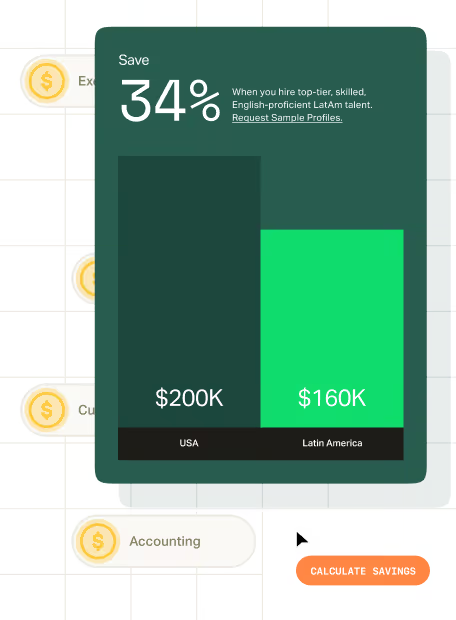
Where that partner sources from changes what you get. Engineering salaries in Latin America run 30 to 70% below comparable US rates, and that gap comes from cost of living, not experience, so the savings buy you seniority you couldn't otherwise afford,.
A senior software engineer in Latin America has salary expectations of $72,000 to $108,000 a year, against $140,000 to $238,000 for the equivalent US hire. A senior DevOps engineer runs $72,000 to $100,000 versus $122,000 to $197,000.
But what surprises clients is rarely the price, as Julia Guillen, Senior Tech Recruiter at Hire With Near, points out:
Clients are consistently surprised with the caliber of talent that's available in LatAm. They don't expect to find senior engineers who've worked with major U.S. companies, understand modern development practices, and often have more hands-on experience with specific frameworks than candidates they'd find locally.
— Julia Guillen, Senior Tech Recruiter, Hire With Near
Latin America is also close enough to overlap your working day. A developer in the region is online during your business hours, so standups happen live, code review lands the same day, and a blocked question gets answered in an hour instead of waiting for the other side of the world to wake up.
ParkMobile is a case in point. Its back-end and platform work had run through third-party agency developers for years, and its Head of Engineering for Mobile Payments and Billing wanted something different: “We don't want to hire junior developers. We really need senior engineers who are able to think along with the product strategy.”
Hire With Near placed 9 senior engineers across platform, backend, and iOS in Colombia, a market ParkMobile had never recruited in before, at a 24-day average time to hire. The result: $1,066,085 in annual savings against US rates, a 73% reduction.
Hear ParkMobile's TA Lead, Akshay Gokarnakar, describe the collaboration in his own words in the video below:
That combination, senior talent at a lower cost, on your schedule, is why Latin America comes up in almost every outsourcing conversation we have.
Talk to a few of the firms above and book a free, no-commitment call with our team too. In 20 minutes, you'll get salary benchmarks for the roles you're filling, a walkthrough of how we screen technical candidates before they reach you, and a straight answer on whether we're the right partner for your roles.
Frequently Asked Questions
What does IT recruitment outsourcing mean?
IT recruitment outsourcing, also called IT recruitment process outsourcing or IT RPO services, means handing some or all of your technical hiring process to an outside recruiting partner that sources, screens, and technically vets candidates for your engineering roles and manages the process through to the offer.
You keep the hiring decision and your own interview loop.
The engagement can cover a single hiring plan, a set of open reqs, or every technical role you open over a multi-year contract.
What are the stages of the IT recruitment outsourcing process?
IT recruitment process outsourcing runs in six stages: role calibration, sourcing, screening and technical vetting, interview coordination, offer and onboarding support, and the guarantee period after the hire starts. Most providers run all six, but some stop at the shortlist and hand the rest back to you.
Ask which stages are in scope before you sign, because the difference between a partner that runs your interview loop and one that emails you resumes is most of the value.
How much does IT recruitment outsourcing cost?
IT recruitment outsourcing is priced one of two ways: a one-time placement fee charged as a percentage of the hire's first-year salary, or an ongoing monthly rate per role or per recruiter for the length of the engagement.
What moves the number is seniority, how rare the skill set is, how many roles you're filling at once, and whether payroll and compliance are included.
Ask any provider two things: is anything payable before you make a hire, and what's covered after the person starts.
What happens if an IT hire doesn't work out?
Most recruiting providers will replace a hire who leaves or doesn't work out within a guarantee window, and ours runs 180 days, double the industry standard, with the replacement search at no additional cost.
Ask every provider on this list three questions: how long the window runs in days, whether it's a replacement or a refund, and whether the window resets when the replacement starts.
Engineering hires are expensive to onboard, so the length of that window is worth negotiating before you sign.
What IT and engineering roles can I hire in Latin America?
US companies hire the full range of technical roles in Latin America, from software engineers, remote full-stack developers, DevOps engineers, and QA engineers through to specialist and support roles.
Cybersecurity analysts cover security monitoring and compliance work, and nearshore data engineers build and maintain the pipelines behind your reporting and ML work. Remote IT support specialists handle internal helpdesk and device management for distributed teams.
All of them work during your business hours at salary expectations well below US rates.
What types of tech companies use IT recruitment outsourcing?
SaaS, fintech, healthtech, ecommerce, and AI companies are the most common buyers of IT recruitment outsourcing, and it shows up wherever a company is hiring engineers faster than its internal team can screen them.
Hire With Near works with companies across industries. Nearshore SaaS recruiting is the most common case, usually for backend, platform, and QA roles as a product scales. Nearshore fintech recruiting comes with its own requirements around security and compliance experience.
Healthtech, ecommerce, and AI companies hire through the same model, and the throughline is technical reqs that outpace internal recruiting capacity.