


%203.svg)
Key Takeaways
- The main benefits of offshore software development are cost, access to specialized engineering skills, and speed: salaries in regions like Latin America run 30–70% below US levels, and a dedicated hiring partner can fill an engineering role in weeks rather than months.
- How far offshore you go decides how much of that you keep. Research from Harvard Business School and INFORMS found that larger time-zone gaps force employees to work outside their normal hours just to stay in sync with a distant team, a pattern that drives burnout and turnover on the offshore side.
- Offshore works best for well-scoped, ongoing engineering work with a clear owner on your side. If your team needs live stand-ups, same-day code review, and incident coverage during US hours, hiring in Latin America is the better call.
Access to talent you can't find domestically, lower costs, and faster hiring are some of the benefits of offshore software development. However, they only show up when the distance between you and the team, meaning which country or region you hire from, is chosen deliberately, not by accident.
Go too far and the time-zone gap eats into the savings: slower feedback loops, delayed releases, and roadmaps that slip a sprint at a time. Stay closer, particularly in Latin America, and you keep most of the cost advantage while gaining a workday that overlaps with yours.
This guide is centered on the six benefits of offshore software development, and it also covers what offshore software development is, what it costs against US salaries, the risks worth planning for, and how to decide between going far offshore and choosing to hire software engineering talent in Latin America.
What Is Offshore Software Development?
Offshore software development means building your software engineering function with professionals based in another country, usually one where salaries sit below US levels.
The defining feature is distance, which shapes both what you pay and how your working day fits together. The most common offshore regions are Asia, Eastern Europe, and Latin America. Nearshoring is a specific kind of offshoring for US companies: hiring in Latin America, where the distance is small enough that your workday still overlaps.
Three engagement models cover most offshore arrangements.
- A dedicated offshore team works only on your product, usually through a partner that handles employment and payroll locally. This is the model Hire With Near operates on.
- Staff augmentation adds individual engineers to your existing team, reporting to your managers.
- A project-based dev shop takes a scope, builds it, and hands it over.
Each carries a different level of control and cost structure, and our guide to hiring an offshore development team goes through them model by model.
The model and the geography are two separate decisions. You can run any of the three with a team on the other side of the world, or with a team close enough to share your workday. Plenty of US companies keep the model and change the geography, choosing to hire software engineers in Latin America as full-time members of their own team.
Related reading: Nearshore vs. Offshore vs. Onshore: Compare Outsourcing Types
What Are the 6 Benefits of Offshore Software Development?
The six benefits of offshore software development are a larger talent pool, specialized skills your local market doesn't cover, lower cost per hire, the flexibility to scale a team up or down, faster time to market, and more in-house time on core product work.
They ultimately come down to four things you can measure: what you pay, which skills you can reach, how fast you can start, and how easily you can change team size.
1. Access to a global talent pool
Offshore hiring gives you access to engineering talent pools far larger than your local market. According to GitHub's 2025 Octoverse report, the platform now counts more than 180 million developers, and Brazil, Mexico, and Colombia stand out as the strongest Latin American markets. Brazil alone is now the fourth-largest developer community in the world.
That scale matters when your requirement is specific: a stack you can't staff in your metro area is often well covered elsewhere. For more market data, see our roundup of offshore software development statistics.
2. Specialized skills your local market doesn't cover
Offshore markets give you engineers who have spent years inside one stack rather than generalists you'll train up. In our engineering searches, the stacks that come up most often are Python, JavaScript, React, Java, .NET, SQL, and Go.
The role profiles follow the same pattern: test automation engineers who have built QA from nothing, DevOps engineers who have run large cloud migrations, mobile engineers who have shipped apps at scale.
I know those profiles exist in the US. The difference is what it costs to hire them and how long the search takes.
3. Lower cost per hire, without a quality trade-off
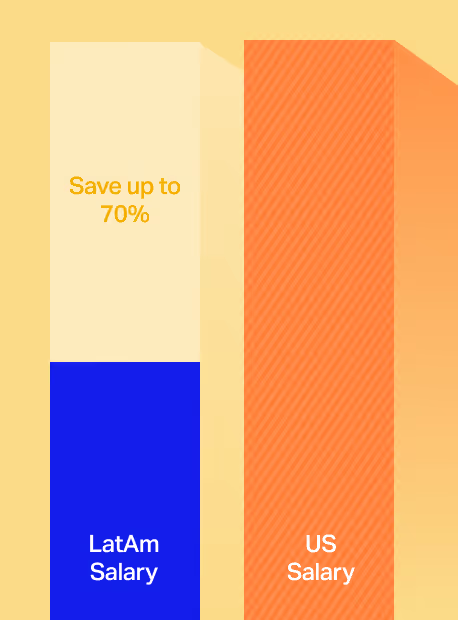
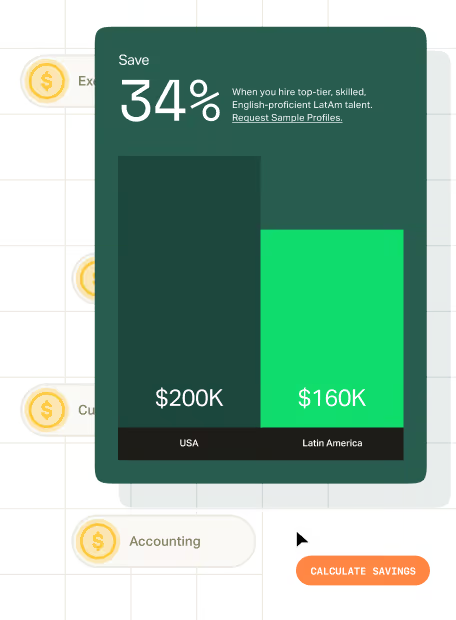
Cost is what makes hiring managers and business leaders consider offshoring. In Latin America, the same engineering profile runs 30–70% below what a US hire would.
I'll cover the role-by-role numbers in the cost section below, but as an example: a mid-level back-end developer in the US earns $73K–$134K annually, while a Latin American professional at the same level charges $48K–$72K, according to our salary benchmarks.
Salaries in Latin America reflect a lower cost of living, not a lower bar. Companies that chase the very bottom of the range tend to pay for it twice, once in rework and once in turnover.
4. Flexibility to scale the team up or down
You can add or remove engineering capacity without running a full US recruiting cycle for every seat. If a product line needs three more engineers for two quarters, an offshore partner can staff it in weeks and wind it down later, without the fixed cost of permanent US headcount.
5. Faster time to market
A question asked in the morning gets answered before lunch instead of the next day, which shortens the calendar between a decision and a release. Real-time conversation also does something a written handoff can't: it settles design decisions, walks through an incident together, and gets a second pair of eyes on a code review the same hour it's opened, not a day later once someone's read a summary and replied.
That speed is the most common driver we hear in nearshore SaaS recruiting conversations: a roadmap with a date on it and a team that's two engineers short, needing people who can move at the same pace as the rest of the org, not on a delay.
6. More of your team's time on core product work
Handing well-defined engineering work to an offshore team frees your in-house engineers for the work only they can do: architecture, product decisions, and the systems the business runs on.
This only holds when the work is genuinely well-defined, though. Ambiguous work sent offshore comes back as questions, and answering those questions is a job in itself.
Which Software Development Services Can You Offshore?
Almost any well-scoped engineering function can be offshored. What travels badly is work that needs continuous, unscheduled context from your US team.
These are the functions US companies move offshore most often:
- Backend and full-stack development: The most commonly offshored work, and the easiest to scope. Python developers, Node.js, Java, and .NET engineers are all well represented across Latin America.
- Front-end and mobile: Component work, design-system implementation, and app development, where scope is visible and reviewable. React developers are the most requested front-end profile we source.
- QA and test automation: Often the first function companies offshore, because coverage gaps are measurable and the work benefits from dedicated focus.
- DevOps, cloud, and infrastructure: Pipeline work, cloud migrations, cost reduction, and reliability engineering.
- Data engineering and AI/ML work: Pipelines, warehousing, and model development, which run on longer cycles and tolerate asynchronous review.
From the editorial work I do interviewing Hire With Near's engineering recruiters, one piece of advice comes up again and again: to make sure you're hiring the right professional for the job you actually need, describe the work, not the title.
Describe the work (“own our React front end and the design-system components”) rather than the label, and the shortlist gets sharper. This is standard ground for nearshore IT and tech recruiting, where most of these searches sit.
Three kinds of work resist offshoring:
- Early product discovery, where requirements change weekly and the work needs continuous, unscheduled context from US colleagues.
- On-call incident response, unless the person works inside your business hours.
- Anything under data-residency or regulatory constraints, where the location of the person and the data is a compliance question rather than a preference.
How Much Does Offshore Software Development Cost Compared to Hiring in the US?
Hiring software engineers in Latin America typically costs 30–70% less than hiring the same profile in the US, with most engineering roles landing in the 59–71% savings band.
For reference on the US side, the US Bureau of Labor Statistics puts the median annual wage for software developers at $133,080 as of May 2024, and projects 16% employment growth for the occupation through 2034. That's the market you're hiring against.
To put the comparison in concrete terms, here's what the most commonly offshored development roles cost in Latin America against equivalent US hires, according to Hire With Near's salary benchmarks:
For the most up-to-date figures, see Hire With Near's US vs Latin America Salary Guide.
In our experience placing these roles, hiring a senior software engineer in Latin America often costs less than hiring a mid-level engineer in the US, which is why companies who make the move rarely end up with a more junior team.
According to Hire With Near's 2026 State of LatAm Hiring Report, which analyzed more than 2,000 placements, 98% of engineering placements were mid-level or senior, and 51% of them were senior.
The bigger risk is picking the wrong number inside the band. Pay at the bottom and you'll get junior-level work no matter what the resume says. Set the target by the scope: if the role owns architecture decisions or a production system, budget in the upper half of the range.
Our guide to IT salaries in the US versus Latin America breaks this down role by role, and the offshore developer rates article covers hourly and vendor pricing.
{{salary-guide-cta}}
What Are the Risks of Offshore Software Development?
Six risks come up most often with offshore software development: communication that breaks down under technical pressure, uneven quality control, a working day that barely overlaps yours, security and IP exposure, seniority claims that don't survive a technical screen, and turnover that takes hard-won context with it.
Each has a specific fix rather than a general reassurance. Our sibling guide to offshore development risks and how to manage them goes deeper on mitigation.
Communication barriers
A strong engineer who can't explain why a pull request broke production, write documentation your team can follow, or hold their end of an architecture review will cost you more than a less experienced engineer who can.
Federico Bilello, Recruiter for Software Engineering at Hire With Near, screens for it directly:
When a senior developer is explaining a project they worked on, I expect them to be able to explain it to me in a non-technical way, without me asking them to. I'm not a developer, so they need to be able to communicate clearly with someone who doesn't have their technical expertise. That tells me they can work with stakeholders and external clients too.
— Federico Bilello, Recruiter for Software Engineering, Hire With Near
When the explanation stays inside jargon, the candidate is usually repeating terminology rather than describing work they understand. Fluency here is about being understood, not about sounding like a US native speaker.
Solution: Decide where decisions get recorded, whether that's a document, a ticket, or a single channel, and use video for anything carrying a design trade-off. Tools like Slack, Microsoft Teams, and Zoom help, but no tool fixes an unclear decision record.
Quality assurance
Any two engineering teams carry different conventions for testing, code review, and what counts as done. Across a large working-hours gap, those differences surface late, usually at release, because nobody is online to catch them earlier.
Solution: Write the standard down: test coverage expectations, what a passing review looks like, and what blocks a merge. Run CI/CD so every commit is built and tested, and review code on a cadence rather than at release.
Time zone differences
Time zone differences are the risk most likely to decide whether offshore works for you. They allow for a “follow-the-sun” development cycle, where work is handed between regions daily, and they also make ordinary coordination expensive.
The cost has been measured. Research from Harvard Business School and INFORMS, based on communication data from 12,038 employees at a large multinational, found that larger time-zone gaps force employees to work outside their own normal business hours just to stay in sync with a distant team, a pattern that creates real strain and contributes to burnout and turnover on the offshore side.
The same research recommends organizing distributed teams along a north-south axis (like the US–Latin America) rather than east to west, so working days overlap instead of alternating.
Here's how the main offshore regions line up against a US working day:
The founder of a web3 and entertainment startup with a distributed engineering team described what the gap does to a release:
We currently have a senior QA that is focused on both manual testing and automation. She's based in Sri Lanka, and I don't get her enough during my day to actually maintain that high quality and high throughput for my team. We often release without her. So it's not good, right?
Solution: Set a core block of overlapping hours that both sides commit to, and put the work that needs live conversation inside it: stand-ups, code review, and anything with a decision attached. Using agile methodologies that promote frequent updates keeps everyone current between those blocks.
Nearshoring is the structural fix rather than a workaround: when the team sits in a nearby region, overlap stops being something you schedule around.
Related reading: Discover the 22 Best Countries To Hire Remote Software Engineers and Developers
Security, IP, and data exposure
Giving an outside team repository access, customer data, and infrastructure credentials is a genuine exposure, and third-party risk is growing. Verizon's 2026 Data Breach Investigations Report, built on 2025 data, found that breaches involving a third party now account for 48% of all breaches, with third-party involvement up 60%.
Solution: Put NDA and IP-assignment terms in the contract, keep repository and production access least-privilege, issue company hardware, and hold everyone to whichever security framework your industry requires. Enforcement across borders is the weak point, so the accountability needs to sit with a company you can hold to it rather than with an individual contractor abroad.
Seniority that doesn't survive a technical assessment
Job titles mean different things from one market to the next, and at a distance you have fewer reference points to calibrate against. AI-assisted resumes make that harder to spot.
The pattern our engineering recruiters see is consistent: the candidates who can't describe their own contribution to a past project are usually the ones who fail the technical screen. Our article about how to spot a fake senior talent covers that in detail.
Solution: Test the work, not the vocabulary. Give the candidate a small real-world task: debug a piece of code, refactor something for scalability, implement a basic API with tests. Review it together on a call. You learn more watching someone think aloud than from an algorithm puzzle.
Several misconceptions about offshore development start here, with a bad experience caused by a weak filter rather than a weak market.
Turnover and knowledge loss
Engineering churn is the most expensive churn a product team has, and offshore setups have two structural causes for it. The first is a night shift nobody sustains: an engineer working through the small hours to overlap your day will eventually leave, and the table above is the reason. The second is split attention, where an engineer carries two or three clients at once.
Solution: Full-time dedicated hires rather than shared contractors, work that happens inside the person's own daytime hours, and screening for tenure patterns. Natasha Tarapow, one of Hire With Near's Recruitment Consultants, looks for candidates averaging two to three years per role, and treats two or three parallel jobs as a red flag rather than a sign of capacity.
What Makes Nearshore Software Development Beneficial?
Nearshore software development is beneficial because you keep the cost advantage of offshore hiring and get your working day back. Nearshore software development outsourcing means hiring engineers in a country close to your own, which for US companies means Latin America, so the benefit is structural rather than something you have to manage around.
It's also not an either-or choice. Plenty of companies keep their offshore team and add a nearshore layer for coverage. A managing director at a US managed IT services company building a Latin American delivery team described that thinking:
We've seen that the Philippines is a good place to find talent, but we also have challenges with transportation, the time zone difference, and natural weather. It's a little extreme in some parts of the year, so we want a backup plan.
Proximity and overlapping working hours
Your nearshore hire is working while you're working, wherever your team sits in the US, as you can see in the table below:
Note: Most Latin American countries don't observe Daylight Saving Time, so these times shift by one hour outside of March–November, when the US reverts to standard time.
That is what the overlap table above buys you in practice: a design question answered in the hour it's asked, a pull request reviewed the day it's opened, and a production bug triaged before anyone logs off.
Cultural affinity
Working practices across much of Latin America line up closely with US business norms, and that shows up in communication habits rather than on a resume. Natasha Tarapow describes what she hears from US teams about how people in the region work:
We're very communicative. People really try to go above and beyond in their jobs.
— Natasha Tarapow, Recruitment Consultant, Hire With Near
The mechanism is convention and timing rather than talent. Teams that share your working day and your professional norms surface problems earlier, because there are hours left in the day to surface them.
Franco Pereyra, Hire With Near's COO, describes what US teams find in the region on its own terms once they hire there:
You'll find people who are proactive and creative. People who come up with ideas and new solutions. If you're looking for folks who can bring something to the table, who will push back if they think your idea doesn't make sense, that's what you find in Latin America.
— Franco Pereyra, COO, Hire With Near
In the video below, our CEO and Co-founder Hayden Cohen explains how to spot cultural affinity when interviewing a developer:
Cost-effectiveness
Nearshore hiring won't produce the lowest headline rate on the market, and it usually wins on total cost: fewer handoffs, less rework from a spec that crossed a full working-day gap, and less turnover from people working through the night.
If you want the how-to rather than the why, we cover how to hire Latin American developers end to end. For a direct comparison of the two models in this region, see offshore software development in Latin America.
Top 5 Offshore Software Development Partners
The right offshore software development partner for your business depends on whether you need engineers or a finished product. That choice is where the benefits of hiring an offshore software development company are won or lost: one model hands you people who join your team, the other hands you delivery you don't manage.
Below are five firms US companies commonly consider, whether you're looking for specialists in sourcing developer talent or broader recruitment agencies with experience assembling development teams.
This list isn’t organized in any specific order. Full disclosure: Hire With Near is one of the five, and we'll be clear about where we fit and where another firm is the better call.
1. Hire With Near

Hire With Near is a recruiting and staffing firm that hires exclusively in Latin America, which means the engineers we place work during your business hours, wherever your team sits in the US. We handle sourcing, screening, and candidate coordination, along with contracts, payroll, and local compliance, so the engineer joins your team and reports to your managers.
We've made 3,500+ placements for 950+ companies from a talent pool of 160,000+ pre-vetted candidates, and we fill 97% of the roles we take on. Most clients see a shortlist in 3 to 5 days and hire in under three weeks. Our recruiters live in the region, and that understanding of the LatAm software industry is what makes the screening work.
We fit companies that want full-time Latin American developers as members of their own team rather than contractors on a project, and that care about live collaboration during their own hours.
That was the case with ParkMobile: after years of outside agencies handling its back-end and platform work, and losing product knowledge every time a contractor rolled off, ParkMobile hired nine senior engineers in Bogotá through Hire With Near, closing the roles in an average of 24 days and saving $1,066,085 a year, a 73% reduction against US rates.
Where we're not the right call: if you need a fixed-scope product built and delivered by an outside team, a development agency is the better fit. And if the only thing that matters is the lowest hourly rate available anywhere, a far-shore vendor will beat us on that number.
Rating: 4.9/5 on G2 (150+ reviews) as of August 2026
2. Toptal

Toptal is a freelance talent network built around selectivity: applicants go through a screening process, and companies are matched with the ones who clear it, across software engineering, design, product, and finance. Engagements are typically contract-based and part-time or hourly, and they start and stop quickly.
Toptal fits short-term, well-scoped work: a specialist for a two-month build or coverage while a full-time search runs. The trade-off is continuity, since freelancers move between clients and context leaves when the contract ends, which is the tension behind our list of Toptal alternatives for hiring remote talent in Latin America.
Rating: 4.7/5 on G2 (270+ reviews) as of August 2026
3. Andela

Andela began as a program to train and place software engineers in Nigeria and now runs as a global marketplace for technical talent, with engineers across Africa, Latin America, and other regions. The model is matching: you describe the role, and Andela proposes engineers from its network, usually on contract engagements rather than direct employment.
Andela fits companies comfortable managing distributed engineers themselves and wanting reach into several regions through one relationship. The trade-off is geographic spread: your match may not sit inside your working day unless you make that a hard requirement up front, and day-to-day management stays with you.
Rating: 4.7/5 on G2 (110+ reviews) as of August 2026
4. BairesDev

BairesDev is an outsourced software development company founded in Buenos Aires, Argentina, now headquartered in the US with delivery teams across Latin America. It sells finished delivery: you bring a product problem, and BairesDev assembles the team, including engineers, QA, and project management, and runs the build.
BairesDev fits companies that would rather hand over a scope than manage engineers. You get delivery management included, plus the working-day overlap that comes with a Latin American team.
The trade-off is control: the team belongs to the vendor, so engineers can rotate, institutional knowledge stays with the vendor, and you may be paying for delivery management you already have in-house.
Our comparison of BairesDev alternatives for hiring remote developers covers that model against hiring engineers directly.
Rating: 4.5/5 on Trustpilot (175+ reviews) as of August 2026
5. Gigster
Gigster assembles project teams from a network of freelance engineers, product managers, and designers, then layers its own project management on top, including AI-assisted planning. The structure is built around discrete projects with a defined outcome rather than ongoing team capacity.
Gigster fits a company without in-house engineering leadership that needs a specific product built: an MVP, an internal tool, or a modernization project.
The trade-off is that the team dissolves when the project does, so if your software is your product and needs continuous work, project-based delivery becomes an expensive way to maintain it.
Rating: 4.7/5 on G2 (4 reviews) as of August 2026
If overlap with your workday is the deciding factor, we compared the field of nearshore software development companies in a separate list.
{{consultation}}
Is Offshore Software Development Right for Your Business?
Offshore software development is the right call when the work is well-scoped, ongoing, and doesn't need someone inside your working day. It's the wrong call when your engineers have to be present, live, for design decisions, code review, and incidents.
The evidence for that verdict is in what companies do next. Hire With Near's research on why US companies hire in Latin America, drawn from more than 2,000 conversations with US companies exploring Latin American hiring, found that 30% of them were already offshore and moving to nearshore, specifically because the time zone gap was costing them real-time collaboration. Only budget was a bigger driver, at 41%.
Offshore development is usually a good fit when:
- The work is well-defined and ongoing, with a clear owner on your side
- You need specialist skills your local market can't supply at your budget
- Your team already works written-first, with decisions documented
- The work tolerates a next-day answer
It's usually a poor fit, and nearshore or onshore hiring is the better answer, when:
- You need incident response or on-call coverage during your business hours
- You're in early product work where requirements change week to week
- Data residency or regulatory rules constrain where the work can happen
- You have no engineering leadership in place to own the scope
In practice, it's rarely all or nothing. A technical co-founder of an early-stage healthcare AI startup, with his engineering team in Eastern Europe, described the version of this we hear most often:
My goal is to continue to keep my team in Romania. No challenges with that at all. They're doing an awesome job. They're really good engineers. It's just that in order to have good coverage for our U.S. customers, I'm looking for options in the same time zone. So with that thought in mind, I thought maybe I should look at Latin America.
From the interviews I do with our engineering recruiters, the tell is almost always the calendar: teams that describe their setup in terms of what they can't schedule are the ones who end up adding a nearshore layer.
Once you've decided to hire outside the US, pick the region on three criteria rather than a ranking. Workday overlap comes first, because it is the one thing you cannot fix later. Depth of talent in your stack comes second, because it decides how long the search takes. Third is the level of English the role genuinely needs, which is higher for an engineer in architecture reviews than for one working from tickets.
Across our engineering placements, Brazil, Colombia, and Argentina are where the hiring concentrates, and the full comparison is in our list of the best countries for software development outsourcing.
Final Thoughts
The benefits of offshore software development are real: engineers you can't hire at home, at salaries well below US levels, with the flexibility to change team size as the roadmap changes. What decides whether you keep those benefits is distance. The further a team sits from your working day, the more of the savings you hand back in rework, delay, and turnover.
At Hire With Near, we help US companies hire engineers in Latin America who work during their business hours, and we handle the contracts, payroll, and compliance around it. Our free guide to hiring remotely in Latin America walks through the whole process if you'd rather read first.
If you're curious about the type of experience, education, and skills the candidates we place have to offer, get a personalized list of pre-vetted sample profiles.
Frequently Asked Questions
What types of software developers can I hire offshore from Latin America?
You can hire a full range of technical roles in Latin America, including full-stack developers in Latin America, remote back-end developers, nearshore front-end developers, mobile developers in Latin America, and remote DevOps engineers.
The stacks we source most often for these roles are Python, React, Java, .NET, and Go. Because the region shares your working day, code review and design questions get answered the same day instead of overnight.
How do I find the best staffing companies to hire offshore developers?
When evaluating offshore staffing partners, look for companies with transparent vetting processes, verified client reviews on platforms like G2 or Clutch, and proven placement track records.
The gap between a promising resume and a real hire is where most partnerships fail. As one SaaS company put it, describing a previous vendor: “On paper, they have all the things. It's just when we do the technical assessment, we're noticing that they're maybe not as senior as we're hoping for.”
The best companies to hire LatAm developers will have recruiters living in the region who understand local talent markets, run real technical assessments, and screen for both English proficiency and cultural fit.
Strong firms also handle contracts, payroll, local compliance, and onboarding, so the hire is set up properly from day one.
What specialized engineering roles can I fill through offshore development?
Beyond general software development, you can hire specialized technical talent offshore, including remote QA engineers for quality assurance and test automation, software engineers with expertise in specific tech stacks, and emerging roles like offshore AI developers for machine learning and artificial intelligence projects.
Savings run highest where US salaries run highest: the table above puts DevOps engineers at up to 70% and QA engineers at up to 63% below US levels.
What are the benefits of an offshore development center?
An offshore development center is a dedicated, ongoing engineering team in one location that works only on your product, and its two real benefits are continuity of context and the ability to grow one team instead of restaffing for every project. Because the same engineers stay with your codebase, institutional knowledge builds rather than resets.
The threshold matters: a development center only pays off at sustained volume. For a handful of engineers, dedicated full-time hires through a staffing partner get you there faster and with less overhead.
How do offshore software development companies vet developers technically?
Strong offshore partners vet with a real-world task rather than a resume review: debugging code, refactoring for scalability, or implementing a basic API with tests, reviewed together on a call so you see how the candidate thinks.
Walking through a past project forces them to explain their own contribution rather than the team's, and a communication check asks them to explain the work to someone who isn't a developer.
Ask any partner what their red flags are. The honest answer is candidates who can't say what they personally did, and candidates who won't discuss a mistake.
How do you protect intellectual property and data security with an offshore development team?
IP and data protection come down to four things: NDA and IP-assignment clauses in the contract, least-privilege access to repositories and production systems, company-provisioned hardware under managed device policies, and compliance with whichever security framework your industry requires, such as HIPAA or SOC 2.
Be realistic about enforcement, because that honesty is what makes the rest workable: pursuing a claim across borders is slower and harder than a domestic one, which is why most companies work through a partner that carries contractual accountability instead of contracting an individual abroad directly.







.webp)


%203.svg)
.avif)





%20(1).avif)

%20(1).png)