.avif)


%203.svg)
Key Takeaways
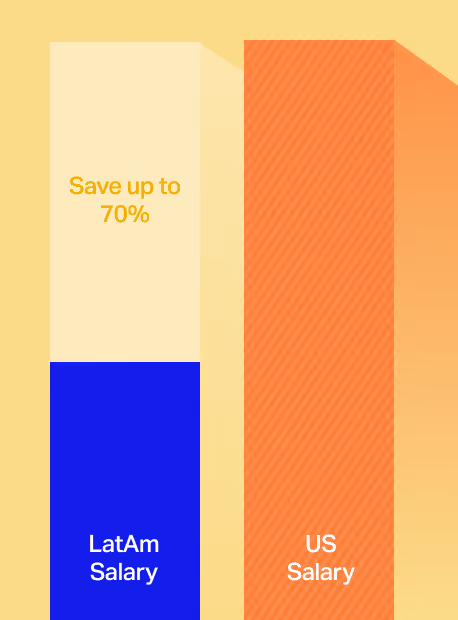
- Hiring offshore ReactJS developers in Latin America typically costs $4,000 to $6,000 a month for a mid-level developer, up to 54% less than the equivalent US salary, and most companies hiring through Hire With Near make a hire in under three weeks.
- You can offshore eight ReactJS developer services, including custom web development, UI/UX implementation, back-end integration, maintenance, and performance optimization.
- Your options split into two categories. Staffing and recruiting companies like Hire With Near source and vet a ReactJS developer who then joins your team. Development agencies and outsourcing vendors like CIGNEX and Maruti Techlabs put their own team on your project or deliver a finished build.
"Offshore" means hiring outside your own country, and for React that can mean Latin America, Eastern Europe, or South and Southeast Asia.
I’ll cover the global picture, but I can lean towards Latin America for one practical reason: a developer there works during your business hours, which the other regions can't offer a US team.
ReactJS is the library behind most modern web interfaces, and in a tight US market the developers who know it well don't stay on the market long. That's what sends teams offshore in the first place.
For a lot of teams, this search starts because local hiring stalled: the candidates who clear your bar are outside the budget, the ones inside need hand-holding on architecture, and the release that needed this hire keeps slipping.
It's why more US teams now hire software engineering talent in Latin America: one US healthtech company kept its full eight-step interview process, filled seven senior engineering roles, and still saved $323,000 a year against US salaries.
This guide covers what you need to know to get started: what an offshore ReactJS developer costs, the best countries to source React talent, and top companies that can connect you with pre-vetted developers.
Why Hire Offshore ReactJS Developers?
You hire offshore ReactJS developers for two reasons: a deeper React talent pool than most US markets offer, and, from Latin America, a developer who is online during your workday.
ReactJS remains one of the most sought-after web frameworks, ranking as the second most used globally in 2025, right behind Node.js.
That demand shows up in our own hiring data too: across the 2,000+ placements in Hire With Near's 2026 State of LatAm Hiring Report, React dominated front-end framework requirements, and demand for software engineers grew 250% year over year, moving the role from 18th to 6th most-filled.
Skilled talent pool
Offshore markets connect you with a deep pool of ReactJS developers. Many have spent years on production applications for US and European companies, working with the same stacks and release practices your team uses.
When you hire ReactJS developers in Latin America, that depth is the point. As an IT and tech recruiting agency working across the region, what we see in candidate pipelines is that React work is routine rather than specialist, so there are more developers who have shipped and maintained it at scale than most US teams expect.
A developer who shares your workday
A developer in Latin America is online and working during your business day, wherever your team sits in the US.
That's the practical difference between nearshore (a nearby country that shares most of your workday, like the Latin American options here) and offshore (far enough that the two workdays barely meet). Onshore, nearshore, and offshore trade off on exactly this point.
What the overlap buys is specific: live stand-ups, an answer the same afternoon you ask the question, and handoffs that happen in real time instead of overnight.
Mexico and Central America share close to a full workday with US teams coast to coast, and Brazil and Argentina run ahead of most US clocks while still sharing the whole afternoon. Most Latin American countries don't observe daylight saving, so the exact gap shifts by an hour twice a year.
In Hire With Near's research on why US companies hire in Latin America, 30% of the 2,000+ companies analyzed were switching from offshore to nearshore for this reason alone: the time zone gap was hurting real-time collaboration.
In my nearly four years recruiting technical talent at Hire With Near, the complaint I hear about a previous offshore team is almost never technical ability. It's the lag.
A question asked in the afternoon gets answered the next day, a manager finds out on Thursday what changed on Tuesday, and a two-day task stretches across a week. When two workdays barely touch, every exchange becomes an overnight round trip.
This is often about adding coverage, not replacing a team that already works. One technical co-founder of an early-stage healthcare AI startup, hiring a senior front-end React developer, put it this way:
My goal is to continue to keep my team in Romania. No challenges with that at all. They're doing an awesome job. They're really good engineers. It's just that in order to have good coverage for our U.S. customers, I'm looking for options on the same time zone. So with that thought in mind, I thought maybe I should look at Latin America.
Overlap is usually the first thing engineering leaders want settled. It sits alongside the others: who manages the person day to day, how their English holds up in an architecture review, and what happens if the hire doesn't work out.
How Much Does It Cost to Hire an Offshore ReactJS Developer?
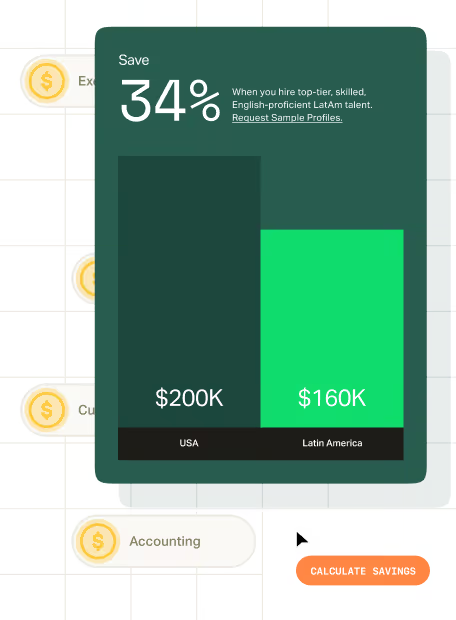
Hiring a mid-level offshore ReactJS developer in Latin America typically costs $4,000 to $6,000 a month, or $48K to $72K a year, according to our salary data. A senior developer runs $6,000 to $9,000 a month, and a junior $2,500 to $3,800.
Here's what hiring a ReactJS developer costs compared to equivalent US hires, according to Hire With Near's salary benchmarks:
For the most up-to-date figures, see Hire With Near's US vs Latin America Salary Guide.
What that spread changes is which candidates are realistically in reach. Look at the table: the senior Latin America band overlaps the US mid-level band, so the budget that buys a mid-level developer in the US can reach a senior one in the region.
That changes who's on your shortlist: developers who have made architecture mistakes, argued about state management on a large codebase, and mentored juniors through it.
The same pattern holds for what other engineering roles cost in Latin America.
Which ReactJS Developer Services Can You Offshore?
Offshore ReactJS developers offer a wide range of capabilities, from building custom web applications to improving speed and responsiveness. Modern JavaScript extensions matter here too: TypeScript developers add the static typing that keeps code reliable and maintainable in complex projects.
Knowing exactly which services you need is the first step if you want to hire an offshore development team.
Here’s a breakdown of the ReactJS developer services you can outsource or hire offshore developers directly to undertake.
Custom web application development
Offshore ReactJS programmers excel at creating tailored web applications that align with your business objectives.
From prototyping to full-scale development, these developers use ReactJS to build fast, scalable, and user-friendly apps designed for smooth functionality. This is the most common brief we get in nearshore SaaS recruiting: a product team that needs another pair of hands on the app itself, not a separate vendor building alongside it.
UI/UX design implementation
A great application isn't just about functionality; it's also about delivering a superior user experience. Your offshore developers can bring your design ideas to life by creating responsive and interactive user interfaces that match your brand identity.
Integration with back-end services
ReactJS is often just one piece of the puzzle. Offshore developers can integrate your ReactJS front end with back-end services like databases, APIs, and other technologies, which is why teams hiring React often hire Node.js developers at the same time. They can deliver end-to-end development support that connects every layer of your software ecosystem.
Maintenance and support
After development, there's still work to be done. Offshore teams conduct ongoing maintenance and support to ensure that your application remains updated, secure, and bug free. Whether addressing technical issues or implementing updates, they help you keep the application stable.
Performance optimization
Applications can become sluggish over time. Offshore ReactJS developers specialize in optimizing performance, identifying bottlenecks, and improving load times. As they fine-tune the code and optimize components, your application continues to deliver a fast and consistent user experience.
Migration and upgrades
Offshore developers can handle the migration of legacy applications to ReactJS or upgrade existing ReactJS development projects to the latest version. These services help you stay ahead of the curve with modernized technology and enhanced features.
Development of mobile applications
React Native, a framework based on ReactJS, enables developers to build high-performing mobile applications. An offshore React Native developer can create cross-platform apps for both iOS and Android, reducing development time and costs while maintaining excellent functionality.
Testing and quality assurance
Testing is a highly necessary part of delivering a successful application. Offshore React developers provide thorough testing and quality assurance services to catch bugs before launch.

Top 7 Countries to Hire ReactJS Developers
For ReactJS, the three countries we would shortlist first are Brazil, Argentina, and Mexico: the largest developer communities in Latin America and the three where we place the most React talent, at $4,000 to $6,000 a month for a mid-level developer, with a workday that overlaps yours.
The best offshore developers can be found all over the world, but choosing an outsourcing destination can get overwhelming. To get you up and running, we’ve put together a list of standout countries for hiring dedicated ReactJS developers.
Hiring developers in Latin America means drawing on a pool that's both large and growing quickly.
GitHub's Octoverse 2025 counts 6.89 million developer accounts in Brazil, the fourth-largest developer population in the world.
Its 2024 report counted another 1.9 million in Mexico, 1.1 million in Argentina, and over 1 million in Colombia, each growing at a double-digit annual rate.
Here's how the seven countries compare on the three things engineering leaders weigh: what the role costs, how much of your workday the developer shares, and English.
The rate figures for Brazil, Argentina, and Mexico come from our own placement data. For the regions we don't place in, the ranges are rough estimates from public aggregators like levels.fyi and Glassdoor, so read them as broad national averages, not the figure you'd pay a specific vetted developer.
Rate figures for Brazil, Argentina, and Mexico come from Hire With Near's own placement data; the other four are approximate ranges from public salary aggregators. English bands and ranks come from the EF English Proficiency Index 2025, which scored 2.2 million test takers across 123 countries and regions.
That last column needs reading carefully. The EF index scores a country's general adult population, not its developers, so it's a rough signal about a national job market and a weak one about any individual candidate.
Strong technical English exists in every country on this list. Finding it is a screening job, not a matter of picking the highest-ranked country, which is why Brazil sits in the Low band and is still our strongest country for engineering placements.
Across the React and front-end searches I've run for US clients, English has never been the thing that settled a search by country. It settles searches candidate by candidate.
Every developer we put in front of a client has been screened for working English, and the bar is technical articulation rather than accent: can they explain why a release broke, walk a non-developer through an architecture decision, and hold their own in a design review.
Brazil
Brazil has become a go-to hiring destination for talented ReactJS developers in the LatAm region. The country boasts a tech-savvy talent pool with many developers who are fluent in English, making communication easy for US businesses. Its time zones are also favorable for real-time collaboration.
Argentina
Argentina is another LatAm powerhouse known for its exceptional software developers. With a strong emphasis on agile development methodologies, the country’s tech sector has grown rapidly. Developers here often have a high level of English proficiency and cultural alignment with US companies.
Poland
The Polish IT outsourcing industry is regarded as one of the best in Europe. Developers here are well versed in advanced technologies like ReactJS and are known for their excellent problem-solving skills. Many Polish professionals also have solid experience working with global clients.
India
Due to the country's vast network of highly skilled developers, India remains a leading outsourcing destination. ReactJS developers in India are not only experienced but also adaptable to various project development needs. The country's education system emphasizes engineering and technology, so tech professionals are always in demand.
Philippines
The Philippines is a top outsourcing destination in Southeast Asia. Known for their strong English proficiency and cultural compatibility, Filipino developers excel in communication and collaboration. The country's IT sector has prospered thanks to strong government support, resulting in a large and skilled tech talent base.
Mexico
Mexico stands out as a nearshore outsourcing destination. Its proximity makes collaboration easy, short travel times (if needed), and a deep understanding of US business practices. Competitive rates paired with strong infrastructure make this country a prime choice for businesses seeking skilled developers.
Ukraine
Ukraine has established itself as a well-known technology hub in Eastern Europe. The country's developers are renowned for their technical skills and proficiency in modern development frameworks. Many Ukrainian developers have a strong command of English and have extensive experience working with US clients.
Should You Use a Staffing Partner, a Freelance Platform, or Hire Direct?
Use a staffing and recruiting partner if the need is permanent, staff augmentation if the work is project-shaped, a freelance platform only if you're willing to be the filter yourself, and direct sourcing if you have the recruiting capacity in-house.
If you're looking to hire an outsourced development team or add one developer to the team you already have, there are four realistic routes. They differ mostly in who does the finding and who handles the employment.
You can source and employ the developer yourself, posting on job boards or LinkedIn and using an employer of record to handle payroll, local benefits, and compliance while the person works as part of your team under your day-to-day management.
That gives you full control, and it leaves the whole sourcing and screening job with you.
You can use a freelance or contractor platform. It's fast and it fits project work, but you are the filter. One solo founder of a fintech SaaS startup described what that looks like:
I've reached the point where I'm past my abilities, my limits as a coder. I uploaded a proposal on Upwork and got like 400 submissions. So yeah, that's great [that you filter it down].
You can use nearshore staff augmentation, where the firm employs a pre-vetted developer who works on your team under your direction. It suits a defined project, or a team you expect to scale up and down.
Or you can work with a specialist staffing and recruiting partner, which does both jobs in one relationship: it sources and vets the developer, then handles employment, payroll, and compliance once you hire.
If the need is permanent, that's usually the simplest path. If it's project-shaped, staff augmentation is the better fit.
Top 7 Companies for Hiring Offshore ReactJS Developers
The companies below split into the two types just described, agencies that sell you their output, and staffing firms that place a developer onto your team.
Staffing and recruiting companies, including the LatAm staffing firms that focus on full-time placements, find and vet a developer who then joins your team and reports to you.
While the country you hire from is important, choosing the right recruitment or development partner matters more.
This list, in no particular order, features some of the best partners to hire dedicated developers, including offshore development companies and those with experience recruiting top dev talent.
For a nearshore-only view, we compare that field separately in our list of the best companies to hire developers in Latin America.
We chose these seven for a public track record of ReactJS delivery across the two models above, a mix of staffing partners and development agencies, so you can compare routes as well as vendors. Hire With Near is our own service, so we've flagged that openly.
Hire With Near
Hire With Near is a staffing and recruiting company, not an outsourcing vendor. We don't sell you a team or a project.
We source and vet a developer who joins your team, reports to you, and works only for you, and we handle contracts, payroll, and compliance from Latin America so you don't have to.
With recruiters based in LatAm, we match on your stack, your team culture, and your working hours. We also cover engineering leadership through executive search in Latin America when the role is a VP of Engineering or a CTO rather than an individual contributor.
Every placement is backed by a 180-day replacement guarantee, double the industry standard. Interviewing is free, and you only pay if you make a hire.
Maruti Techlabs
Based in India, Maruti Techlabs has been delivering custom engineering solutions since 2009. Its team of 100+ highly skilled engineers works with long-term clients worldwide, creating scalable and cost-effective solutions. Maruti Techlabs provides value by going the extra mile for its clients.
CIGNEX
CIGNEX has been providing enterprise-grade open-source, cloud, and automation solutions since 2000. Its pool of 60+ ReactJS developers is skilled in crafting interactive web apps across various industries. With flexible hiring models, you can easily access experienced developers who will tailor your project to your needs.
Relevant Software
Relevant Software combines global expertise with custom development services, especially for healthcare apps. Its ReactJS developers work remotely from around the world, integrating into your team. With their skilled team, you can guarantee scalability, efficiency, and tailored solutions for your unique requirements.
Creole Studios
With development centers and offices worldwide, Creole Studios offers flexible hiring options to meet diverse client needs. Its ReactJS developers craft exceptional digital experiences, from concept to execution. The company even offers a three-day trial of its services before committing.
Outsourced.ph
Outsourced is a premium outsourcing company in the Philippines that offers dedicated remote staff focused on delivering high-quality services. By partnering with them, you can quickly scale your team with skilled ReactJS developers backed by high-tech infrastructure, all within your budget.
Mobilunity
Mobilunity is a nearshoring company based in Eastern Europe with a strong global presence. With dedicated development teams available to businesses worldwide, their services can bridge skill gaps with ease. The company’s model connects clients to an extensive talent pool while allowing them to maintain complete control over their projects.
Final Thoughts
If you can’t find the ReactJS talent you need locally, or the rates are beyond your budget, you’re probably weighing your offshore options. Should you look at Eastern Europe? Southeast Asia?
Here's what we've learned from helping 950+ US companies: for React, Latin America pairs competitive rates with the one thing more distant regions can't offer, a developer who works your hours.
You get developers online during your business day, who understand US market expectations and communicate clearly with your existing team.
If you need an experienced React developer, and you need them soon, we can tell you what that hire costs in Latin America and put candidates in front of you.
At Hire With Near, we connect US businesses with top ReactJS developers in Latin America, and most of our clients make a hire in under three weeks. Our developers bring the technical expertise you need with the collaboration style that works for US teams. Our guide to hiring remotely in Latin America walks through the mechanics if you want the wider picture first.
Book a free consultation call to talk through your specific project needs and timeline with our team. You'll get salary benchmarks and a walkthrough of how the process works, so you have what you need to decide whether it's right for you.
{{latam-hiring-cta-v2}}
Frequently Asked Questions
How much does it cost to hire an offshore ReactJS developer?
Budget $4,000 to $6,000 a month for a mid-level developer in Latin America, according to our salary data, and treat that as the salary line only.
On top of that, budget for a partner's fee if you use one, a laptop and software, local benefits, and any employment costs in the developer's country. Three things move the total: seniority, the country you hire in, and how you engage the person. Our breakdown of offshore developer rates shows how the ranges shift by region.
Where can you hire offshore React JS programmers?
There are four realistic routes: a staffing and recruiting partner, a development agency, a freelance platform, or direct sourcing on job boards and LinkedIn.
A staffing and recruiting partner finds and vets a developer who joins your team, and handles the employment side. A development agency sells you its own team or a finished project.
A freelance platform is the fastest and lowest-cost way to start, and you do all the filtering. Direct sourcing gives you full control and the whole workload, compliance included.
How do you hire dedicated offshore ReactJS developers?
You define the role and the stack, source candidates, screen them technically, interview a shortlist, then hire. Working with us, that runs on a real clock: a shortlist of candidates in 3 to 5 days, and most of our clients make a hire in under three weeks.
Dedicated means exactly that, too: the developer works full-time for your team, reports to you, and isn't split across other clients. Our guide to hiring offshore software developers covers the wider process step by step.
What is the difference between offshore, nearshore and onshore React hiring?
Onshore means hiring in your own country, nearshore means a nearby country whose workday largely overlaps yours, and offshore means far enough away that the two workdays barely meet.
The three models fit different needs: onshore for work that has to sit in-office, nearshore when you need live collaboration, offshore when the work is genuinely asynchronous. Outsourcing is a separate question. It describes who employs and manages the person, not where they sit.
Which countries are best for hiring offshore React developers?
Brazil, Argentina, and Mexico are the three we'd recommend first for ReactJS. Brazil is our strongest country for IT and engineering placements and has the deepest React pool in the region. Argentina is the highest-ranked Latin American country on the EF English Proficiency Index.
Mexico gives you close to a full workday of overlap wherever your team sits in the US. The table above compares all seven, and our roundup of the best countries to hire remote software engineers and developers goes wider.
Is React Native the same as ReactJS?
No, they're different technologies. ReactJS is a JavaScript library for building web interfaces; React Native is a framework for building mobile apps. They share React's component model but not what they produce, and a developer who is strong in one isn't automatically strong in the other. If you're hiring for iOS or Android, that's a different search from this one.
What other developer roles can I hire in Latin America?
US companies most often pair a React hire with front end developers, full stack developers, and QA engineers, plus Node.js and TypeScript specialists.
React work rarely arrives alone: the interface needs an API behind it, types across it, and tests around it. These roles fall into similar salary bands and share your workday, so you can staff a full slice of the team without giving up real-time collaboration.
How do you vet offshore ReactJS developers beyond their resume?
Three filters, in this order: a structured project walkthrough, a real-world technical task, and a communication check. I ask every candidate to walk me through a project they worked on themselves, not the stack list, but what their role was, what they built, and what went wrong.
Then I check whether they can explain it to someone who isn't a developer, because that's what an architecture review or a client call demands.
The task itself is small and real, usually a debug, a refactor for scalability, or a basic API with tests, and we go through it together on a call. Resumes are easy to write and AI has made them easier. A candidate talking through their own decisions for twenty minutes is much harder to fake.







.webp)


%203.svg)
.avif)





%20(1).avif)

%20(1).png)