%203.svg)
Key Takeaways
- A Node.js developer in Latin America costs $30K to $108K a year depending on seniority, against $80K to $189K in the US, a 43–68% saving that holds while preserving a full overlapping workday.
- The three problems that derail offshore Node.js projects are time zone gaps, loose IP and data-security controls, and unspoken differences in working norms; the first is solved by geography, the other two by contract terms and onboarding you control.
- Judge any offshore Node.js development company on six criteria: how it vets technical skill, whether it knows your stack, working-hours overlap, pricing transparency, what happens after the hire, and proof it has placed engineers for companies like yours.
Offshore Node.js development is how many US companies add experienced Node.js engineers when the US market rate for that experience doesn’t fit the budget. Node.js is a popular runtime for building scalable, high-performance applications, but engineers who’ve actually worked in it at depth are scarce everywhere, and scarcest within reach of a growing team’s budget.
Increasingly, US companies are looking to hire offshore software developers in Latin America and other regions to get the full value of Node.js development while making the most of their budgets. That shift is a big part of why IT and tech recruiting in Latin America has grown so quickly.
Below, you’ll find what hiring offshore Node.js developers costs by seniority, the three things that most often go wrong (time zone gaps, security exposure, and working norms nobody wrote down), and the six criteria worth judging an offshore Node.js development company on.
Why Do US Companies Hire Offshore Node.js Developers?
US companies hire offshore Node.js developers for five reasons: senior-level Node.js talent at a mid-level US salary, help improving an existing codebase, the flexibility to scale a team up or down, real-time overlap with their in-house engineers, and continuity on a codebase that will outlive any single contract.
These are the five that come up most often when US hiring managers talk to the engineering recruiters at Hire With Near.
1. More senior talent for the same budget
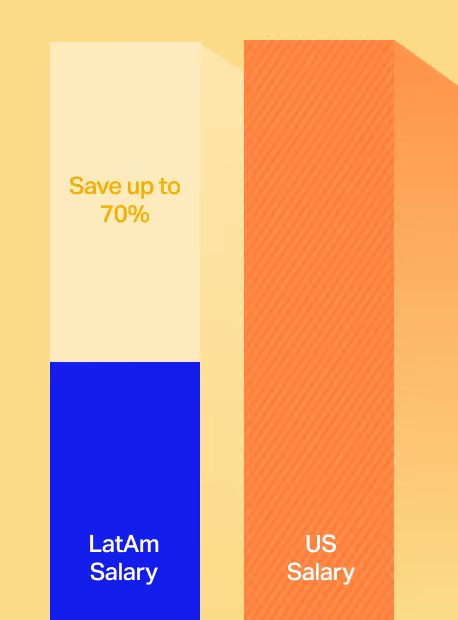
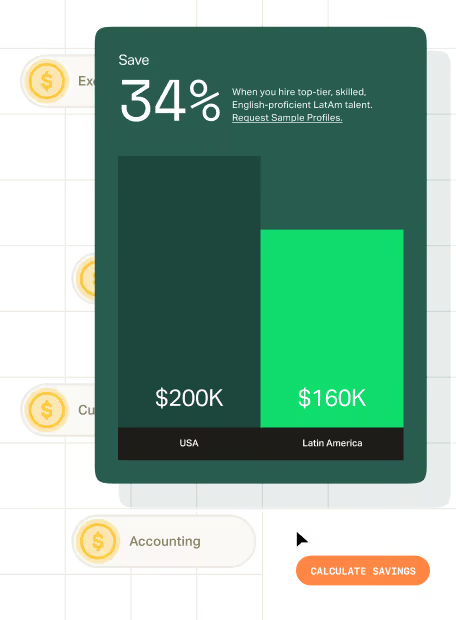
Hiring a Node.js developer in Latin America costs 43–68% less than the equivalent US hire, according to our salary data, and the gap is widest at the junior end. But the number that surprises US clients most isn’t the percentage: hiring a senior Node.js engineer in Latin America often costs less than hiring a mid-level engineer in the US.
On nearly every first call, Hire With Near’s engineering recruiters hear the same assumption: that a lower salary band must mean a less experienced engineer. It isn’t true. The developers on the other end of that lower number often have a decade of production experience, much of it already on US or global teams, working in English every day.
Most teams put the savings back into the project rather than just banking them: a second engineer, the QA coverage a Node service needs before it goes to production, or the DevOps time nobody budgeted for. Offshore hiring also shortens delivery cycles, since you’re adding capacity in weeks instead of running a three-to-six-month US search first.
2. Improve existing projects
Most Node.js applications that need help were built fast and are now struggling under load: memory leaks nobody has traced, an Express monolith that needs breaking into services, npm dependencies that haven’t been audited in two years.
That is specialist work, and it’s usually easier to hire for offshore than locally, because you’re recruiting from a much larger pool of engineers who have done exactly that job before.
We break the case down further in our guide to offshore back-end development.
3. Flexibility and scalability
Offshore Node.js teams let you change the size of your engineering team without the commitment a local full-time hire carries.
If a feature launch needs three more engineers for only two quarters, or a project phase wraps and the team can shrink, an offshore arrangement absorbs that far more easily than a local headcount plan does.
4. You don’t have to trade your working day for the savings
“Offshore” has a reputation for meaning your engineer is asleep during your afternoon: a code review that sits overnight, a production question that doesn’t get answered until the next US morning. That reputation is earned in some regions, but it’s a fact about geography, not a fact about offshoring itself.
Latin America, for example, doesn’t have that gap: your developer is at their desk during your business hours, wherever your team sits in the US. Code review happens the same day. A production question at two in the afternoon gets an answer a few minutes later.
That’s also why so many companies who hit the time-zone problem elsewhere end up switching to Latin America instead of giving up on offshore hiring entirely. In Hire With Near’s analysis of 2,000+ hiring conversations, 30% of US companies exploring Latin America were already offshoring somewhere else. When they explain the switch, the reason we hear most often is that the time zone gap was costing them more than the salary gap was saving them.
5. Retention and continuity on a long-lived codebase
A Node.js back-end usually outlives whoever wrote it, so churn costs more than any hourly rate difference saves.
A two-person software team in the US tax industry described what happens when that goes wrong. Their MVP had been built by offshore contractors:
They’ve since kind of disappeared or fell off the map to us. So we were looking for either a direct hire or a team or an agency that we could work with to put more production into or to put more development into the application.
Rebuilding context in a codebase you didn’t write is slow, expensive work. A dedicated hire who stays for years never generates that bill.
When Should You Hire Offshore Node.js Developers?
The reasons above explain why offshore Node.js hiring works in general. This section is about recognizing the moment it’s actually the right call for you. Five situations tend to be the tipping point.
A domestic search that’s already stalled
If a Node.js req has been open for 60 to 90 days with no offer accepted, or the candidates reaching final rounds keep falling short on seniority, that’s often a supply problem, not a patience problem.
69% of US employers say they’re struggling to find the skills they need across the board, according to the ManpowerGroup 2026 Global Talent Shortage Survey, and Deloitte’s research on the tech talent shortage points in the same direction for engineering specifically, projecting US demand for 7.1 million tech jobs by 2034.
A launch date that won’t move but your headcount can’t flex fast enough
If a feature commitment or a contractual deadline needs more engineering hands than your team currently has, and hiring a full-time local employee would take longer than the runway you have left, that’s a capacity problem with a hard deadline attached, which is exactly what offshore hiring is built to solve quickly.
This is especially common in nearshore SaaS recruiting, where a Node.js API sits underneath the whole product and feature demand arrives faster than headcount does.
A quote came back over what the role can justify
If you’ve priced out the role locally and the number doesn’t work, that’s different from assuming offshore is cheaper by default. It means you already know the ceiling, and offshore hiring is worth evaluating specifically because it can close that gap without lowering the bar on experience.
The work needs a capability your team doesn’t have in-house
Whether that’s a memory leak nobody on the team has traced before, a migration to microservices architecture, or integrating Node.js with something like MongoDB, this is a case for hiring specifically for depth in that problem, not just adding general capacity. Ask any candidate or provider for the specific problem they’ve solved before, not just familiarity with the stack.
You’re building for a market you haven’t shipped to before
Expanding into a new market often means handling things a v1 product never had to: local payment rails, currency and language handling, regional data rules. Developers who’ve already shipped a localized product before can handle the parts that break a launch in a market you haven’t built for yet.
What Are the Challenges of Offshore Node.js Development?
Three things go wrong with offshore Node.js development: a time zone gap that turns every question into a day of delay, security and IP exposure that a vendor NDA alone does not close, and working norms nobody wrote down.
In the conversations our recruiters have with CTOs who have already tried offshoring, the pattern that emerges is that almost none of these are technical problems. The code usually arrives. It’s everything around the code that breaks.
Distant time zones
Whether time zone gaps are a problem depends entirely on where you hire. For a US company, Latin America runs on the same general band of hours as the continental US, so a developer there is at their desk during your business day, not asleep through most of it.
Note: Most Latin American countries don’t observe Daylight Saving Time, so these times shift by one hour outside of March–November, when the US reverts to standard time.
Other offshore regions are a different story. One founder of an early-stage startup, whose engineering team was based in India, described the cost of the gap this way:
They did a pretty decent job refactoring a lot of code, to be honest. It’s just, you lose a day. You lose a day every single time just from a message. I can’t do that anymore.
Research from Harvard Business School and INFORMS, tracking more than 12,000 employees at a Fortune 100 firm, found that the larger the time zone gap between two colleagues, the more of their work gets pushed outside normal business hours for one side of the pair.
The researchers’ recommendation for teams that depend on real-time collaboration is to organize distributed teams north to south, not east to west, which is exactly the US-to-Latin-America axis.
The fix is geographic, not procedural. Hiring in Latin America means your developer is online during your business hours, whether your team runs on Pacific, Mountain, Central, or Eastern time, so standups happen live and code review doesn’t wait overnight.
We cover the specifics in our comparison of nearshore versus offshore software development.
Risk of security loss and data leakage
An engineer working on your Node.js services will have repository access, infrastructure credentials, and very likely customer data, and a vendor-level NDA doesn’t cover that.
The scale of third-party exposure is worth knowing before you sign anything. According to the Verizon 2026 Data Breach Investigations Report, breaches involving a third party now account for 48% of all breaches, a 60% increase year over year.
Here’s what to require from any offshore Node.js development company, rather than assuming their standard contract covers it:
- An NDA and IP assignment signed by the individual engineer, not only by the vendor: If the person writing your code hasn’t signed anything, the paperwork protects the wrong party.
- Scoped repository and credential access: Read access to what they need, write access to what they own, no shared admin accounts, and revocation on day one of any change.
- SSO and a device policy: Company-managed identity, enforced MFA, disk encryption, and a stated position on whether work happens on their machine or yours.
- Named liability in the contract: Who carries the cost if data leaves, and what the notification obligation is.
Be realistic about enforceability: a contract signed across borders is a deterrent and a basis for recovery, not a guarantee. The operational controls above are what limit the blast radius, which is why they matter more than the wording of the NDA.
Cultural differences
Distributed teams break on unwritten expectations far more often than on stated ones: how quickly a message should get a reply, whether you flag a blocker or work around it, how much detail a status update needs.
None of that is a quality of any region’s professionals. It’s a function of nobody having written the expectations down. Set them explicitly in week one, in the same document as the technical onboarding, and most of the friction disappears.
On the cultural side, the pattern our recruiters report from Latin America is a communicative one. Natasha Tarapow, Hire With Near’s Recruitment Consultant, based in Latin America herself, puts it this way:
We’re very communicative. People really try to go above and beyond in their jobs.
— Natasha Tarapow, Recruitment Consultant, Hire With Near
Much of that comes from experience: many of the engineers Hire With Near places have already spent years on US and global product teams, so US working norms are familiar ground rather than something new to adapt to.
How Much Does Offshore Node.js Development Cost?
Hiring a Node.js developer in Latin America costs $48K to $72K a year at mid-level and $72K to $108K at senior level, which is 43–68% less than the equivalent US hire depending on seniority, with the widest gap at the junior end.
The total cost varies with location, seniority, and how complex the work is, but the salary is the part you can benchmark before you talk to anyone.
To put it in concrete terms, here’s what hiring a Node.js developer costs compared with an equivalent US hire, according to Hire With Near’s salary benchmarks:
For the most up-to-date figures, see Hire With Near’s US vs Latin America Salary Guide.
The savings are largest at the junior end and narrow as seniority rises, which is worth knowing before you assume the top figure applies to the senior hire you want.
Even so, hiring a senior Node.js engineer in Latin America often costs less than hiring a mid-level engineer in the US. You’re hiring for more seniority at the same cost, not paying less for the same seniority.
According to Hire With Near’s 2026 State of LatAm Hiring Report, 98% of the engineering roles we filled last year went to mid-level or senior professionals, and 51% of them were senior.
What you’ll pay by region
Published hourly rates by region are worth treating with caution, because almost all of them come from vendor blogs with no stated methodology and they contradict each other by wide margins. What holds up is the direction of travel.
South and Southeast Asian rates typically sit below Latin American ones, and Eastern European rates land in a similar band to Latin America’s. What changes alongside the rate is the overlap with your working day, which is the variable that decides how much of the saving you keep.
For a US benchmark that isn’t self-reported, the Bureau of Labor Statistics puts the median annual wage for software developers in the US at $133,080 as of May 2024, with employment projected to grow 15% through 2034. That covers software developers generally rather than Node.js specifically; the table above carries the Node.js numbers.
If you want a broader breakdown, we track how much offshore developers cost across regions and seniority levels.
Related reading: Discover the 22 Best Countries to Hire Remote Software Engineers and Developers
Which Latin American countries are strongest for Node.js work
Brazil, Colombia, and Argentina are the three strongest Latin American markets for Node.js work, and each is strong for a different reason.
- Brazil is where we place the most engineers, and it has the deepest developer community in the region by a wide margin, with 6.89 million developers on GitHub, according to GitHub’s Octoverse 2025 report.
- Colombia has become one of our most common hiring destinations overall, helped by a large mid-market services sector that has trained a generation of engineers on US client work.
- Argentina has a long-established senior JavaScript community and a strong track record in business English, which matters when the engineer has to explain an architecture decision on a call.
- Mexico is the closest fit if near-total workday overlap is your priority, particularly for teams in the Central and Mountain states.
For a wider view of the region’s engineering talent, see our guide to hiring Latin American developers.
What Should You Look for in an Offshore Node.js Development Company?
Judge an offshore Node.js development company on six things: how it vets technical skill, whether it understands your stack, how much of your working day it overlaps, pricing transparency, what happens after the hire, and whether it can show you engineers it has placed for a company like yours.
From the editorial work I do interviewing Hire With Near’s engineering recruiters, the difference between a partner who filters candidates and one who forwards resumes shows up in exactly those six places. If you want to see how specific providers stack up before you read the criteria, we also compare the best companies to hire developers in Latin America separately.
1. How they vet technical skill
A technical filter has three parts:
- A small real-world task: debugging a piece of code, refactoring something for scalability, or building a basic API with tests, either live or as a take-home.
- A review of that task together on a call, which is where you find out whether they reason about clean architecture or just produce working output.
- A project walkthrough the candidate has to explain in plain language, because a developer who can’t make a technical decision understandable to a non-developer is usually repeating terminology, not applying it.
Skip any of the three and this is what tends to happen. One talent acquisition leader at a mid-market compliance company, already working with a staffing platform, described it this way:
Right now, [our current vendor] is sending us candidates, and their resumes do look good, but when they do make it to our technical assessment and our interview rounds, our hiring team is finding that they’re maybe not as senior as we’re hoping for.
Federico Bilello, a Software Engineering Recruiter at Hire With Near, describes the signal he screens for above the stack list:
The main thing I look for is ownership. I always look for developers who have worked in startups or smaller companies, because those are the people who probably have ownership. If you bring them a problem, they won’t ask how to solve it, they’ll try their own ideas, they’ll be creative.
— Federico Bilello, Software Engineering Recruiter, Hire With Near
Two red flags our recruiting team watches for: a candidate who can’t describe what their actual role was on a past project, and a candidate who won’t discuss a mistake. For a fuller breakdown of the process, see our guide to hiring top Node.js developers.
2. Whether they know your stack
If a partner can’t ask specific questions about your stack, they’re just matching job titles, and job-title matching is how you end up with a resume that looks right and a candidate who fails your technical round.
Node.js rarely runs alone, so a good screen goes past “do you know Node”:
- Have they worked with both SQL and NoSQL databases, and done the data modeling themselves?
- Have they really used microservices and Docker, or just heard of them?
- Are CI/CD pipelines part of their daily work?
- How do they choose frameworks and tools for a new project?
One thing worth knowing before you write the job post: don’t over-specify the framework. An experienced developer who understands the core principles adapts across frameworks easily.
Be exact about the problems you need solved. Be flexible about which library solved a similar problem last time. Our recruiters see this often, and it costs companies good candidates for no benefit.
3. Time zone and working-hours overlap
Ask where the engineer will physically be, not where the company is headquartered, because those are often different.
Providers with globally distributed benches will match you with whoever fits the skills first and sort out hours afterward. A regionally focused partner is making that decision for you before the shortlist exists.
4. Pricing transparency and what the fee covers
You should be able to see the difference between what the engineer earns and what you pay, and any provider that won’t show you that split is asking you to trust a number you can’t check.
One owner of a small e-commerce holding company described what happens when the split stays hidden:
Our issue with the other company was they wouldn’t tell us how much we were paying them. And one of the people that I interviewed said that the job was listed at like 50% less than what they told us we’d be paying. So that means that their fee was super high.
That’s something that just really didn’t sit right with me.
Four questions worth asking every provider:
- Is the fee one-time or recurring?
- Is it a percentage of salary or a flat amount?
- What is included beyond sourcing, and specifically who handles payroll, benefits, and local compliance?
- And is there anything payable before you make a hire?
The answers will differ by model, which is fine. Not being able to get the answers is the signal.
5. What happens after the hire
Ask what the provider does when a placement doesn’t work out, and get the answer in specifics: whether it’s a replacement or a refund, how long the window is, and what triggers it.
Then ask about retention, because a replacement guarantee only covers the first few months and a Node.js back-end needs someone who is still there in year three. A provider who tracks how long their placements stay will tell you the number without being asked twice.
Also confirm whether the engineer is dedicated to you or splitting attention across several clients, and who’s legally responsible for payroll, benefits, and compliance in the engineer’s country.
6. Proof they’ve done this for a company like yours
Ask for a placement in your situation: similar company size, similar hiring bar, similar stack.
One fast-growing US healthtech startup is a good example of what that proof looks like. They needed to scale engineering across back-end, DevOps, QA, mobile, and front-end, but had only two internal recruiters running an eight-step interview process with deep technical screens and coding assessments, and they refused to lower the bar to move faster.
Hire With Near took on sourcing, screening, and candidate coordination across every role so the internal team could spend its time evaluating rather than managing the pipeline.
They kept all eight steps, hired 7 engineers, averaged 14 days to hire, and saved $323,000 a year against US salaries, a 33% reduction. The detail that matters is the 14 days with the full process intact: speed and a high bar are not a trade-off when the partner is doing the sourcing and screening properly.
If the role you’re filling is an engineering leadership hire rather than an individual contributor, that is a different search, and we handle it through executive search in Latin America.
How Do You Make Offshore Node.js Development Work?
Offshore Node.js development works when you get four things right up front: buying on total cost rather than the lowest rate, keeping the roadmap owned on your side, choosing the right region, and hiring through an established partner rather than individual freelancers.
Don’t buy on price alone
The lowest hourly rate on the table is rarely the lowest total cost. Rework, missed deadlines, and code that has to be rewritten by the next engineer all land on your budget later, and they typically cost more than the rate difference saved.
Balance cost against quality when you select a partner. Be suspicious of any quote that’s dramatically below the others; it usually means something’s being cut.
Practice project ownership and management
Keep oversight of the project and check progress on a regular cadence. Clear communication and real project management are what get an offshore team delivering on time and to your standard.
Someone on your side has to own the roadmap and the technical decisions. Offshore capacity extends your team, but it doesn’t replace the person who decides what gets built.
Choose the right location
Look for regions with a large, active Node.js community and a favorable business environment, such as Eastern Europe, Latin America, and Southeast Asia.
The developer community in Latin America has grown fast enough to make it an easy shortlist entry. According to GitHub’s Octoverse 2025 report, the region added 3.2 million net new developers between 2024 and 2025, with Brazil, Mexico, and Colombia as the standout markets.
Brazil alone now has 6.89 million developers on GitHub, the fourth-largest developer population in the world.
If you’re weighing the region as a whole rather than a single country, our guide to hiring remotely in Latin America covers how the process works end to end.
{{state-latam-hiring}}
Partner with strong software offshoring companies
Rather than hiring individual freelancers, consider partnering with an established company that carries real accountability and a track record you can check. A freelancer who disappears mid-project leaves you with no one to call; a company has other people who can pick up the work. Ask for client references you can actually contact, not just a logo wall on their website.
How Can You Hire an Offshore Node.js Developer?
Once you know what to look for, there are four routes to the hire itself, running from the most work on your side to the least:
1. Source and hire on your own
You run the sourcing, screening, and technical evaluation yourself, then handle employment across borders. That means either a local entity or an employer of record that manages contracts, payroll, local benefits, and compliance while the person works as part of your team under your day-to-day management.
The gap worth knowing up front: an EOR handles employment logistics, not recruiting. You still find, screen, and close every candidate yourself, often in a market you don’t know well. It gives you full control, and it is the most work.
2. Freelance and contractor platforms
Upwork, Toptal, and similar marketplaces give you fast access to contractors and are genuinely good for a bounded project or a trial run. They’re built for project and part-time contract work, though: you own the vetting, the quality bar, and the retention risk, and most freelancers are working with several clients at once.
For a full-time need, specialist staffing produces different results than a freelance platform.
3. Nearshore staff augmentation
A firm places pre-vetted engineers onto your team to work under your direction while it stays the legal employer and handles payroll, benefits, and compliance. It suits a defined project or a team you expect to scale up and down. Hire With Near offers this through our nearshore staff augmentation service.
4. A direct-hire staffing and recruiting partner
The partner sources, screens, and presents pre-vetted candidates, and once you hire, handles the employment logistics. It’s the only option on this list that does both jobs in one relationship: Hire With Near typically sends a shortlist of Node.js developers in 3 to 5 days, and most clients make a hire in under three weeks. It’s why most companies hiring a full-time Node.js engineer end up here.
If you’re weighing your options across all four routes, our list of the top sites and platforms for hiring offshore developers and our roundup of offshore development companies both break down who each option fits.
Final Thoughts
Offshore Node.js development is a smart strategy for companies that need engineering capacity they can’t find or afford locally.
After deciding that’s the path your business is taking, the next step is choosing how: whether you’re sourcing on your own, hiring a freelancer, using a staff augmentation company, or the easiest option, relying on a staffing and recruiting company.
If you want to explore what it would look like to hire Node.js developers in Latin America, the best next step is to book a free consultation to talk through your requirements with our team. We’ll give you salary benchmarks for the role and walk you through the process.
{{latam-hiring-cta-v2}}
Frequently Asked Questions
Do offshore Node.js developers in Latin America speak good enough English for technical work?
Yes. Latin American engineers routinely work in English on US product teams, and the marker that matters isn’t accent but whether they can explain a technical decision clearly enough for a non-specialist to follow.
Require prior experience on US or North American projects, then test it directly: ask the candidate to walk a non-technical person through a past project.
If they can explain why they chose Postgres over Mongo without retreating into jargon, they will handle your architecture reviews, your documentation, and your incident calls.
What happens if an offshore Node.js developer doesn’t work out?
A good provider replaces the hire at no additional cost within a defined guarantee window. Ask three things before you sign: whether it is a replacement or a refund, how long the window runs, and what triggers it.
90 days is common in the industry and is short for an engineering hire, because a Node.js developer is often still learning the codebase at that point.
Every Hire With Near placement is backed by a 180-day replacement guarantee, which is double the industry standard.
How long does it take to hire an offshore Node.js developer?
Most companies hire in under three weeks, with a shortlist of candidates arriving in 3 to 5 days. Speed doesn’t have to mean a shortcut: the healthtech startup described earlier kept an eight-step process with deep technical screens and coding assessments and still averaged 14 days to hire across 7 engineers.
What compresses the timeline isn’t skipping steps, but having a partner run sourcing and first-round screening in parallel while your team stays focused on evaluating the people who reach it.
How long do Latin American Node.js developers stay in a role?
Hire With Near’s placements stay an average of three years, and 80% stay two years or more. The reason is structural: a professional earning well above their local market, on a US product team with real growth opportunities and proper benefits, has little reason to move.
This is also where a dedicated hire differs most sharply from a contractor-marketplace arrangement, where the engineer is working several accounts at once and the relationship ends with the project.
What other developer roles can I hire in Latin America?
Beyond Node.js developers, US companies commonly hire nearshore back-end developers, remote full-stack developers, JavaScript developers in Latin America, remote React developers, and nearshore DevOps engineers from Latin America.
Most teams that add a Node.js engineer end up hiring at least one of these next, because a Node backend rarely ships without a frontend and a deployment pipeline behind it. The same cost and working-hours advantages apply across every one of those roles.
What other industries hire developers in Latin America?
Hire With Near works with companies across virtually every industry, so the answer is essentially all of them, with the heaviest concentration wherever software is the product or the operating layer. Fintech recruiting in Latin America is common for backend, payments, and data engineering roles, and nearshore healthcare recruiting covers platform, integration, and QA work under strict compliance requirements. Logistics, insurance, real estate, and manufacturing companies hire engineers in the region too.







.webp)


%203.svg)

.avif)





%20(1).avif)

%20(1).png)