Key Takeaways
- Nearshore software development in Latin America puts developers within zero to three hours of most US time zones, so stand-ups and code reviews happen live instead of overnight.
- Senior developers in Latin America have salary expectations of $72K to $108K a year against $106K to $189K in the US, according to our salary data, and many have already worked with US clients.
- The model you choose matters as much as the country: hiring through staff augmentation or direct hire gives you far more control than handing a project to a dev shop.
Nearshore software development in Latin America gives US companies real-time collaboration with their engineers, without the drag of a 10-hour time zone gap. The developers work within zero to three hours of most US time zones, so workdays overlap, stand-ups happen live, and a question sent after lunch gets answered that afternoon instead of the next morning.
The overlap is only part of why US teams choose the region. Latin America has a deep pool of experienced engineers: 98% of the engineering roles Hire With Near filled between October 2024 and October 2025 went to mid-level or senior developers, and many of them have already worked with US clients and are used to US work practices.
Hire With Near helps US companies build these teams. We source and vet candidates for your stack and handle payroll and local compliance in the background, so you can hire software engineers from Latin America who join your team full time.
If you're interested in hiring developers based in the region, stick around: I'll explain how it can benefit your company, what the top countries to hire from are, how much these professionals usually earn, and which risks to watch for and how to avoid them.
What Is Nearshore Software Development in Latin America?
Nearshore software development in Latin America is a way of building an engineering team with developers in nearby countries, so they work during your day and not overnight. They join your stand-ups, run the same sprints, and use the same tools as in-house engineers, with salary expectations 30 to 70% below comparable US salaries.
In practice, a Chicago SaaS company might add three senior back-end developers in Colombia to its own sprint team. They join the 9 a.m. stand-up, pick up tickets from the same Jira board, and push to the same repos as the US engineers.
Another example: a company based in Denver needs a mobile app built. It brings on a dedicated team of mobile developers in Mexico, led by its own product owner, who demos progress live every Friday afternoon.
Both setups rest on three pillars:
- Time zone: Your developers work during your business hours, so feedback happens the same day.
- Culture: Many developers in the region have years of experience with US clients and US working norms, from sprint rituals to direct feedback.
- English: Code reviews, documentation, and calls often happen in English, so a large share of the region’s developers use it daily.
You can start with a single hire, add more as the roadmap grows, and keep the same rituals as the team gets bigger.
Why Is Latin America a Software Development Hub in 2026?
Latin America has become a software development hub because its developer population, STEM graduate pipeline, and startup ecosystem are all growing fast.
Brazil, for instance, has 10.2 million developers on GitHub, the fourth-largest developer population in the world, according to GitHub’s Octoverse 2026 report. It added 3.28 million this year, the third most of any country, and GitHub names fintech and digital payments as the growth driver across the Americas, pointing to Brazil’s mature, fast-growing fintech sector.
Universities are a big part of that growth. In 2020, 26% of Mexico's graduates were in STEM fields, compared with 20% in the US, and Mexico produced about 221,000 STEM graduates that year, according to Georgetown's Center for Security and Emerging Technology.
Local startups are also training engineers on modern stacks. Venture capitalists invested $2.2 billion in early-stage Latin American rounds in 2025, the largest annual amount of early-stage capital since 2022, according to LAVCA's 2026 Trends in Tech.
The skills in demand have shifted too, and the region now has AI, data, cloud, and cybersecurity talent, including data engineers who build the pipelines AI products depend on.
For more on the trends behind this, see why the Latin American software industry is thriving.
What Are the Benefits of Nearshore Software Development in Latin America?
The biggest benefits of nearshore software development in Latin America are real-time collaboration during the US workday, strong English and cultural familiarity, lower salary costs, and a large, fast-growing developer pool, with easy travel, tax incentives, and solid infrastructure adding to them.
Time zone overlap and real-time Agile
Your developers in Latin America share most of your business day, whether your office runs on Pacific, Mountain, Central, or Eastern time. That matters for Agile, the way many software teams work, in short sprints built on daily check-ins. Stand-ups, sprint planning, demos, retrospectives, and pull request reviews all need people online at the same time. With nearshore developers, they happen live during your day, so a bug reported at 2 p.m. can be fixed before it ends.
Time zone gaps break that rhythm. A 2024 study in Organization Science by researchers at Harvard Business School, Georgetown University, and Rice University found that larger time zone gaps push more of a team’s work outside normal business hours for one side of the pair. For an Agile team, that means stand-ups and reviews either land at an inconvenient hour or get replaced by delayed written updates.
Our article on how LatAm developers keep teams moving shows what this looks like in practice.
Cultural fit and product ownership
Many developers in the region have spent years on US product teams, so sprint rituals, written specs, and direct feedback are familiar ground. Our recruiters say they're used to pushing back on a spec, flagging risks in planning, and owning a feature end to end.
English skills
English is strong among senior developers across the region. Argentina and Uruguay, for example, rank 26th and 34th of 123 countries in the EF English Proficiency Index 2025, in the High and Moderate bands. The developers hired by US companies work in English all day, in pull request comments, documentation, and architecture discussions.
Salaries 30 to 70% below US levels
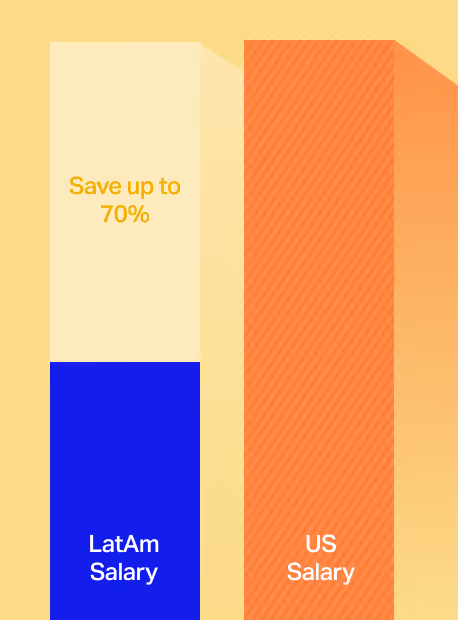
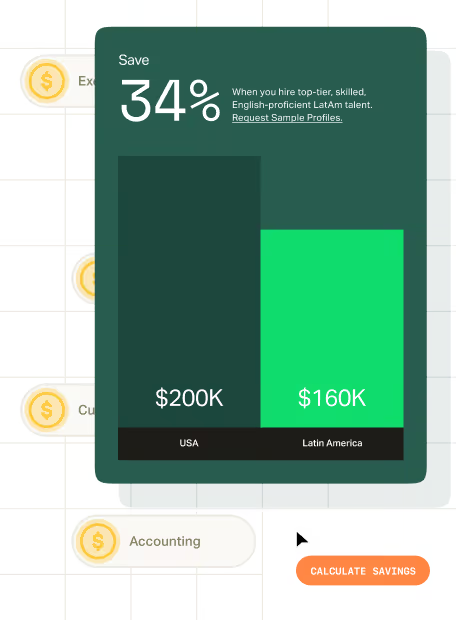
Developer salaries in Latin America reflect a lower cost of living, and they run 30 to 70% below comparable US salaries, according to Hire With Near’s salary data. That means you can pay competitive local rates and still spend far less than on a comparable US hire.
The full breakdown by role and seniority is in the cost section below.
Senior talent pool
The region's pool runs deep at senior levels, especially in Brazil, Mexico, Colombia, and Argentina. Julieta Gorodetzky, Tech Recruiter at Hire With Near, sees it on every search:
What surprises clients is the quality of the developers. Most of the engineers we target have already worked with US clients, so they're used to the pace. And the level of engineering in countries like Argentina, Colombia, Brazil, and Mexico is top tier. Some may even be technically stronger than engineers clients would find in the US, and the quality they get for what they invest is hard to match.
— Julieta Gorodetzky, Tech Recruiter, Hire With Near
Short flights when you need to meet in person
Some moments are worth doing in person: a project kickoff, a planning session, or the first week of a new team lead. Companies that hire in countries like Mexico or Colombia can make that happen easily, since both have direct flights from large US airports and the trip takes only a few hours.
Investment incentives
Some governments in the region cut taxes on software work to attract it. Uruguay, for example, exempts income from software development services performed in the country from corporate income tax, under Uruguay’s Decree 244/018. The exemption applies when the company employs qualified full-time staff and incurs more than half of its direct costs in Uruguay.
Internet and tech infrastructure
Connectivity varies across Latin America, but its most connected countries match or come close to US levels. In 2024, 95.6% of people in Chile and 92.0% in Uruguay were online, compared with 94.7% in the US, according to the World Bank.
Brazil, Mexico, and Colombia sit between 79% and 85%, with the strongest connectivity in the major cities where most tech work happens.
How Does Nearshore Compare With Offshore and Onshore Software Development?
Nearshore development in Latin America gives you nearly the same working hours as an onshore US team at a lower salary cost. Offshore teams in Asia or Eastern Europe usually offer the lowest hourly rates, but the least overlap.
The table below compares the three models on the factors that shape daily work:
The distance is what pushes most companies out of offshore arrangements. In Hire With Near’s analysis of 300 calls with US companies hiring engineers, the most common reason was moving engineering work off an offshore team in a distant time zone, at 30%, ahead of cost savings at 26%. Another 15% were leaving a development outsourcing firm.
The job descriptions tell the same story: 51% of the engineering job descriptions these companies sent us name a US time zone or US business hours. Both figures come from companies that came to Hire With Near, not a survey of the US market.
The founder of a small entertainment startup with a globally distributed engineering team described exactly that problem to us:
We have currently a senior QA that is focused on both manual testing and automation. She's based in Sri Lanka, and I don't get her enough during my day to actually allow to keep on that high quality and high throughput for my team. So we often release without her. So it's not good, right?
The problem in that story is the distance between her workday and the founder’s. For a deeper comparison of the two models, read our guide to nearshore vs offshore software development.
Cost isn’t what drives the move. Companies leaving an offshore team have already captured most of the savings over US hiring, and what they want next is capability. Pedro Vasconcelos, Account Executive at Hire With Near, hears this from companies that have hired in Asia before:
A lot of the companies I talk to have hired in Asia before, especially the Philippines, or they still have a team there. The main thing I hear from them isn't about budget. It's about what they need the person to do. At a startup, you're hired to do one thing, and then a lot of other things come up that someone has to solve day to day. These companies want an engineer who can be flexible, think strategically, and go beyond the basics of the role. They'd still save money, but what they're really after is someone who can take on more.
— Pedro Vasconcelos, Account Executive, Hire With Near
The difference is mostly the hours and the model: an engineer who’s online during your day can pick up problems as they come up. Our research on why US companies hire in Latin America explores those motivations in more depth.
What Are the Best Latin American Countries for Nearshore Software Development?
The best Latin American countries for nearshore software development are Brazil, Mexico, Colombia, Argentina, Costa Rica, Chile, and Uruguay. Each country fits a different need, so the table below compares them on time zone, developer pool, and strengths:
Developer accounts and growth: GitHub Innovation Graph, Q2 2025 to Q2 2026, for all countries except Brazil. Brazil: GitHub Octoverse 2026, published October 2026, with the developer count as of September 2026.
Brazil
Brazil has the largest developer community in Latin America. Its main hubs are São Paulo, Rio de Janeiro, Florianópolis, and Belo Horizonte, and its fintech sector produces engineers experienced in high-volume, regulated systems. São Paulo developers start ahead of East Coast teams and share most of the afternoon with the West Coast.
In the first half of 2026, Brazil passed Argentina and Colombia in placements made by Hire With Near: more than one in five professionals we placed across all roles were based in Brazil, according to Hire With Near's Midyear Hiring Report.
Further reading: Hire Developers in Brazil: Salaries, Skills & Hiring Models
Mexico
Mexico has the second-largest developer community in the region after Brazil, and its STEM graduate share is above the US. Mexico City, Guadalajara, and Monterrey are the main hubs. Most of Mexico aligns with US Central time, which makes it the easiest fit for teams in Texas and the Midwest, with still-solid overlap for the West Coast.
Further reading: How to Hire Developers in Mexico: Cost, Talent, and the 4 Ways to Hire
Colombia
Colombia’s software industry sold $14.6 billion in 2025, up 18.1%, and exported $2.04 billion in software, up 12.3%, according to figures from the industry association Fedesoft, reported by Colombia One. Bogotá and Medellín are the main hubs.
Further reading: Hire Developers in Colombia: Costs, Skills & Hiring Options
Argentina
Argentina’s software industry exported a record US$2.85 billion in the 12 months to March 2026, and the US is its biggest customer, at 49.1% of export revenue, according to the industry chamber CESSI, as reported by Mercado.
Argentina’s developer base grew 36% in a year, to about 1.8 million developer accounts on GitHub.
The sector employs about 162,000 people and has created more jobs than any other part of the economy over the last decade. Buenos Aires, Córdoba, and Rosario are the main hubs.
Further reading: Hire Developers in Argentina: Costs, Skills & Timelines
Costa Rica
Costa Rica is a smaller market, with most tech work in and around San José. It ranks first in Latin America for ICT services exports, according to WIPO data cited by PROCOMER, and more than 350 multinational services companies operate there, so it’s a market built around serving global companies. It suits teams that need a few experienced developers.
Further reading: How to Hire Developers in Costa Rica: Costs, Skills, Routes
Chile
Santiago is the center of Chile’s tech scene. Chile leads the Latin American AI Index (ILIA), and the big cloud providers are investing there: Microsoft opened a cloud region in Santiago in 2025, and AWS announced a US$4 billion region planned for the end of 2026, according to the US Commercial Service.
Further reading: Hire Software Developers in Chile: Salaries, Skills & How-To
Uruguay
Montevideo is Uruguay’s tech hub. The country’s IT sector had revenue of US$3.68 billion in 2024, and 63% of it came from international customers, according to the Uruguayan chamber of information technology, CUTI, as reported by La Mañana.
Further reading: Hire Developers in Uruguay: Salaries, Skills, and Vetting
How Do You Choose the Right Latin American Country for Nearshore Development?
Choose the right Latin American country by matching it to five factors: your team's time zone, your tech stack, the team size you plan to build, the English level the role needs, and how you'll handle local employment rules.
I talked to our recruiters before writing this article, and they described the same pattern: engineering leaders often show up asking for one specific country, but the role’s requirements should decide where to hire.
Time zone
If your team is on Central or Pacific time, Mexico and Costa Rica give you the most overlap. East Coast teams share nearly the whole day with Colombia. Argentina, Brazil, Chile, and Uruguay start ahead of you and still cover most of your afternoon.
You can check how time zones align in the table below:
Note: During Daylight Saving Time, Santiago, Chile operates 1 hour ahead of US Eastern Time (EDT) while observing its own Daylight Saving Time, and aligns with US Eastern Time during its winter standard time (mid-April to early September).
Tech stack
Write your stack into the role definition and search against it. Common stacks such as JavaScript, Python, and Java are well represented in every major market.
For niche frameworks or AI work, the larger pools in Brazil and Mexico give you more candidates.
Team size
For one or two hires, any of the seven countries works. A team of 10 or more is a different search.
Brazil, Mexico, Colombia, and Argentina are the biggest markets, with developer communities of roughly 1.8 million to 10 million accounts on GitHub, so there are more people with the stack and seniority you need, and it stays easier to keep hiring as the team grows.
Chile, Costa Rica, and Uruguay are smaller, with roughly 177,000 to 906,000 accounts, so filling ten seats with the right people can take longer than filling one.
English level
Argentina, Honduras, and Uruguay lead the region on the EF English Proficiency Index, but national rankings understate developers elsewhere. Brazil, Colombia, and Mexico sit in the Low or Very Low bands overall, yet EF’s IT test takers in Brazil and Mexico reach the High band, and in Colombia the Moderate band.
You’ll find fluent senior developers in every country here, but screen for it directly: a live conversation about a past project, a written sample such as a pull request description, and, for client-facing roles, a call with someone non-technical.
Local employment rules
Each country has its own labor laws, payroll rules, and mandatory benefits. If you don't have a local entity, you'll most likely work with an employer of record or nearshore staffing companies. They handle payroll, compliance, and local benefits while the developer works on your team under your day-to-day management.
For a wider view of options, see our ranking of the best countries for software development.
How Much Does Nearshore Software Development in Latin America Cost?
According to our salary data, developers in Latin America have salary expectations of $30K to $46K a year at junior level, $48K to $72K at mid-level, and $72K to $108K at senior level. That puts salaries 30 to 70% below comparable US salaries, with the biggest gap at the junior level.
To show how that plays out across common roles, here's how salaries for five software development roles compare with equivalent US salaries:
*For the most up-to-date figures, see Hire With Near's US vs Latin America Salary Guide.*
In practice, a senior engineer in Latin America often has salary expectations at or below what a mid-level engineer earns in the US. Seniority moves the number most, followed by the stack and any specialist skills.
Our full breakdown of IT and software development salaries in Latin America covers more roles.
Salary vs. dev-shop hourly rates
A salary is what the developer earns, while a dev shop's hourly rate also covers its margin, project management, and overhead. To compare them, multiply a dev shop's hourly quote by roughly 2,000 working hours a year and set it against the salary range above.
Our article on what offshore developers cost walks through how agencies price their rates.
The AI and specialist premium
Specialist roles command higher salaries at every level. In our salary data, AI developers and data engineers start at $42K a year at the junior level, compared with $30K for a generic developer, and senior mobile developers reach $120K. If your roadmap depends on AI or data work, budget for the top of the range.
{{latam-hiring-calculator}}
What Are the Nearshore Engagement Models?
The five main nearshore engagement models are staff augmentation, a dedicated team, a project-based dev shop, a hybrid setup with a US lead and a Latin American team, and direct hire. The real difference between them is who manages the developer day to day and whether that developer works only for you.
You can see an at-a-glance comparison in the table below:
With nearshore staff augmentation and direct hire, you work directly with the engineer, and they join your stand-ups, your Slack, and your repos.
In a dev shop, the vendor's project manager sits between you and the people writing the code, and developers may rotate across several clients.
If you're comparing providers on that row, our roundups of the best LatAm outsourcing companies and top nearshore software development companies show how firms differ.
Some engineering teams are moving from vendor-run models to staff augmentation and direct hires. In Hire With Near’s analysis of 300 calls with US companies hiring engineers, 15% were leaving a development outsourcing firm, a higher share than the 11% in other departments. What they asked for was engineers in Latin America on their own team, working under their own direction.
ParkMobile, part of the mobility platform Arrive, made that move. Its back-end and platform work had run through agency developers for years, and leadership came to see that as a risk to the business.
Working with Hire With Near, ParkMobile replaced agency developers with nine in-house engineers across platform, back-end, and iOS, at a 24-day average time-to-hire and $1,066,085 a year below US rates, a 73% reduction. The team performed well enough that ParkMobile expanded the program to team leads, and Colombia became a hiring hub other divisions now push for.
You can see the company's Talent Acquisition Team Lead talking about our partnership in the video below:
If you want engineers of your own working your hours, a specialist partner is the simplest route. Through staff augmentation, the partner finds and vets the developer and handles contracts, payroll, and compliance, while you manage the work. With a direct hire, the partner finds and vets the developer and you employ them.
What Are the Challenges of Nearshore Software Development in Latin America?
The main challenges of nearshore software development in Latin America are currency swings, competition for senior developers, offshore's lower hourly rates, different national holidays, local labor laws, and protecting IP across borders. Each has a practical fix.
Inflation and pay currency
Several countries in the region have volatile currencies and high inflation, which can erode a developer's local-currency pay within months.
Fix: Set pay in US dollars at a fair market rate and review it once a year, so the salary holds its value.
Competition for senior talent and retention
The same overlap that draws you to Latin America draws every other US company, so senior developers get frequent offers.
Fix: Pay at market, give the developer real ownership of a product area, and show a career path. Long tenure is realistic: 80% of our hires stay 2+ years.
Offshore still has lower hourly rates
Offshore teams in Asia usually quote lower hourly rates than nearshore teams.
Fix: Compare total cost, including rework, management time, and delayed releases, as in the comparison earlier in this guide.
Different national holidays and calendars
Each country has its own holidays, and they don’t line up with the US calendar. Brazil slows down for Carnival, Holy Week is a long break across much of the region, and national days fall on different dates. A sprint planned around US holidays can lose days of overlap without warning.
Fix: Share a holiday calendar for each developer’s country at kickoff, and plan sprints and releases around it.
Local labor law and compliance
Every country has its own employment law, payroll rules, and required benefits, and getting them wrong creates exposure in the developer’s country. Not every required benefit applies to every hire: which ones do depends on the country and on how the developer is engaged, so a checklist copied from another country or another hire can be wrong in both directions, missing a cost you owe or adding one you don’t.
Fix: Work through an employer of record or a staffing partner that handles contracts, payroll, compliance, and local benefits, and that explains which benefits apply to each hire, while the developer works on your team under your day-to-day management.
IP and data security
Giving someone in another country access to your repos and customer data raises fair questions about ownership and security.
Fix: Put IP assignment and confidentiality terms in the contract, issue company-managed devices, grant least-privilege access to repos and environments, and run a clear offboarding checklist.
If data security worries you, in the video below, our CEO Hayden Cohen explains how companies protect it with teams outside the US:
Our article on managing offshore development risks covers more controls.
How Do You Vet and Hire Software Developers in Latin America?
To vet and hire software developers in Latin America, define the role and stack, pick a country and model, source candidates, have your own engineer run a live technical interview, check English and communication, take references, and confirm local compliance.
The steps below show who does what at each stage:
- Define the role and stack: Write down the languages, frameworks, seniority, and what the person will own in their first six months.
- Pick a country and model: Use the decision factors above to choose where to search and whether you want staff augmentation, direct hire, or a vendor team.
- Source candidates: Search job boards and LinkedIn yourself, or have a partner source and pre-screen. A good partner sends a shortlist of candidates matched to your requirements.
- Run the technical interview: Meet the candidate first, then have your engineer run a live technical exercise or code review. If you're not technical, ask a trusted engineer to lead a live discussion of past architecture decisions.
- Check English and communication: Ask the candidate to explain a technical decision live, the way they would in a code review.
- Take references: Ask former managers what the candidate owned and how they handled a production incident.
- Confirm compliance: Make sure an employer of record, staffing partner, or your own entity covers contracts, payroll, and local benefits before the start date.
From the editorial work I do interviewing our tech recruiters, the strongest signals in a developer interview come down to four checks:
- Explains technical choices: Strong candidates can say why they chose one approach over another, and what they'd change now.
- Raises risks early: They flag a dependency, a missing requirement, or a performance concern before it becomes a missed deadline.
- Talks about outcomes: They describe what shipped and what it changed for users.
- AI readiness: They use AI coding tools well and can review AI-generated code critically. Our guide on how to interview developers for AI skills gives specific questions.
Julieta adds that ownership shows up quickly in how candidates describe past work:
We can tell very quickly from how they respond. They always say 'we': we did this, my team created that. So we push: What was your responsibility? What did you accomplish? What was the main feature you developed end to end?
— Julieta Gorodetzky, Tech Recruiter, Hire With Near
Skipping that pre-vetting is expensive. A digital product studio that hired a senior full-stack engineer in Argentina had two generalist staffing vendors sending candidates without enough screening. Its own engineering leadership was doing the vetting across several open senior searches.
It came to Hire With Near and filled the role in 34 days with an engineer who now owns back-end architecture for an enterprise account, at a salary 47% below the US equivalent.
For more details on each step, see our guide on how to hire Latin American developers.
How Do You Integrate and Manage a Nearshore Development Team?
You integrate a nearshore development team by treating it as part of your engineering team from day one: same tools, same rituals, same definition of done, with clear overlap hours and one lead who connects everyone.
Git and Jira access from day one
Give new developers access to your repos, ticketing, documentation, and chat on their first day, so their first week goes into your codebase instead of waiting on permissions.
Core overlap hours
Agree on a block of four to six hours when everyone is online for stand-ups, pairing, and reviews. Outside that block, let people work the schedule that suits them.
A shared definition of done
Write down what done means: tests passing, code reviewed, documentation updated, and deployed to staging. A written standard settles most disagreements before they start.
Sprint cadence
Run nearshore developers on the same sprint schedule as your US engineers, with the same planning, review, and retro meetings. That's the setup many engineering leaders ask for. As one engineering leader at a mid-market entertainment and experience company put it on a call with us:
Some options are very pricey, and others require you to use their whole department and team. We want to augment our team, not hire a full group. We already have our own flow, and we’d love to add one or two people to our group, in our stand-ups, as an extension of our team rather than outsourcing. That’s a very high priority for us from a creative perspective.
One lead as the bridge
As the team grows, name one lead, in the US or in Latin America, who owns communication between product and engineering. That person keeps priorities clear and catches blockers early.
Scaling from one developer to a team
Start with one or two senior developers who learn your codebase and set the standard. Add mid-level engineers once a senior lead can review their work, and grow toward a hub in one country when you pass five or six people.
AI and legacy modernization work
Nearshore teams often take on AI integration and legacy modernization, such as migrating old services or adding AI features to existing products. By September 2026, more than 40% of pull requests on GitHub started with an AI agent's first draft, up from 17% in March, according to GitHub's Octoverse 2026 report. That shifts more of the job toward specification and review, which is work senior developers do well.
For more on these topics, see the questions tech leaders ask when hiring in Latin America.
How Does Hire With Near Help You Hire Developers in Latin America?
Hire With Near helps you hire developers in Latin America who join your team full time. You describe the role and stack, we source and screen candidates for background, communication, and culture fit, and you run the technical interview and make the decision.
You can work with us in one of two ways. With a direct hire, we find and vet the developer and you employ them yourself. Through our staffing model, we handle contracts, payroll, and compliance while you manage the engineer day to day.
- Shortlist speed: On 84% of our engineering searches, the first shortlist arrives within five days of kickoff, and most of our clients make a hire in under three weeks. Through our nearshore staffing services, we also handle payroll, compliance, and local benefits once you hire.
- Replacement guarantee: Direct hires through Hire With Near are backed by a 180-day replacement guarantee. If a hire doesn't work out in that window, we find a replacement at no additional cost. Under our staffing model, replacements have no time limit.
- Retention and check-ins: Our placements stay an average of three years, and we check in at 30, 60, and 90 days, and once a quarter after that.
Our IT and tech recruiting in Latin America covers the full engineering team, from developers to DevOps and QA, and we also run engineering leadership searches for roles such as CTO and VP of Engineering.
If you're ready to hire software engineers based in Latin America, the best next step is to book a free consultation and talk through your requirements with our team. We'll share salary benchmarks for your stack and walk you through the process so you can decide whether hiring in the region is what your company needs.
If you’d rather see the caliber of engineers first, you can also request pre-vetted candidate profiles.
{{latam-hiring-cta-v2}}
The difference between nearshore, offshore, and onshore software development is where the developers are based: onshore developers work in your own country, nearshore developers in a nearby country with a similar workday, and offshore developers far away, with little overlap.
Nearshore offers near-onshore collaboration at lower salary costs.
Nearshore developers in Latin America earn roughly 30 to 70% less than comparable developers in the US, according to our salary data.
In our data, senior developer salaries top out around $108K a year, well below US senior pay. Dev shops bill more per hour because their rates include margin and management.
No, nearshore software development in Latin America usually isn’t cheaper per hour than Asia or Eastern Europe, where offshore teams often quote less.
Total cost tells a different story: real-time overlap cuts the rework, delays, and management overhead that build up when your team and your developers work different hours.
Brazil, Mexico, Colombia, and Argentina have the deepest pools of experienced software developers in Latin America, with Costa Rica, Chile, and Uruguay offering smaller, highly skilled markets.
The best choice depends on your time zone, stack, team size, and English needs rather than a single ranking.
Most of Latin America is zero to three hours from most US time zones, so developers there work during your business hours. Mexico and Costa Rica align roughly with US Central, Colombia with US Eastern, and Argentina, Brazil, Chile, and Uruguay sit an hour or two ahead of the East Coast, shifting with daylight saving.
English among senior Latin American developers is generally strong, because many work with US clients in English every day. Argentina ranks highest in the region on EF's English Proficiency Index, followed by Honduras and Uruguay.
Always check it in a live conversation where the candidate explains a technical decision, since that's how they'll communicate on your team.
Latin America has a large pool of mid-level and senior software developers, many with years on US product teams. Judge seniority by what a developer has owned, such as architecture decisions, mentoring, and raising risks early, rather than years alone, and test it in a technical interview run by your own engineer.
You protect IP and data with a nearshore team in Latin America through contract terms and access controls. Include IP assignment and confidentiality clauses, use company-managed devices, give developers least-privilege access to repos and production data, log access, and follow a strict offboarding checklist when someone leaves.
Yes, nearshore teams work in regulated industries like healthcare and fintech, provided you apply the same access controls, training, and compliance processes you use for US staff. Companies use healthcare recruiting in Latin America for healthtech engineering and fintech recruiting in Latin America for payments and banking products, where Brazil's fintech experience stands out.
Hiring and onboarding a nearshore developer typically takes under three weeks of search with a specialist partner, plus the candidate’s notice period. On 84% of our engineering searches, the first shortlist arrives within five days of kickoff.
The start date then depends on the candidate's notice period, and onboarding goes fastest when tool access is ready on day one.
Yes, you can scale a nearshore team up or down, and staff augmentation makes that easiest because you add or release developers without building local infrastructure. To grow into a full hub, start with senior developers, name a lead as the bridge, and add engineers in one country, as ParkMobile did in Colombia.
Nearshore staff augmentation is better than hiring in-house developers when you need senior capacity quickly or flexibly, since the partner handles sourcing and employment while the developers work on your team. For permanent core roles, a direct hire may suit you better.
Our guide to nearshore staff augmentation compares both.
Related Posts


Discover why hiring in LatAm is a cheat code. Download our free guide now.