%203.svg)
Key Takeaways
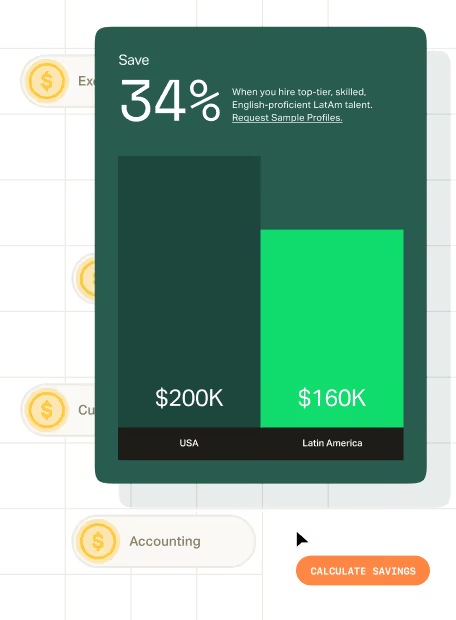
- Nearshoring to Latin America gives US companies time zone alignment, strong English proficiency, and 30-70% more budget capacity; the same spend that covers one US hire typically covers two comparably skilled LatAm professionals.
- You don’t need a foreign legal entity to hire Latin American professionals. Most US companies use a nearshore staffing partner that handles compliance and payroll, removing the need to set up any foreign entity.
- The top roles US companies are nearshoring right now are BDR/SDR, accountant, customer support rep, executive assistant, and software engineer.
The practice of nearshoring to Latin America has accelerated significantly over the past few years.
Thanks to time zone alignment, deep talent pools, and salary savings of 30–70% compared to US rates, US companies are building remote teams in countries like Mexico, Brazil, Argentina, and Colombia at a pace that shows no signs of slowing.
If you’re here, it’s because this topic also interests you and your company. And it’s natural that many questions about nearshoring to Latin America come up while researching. What does this cost? Can I get the same quality of talent? How do I hire someone in another country without setting up a foreign entity? These are just a few examples.
This article answers all ten of the most common questions we hear about nearshore hiring in Latin America, drawn from Hire With Near’s CEO, Hayden Cohen’s, firsthand experience helping 950+ US companies build remote teams in the region.
Here they are:
1. Why Is Everyone Talking About Nearshoring to Latin America?
Nearshoring to Latin America has grown sharply since 2020, and the reasons aren’t hard to find. The surge in remote hiring started during the pandemic. Companies learned that employees at virtually any level could work remotely and remain productive.
That shift also triggered “The Great Reshuffle,” with millions of workers changing jobs and creating labor shortages across many industries. In response, many US companies expanded their talent search outside the US.
According to ManpowerGroup’s 2026 Global Talent Shortage Survey, 72% of employers report difficulty filling roles, near a record high. For many, looking to Latin America became a practical response to this real problem.
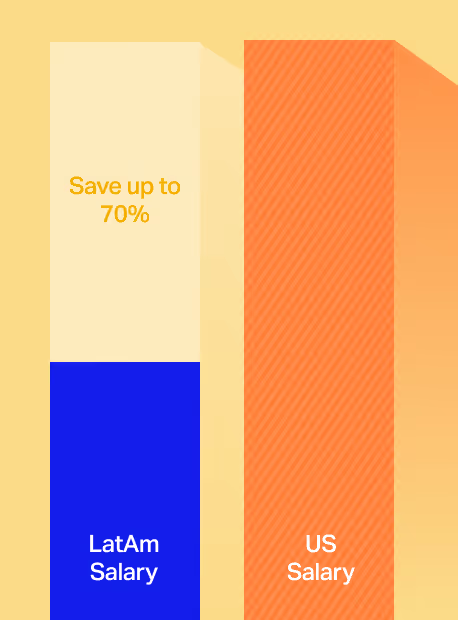
Hiring globally also offers a significant cost advantage: the same budget that covers one US hire often covers two equally qualified LatAm professionals, letting companies build a larger, high-performing team without increasing headcount spend.
Related reading: Why Thousands of Leading US Companies Are Hiring Talent in Latin America
2. Should I Hire from Latin America, Canada, the Philippines, India, or Eastern Europe?
Latin America, India, and the Philippines are the three most common regions that US companies evaluate. They serve different needs.
- Hiring remote talent from India gives you access to a large pool of professionals, especially in technical fields like IT and engineering, at competitive rates. Indian professionals are known for strong technical expertise, making them a natural fit for tech-driven roles.
- The Philippines has excellent English proficiency and a strong customer service tradition, making it a common choice for call center and support roles. Filipino professionals also adapt well across cultural contexts.
- Nearshoring to LatAm provides the best time zone alignment with the US, enabling real-time collaboration during normal business hours. The region offers a highly educated workforce with strong English skills and is a viable option for virtually any role type, not just tech or support.
The time zone point isn’t just a talking point. Research from Harvard Business School and INFORMS found that synchronous communication declines by 11% for each additional hour of time zone difference between team members. When your LatAm hire is working in the same hours as you, collaboration doesn’t require scheduling gymnastics.
A finance operations lead at a US consumer goods company put it directly:
Anybody in South America is in a good time zone. They’re all close enough. Because my second option was to go to India and the Philippines, and I don’t want to go there because the time difference makes it really hard to be effective.
That experience isn’t unusual. According to Hire With Near’s analysis of why US companies hire in LatAm, 30% of companies that turn to LatAm hiring are doing so specifically to escape the time zone gaps that come with India and Philippines offshore arrangements.
Northstar Financial Consulting Group, a Beverly Hills accounting and CFO firm, learned this firsthand. They’d tried Indian contractors before partnering with Hire With Near, but when Northstar’s California team arrived at work, it was already evening for their contractors. Real-time collaboration was impossible.
After switching to Latin America, they hired 12 people across finance, accounting, operations, and admin, doubled the company in 12 months, and saved more than $250,000 per year.
Before you start your search, it helps to be clear on a few questions:
- Do you need your new hire to work synchronously or asynchronously?
- What English level does the role require?
- Is the working culture in the region a strong fit for your company?
- Is the talent pool in that region experienced enough for the role?
Your answers will narrow the field quickly.
3. What Are My Options for Hiring Someone in a Foreign Country to Work for Me?
When it comes to hiring foreign remote employees, the process is similar to hiring locally: source, screen, interview, and hire. You can either do this on your own or partner with a staffing or recruiting agency that has the knowledge, network, and infrastructure to hire from your target region.
Beyond sourcing, you’ll also need to think about how you pay them, how you classify them, and how you comply with local labor laws.
The most common structures are direct employment through a foreign entity, using an Employer of Record, or working with a staffing partner that handles both talent acquisition and payroll compliance.
If your company has the resources and bandwidth, you can handle the hiring process yourself. That said, navigating the nuances of international hiring for the first time is often more time-consuming and expensive than companies expect.
Partnering with a recruiting agency that specializes in LatAm hiring, like Hire With Near, tends to be the faster path. They already know the talent market, the compliance requirements, and how to screen candidates effectively for US company expectations.
4. Can I Get the Same Quality of Talent Nearshore as I Would Hiring Locally?
Yes, and in some aspects, you may do better. LatAm professionals range from junior to senior, and many bring deep expertise in roles like finance, engineering, operations, and marketing.
Countries like Costa Rica and Argentina rank among the top nations in the EF English Proficiency Index. For decades, US companies like PwC, Microsoft, and Google have established operations in the region precisely because the talent is there.
What our recruiting team notices consistently, beyond the technical qualifications, is something harder to measure. Franco Pereyra, COO of Hire With Near, describes it this way:
What sets Latin American talent apart from other regions is that you’ll find people who are proactive and creative. People who come up with ideas and new solutions. If you’re looking for folks who can bring something to the table, who will push back if they think your idea doesn’t make sense, that’s what you find in Latin America.
LatAm professionals work during overlapping US hours and share many professional norms with US companies. Many have direct experience working with US clients, which makes integration smoother than with more geographically distant regions.
5. How Can I Make Sure Remote Workers Are Set Up to Succeed?
Remote success starts with the basics. Before your new hire starts, make sure they have:
- A fast and stable internet connection
- A professional workspace
- The necessary hardware and software (computer, webcam, company email access, and any tools your team uses)
Once the basics are covered, the biggest factor is a strong onboarding process. A well-structured remote onboarding sets clear expectations and KPIs from day one. That typically means short-term goals for the first week and month, and longer-term milestones for 90 days and six months.
This gives your new hire a clear direction and gives you a concrete benchmark to evaluate their progress.
6. How Can I Hire Nearshore If I Don’t Have an Entity Overseas?
You don’t need one. This is one of the most common misconceptions about nearshoring, and one of the biggest barriers that turns out not to be a barrier at all.
When you work with a staffing agency specializing in Latin America, they handle the compliance and payment infrastructure on your behalf. You don’t need to set up a foreign entity, navigate international employment law, or figure out cross-border payment logistics yourself.
Hire With Near’s nearshore staffing services take care of the process end to end, from sourcing and vetting to compliance and payroll and benefits administration.
For companies that want to handle international employment compliance on their own, EOR platforms like Deel exist for that purpose.
But for most US companies, working with a company like Hire With Near is the simpler, faster path.
7. What Mistakes Do Companies Make When Hiring Globally?
The five most common mistakes US companies make when hiring globally are: not setting objectives for the new hire, skipping remote training, treating remote workers as resources rather than teammates, assuming nearshoring is only for junior roles, and focusing only on cost.
Here’s what each looks like in practice.
Not having objectives for the new hire
Without clear goals, it’s hard to define what success looks like. If you don’t define the outcome you want your new hire to drive, it’s also harder for recruiters to know what to look for in a candidate. Before you start your search, assess your requirements and set precise goals.
Not training remote talent
Remote professionals in LatAm are often highly motivated and growth-oriented. They’re entrusting their career to your company as much as you’re entrusting your company’s success to them.
Invest in training them thoroughly and providing opportunities for professional development, and you’ll see the results in their output.
Thinking of remote workers as resources rather than teammates
Remote workers are just as important to your team as your on-site employees. Include them in meetings, Slack conversations, and other important communications. They need context and to feel like part of the team to do their best work.
Believing you can only hire junior or assistant roles
A common misconception is that nearshoring is only for junior or assistant positions. The truth is you can hire highly qualified VPs and managers, or build an entire department with remote talent based in LatAm.
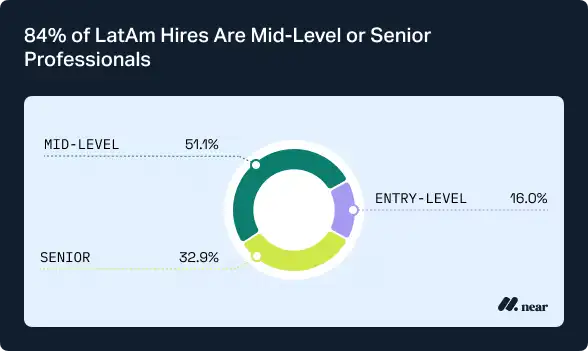
In fact, 84% of Hire With Near’s placements are mid-level or senior professionals, according to our 2026 State of LatAm Hiring Report.
Only considering cost
While cost savings are a primary driver for nearshoring, focusing only on the cheapest option often leads to a costly hiring-and-firing cycle. Balance cost with experience and specialized expertise. Investing in the right talent from the start saves more in the long run.
8. How Do I Know My Remote Worker Isn’t Working for Someone Else at the Same Time?
Time-tracking software is one practical tool. It lets you monitor how much time workers spend on tasks and how they’re using their time during working hours.
Clear working hours and deadlines also help. Setting explicit expectations about when your hire should be available and what they need to deliver daily or weekly gives you a concrete standard to evaluate against.
The most useful question is simpler than it sounds: Are they consistently delivering quality results? If they are, you don’t have much to worry about.
You do need to decide how much you want to trust workers to manage their time independently versus how much monitoring you want in place.
That decision affects the type of talent willing to work with you. Not everyone is comfortable with detailed time tracking, and the candidates who are comfortable with it tend to be different from those who prefer outcome-based accountability.
9. How Do I Figure Out How Much to Pay LatAm Professionals?
The right compensation for LatAm professionals depends on the role, seniority level, and country. It’s also typically lower than most US hiring managers expect.
According to Hire With Near’s 2026 State of LatAm Hiring Report, based on 2,000+ placements, companies saved an average of $35,000 to $64,000 per hire compared to US equivalents, a 30–70% reduction depending on the role and seniority level.
To make that concrete: a US fitness equipment brand hired a bilingual customer support professional from Argentina for $20,400 per year. The US equivalent would’ve cost $52,000–$54,000 a year. That’s $31,600 back in the business annually, on a single hire.
Here’s what current 2026 compensation benchmarks show for the top five roles US companies hire in LatAm:
Ranges cover junior through senior levels.
For a more complete picture, you can explore our US vs. Latin America salary guide with salary comparisons by role.
It’s also worth understanding that there are two distinct talent markets in LatAm:
- The local market: Local companies hire professionals as employees with benefits required under local labor law.
- The international remote market: LatAm professionals are often hired as contractors to work remotely for companies abroad.
Salary expectations differ between these markets. If your offer matches what a local company pays but doesn’t include local benefits, you’re not going to attract the strongest candidates.
Offering competitive rates relative to the international remote market is what secures high-quality talent. You’ll still realize substantial savings compared to a US equivalent hire.
10. What Are the Most Common Roles Being Nearshored to Latin America From the US?
According to Hire With Near’s 2026 State of LatAm Hiring Report, these are the top ten roles US companies are hiring from LatAm right now:
- BDR/SDR, most commonly hired from Colombia
- Accountant, most commonly hired from Colombia
- Customer support rep, most commonly hired from Jamaica
- Executive assistant, most commonly hired from Colombia
- Financial analyst, most commonly hired from Colombia
- Software engineer, most commonly hired from Brazil
- Bookkeeper, most commonly hired from Argentina
- Marketing specialist, most commonly hired from Mexico
- Legal assistant, most commonly hired from Argentina
- Administrative assistant, most commonly hired from Colombia
Keep in mind that virtually any role that can be done remotely can be filled from Latin America. But this list reflects where placement volume is highest and where US companies have found the most consistent results.
We also consistently see that there is no limit to the industries that hire in LatAm. We’ve helped companies working in SaaS, financial services, real estate, healthcare, marketing, accounting, and beyond. The cost savings and time zone alignment make nearshoring viable regardless of sector.
The talent quality holds up. Northstar Financial Consulting Group, an accounting and CFO firm, built a 12-person team across finance, accounting, operations, and admin through Hire With Near. Their CEO, Lorenzo Nourafchan, said:
What stood out to us was Hire With Near’s personal touch and candidate quality. They understood our problem and solved our hiring needs.
The company doubled in size in 12 months and saved more than $250,000 per year.
How Hire With Near Helps US Companies Hire in Latin America
If your questions about nearshoring to Latin America have led you to this point, the next step is understanding what makes a hiring partner worth working with and whether Hire With Near is the right fit for your situation.
Here’s what sets us apart from other options:
We only source talent in Latin America. We’re not a global staffing platform spreading resources across 50 countries. Every recruiter, every process, and every placement is focused on one region. That specialization shows up in candidate quality and search speed.
We vet for US-client readiness, not just skills. Our screening process also evaluates English proficiency, communication style, cultural fit, and prior experience with US companies. The candidates you meet have already been filtered for the things that determine whether a hire integrates well.
Most placements are completed in under three weeks. With a pre-vetted pool of 160,000+ candidates, we move fast. You’re not waiting months for a shortlist.
No fee until you hire. 180-day replacement guarantee. You take on no financial risk until you’ve made a hire you’re confident in. If something goes wrong in the first six months, we replace the candidate at no cost.
950+ US companies have built teams with us. From single hires to 20-person departments, across finance, sales, engineering, marketing, operations, and more.
Book a free consultation to talk through your requirements with our team.
We’ll walk you through salary benchmarks for the roles you’re hiring, explain the process from first candidate to day one, and give you a clear picture of whether it’s the right fit for your business.
{{latam-hiring-cta-v2}}







.webp)


%203.svg)
.avif)





%20(1).avif)

%20(1).png)