%203.svg)
Key Takeaways
- You can outsource e-commerce development five ways: a freelancer for a discrete task, an agency for a defined build, a software development company for deep platform work, staff augmentation for extra capacity without permanent headcount, or your own developer through a staffing partner for continuous store work.
- Hiring a dedicated e-commerce developer in Latin America costs $30K to $90K a year, compared to $57K to $138K for a comparable US hire, often less per year than an agency retainer covering the same maintenance.
- Outsourcing is the wrong call when the store work never ends, when your storefront logic is the product, or when nobody on your side can write a spec and review what gets delivered.
The right way to outsource ecommerce development comes down to one question: does the work have an end date? A build, a replatform, or a redesign suits a vendor. Store work that never stops suits a dedicated e-commerce developer of your own.
For many businesses considering outsourcing as their first option, the work doesn’t end: checkout is leaking conversions on mobile, a replatform keeps slipping, and two integrations broke during last month’s promotion.
When everyone is at nearly full capacity, fixes queue behind whoever has a free afternoon, and the queue shows up in the numbers: orders that never complete, a campaign that underperforms because the landing page shipped late, a roadmap that sits still while competitors ship.
This guide covers your five realistic options, what each model costs, how to vet and manage a partner, and when outsourcing is the wrong answer.
Why Do Companies Outsource E-Commerce Development?
Companies outsource e-commerce development because a store needs platform-specific engineering skill in bursts that rarely justify a full-time hire. Buying that skill by the project is faster than building it internally.
The e-commerce sector accounted for 16.4% of total US retail sales in 2025 and grew 5.4% against 3.5% for retail overall, according to the US Census Bureau, so the work keeps arriving.
Access to specialized technical talent
Finding developers with real depth in one e-commerce platform is hard when you limit the search to your own city. The pool for specialized skills like Shopify Plus customization or advanced WooCommerce integration is small, and the experienced tier is the one everyone is competing for.
Hiring rebounded in 2024 for mid- and senior-level roles while new graduates fell to about 7% of hires at large tech companies, according to SignalFire’s State of Tech Talent Report. The same report found companies posting junior roles and filling them with senior individual contributors.
A team that works on online stores full-time has already shipped dozens of them, so payment gateway security, cross-border tax compliance, and flash-sale traffic are known problems to them.
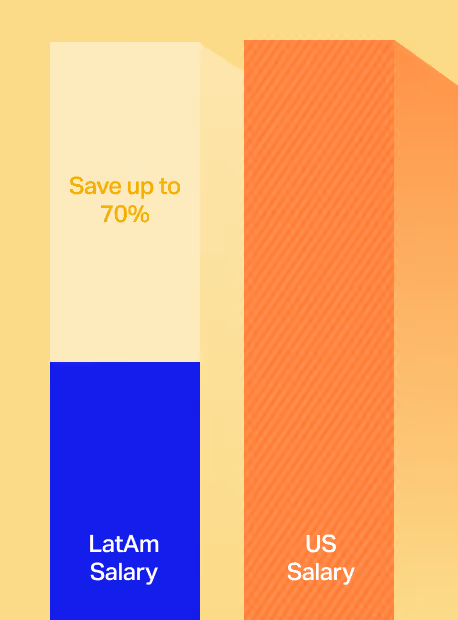
Hiring costs 30–70% less than in the US
Salary is only part of what an employee costs. In its Employer Costs for Employee Compensation release for March 2026, the Bureau of Labor Statistics puts employer benefit costs for private-industry workers at $14.01 per hour worked against $32.60 per hour in wages. That’s about 30% of total compensation, before recruiting, equipment, workspace, and ramp-up time.
Rates fall further when you work with developers in regions with a lower cost of living. When you hire Latin American developers, for example, costs typically run 30–70% below what you’d pay in the US. That gap comes from market differences, not from underpaying anyone: developers there earn competitive local salaries, which is why these arrangements hold up over years rather than months.
Faster time to market
A store build means catalog management, checkout flows, payment processing, order management, and a dozen integrations. A team that has built one before skips the discovery, so you can be live in weeks instead of months.
For a seasonal business, weeks versus months is the difference between catching the season and missing it.
Scalability for seasonal demands
E-commerce traffic is predictable in shape if not in size: holiday peaks, product launches, campaign spikes. An outsourced team scales for those windows without you carrying headcount you only need in Q4, and when traffic drops back, so does the spend.
Which E-Commerce Functions Can You Outsource?
Almost any technical function behind your storefront can be outsourced: the platform build, payment integrations, APIs, database work, mobile apps, and infrastructure.
Many companies choose to hire e-commerce developers only for the build, but end up keeping them on for the maintenance that follows.
Platform development and customization
Outsourced e-commerce developers can stand up your platform and build the custom functionality your business model needs, but be specific about which platform.
Shopify, Shopify Plus, Magento and Adobe Commerce, WooCommerce, BigCommerce, and headless builds each have their own templating language, extension model, and checkout rules. A strong React developer with no Liquid experience isn’t a Shopify developer.
Ask for named work on your exact platform and version, and treat “we do all platforms” as a claim to test rather than a credential. A team that clears that bar can then build what differentiates you: product configurators, recommendation engines, or a checkout flow that enhances the customer experience instead of getting in its way.
Payment gateway integration and security
Payment processing is the function least worth learning on the job. Developers who specialize in e-commerce know PCI compliance requirements and can integrate credit cards, digital wallets, and buy-now-pay-later options without leaving gaps in the controls that protect customer data.
API development and third-party integrations
Modern stores connect to five or six external systems: your ERP, CRM, shipping providers, tax engine, and marketing tools. Each has its own authentication model, rate limits, and data quirks, which is why API development is usually the first thing store owners outsource after the build.
Database architecture and optimization
As your catalog and order volume grow, database performance becomes something customers feel: slow page loads, broken search, abandoned carts.
Experienced back-end developers design schemas that hold up at tens of thousands of products, then add caching and indexing so the store stays fast on your busiest day.
Mobile app development
A dedicated app can lift repeat purchase rates, but building native apps for iOS and Android calls for skills different from web development.
Mobile developers know both the technical requirements and what shoppers expect on a phone.
DevOps and infrastructure management
Behind every store that stays up is infrastructure someone maintains: servers, databases, load balancers, monitoring.
DevOps engineers set up the deployment pipelines, automated tests, and alerting that catch problems before your customers do.
Other functions you can outsource
Beyond development itself, five adjacent functions come up constantly:
- UX/UI design: Shopping flows and interfaces that convert
- Digital marketing: SEO, paid acquisition, and lifecycle campaigns
- Content creation: Product descriptions, category pages, and blog posts
- Data analytics: Turning customer behavior into merchandising decisions
- Customer service: Inquiries, returns, and support tickets
What Are the Different Ways to Outsource E-Commerce Development?
There are five ways to outsource e-commerce development: a freelancer or marketplace platform, an e-commerce development agency, a software development company, nearshore staff augmentation, or your own developer through a staffing partner.
They differ mainly in how much of the finding, managing, and employing you keep, and they’re ordered below from the option that leaves you the most work to the one that leaves you the least.
Route 1: Freelancers and marketplace platforms
Platforms like Upwork, Toptal, and Fiverr get you a developer in days at the lowest rates of any option, which fits a discrete task: a landing page, a theme tweak, a one-off integration.
What you keep is everything else: finding the person, judging the work without a technical reviewer, managing the timeline, and starting over when they move on. The developer is also shared by design, which is fine for a two-week job and a problem for anything ongoing.
Natasha Tarapow, Hire With Near’s Recruitment Consultant, sees the pattern in candidate histories:
A lot of developers also have two or three jobs in parallel. You’d think, wow, they must be amazing. But it’s a red flag, because they’re probably not performing well at all of them. Or if they are, it’s because the expectations are very low. I always look for candidates who stay at least two or three years on average at each job.
— Natasha Tarapow, Recruitment Consultant, Hire With Near
For a full-time need, specialist staffing produces different results than a freelance platform, and the tradeoffs between freelancers and development companies come down to capacity now versus continuity later.
Route 2: E-commerce development agencies
An agency brings a full team under one contract: strategy, design, development, QA, and project management. That’s the right shape for a defined build, replatform, or redesign with a clear end date, and it needs the least technical supervision from you.
You’ll pay a project fee or a monthly retainer, and your work competes for time on a team that’s split across other clients. That makes agencies strong on a scoped project and less suited to sitting in your admin every week.
Plenty of the LatAm outsourcing companies US teams work with run exactly this model, at nearshore rates.
Route 3: Software development companies
An e-commerce development company, or general dev shop, gives you a deeper engineering bench: custom platform work, complex integrations, performance engineering, and long multi-phase engagements. If your build needs real architecture rather than theme work, this is usually the strongest technical option.
The tradeoff is commercial judgment. Dev shops are staffed to write software, not to have an opinion on your merchandising or which checkout variant converts better, so you supply that direction and someone who can review the engineering approach.
Hayden Cohen, Hire With Near’s CEO and Co-founder, makes the transparency case directly in the video below: pay structured through a dev shop hides what the developer earns, while a direct-hire model doesn’t.
Route 4: Nearshore staff augmentation
Staff augmentation puts a pre-vetted developer on your team, working under your direction and in your process, while the firm handles contracts, payroll, benefits, and local compliance.
It sits between a marketplace and a permanent hire, and it fits a defined project, a peak season, or capacity you don’t want to commit to permanently.
The difference between staff augmentation and project outsourcing is mostly about who directs the work day to day.
Route 5: Hiring your own e-commerce developer through a staffing partner
This is the simplest option once the store work is continuous, because one relationship covers both jobs. The partner sources and vets candidates. Then, you interview and choose and the partner handles payroll, benefits, and compliance. You get someone who learns your store, works your hours, and usually is still there in year three.
It’s also where the middleman friction goes away. One operator at an e-commerce holding company running multiple D2C brands described what pushed them off their previous arrangement:
The other company, everything goes through them and there was too much back and forth. That was a big issue that I had with them. I also like the idea of us being able to onboard them as our own.
Hire With Near works this way through our nearshore staffing and recruiting services, placing IT and tech talent in Latin America with US companies. If the goal is to hire your own e-commerce development team rather than rent one, that’s the route.
Once you know which shape fits, the next step is pricing the role out.
{{prevetted-banner}}
How Much Does It Cost to Outsource E-Commerce Development?
Outsourcing e-commerce development runs from a few hundred dollars for a single task to six figures a year to employ a dedicated developer. The number is driven by which model you pick and how senior the developer is.
The five routes reduce to four ways you’ll actually be billed: dev shops and agencies both price against project fees or retainers depending on scope, while freelancers, staff augmentation, and a direct hire each have their own distinct shape.
Freelance hourly rates
You pay for hours worked, typically $25 to $100 an hour depending on seniority and platform. It’s the lowest total cost for small jobs and the hardest to budget for anything ongoing, since the total depends on scope you haven’t defined yet.
Agency project fees
You pay a fixed price for a defined build, quoted after discovery. Predictable if the scope holds, and change orders are where the surprises live. Redesigns and replatforms are usually quoted this way.
Retainers and time-and-materials billing
A monthly fee for a block of capacity, or hourly billing against actual work. This is how most dev shop maintenance work and nearshore staff augmentation get billed, and it’s the one worth watching: a retainer covering routine store work often costs more over twelve months than a salaried developer would.
A salaried dedicated developer
One annual figure you can compare directly against a US salary, and the only model where the cost stops climbing with the amount of work you send.
Whichever you pick, ask what share of what you pay reaches the person writing the code. Another operator running multiple D2C brands told us why they left a previous provider:
Our issue with the other company was they wouldn’t tell us how much we were paying them. And one of the people that I interviewed said that the job was listed at like 50% less than what they told us we’d be paying. So that means that their fee was super high. That’s something that just really didn’t sit right with me.
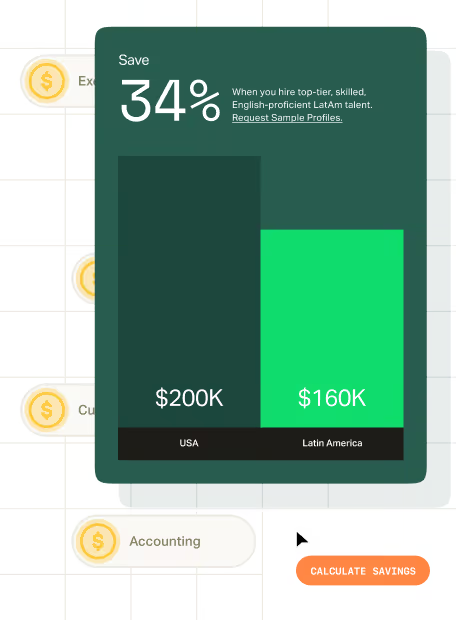
To put the dedicated-developer option in concrete terms, here’s what hiring e-commerce development roles costs in Latin America compared to equivalent US hires, according to Hire With Near’s salary data:
For the most up-to-date figures, see Hire With Near’s US vs Latin America Salary Guide.
That gap changes who you can hire. Hiring a mid-level Shopify developer in Latin America costs about what a junior US hire costs, so the person maintaining your store has shipped this work before instead of learning on your traffic.
According to Hire With Near’s 2026 State of LatAm Hiring Report, US companies saved $23,000 to $85,000 a year on a software engineer hired in Latin America versus a US equivalent. In the same report, 98% of our engineering placements were mid-level or senior.
An agency retainer for maintenance-level work often costs more per year than employing a mid-level e-commerce developer in Latin America, one person, working only on your store, not split across an agency’s other clients.
{{salary-guide-cta}}
How to Outsource E-Commerce Development Services
Outsourcing well comes down to defining the work precisely, testing the people who will do it, and starting small. Follow these six steps in order.
1. Define your goals
Identify what the work should change: conversion rate, page speed, a launch date, an integration that stops breaking. Be specific about scope, timeline, and budget. That’s what lets you tell later whether it worked, and what lets you compare quotes from different providers on equal footing.
2. Research outsourcing providers
Shortlist providers with named work on your platform, not e-commerce experience in general. Ask for two stores they built or maintain on your platform and the version, then ask to speak with one of those clients about what maintenance looked like six months in.
Look at where they hire too. When you’re outsourcing to Latin America, overlapping hours with US teams changes how fast a broken checkout gets fixed. If you’re weighing regions rather than vendors, the best countries for software development outsourcing differ more on time zone and English depth than on raw skill.
Compare three to five, and treat a portfolio of finished sites as proof the company shipped, not proof that the person assigned to you can.
3. Request proposals
Share the same brief with everyone on your shortlist so the proposals are comparable. Evaluate on cost, timeline, and what’s explicitly out of scope, because that’s where change orders come from.
4. Interview the people who will do the work
Interview before you choose, and interview the developer, not just the salesperson. Ask who specifically will write the code, then talk to that person.
Two moves do most of the work. First, ask them to walk through a project they shipped: what their role was, what they decided, and what they’d do differently. Our engineering recruiters watch for two things in that answer: candidates who can’t describe what they personally did, and candidates who won’t talk about anything that went wrong.
Second, require a small paid technical task, scoped narrowly: debug a piece of code, refactor something for scale, or build a basic API with tests. Review it together on a call. This is a filter, not a trial run, so keep it short. A brief exercise reviewed live tells you more than a multi-round gauntlet, and long processes lose the strongest candidates to faster employers.
5. Start with a pilot project
Once you’ve narrowed it down to the developer or vendor you’re leaning toward, test the relationship before you commit to a longer engagement. Run one small, real piece of production work: a single integration, a page-speed pass, one bug that’s been sitting in the queue.
You’ll learn their communication cadence, their code quality on your actual codebase, and how they handle a question at 4 p.m. on a Friday.
6. Sign a detailed contract
Put deliverables, timelines, payment terms, acceptance criteria, confidentiality, and IP assignment in writing. Name who owns the code and the accounts, and what happens when the engagement ends.
Revisit it as the work evolves: a maintenance relationship in month nine rarely looks like the one you scoped in month one.
How Do You Manage an Outsourced E-Commerce Development Team?
Managing an outsourced development team comes down to six things. Define what done means in writing, get live overlap with your workday, and own your own accounts and code. Then, run a release process you can undo, keep a weekly rhythm that ties the work to a number, and treat the developers as teammates rather than a ticket queue.
From the editorial work I do interviewing Hire With Near’s engineering recruiters, the same failure keeps surfacing. Store owners who come to us after an outsourcing arrangement went wrong rarely describe bad code. They describe not knowing what was being built, not reaching anyone the day something broke, and finding out they didn’t hold the keys to their own storefront.
Define done before any work starts
Write down what finished means for each piece of work, in a sentence anyone could check. Name the acceptance criteria, the browsers and devices it has to work on, a page-speed threshold it can’t fall below, and what launched includes: tested, documented, deployed, monitored.
Without that, every review becomes a negotiation and you pay twice for the same feature.
Require real-time overlap, and use it
Get a written commitment to at least four hours of live overlap with your working day, before you sign anything. This is the most useful clause in a development contract.
When a partner works while your office is closed, every clarification costs a day: you ask in the afternoon, they see it next morning, you read the answer the following afternoon.
A store takes orders around the clock, so a broken checkout that could be fixed in two hours sits overnight instead.
Hiring in Latin America is what makes the overlap work. Your developer is at their desk during your business hours, whether your team runs on Pacific, Mountain, Central, or Eastern time. That means a standup you both attend live, and a same-day fix on the things that cost money.
The region spans roughly the same band of hours as the continental US, and most countries there don’t observe daylight saving. The exact gap shifts by an hour twice a year depending on where you sit, but the overlap with your business day holds either way.
That overlap is real enough to run a live standup, which is why it’s usually the first thing tech leaders ask about when they’re hiring developers in Latin America.
Own the accounts, the code, and the credentials
You hold the Shopify or Magento admin, the repository, the domain registrar, the hosting account, and the payment gateway credentials. The developer or agency gets scoped access under named accounts, and that access is revoked the day the engagement ends. A partner who insists on holding your accounts is holding your business.
Insist on code review, staging, and a rollback plan
Nothing reaches the live store without review and a staging test, and nothing ships without a documented way to undo it. A broken checkout costs revenue by the hour, and the fastest recovery is a rollback, not a fix under pressure.
If nobody internally can review code, make review part of the contract: the provider reviews their own work through a second engineer and shows you the record. And schedule releases away from your peak windows. Nobody should be deploying the week of Black Friday.
Ask for a weekly update, and check it against a number
Ask for a short written update every week: what shipped, what’s next, what’s blocked. Keep a shared board so you can see the queue without asking.
Then once a month, review the work against the metric it was meant to move, whether that’s conversion rate, mobile load time, or hours saved on manual order handling.
That monthly review is where you find out whether you’re buying progress or activity, and most common nearshore outsourcing mistakes come down to nobody checking.
Treat the developers as part of the team, not tickets in a queue
Developers do their best work for you when they understand your business. Explain why a feature matters, share the numbers it should move, and give feedback directly rather than through a project manager.
Our guide to hiring and managing an outsourced development team goes deeper on the operating rhythm.
When Is Outsourcing E-Commerce Development Not the Right Choice?
Outsourcing is the wrong choice when the work is continuous, when the code is your competitive advantage, or when nobody on your side can specify and check what gets built.
In those cases, a vendor relationship adds cost and risk instead of removing it, and the honest answer is that you have a hiring problem, not an outsourcing problem.
In the conversations our recruiters have with US e-commerce operators, the companies leaving outsourcing rarely lead with price. In Hire With Near’s analysis of 2,000+ conversations with US companies exploring Latin American hiring, 12% were switching from outsourcing to direct hiring. The reasons they gave were the middleman, the revolving door of people, and workers who never felt part of the team. Within that group, IT and engineering accounted for 16% of the roles moving in-house.
Here are the six cases where outsourcing doesn’t fit.
The work never ends
If someone needs to be in your store admin every week, that’s a job, not a project. Maintenance, optimization, small feature work, and seasonal prep are continuous by nature, and a retainer for a share of somebody’s attention is the most expensive way to cover them.
Bonfire, an e-commerce platform for custom apparel and fundraising, hit this from the hiring side. Their Director of Design and UX was running every technical search himself, at two to three months per hire.
Hire With Near ran sourcing and screening, so he only handled final interviews. The search closed in six weeks, saved about $53,000 a year against a comparable US hire, and the engineer stayed more than two years. He put the difference this way:
It was shocking to see the difference between the talent Hire With Near brought versus other firms I worked with. Our hires are extraordinary and a great cultural fit
— Thomas Elliott, VP of Product Management, Bonfire
The platform is the product
If your checkout, pricing logic, fulfillment rules, or headless front end is what makes the business different, that knowledge shouldn’t live in a vendor’s head.
When the engagement ends, the understanding leaves with it, and the next team spends months rediscovering why the code does what it does.
Outsource around the core; keep the core.
Nobody on your side can write a spec or review the work
Outsourcing amplifies whoever manages it. With a clear spec and a technical reviewer, a good partner moves fast. With neither, you get expensive rework: features built to the wrong assumption and discovered after they’re paid for.
If you have nobody, the fix that pays for itself fastest is usually one person of your own who can.
When price is the only filter
Lowest-bid project work has one recurring failure mode, and it isn’t bad code. It’s that nobody is contracted to be there when the work is done: no continuity clause, no handover, no named owner of the codebase. The developers deliver what was scoped and the engagement ends, which is exactly what the contract said.
One founder of a two-person software team described what that left them with:
One of them was developed by some people in Ukraine, and they’ve since kind of disappeared or fallen off the map to us. So we were looking for either a direct hire or a team or an agency that we could work with to put more production into or to put more development into the application. It’s really kind of an MVP right now. There’s a limited feature set.
An MVP nobody owns is a liability with a login page. If price is your only filter, a junior dedicated developer who stays is usually the better bet.
Our comparison of hiring an in-house developer versus outsourcing walks through where each one breaks, and the risks worth managing in offshore development covers the rest.
You need an engineering leader, not hands
If the real gap is technical judgment, someone to own architecture, sequence a roadmap, and decide what not to build, no development agency fills it. That’s a leadership hire, and Hire With Near fills CTO, VP of Engineering, and lead-level roles through executive search.
Compliance or data constraints rule it out
Some businesses can’t hand customer payment data, health information, or regulated records to a third party, whatever the contract says. If your obligations mean access has to stay inside your own employment relationship, that settles the question before cost enters it.
When two or three of these apply, the alternative isn’t a better vendor. It’s a developer of your own, and our guide to hiring remotely in Latin America covers how that runs from role definition to start date.
Final Thoughts
Outsourcing e-commerce development is a real answer to a real problem, but only for the right shape of work. Project work with a start and an end suits a vendor. Continuous store work suits a person who’s your employee.
The deciding question isn’t which agency is best. It’s whether the work stops. If someone needs to be in your admin every week, understanding your catalog, your promotions, and your integrations, that’s a hire.
At Hire With Near, we connect US businesses with e-commerce developers in Latin America who specialize in this kind of work. Our vetted developers have spent years building and optimizing online stores on Shopify, Magento, and WooCommerce. They work in overlapping hours with your team, communicate fluently in English, and hiring them costs 30–70% less than hiring domestic developers.
Still weighing agencies first? Our roundup of companies that handle Shopify development is a good place to compare. When you want to price out a dedicated developer instead, book a free consultation call with our team. We’ll give you salary benchmarks for the platform and seniority you need and explain how the process works.
{{latam-hiring-cta-v2}}
Frequently Asked Questions
What e-commerce development roles can I hire in Latin America?
You can hire the full set of e-commerce development roles in Latin America, from platform specialists to the engineering functions around them. US companies most often hire Shopify developers in Latin America, remote Magento developers, nearshore WordPress developers for WooCommerce stores, and BigCommerce developers who work your hours.
Around them sit API developers, back-end engineers based in the region, mobile developers, DevOps engineers in Latin America, nearshore QA engineers, and UX/UI designers, all working in overlapping hours with US teams.
What other industries hire tech and e-commerce talent in Latin America?
Hire With Near places technical talent across SaaS, consumer goods, healthcare, fintech, logistics, and marketing agencies.
Nearshore SaaS recruiting is common for product, platform, and customer-facing engineering teams, while CPG recruiting in Latin America tends to cover the D2C storefronts, data, and operations behind consumer brands.
The common thread is work that benefits from real-time collaboration rather than overnight handoffs.
How good is the English of Latin American e-commerce developers?
Latin American developers who work with US companies typically have strong professional English, written and spoken, because most have been on US teams for years already. That’s borne out at the country level too: Argentina ranks first in Latin America and 26th out of 123 countries worldwide on the 2025 EF English Proficiency Index.
Separate fluency from accent: the accent is irrelevant, while the ability to explain why a deploy broke checkout is not. A country-level score also can’t tell you how one specific candidate communicates, so don’t stop there. Ask a candidate to explain a past technical decision to someone non-technical, and require experience working directly with US teams rather than through an intermediary.
What happens if the developer or agency doesn’t work out?
Each model gives you a different remedy: a replacement search, a notice period, or escrowed milestones. Settle which one you have before you sign.
Recruiting and staffing firms generally offer a replacement guarantee, meaning they run the search again at no additional fee within a defined window. Agency contracts rely on notice periods and acceptance terms, while marketplace platforms use milestones and escrow.
Ask any provider two questions: what happens if this person isn’t right in month two, and who owns the code either way?
How long do outsourced e-commerce developers usually stay?
Continuity is a function of the model, not the person. Project engagements end by design, so a freelancer or agency rolls off when the statement of work closes.
A dedicated hire behaves differently: 80% of Hire With Near’s placements stay two or more years, and our placements average three years overall.
The UX engineer Bonfire hired through us stayed over two years, long after a project team would have moved on.
How do I protect my store data, customer information, and IP when I outsource ecommerce development?
Protect it with controls you hold, not with promises about trustworthy people. Before anyone gets access, sign an NDA and a written IP assignment naming your company as the owner of all code and creative work.
Then grant least-privilege access under named accounts in systems you own, so you can revoke it in one click. Keep real customer records out of staging, and keep the developer outside your payment card scope wherever your platform allows. Close every engagement with an offboarding checklist: access revoked, credentials rotated, code and documentation handed over.
How long does it take to hire or onboard an e-commerce developer?
Days to weeks, depending on the model. A freelancer can start within days, and an agency engagement usually needs one to three weeks of scoping and contracting first. A vetted dedicated developer takes a few weeks: Hire With Near sends a shortlist in three to five days, and most of our clients make a hire in under three weeks.
What slows any of these down is a spec nobody has written, and a long interview process that loses the strongest candidates to faster employers.







.webp)


%203.svg)
.avif)





%20(1).avif)

%20(1).png)