Key Takeaways
- Outsourcing Android app development means contracting an external agency, dev shop, or staff-augmentation firm to build your Android app, and it works best for fixed-scope projects with a written spec and a defined end date.
- Android outsourcing services cover the whole lifecycle: UI/UX, native Android development, back-end, QA, MVP builds, and post-launch maintenance.
- Work out what it costs and which parts you can actually hand over before you start. Skip that and the budget catches you out later.
Android app development outsourcing means contracting an outside agency or dev shop to build your Android app instead of building it in-house.
It gets you specialized Android expertise, a lower up-front cost, and a shorter path to a shipped app, and it works best for a bounded build with a written spec and an end date.
It also has failure modes worth pricing in before you sign: divided attention, a rotating team, and the reasoning behind the code walking out when the contract ends.
This guide covers what outsourcing Android development costs, where it goes wrong, and 11 partners worth a call.
Plus, when hiring your own Android developers in Latin America, who work during your business hours, wherever your team sits in the US, is the better trade.
8 Benefits of Android App Development Outsourcing
Outsourcing Android development makes sense when you need capability you don't have in-house and a shipped app sooner than hiring allows. Here are the eight benefits that come up most.
- Access to global talent: Outsourcing app development opens the door to a pool of highly skilled Android developers. A team that has shipped a dozen Android apps has already hit the Play Store rejections and OS-version bugs your first release will run into.
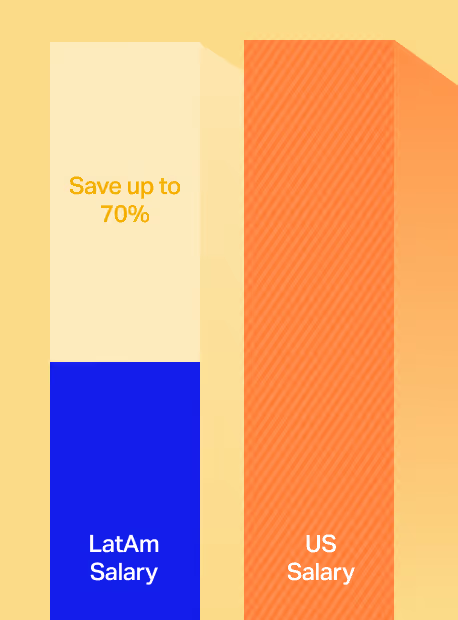
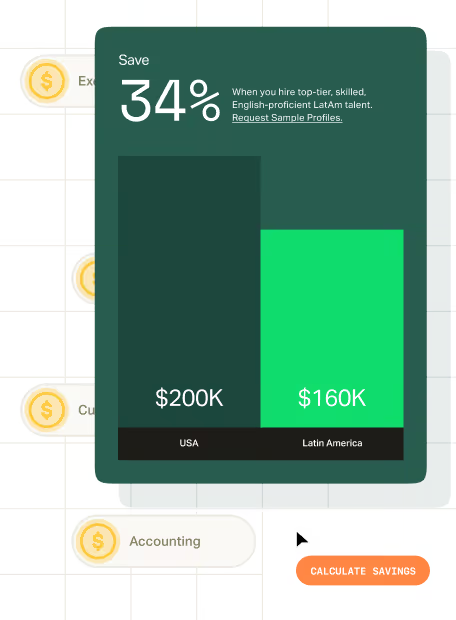
- Lower cost per engineer: The savings come from the rate differential. The US Bureau of Labor Statistics puts the median annual wage for software developers at $135,980 as of May 2025, while comparable salaries in Latin America run 30 to 70% lower. Outsourcing also removes hiring overhead: recruiting, onboarding, equipment, and paying for capacity between projects.
- Faster time to market: A team already staffed and focused on your build shortens the development cycle, so you ship weeks earlier than you would while still hiring for the role.
- Scalability and flexibility: You scale up or down with the project, without the long-term commitments of an in-house team.
- Sharp focus on core business: Your own team gets their week back for the work only they can do: the roadmap, the customers, and the parts of the product you won't hand to anyone else.
- Risk mitigation: A team that ships Android regularly already has crash reporting and staged rollouts set up, so a bad release gets caught at a small percentage of users rather than all of them.
- Access to current tooling: Outsourcing teams often have to build infrastructure, device labs, and monitoring you haven't bought yet, so your app ships on current Android APIs and a tested release pipeline.
- Enhanced quality assurance: Good partners run automated test suites, device-lab coverage across OS versions, and release checklists. That's what keeps crashes and slow screens out of your Play Store reviews.
Related reading: Android Game Development: Services You Can Outsource and Top Companies to Partner With
What Android App Development Services Can You Outsource?
Android outsourcing services cover the whole app lifecycle, from the first wireframe to post-launch maintenance. Most teams that outsource Android app developer services start with one phase and expand. Here's what you can hand over:
- UI/UX design: Designers build interfaces for Android devices and screen sizes, so navigation behaves the way Android users expect. This is often the first piece companies hand over, and specialist UI/UX designers are one of the easier roles to source in Latin America.
- Custom Android app development: A custom build means the app is written for your workflow rather than configured from a template: your data model, your integrations, your release schedule.
- Mobile strategy consulting: Outsourced consulting gets you a roadmap for the build, the launch, and what happens after it.
- Back-end development: Back-end work handles data management, API integration, and server-side logic. Outsourcing it is how most teams get a performant, scalable foundation without hiring a server-side specialist, and plenty keep the Android work in-house and outsource only the back-end developers.
- App testing and quality assurance: Good testing catches most device- and OS-specific failures before release, so your app behaves the same across the Android OS versions and screen sizes still in real use. Dedicated QA engineers are worth insisting on, because developers testing their own releases miss those failures.
- App maintenance and support: Outsourced maintenance covers the updates, bug fixes, and OS-version work that keep a shipped app running.
- MVP development: Outsourcing a Minimum Viable Product (MVP) gets a working prototype in front of users quickly, so you validate the idea before funding the full build.
- App integration services: Outsourced integration work connects your Android app to the other systems and third-party services it has to talk to.
What Are the Risks of Outsourcing Android Development?
The main risks of Android app development outsourcing are divided attention, requirements getting lost through a middleman, source-code and credential exposure, and knowledge walking out the door when the contract ends. All four are manageable if you price them in before you sign.
The founders who end up unhappy with an outsourcing partner rarely have a code problem. What breaks is the distance between the person who knew what the product needed and the person typing it. One founder of a pre-seed mobile app startup put it this way:
We've been working with a boutique company that does, they're a one-stop shop, they do all types of the full tech stack, UI/UX, AI prompting, engineering. But they're a little expensive for the work that they're doing. They're not meeting deadlines. The app isn't working as specified.
Expensive for the output, late, and not built to spec. Each of those traces back to a fixable gap:
- Divided attention and rotating staff: Your build is one of several in the vendor's queue, and the engineers on it can change between sprints. Ask for named engineers in the contract and notice before anyone rotates off.
- Requirements loss through a middleman: If everything you say passes through an account manager before it reaches the developer, your spec gets summarized twice. Insist on direct access to the assigned engineer, in your stand-up and your issue tracker, and treat "all communication goes through your account manager" as a red flag, not a service level.
- IP, source code, and credential exposure: The team will have repo access, customer data, and infrastructure credentials. Real protection is structural, not contractual: IP assignment signed by the individual engineer and not only the vendor entity, Play Store signing keys and console access held on your side, repo permissions scoped to the build, and same-day credential revocation at offboarding.
- Knowledge that leaves with the contract: When the engagement ends, the reasoning behind the architecture goes with it. Require written architecture decisions, a documented release process, and a handover session as deliverables, not favors.
- Quality variance between the pitch team and the build team: The senior engineers on the sales call are often not the ones assigned to your project. Interview whoever will write your code before you sign.
- Scope and cost drift: Fixed-bid quotes drift when the spec moves. Agree up front on how change requests are priced and who signs them off.
None of this is a reason to avoid outsourcing, only to go in with the risks handled up front. Our guide to offshore development risks and how to manage them covers the safeguards, and the most common nearshore outsourcing mistakes shows where teams trip up.
In-House Android Team vs. Outsourced Android Development: Which Is Right for You?
Choose outsourced Android development when the work is a bounded project with a spec and an end date, and choose hiring your own Android developer when the app is your product and the roadmap keeps moving.
Across the 950+ US companies we've helped build Latin American teams for, the ones that get this call right decide it once, on the shape of the work, rather than re-litigating it every quarter.
There are three routes to compare:
- Project outsourcing to an agency or dev shop: You buy a delivered app. The vendor owns the team and the timeline; you own the spec and the acceptance criteria.
- Staff augmentation: The firm places pre-vetted engineers onto your team under your day-to-day direction, and handles payroll, local benefits, and compliance for them. More flexible than a permanent headcount, more accountable than a freelance marketplace.
- Hiring your own Android developer through a specialist partner: A recruiting partner sources and vets the engineer; you employ them, direct them, and keep them. Our guide to hiring models for Latin American developers walks through that route, and executive search in Latin America covers the mobile lead above the first hire.
Divided attention doesn't slow down the code itself. What it costs you is context: the spec re-explained every sprint, decisions made without the history behind them, and no one who can tell you why the codebase works the way it does.
Shared capacity is still the right trade for a bounded project, which is the honest test in our breakdown of whether to hire a developer or outsource.
Companies really do make this switch. In Hire With Near's research into why US companies turn to Latin America, 12% arrived after moving from outsourcing to direct hiring, and IT and engineering made up 16% of that group.
The recurring complaint is the middleman: no direct control, a revolving door of people, and workers who never feel like part of the team.
ParkMobile, whose parking app is used in over 4,200 cities, is what that transition looks like at scale. Its platform work had run on agency developers for years, until its engineering leadership came to treat that dependency as a business risk, and US rates of $148K to $214K per role ruled out replacing the agency at home.
With Hire With Near, it hired nine senior engineers in Colombia at a 73% cost reduction worth $1,066,085 a year, averaging 24 days to hire. Their TA lead, Akshay Gokarnakar, described it this way:
Collaboration with Hire With Near is solving the problem of entering a completely new market for us. They have been an invaluable partner in this expansion, helping to successfully close roles quickly. Their deep understanding of the local talent landscape is what allows them to source and vet top-tier candidates efficiently.
— Akshay Gokarnakar, TA lead, ParkMobile
Hire Your Own Android Developer in Latin America Instead
Hiring your own Android developer in Latin America usually gets you the same 30 to 70% saving as outsourcing, and the knowledge stays with you when the quarter ends. If cost savings are what drew you to outsourcing in the first place, this is the comparison to run.
Hiring your own Android developer in Latin America gives you a team member who works only on your product, learns your codebase, and takes direction from you on priorities, timelines, and quality standards.
The advantages of building your dedicated team:
- Full-time dedication: When you hire an app developer in LatAm, they work only for you and become an expert in your app's architecture rather than one of five codebases this quarter.
- A shared working day, not a handoff: Your Latin American hire is online during your business hours, wherever your team sits in the US. Code review happens the same day it's raised, stand-ups happen live, and a bug found in the morning is fixed the same afternoon rather than acknowledged overnight.
- Technical English you can verify: Accent isn't the risk; articulation is. Ask candidates to walk you through a past build without prompting, read a pull-request description they've written, and check whether they've worked directly with US stakeholders. An engineer who can explain why their change broke production beats one who writes tidier code.
- Long-term relationship: Your developer keeps the reasoning behind past decisions, so the app evolves instead of being rewritten each time a contractor rotates out.
- Comparable cost savings: Save 30 to 70% against US developers at the same level of expertise. According to our salary data, senior Android developers in Latin America run $78K to $120K annually against $103K to $189K in the US.
- A hiring timeline that fits your quarter: You'll see a shortlist in 3 to 5 days, and most of our clients hire in under three weeks. Be honest about the tail: the developer's notice period sits on top, so a role you open this month is realistically contributing next month, not next week.
The short video below runs the same comparison this section turns on, handing your build to a dev shop versus hiring the developer directly onto your team:
Outsourcing solves a capacity problem now. Your own developer solves it and keeps the context: a year in, the person who wrote the code can tell you why it works the way it does.
The mechanics of hiring remotely in Latin America are in our free guide, and we help US companies hire software engineering talent in Latin America across mobile, back-end, and QA.
Top 11 Reliable Partners for Android App Development Outsourcing
Eleven partners are worth a call. Seven are full-service product studios that design, build, and ship the app for you: Netguru, Appinventiv, Innowise, Yalantis, Hyperlink InfoSystem, Andersen, and Cheesecake Labs.
Three plug developers into your existing team: BairesDev, Toptal, and Andela. The eleventh is Hire With Near, for teams who would rather employ the Android developer than contract the work out.
Every company below holds a rating of 4.5 or higher with at least 50 client reviews on an established review platform (G2, Clutch, Trustpilot, GoodFirms, or ClearlyRated). From that pool, we looked at real Android delivery work, engagement models, and client fit.
The list spans app development outsourcing from Android-only build teams to staffing and recruiting solutions for hiring developers.
The list is in no specific order and implies no ranking. For a wider shortlist, see our roundups of nearshore software development companies and LatAm outsourcing companies.
1. Hire With Near
Hire With Near is a staffing and recruiting agency that helps US companies hire remote professionals in Latin America, across software engineering, data, design, finance, and operations. It's the one option here that isn't an outsourcing vendor: instead of delivering the app, we help you hire the Android developer who builds it, on your payroll and reporting to you.
We draw on a pre-vetted pool of 160,000+ candidates, have hired for 950+ US companies, and fill 97% of the roles we take on. We hold a 4.9 rating on G2 across 150+ reviews and ranked No. 118 on the 2026 Inc. 5000 list of the fastest-growing private companies in America.
Our recruiters place mobile, back-end, and QA engineers every week, including Kotlin developers, the primary language for modern Android apps. Best for teams who want to employ the engineer rather than contract the build out.
Drew Prescott, co-founder and CEO at R\nd, described the result this way:
Hire With Near not only helped us navigate the hiring process but fundamentally changed our approach to building our team. Their ability to connect us with high-quality, dedicated talent has been invaluable.
— Drew Prescott, Co-founder and CEO, R/nd
2. Toptal
Toptal is a talent network that screens applicants and matches you with freelance Android developers, typically within about 48 hours, and fewer than 3% of the people who apply each year make it through. It holds a 4.7 rating on G2 across 270 reviews. Best for filling one specific Android gap quickly on a contract basis, not for handing over an entire build.
3. BairesDev
BairesDev is a US-headquartered nearshore partner with more than 4,000 engineers across Latin America, delivering iOS and Android work through dedicated teams or staff augmentation and typically assembling a team in two to four weeks.
Its engineers work during your business day rather than handing work back overnight. It holds a 4.9 rating on Clutch across 63 reviews. Best for larger programs where you want a nearshore team you can scale.
4. Andela
Andela runs a vetted talent marketplace of roughly 150,000 technologists across more than 135 countries, including Latin America. Its Android bar is specific: at least four years in an Android role and demonstrated Java and Kotlin proficiency, with a portfolio to match. It holds a 4.7 rating on G2 across 110 reviews. Best for sourcing Android engineers from a global pool when you intend to direct the work yourself.
5. Andersen
Andersen is a Warsaw-headquartered IT partner with 19 years behind it, more than 150 Android developers, and 110-plus Android apps shipped, working in Kotlin, Java, and Jetpack Compose across wearables, IoT, and enterprise deployments.
Engagements run as a dedicated team, staff augmentation, fixed price, or time and materials. It holds a 4.9 rating on Clutch across 129 reviews. Best for enterprise Android projects that need a full-cycle team.
6. Appinventiv
Appinventiv builds native Kotlin apps with Material Design and Jetpack Compose, extending to wearables and Android TV, and its mobile app development work includes consumer brands such as KFC, Adidas, and Domino's. It holds a 4.6 rating on Clutch across 90 reviews. Best for consumer-facing Android apps that need design polish and the capacity to handle real download volume.
7. Yalantis
Yalantis is a compliance-first engineering firm with 17-plus years, roughly 400 specialists, and an R&D lab, building Android apps in Kotlin and Java with documentation written for auditors rather than added afterwards. Its deeper expertise sits in IoT, embedded, healthcare, and fintech. It holds a 4.8 rating on Clutch across 79 reviews. Best for Android apps tied to hardware or regulated data.
8. Netguru
Netguru earned a place for the breadth of its Android practice: native Kotlin and Java builds plus Kotlin Multiplatform, extending to Android TV and Android Auto, from a 600-person team in Poznań, Poland with 2,500-plus projects and 15 years behind it. Clients include Volkswagen, IKEA, Babbel, and Delivery Hero.
It holds a 4.8 rating on Clutch across 73 reviews. Best for design-led consumer apps where the product still needs shaping.
9. Hyperlink InfoSystem
Founded in 2011 with offices in India, the US, and the UK, Hyperlink InfoSystem has delivered more than 4,500 mobile applications and covers Kotlin and Java development, QA, IoT, and migrating existing apps onto Android. It carries the largest review base on this list, a 4.8 rating on Clutch across 174 reviews. Best for budget-sensitive builds and teams that want a partner used to shipping at volume.
10. Innowise
What stands out about Innowise is Android depth beyond the phone: 60-plus Android developers and 130-plus Android projects spanning smartwatches, smart TVs, POS terminals, and payment systems, in Kotlin, Java, and Jetpack Compose.
Engagements run fixed price, time and materials, or staff augmentation, from offices across Europe and the US. It holds a 4.9 rating on Clutch across 73 reviews. Best for Android work that touches devices other than handsets.
11. Cheesecake Labs
Cheesecake Labs is on this list for the nearshore angle: a product engineering studio based in Florianópolis, Brazil with a San Francisco office, 13 years in business, and 300-plus products delivered, including the Android release of Tapcart's platform.
Work runs as full project delivery, dedicated teams, or staff augmentation, with time-zone overlap with US teams. Clients include Mercado Libre, PepsiCo, and AB InBev. It holds a 4.9 rating on Clutch across 64 reviews. Best for US teams that want a nearshore studio on a product build.
How Do You Choose an Android App Development Outsourcing Partner?
Choose an Android app development outsourcing partner on six things you can verify before you sign.
Can you interview the engineer assigned to your build? Who owns each step of delivery? Is the Android depth real or general mobile experience? Where does the partner source engineers? What happens when someone rotates off? And who owns the IP?
Does the technical filter exist?
Ask to run a live technical interview with the engineer who will write your code, not a sales engineer.
Ask for a code sample or a short take-home in Kotlin, and for named professional years with the specific tools rather than total years in the industry. Federico Bilello, Recruiter, Software Engineering at Hire With Near, is direct about why the interview itself is not optional:
Even though I do everything I can to verify a candidate's skill set before they get to the client, there's always a small percentage who make it through to the technical interview. The only way to truly find out if someone is proficient is that technical interview. That's where the truth comes out.
— Federico Bilello, Software Engineering Recruiter, Hire With Near
A partner who won't let you interview the assigned developer is asking you to trust a filter you can't see.
Who owns what, end to end? Get an ownership map in writing before the contract. Name who writes the spec, who runs QA, who owns the Play Store release and the review responses, and who is on the hook when a sprint slips. Vague answers here are where "we thought you were handling that" comes from.
Is the Android depth real? Android application development outsourcing and general mobile outsourcing are not the same purchase, even though Android outsourcing services get sold as if they were.
Look for Kotlin depth rather than Java-with-Kotlin-sprinkled-on, Jetpack Compose on shipped apps, someone who has handled a Play Store release and a policy rejection, and testing across OS-version fragmentation rather than one flagship handset.
Where does the partner source engineers? Sourcing geography drives both overlap and rate. Latin America is now one of the deeper developer markets open to US teams: GitHub's Octoverse 2025 counts 6.89 million developer accounts in Brazil, the fourth-largest developer population in the world.
Its 2024 report counted another 1.9 million in Mexico, 1.1 million in Argentina, and over 1 million in Colombia. Our guide on where to outsource app development compares the regions on cost and overlap.
What happens when it doesn't work out? Ask for the exit and replacement terms in specifics: how fast a replacement is staffed, who pays for the ramp, and what happens to the code when a person rotates off. For our own placements the benchmark is a 180-day replacement guarantee, double the industry standard, and a fair bar to hold any vendor to.
Who owns the IP? Confirm assignment is signed by the individual engineer, not just the vendor entity, and that signing keys and console access stay on your side.
Answer those six questions and Android app development outsourcing stops being a bet on a sales call. Our best practices for outsourcing developers covers what comes after signing.
How Much Does It Cost to Outsource Android App Developers?
Hiring an Android app developer in Latin America costs $48K to $120K a year depending on seniority, against $73K to $189K for comparable seniority in the US, according to our salary data. Outsourcing the same work is priced per project or per hour rather than per person, which is why the two routes are hard to compare until you put the rates side by side.
These figures for the dedicated-developer route come from Hire With Near's annual US vs. Latin America Salary Guide:
For the most up-to-date figures, see Hire With Near's US vs Latin America Salary Guide.
Read that savings column as a reach rather than as a discount. Hiring a senior Android developer in Latin America often costs less than hiring a mid-level one in the US.
That's what lets a small product team put a senior engineer on the app, instead of settling for the most junior engineer they can afford in the US market. Our US vs. Latin America salary data for IT roles covers the roles around the Android hire.
Those are benchmarks, and what companies realize in practice sits close to them. Across the placements in Hire With Near's 2026 State of LatAm Hiring Report, software engineering roles saved companies $23,000 to $85,000 a year against US equivalents, and 98% of those placements were experienced professionals, not juniors.
That second number matters more, because the low end of a salary range is where people assume the compromise hides.
Whether you outsource Android application development by the project or by the hour changes what you can predict, and several other factors move the number too:
- Geographical differences: Rates track the local cost of living and how hard local tech talent is to win, so where the vendor's engineers sit moves the number more than the logo on the proposal.
- Project complexity: Simpler apps often land between $5,000 and $30,000. Apps with payments, third-party integrations, offline sync, or regulated data cost several times that, and any quoted figure is only meaningful next to a written scope.
- Experience level: Developers with more Android-specific experience command higher rates, and senior engineers with a decade of shipped Android work command higher salaries.
- Development timeline: Compressed timelines carry premium pricing, because the vendor has to put more people on the build at once.
- Additional services: UI/UX design, QA testing, and ongoing maintenance are often priced on top of the base development fee rather than inside it.
- Fixed price vs. hourly rate: A fixed price suits a finished spec but gets expensive when requirements move; an hourly rate is more flexible for a product still taking shape. Our breakdown of how an outsourced development team is structured covers how each model bills.
Final Thoughts
Android app development outsourcing is the right call for a bounded build with a written spec and an end date, and the wrong one for an app that keeps changing. Sort out which one you're building first. The price question only makes sense after that.
You've got what the call takes: a rate table putting Latin American Android salaries next to US ones, 11 partners with their review ratings, and six questions for any vendor.
If the app is your product, building your own dedicated development team in Latin America is usually the better trade: same-day code review, and knowledge that stays in the team. Hire With Near connects US companies with Latin American professionals who perform like their best US hires, at salaries 30 to 70% lower than comparable US rates.
Get a list of pre-vetted developer candidates to see the caliber of Android developer we can put in front of you.
{{consultation}}
Frequently Asked Questions
How much does it cost to outsource app development?
Whole-project fees run from about $5,000 for a simple, single-purpose app to well over $100,000 for one with payments, integrations, or regulated data. Android app development outsourcing is quoted either as a fixed bid against a written spec or as an hourly rate. Ask any vendor what their number excludes before comparing it to another.
How much does it cost to develop an app for Android?
An Android build costs either a project fee or a developer's salary. Contracted out, a straightforward Android app starts in the low five figures and rises with feature complexity. Staffed with your own engineer, the cost is a salary: $48K to $120K a year in Latin America against $73K to $189K in the US, per our salary data above. The salary route costs more in month one and less by year two.
Is Android development worth it in 2026?
Yes. Android is still the operating system on the majority of the world's phones, so for any product with users outside the US and Western Europe, skipping Android means skipping most of the addressable market.
It's also the easier platform to staff: Android engineers are more widely available in Latin America than iOS specialists, which shortens the search and keeps salary expectations lower.
How much does it cost to pay someone to develop an app for you?
That depends on the pricing model: an hourly rate, a fixed bid for the project, or a monthly rate for a dedicated developer.
Hourly fits work still moving, a fixed bid fits a finished spec, and a monthly rate fits an app with no end date. Seniority and who owns QA after launch move all three. Use the salary table above to pencil out the dedicated-developer path.
What Android app development services can you outsource?
Any part of the Android lifecycle, from the first wireframe to post-launch maintenance, as the services section above lays out. What separates a real Android team from a generic mobile shop is specific: Kotlin depth, Jetpack Compose on shipped apps, someone who has handled a Play Store release and a policy rejection, and testing across the OS versions and screen sizes still in real use. Hire With Near places Kotlin developers and mobile developers if you'd rather employ than contract.
Should you outsource Android development or hire your own Android developer?
Outsource when the build is a bounded project with a written spec; hire your own developer when the app is your product and the roadmap keeps moving.
Hiring in Latin America makes the second option practical for most US teams: the person is online during your business hours whatever US time zone you're in, so stand-ups and code review happen live instead of overnight. The questions tech leaders ask about hiring developers in Latin America covers what usually comes next.