.webp)


%203.svg)
Key Takeaways
- There are four ways to build an offshore development team: build it yourself with an entity or EOR, use freelance platforms, bring in a staff augmentation firm, or work with a staffing and recruiting partner. For a full-time dedicated team, the partner route is usually the fastest.
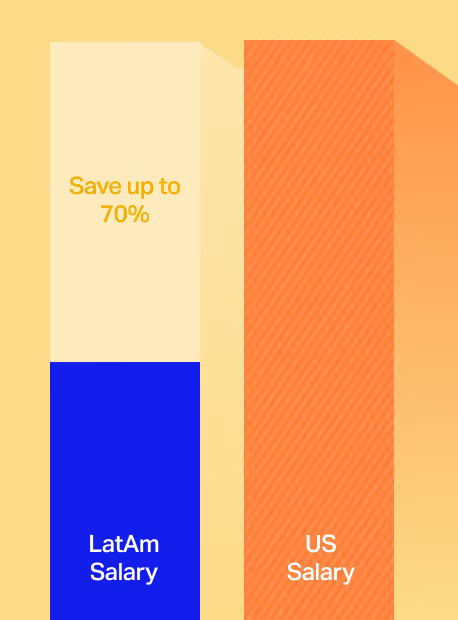
- Nearshore hiring in Latin America puts engineers online during US business hours, so standups happen live and code review lands the same day, with salary expectations running 30–70% below US levels.
- Brazil, Argentina, Colombia, and Mexico are the leading hubs, and one of the most telling vetting tests is asking a candidate to explain a past project to a non-engineer.
Hiring an offshore development team starts with one decision: how much of the work you want to own. You can source and employ engineers entirely on your own, bring in a staff augmentation firm that supplies pre-vetted developers from its bench for flexible or project-based work, or rely on a staffing and recruiting partner that finds vetted developers and sets them up as your own dedicated, permanent team.
If you're a founder or engineering leader reading this, you already know the squeeze. You need to ship, the senior engineers who clear your bar want $180,000 plus equity, and the roles have been open for months while your current team absorbs the overflow. That's why so many US companies look abroad.
This guide covers how to build an offshore team the right way: the models for putting one together, offshore versus nearshore, the best countries in Latin America, what it costs, and how to vet IT and tech talent so you get engineers who ship.
What Is an Offshore Development Team?
An offshore development team is a group of software engineers based in another country who build and maintain your product as an extension of your in-house team. You set the priorities and the roadmap, and they work in your repositories, your tools, and your sprint rituals, like any other engineer on your team.
A typical team combines a few core roles:
- Back-end developers build the server-side logic behind your product: the APIs, the database design, authentication, and the integrations with payment, email, or third-party services. If your product stores data or processes transactions, this is usually your first hire.
- Front-end developers build the interface users interact with. They turn designs into working screens, make the product responsive across devices, and keep pages fast and accessible.
- Full-stack developers work across both layers, so one person can ship a feature from the database to the screen. They're a common first or second hire on small teams, where you need range more than a narrow specialty.
- QA engineers test the product before customers do. They write test plans, build automated test suites, run regression checks before each release, and catch the edge cases developers tend to miss in their own code.
- DevOps engineers own the path from code to production. They set up deployment pipelines, manage cloud infrastructure, monitor uptime, and handle security and scaling, so releases are routine instead of risky.
Larger teams add a tech lead who sets technical direction and reviews the work.
Unlike freelancers or project-based agencies, whose people often split their week across several clients, the engineers on an offshore development team work full-time on your product only.
Why Hire an Offshore Development Team in 2026?
Hiring an offshore development team often costs far less than hiring the same engineers in the US, whether you hire in Eastern Europe, Southeast Asia, or Latin America.
For many roles, that gap decides whether a hire happens at all. Without it, demand keeps coming while the budget stays put, and a US search for a senior engineer takes three to six months, if it closes at all. In the meantime, your current engineers absorb the backlog on top of their own work, deadlines slip, and goals you set for the quarter go unmet.
Here’s what a strong offshore team gives you:
Hiring senior engineers costs less
Offshore engineers have salary expectations below those of their US equivalents, because those expectations reflect a lower local cost of living. In Latin America, for example, those expectations run roughly 30–70% below US levels. That gap is what lets a team add senior engineers it couldn't afford to hire locally.
We cover salary ranges by role and seniority in the cost section below.
You reach experienced engineers you couldn’t fill locally
Looking beyond the US opens a global pool of engineers fluent in modern stacks, from React and Node.js to Python, Go, and cloud platforms like AWS and Azure. Instead of competing for the same local candidates every other company is chasing, you can hire remote developers from a far wider market.
Eastern Europe, particularly Poland, Romania, and Ukraine, has produced strong engineering talent for decades, with deep expertise in backend systems, data engineering, and cybersecurity.
US companies hiring in Latin America mostly hire experienced engineers. According to Hire With Near's 2026 State of LatAm Hiring Report, 98% of the engineers we placed were mid-level or senior, and more than half were senior. That's a pattern in who gets hired, so the savings come with the experience level most teams are looking for.
The seniority shows up in more than years of experience. Federico Bilello, Software Engineering Recruiter at Hire With Near, explains what signals it:
The main thing I look for is ownership. I always look for developers who have worked in startups or smaller companies, because those are the people who probably have ownership. If you bring them a problem, they won’t ask how to solve it; they’ll try their own ideas, they’ll be creative.
— Federico Bilello, Software Engineering Recruiter, Hire With Near
You can pick the overlap that fits how you work
Where you hire shapes how you collaborate. A distant time zone can give you follow-the-sun coverage, where work continues after your team logs off, while a nearby region gives you live overlap for standups and real-time code review. Which one fits depends on how much real-time collaboration your work needs.
If you want that live overlap, hiring in Latin America puts engineers online during your business hours, whether your team runs on Pacific, Mountain, Central, or Eastern time. The overlap is close to a full workday for teams in the Central and Eastern states and still covers a solid block of the day on the West Coast.
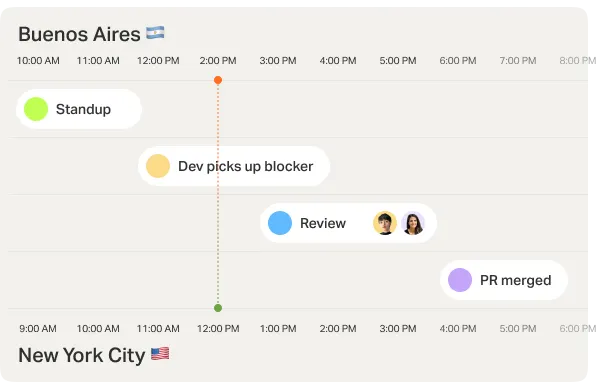
Buenos Aires, one of Latin America’s biggest tech hubs, is a good example. The image below shows how its workday lines up with an East Coast team in New York City. Teams farther west still share a solid block of the day with Buenos Aires:
For how to set core hours and handle the practical side of hiring across the region, see our guide to hiring remotely in Latin America.
You scale up or down without the overhead
Offshore teams let you add engineers as a project ramps and hold steady when it doesn’t, without the fixed cost of building out a full in-house department.
That flexibility matters most for startups whose needs shift quarter to quarter.
Your core team stays focused on the product
When an offshore team owns backend hardening, QA, or deployment reliability, your internal team spends its time on the roadmap instead of firefighting.
For example, without a dedicated QA engineer, your senior developers often spend release week running regression tests by hand and fixing whatever breaks. An offshore QA engineer who owns that testing hands those days back to the people building the next feature.
Related reading: Hiring an Offshore Development Manager: Benefits, Skills To Look for, and Top Hiring Partners
{{state-latam-hiring}}
Offshore vs. Nearshore Software Development: Which Is Right for Your Team?
So far, we’ve been using “offshore” as a catch-all term, but there’s an important distinction worth making before you choose a model.
Offshore means engineers in distant time zones. For US companies, that's typically the Philippines, India, or Eastern Europe. Nearshore means engineers in nearby regions, primarily Latin America, who are online when your US team is.
The difference is time zones, and for most teams that need to collaborate in real time, it’s the most consequential variable in the decision.
That overlap is not a soft preference; it has a measurable effect on how a team works. Research from Harvard Business School and INFORMS found that each additional hour of time-zone difference reduces real-time communication by about 11%.
The study also found that distributed teams perform best when organized along a north-south axis, such as the US to Latin America, rather than east to west.
The reason is simple: a New York and São Paulo pairing keeps almost the full business day in common, while a New York and Manila pairing loses most of it.
The same pattern shows up in what US companies tell us. One company running senior QA offshore in Sri Lanka put the problem plainly:
Our senior QA in Sri Lanka is excellent, but we don’t get enough overlap to keep quality and throughput high. We often ship without her. The fix is obvious: a tester who is online when we are.
That’s the exact reason a large share of companies exploring Latin American hiring are moving off far-offshore teams: they want engineers in their hours for standups, code review, and fast feedback loops. When you hire a development team in Latin America, the workday overlap does most of the collaboration work for you.
Far-offshore isn’t wrong for every workstream. If the work is well-documented and asynchronous, where a clean handoff at the end of your day is enough, a distant time zone can fit. The honest rule of thumb: the more real-time collaboration a project needs, the more nearshore pays off.
If you want the full comparison, this piece on why Latin America stands out for software development breaks it down.
If offshore hiring hasn’t worked for you before, the reasons are usually the same. We broke down the seven most common offshore hiring mistakes and what to do instead.
Throughout this guide, I use “offshore development team” in its broad sense, covering both offshoring and nearshoring.
What Are the Engagement Models for Hiring Offshore Dedicated Development Teams?
There are four engagement models for hiring nearshore developers: build it yourself with an entity or EOR, use freelance platforms, bring in a staff augmentation firm, or work with a specialist staffing and recruiting partner.
The choice comes down to two questions: how much of the work you want to carry yourself, and whether you want engineers who are yours for the long run or flexible capacity you can spin up and down.
The options below run from most hands-on to least, ending with the model built for a long-term team.
Option 1: Build it yourself
Building it yourself gives you the most control and the most work. You source engineers on your own through job boards for hiring in Latin America, LinkedIn, and referrals, then you become their employer.
If you want the engineers to be part of your team, that means one of two mechanisms:
- You can establish a legal entity in the country, which gives you full control but takes 3 to 6 months, real upfront cost, and ongoing legal and accounting support. It only pays off at volume.
- You can use an employer of record (EOR), a third party that becomes the legal employer on paper while you manage the work day to day, handling contracts, payroll, tax, and compliance.
An EOR handles employment logistics, but not recruiting. You still have to source and vet every engineer yourself.
Finding the talent is the hardest and most time-consuming part of the whole exercise, and it’s exactly what the partner model handles.
Option 2: Freelance and contractor platforms
Freelance platforms like Upwork and Toptal give you fast access to contractors, but they're built for project work, not a full-time dedicated team. For a side-by-side, see Hire With Near vs. Toptal.
For a short prototype or a one-off task, that can work. For a team you want to keep and grow, the difference between freelance developers and a dedicated development team shows up quickly in three places. On a platform, you do the vetting yourself, the engineer rarely works only for you, and there's no telling whether they'll still be on your team a year from now.
Option 3: Staff augmentation
Staff augmentation is one of the fastest and easiest ways to add engineers. A staff augmentation firm keeps a bench of pre-vetted developers ready to go. You describe what you need, and the firm places people from that bench onto your team to work under your direction. The firm stays their legal employer and handles payroll, benefits, and compliance, so there's no entity or EOR for you to stand up.
This model fits teams that want to scale up or down, staff a defined project, or add capacity without committing to permanent headcount.
The trade-off is simple: the engineers stay on the vendor's payroll and team. They typically work on shorter-term contracts, so they build less of the long-term institutional knowledge a permanent team accrues, and they roll off when the engagement ends.
That makes staff augmentation a strong fit for flexible, project-based capacity and a weaker one when you want a team that grows with you.
If you're weighing it against handing off a whole project, this breakdown of staff augmentation versus outsourcing for software development goes deeper, and IT staff augmentation covers how the model works in practice.
Option 4: A specialist staffing and recruiting partner
A staffing and recruiting partner does both jobs for a team of your own: it finds and vets the engineers and sets them up as your own dedicated team members, in one relationship. This is the simplest path if you're building a full-time offshore software development team.
You describe the roles, we present pre-vetted engineers through our nearshore staffing and recruiting services, and once you hire, we handle payroll, benefits, and compliance.
It also scales from one engineer to a full team with the same partner. ParkMobile, a parking and mobility platform that's part of Arrive, had relied on agency developers for its back-end and platform work for years, and its engineering leadership saw that dependence as a business-viability risk.
Working with Hire With Near in Colombia, a market it had never recruited in, ParkMobile replaced its agency developers with 9 senior engineers based in Latin America across platform, back-end, and iOS.
The numbers: a 24-day average time-to-hire and $1,066,085 in annual savings versus US rates, a 73% reduction. ParkMobile then expanded the program to hire team leads in Colombia.
In the video below, Akshay Gokarnakar, the company's TA Lead, talked about the partnership:
For senior leadership roles like an engineering manager or VP of technology, executive-level hires run through the same partner relationship.
Here’s how the four options compare:
Related reading: Struggling to Expand Your Offshore Team? Here’s How to Nail It
How Much Does It Cost to Hire an Offshore Development Team?
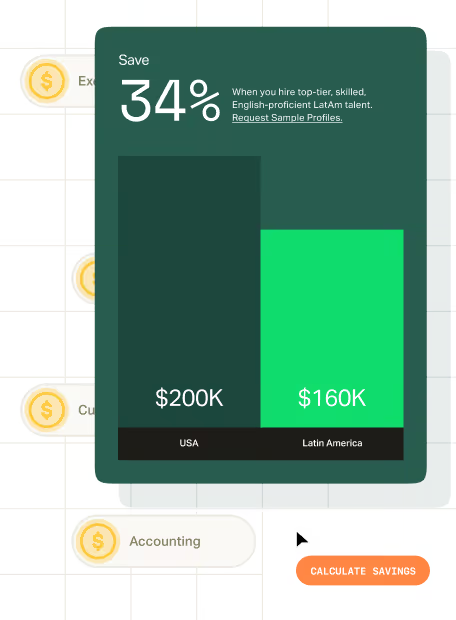
A core offshore development team in Latin America costs roughly 30–70% less than the same team hired in the US, with individual engineers ranging from about $30,000 to $108,000 a year, depending on role and seniority.
To put that in concrete terms, here’s what the core roles on an offshore development team cost in Latin America compared with equivalent US hires, according to Hire With Near’s salary benchmarks:
For the most up-to-date figures, see Hire With Near's US vs Latin America Salary Guide.
Budget for the seniority your roadmap needs, not the bottom of the range. A senior engineer in Latin America typically has salary expectations at or below what a mid-level engineer earns in the US, so you can often staff a more senior team than a US budget would allow.
Your total cost shifts with the model you choose:
- Staff augmentation usually means an hourly rate with a vendor markup on top of the engineer’s pay.
- Freelance platforms charge project or hourly rates, plus the hidden cost of the management and quality control you take on yourself.
- Hiring your own dedicated team through a partner means the engineer's salary plus a partner fee, charged once or monthly depending on the model. The engineers are part of your own team, so you're not paying for people who rotate off when a contract ends.
Whichever model you're weighing, ask each provider for the all-in cost per engineer (salary, fees, and anything billed separately) so you can compare the options side by side before you commit.
For a fuller breakdown, see how developer salaries in Latin America compare to those in the US, or this look at how much offshore developers cost across regions.
What Are the Top Latin American Countries for Hiring Offshore Development Teams?
The top Latin American countries for hiring an offshore development team are Brazil, Argentina, Colombia, and Mexico. The right one for your business depends on the team you're building.
- Brazil is Hire With Near’s number-one country for IT and engineering placements and home to the region’s largest developer community. It’s the deepest pool for a back-end-heavy, full-stack, or mobile developer team, with strong experience on modern frameworks and cloud platforms.
- Argentina has some of the region’s most experienced senior engineers and consistently high English proficiency. That makes it a strong fit when your team needs architects, staff-level engineers, or a technical lead who can communicate clearly with US engineering leaders and product managers.
- Colombia was Hire With Near’s number-one overall hiring destination in 2025, with a fast-growing developer pool and working hours that overlap closely with US business hours. It’s a reliable source when you're building a team across most engineering roles at once.
- Mexico offers the closest nearshore proximity to the US, working hours that closely match Central and Mountain teams, and a strong STEM pipeline. For teams that want maximum real-time overlap, nearshore software development in Mexico is often the first stop.
The scale behind these hubs is substantial. According to GitHub's Innovation Graph, Brazil had about 8.3 million developer accounts in the first quarter of 2026, Mexico about 2.9 million, Colombia about 1.7 million, and Argentina about 1.6 million. All four grew by more than 30% year over year.
Related reading: Discover the 22 Best Countries to Hire Remote Software Engineers and Developers
{{state-latam-hiring}}
How To Hire an Offshore Development Team?: A Step-by-Step Guide
To hire an offshore development team, follow eight steps: define your objectives, choose an engagement model, shortlist and vet candidates, assess technical skills, set communication protocols, confirm time-zone overlap, sign a clear contract, and start with a pilot project before you scale.
How much of this you handle yourself depends on the model you choose. If you're sourcing on your own through job boards or referrals, every step below applies to you.
If you're working with a staffing and recruiting partner like Hire With Near, steps 3 and 7 are largely handled for you, and step 4 is shared. The partner sources, screens, and handles payroll, benefits, and compliance, so you're evaluating a shortlist rather than building one from scratch.
Here’s the sequence:
1. Define your objectives
Start by outlining the scope, goals, and technical requirements of the work, including the languages, platforms, and features involved. Be specific about seniority too: a greenfield build needs different engineers than maintenance and hardening.
A clear scope tells you, or a partner, which stack and seniority to screen for, and gives you a benchmark to judge the first month of work against.
2. Choose your engagement model
With your objectives defined, match them to one of four models described earlier in this article: build it yourself with an EOR or entity, use freelance platforms, bring in a staff augmentation firm, or work with a staffing and recruiting partner.
As a rule of thumb, ongoing work that needs engineers fully embedded in your team points to a partner. A defined stretch of extra capacity points to staff augmentation, and a short, one-off task can sit on a freelance platform.
3. Shortlist and vet for real signals
In dozens of conversations with Hire With Near's software engineering recruiters this year, the same red flag keeps coming up: a candidate who lists an impressive stack but can't say what they personally built, or who goes quiet when asked about a mistake.
- If you're sourcing on your own: Look past polished portfolios to how a candidate thinks and communicates. Ask candidates to walk through a past project and explain it to a non-engineer (an engineer who can make complex work clear will collaborate well with your team). Treat English as a skill you test, not one you assume: that walkthrough is the test, because it shows whether the candidate can explain a technical decision to your product manager. Watch for regional quality signals: a well-known employer like Mercado Libre is a green flag, while three parallel full-time jobs is a red flag.
- If you're working with a partner: Your shortlist arrives pre-vetted. Before a candidate reaches you, the partner has sourced them for your stack and screened their English skills. Your job is to run a final interview that tests communication and cultural fit. The “explain a past project to a non-engineer” exercise still applies and is worth running yourself to confirm the candidate will collaborate well with your team.
Natasha Tarapow, Recruitment Consultant at Hire With Near, explains why that exercise carries so much weight:
We always ask candidates to tell us about a project they've worked on: not just that they use this language and that one, but what their role was and what they actually did. It's important that they can explain their work to someone who isn't a developer. If they can do that, that tells me a lot.
— Natasha Tarapow, Recruitment Consultant, Hire With Near
Ask these questions in the final interview:
- Walk me through a project you built. What was your role, and what did you personally ship?
- Explain that project as if I were a non-engineer on our product team.
- Tell me about a mistake you made in production. What did you change afterward?
- If you hit a blocker and your lead is offline, what do you do next?
- How did the ticket you were working on connect to the product goal?
If you want to know what US tech leaders typically ask before committing to Latin American hiring, we collected the most common doubts in the questions tech leaders ask when hiring in Latin America.
4. Assess technical proficiency
- If you're sourcing on your own: Verify skills with real work, not just conversation. Hire With Near's recruiters recommend a small, real-world task, such as debugging a function, refactoring code for scalability, or building a basic API with tests, done live or as a take-home and then reviewed together on a call. Confirm hands-on experience with the specific tools and platforms your stack depends on, but don't over-weight exact framework versions: experienced developers adapt quickly when they understand the core principles.
- If you're working with a partner: What the partner has already screened depends on the company. Some run their own technical assessment before candidates reach you. Others, including Hire With Near, run first-round interviews that cover experience, communication, and English, and leave the technical assessment to your team. We can help you decide what to test and administer it for you if you want. Ask which model you're getting. Either way, confirm the candidate's hands-on experience with your specific stack and run a short technical conversation to make sure their depth matches what the role needs.
Either way, keep the process short. Long, multi-assessment processes push the strongest candidates to drop out, because they usually have other offers.
5. Establish communication protocols
Agree up front on how updates, reviews, and feedback will flow. Set core collaboration hours, pick your tools (Slack, Jira, or similar), and define response-time and escalation expectations.
A written escalation path, for example, tells a blocked engineer who to contact and how fast to expect an answer, so a question doesn't sit for a day.
6. Confirm time-zone overlap and schedules
Set the working-hours expectation early. The region you're hiring from determines how much overlap you'll naturally have with your US team and how much you'll need to engineer around the gap.
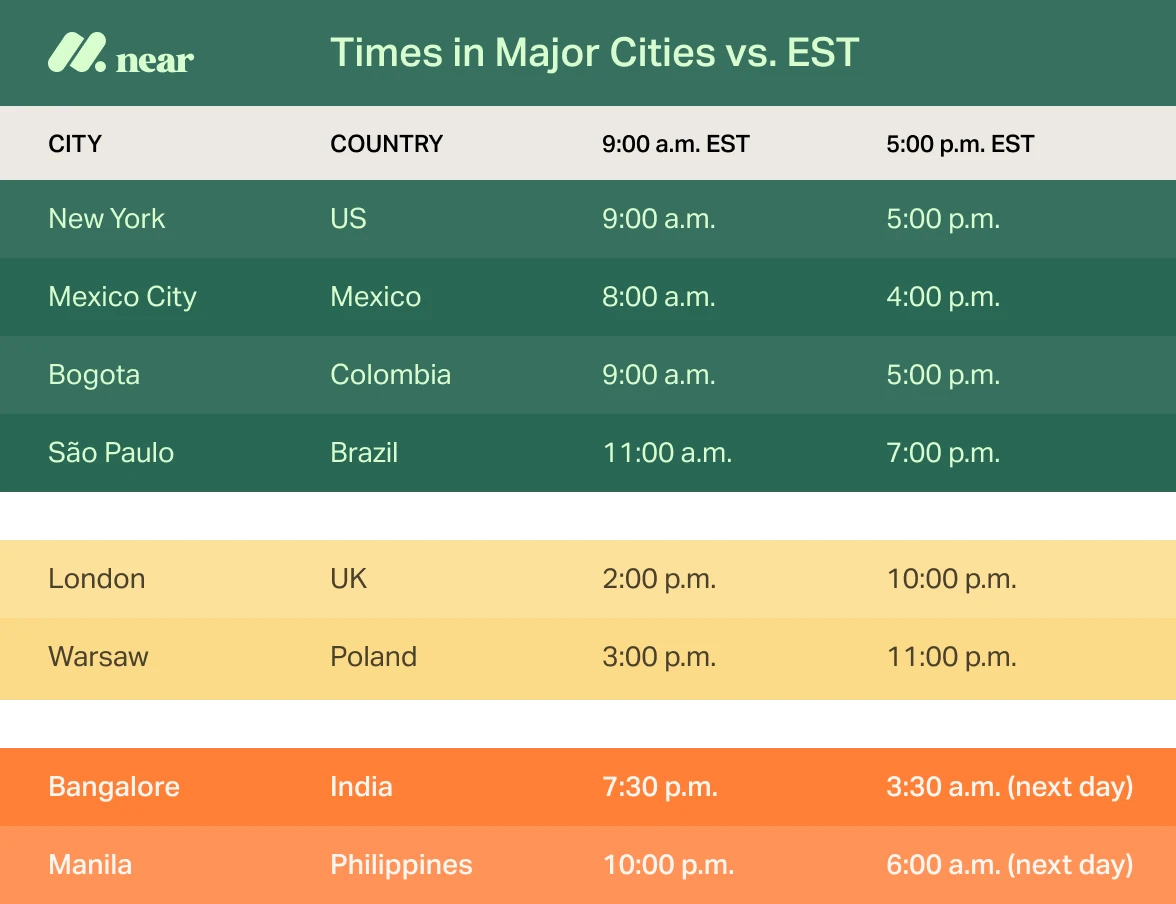
That overlap matters more than it might seem. A 2024 study in Organization Science of more than 12,000 employees at a multinational firm found that real-time communication, such as calls and video chats, drops as the time difference between colleagues grows, while email and chat volume stays the same.
The researchers suggest that companies whose teams sit north to south, not east to west, may keep more of that real-time collaboration. For a US company, Latin America is the north-south option.
Eastern Europe offers partial overlap with US mornings, which can work for async-heavy workflows but limits real-time collaboration.
Far-offshore regions like Southeast Asia or India typically require deliberate scheduling to create any meaningful overlap at all.
Agree on the core hours everyone is online, then allow flexibility around them. The less natural overlap your region offers, the more disciplined your communication protocols need to be.
7. Sign a comprehensive contract
- If you're sourcing on your own: Put the agreement in writing with deliverables, timelines, intellectual property ownership, and confidentiality. Include clauses for dispute resolution, performance expectations, and termination so both sides are protected.
- If you're working with a partner: Much of the compliance and IP framework is handled inside the partner relationship. Review what's covered by the partner's employment agreement and focus your own contract on deliverables, performance expectations, and termination terms.
8. Start with a pilot project
Prove the fit with a small, real project before you commit to a larger build. A pilot shows you the team’s code quality, communication, and reliability under actual conditions, so you scale up with evidence instead of a hunch.
Common mistakes to avoid when hiring an offshore development team
The most common mistake is making your final decision on who to hire based on the resume and stack list alone, without testing how a candidate thinks and communicates. A few others come up again and again:
- Picking a region without checking the overlap: If your work depends on live standups and code review, a distant time zone turns every question into a next-day reply.
- Running a long, multi-round process: The strongest candidates often have other offers and drop out of slow processes. That risk multiplies when you're filling several roles at once, because every open role has candidates waiting on your next step.
- Using a freelance platform for a permanent team: Freelancers often split their week across clients, and you carry the vetting and retention yourself.
- Scaling before a pilot: A small, real project shows you code quality and communication before you commit to a larger build.
How to Find Offshore Development Teams for Hire
You find offshore development teams for hire through four channels: job boards, LinkedIn, and referrals; freelance marketplaces; vendor directories and review sites like Clutch and G2; and specialist staffing and recruiting partners.
For a dedicated, full-time team, a partner is usually the fastest route, because it handles the search, the vetting, and the employment side in one relationship.
Where you look depends on how you want to hire offshore development talent:
- Job boards, LinkedIn, and referrals give you the most control, but you run the whole search and still need an EOR or entity to employ anyone.
- Freelance marketplaces get someone started fast, but they're built for project work rather than a team you keep.
- Directories and review sites help you compare providers, but they can't tell you how rigorously a provider vets engineers.
- Specialist staffing and recruiting partners source and vet the engineers, then handle payroll, benefits, and compliance.
For a starting shortlist of providers, see our roundups of the best companies to hire top LatAm developers and the top offshore development companies.
Before you sign with any provider, ask these questions:
- How do you vet engineers technically? Look for a live coding exercise or a real-world take-home task reviewed with the candidate, plus an English screen. A resume review alone isn't vetting.
- Do you search fresh for my stack, or pull from a bench? A bench, common in staff augmentation, starts faster but limits you to whoever is available. A fresh search targets your stack and seniority.
- Will the engineers work only for me? A dedicated team is full-time on your product, not juggling other clients.
- Will I work with the engineers directly? With a dedicated team, engineers join your standups and report to you, with no project manager relaying requirements in between.
- What happens if a hire doesn't work out? Ask how long the replacement guarantee lasts and what it covers.
- How fast will I see a shortlist? A provider that does its own sourcing should show you candidates within days, not weeks.
For reference, Hire With Near delivers a shortlist of candidates in 3 to 5 days, and most of our clients make a hire in under three weeks. Every placement is backed by a 180-day replacement guarantee (double the industry standard).
Final Thoughts
The hard part of building an offshore development team is deciding how much of the sourcing, vetting, and employment you want to carry yourself. Build it on your own and the search is yours. Bring in a staff augmentation firm and you get flexible capacity that rolls off when the contract does. Work with a staffing and recruiting partner and you get a team of your own that works your hours, with salary expectations 30–70% below US levels.
If you're building a full-time team, you can hire a dedicated software engineering team in Latin America through Hire With Near: a pre-vetted shortlist in 3 to 5 days, and most clients make a hire in under three weeks.
Book a free consultation and we'll walk through the roles you need, share salary benchmarks for them, and tell you plainly whether a partner or another model fits your team.
{{latam-hiring-cta-v2}}
Frequently Asked Questions
What's the difference between an offshore and a nearshore development team?
A nearshore development team works in nearby countries with overlapping working hours, while an offshore development team usually works in distant time zones where real-time collaboration is harder.
For US companies, nearshore typically means working with nearshore software development companies or engineers in Latin America, who are online during your business day. Offshore development often involves teams in Asia or Eastern Europe, where a large time-zone gap means questions sent in your afternoon wait until the next morning.
What other roles can I add to an offshore development team from Latin America?
Beyond the core back-end, front-end, QA, and DevOps roles, you can add software engineers, mobile developers, and Python developers to an offshore development team in Latin America. Software engineers anchor product work, mobile developers take your app to iOS and Android, and Python developers cover data-heavy back ends and automation.
Salary expectations for these roles typically run 30–70% below US equivalents, and the engineers work during your business hours, so the whole team collaborates in real time.
How quickly can an offshore development team start?
An offshore development team can start within a few weeks when you work with a specialized recruiting partner. Through Hire With Near, you get a shortlist of candidates in 3 to 5 days, and most of our clients make a hire in under three weeks.
Building it yourself through in-house sourcing or setting up a legal entity takes longer, and freelance platforms offer fast access but leave the vetting and management to you.
Can a Latin American development team work the same hours as my US team?
Yes. A Latin American development team works during US business hours, so it overlaps your team's day whether you're on the East Coast, in the Central states, or on the West Coast.
Working hours across the region overlap most of a US business day wherever your team sits, from the East Coast to the West Coast, with the exact gap shifting by season.
Daily standups happen live, urgent bugs get fixed the same day, and code review doesn't stall overnight.
I need an offshore development team for just 6 months. What are my options?
Staff augmentation is the model best suited to this. A staff augmentation firm place a development team from its bench for a defined period and remains their legal employer, handling payroll, benefits, and compliance, so there's no entity to set up and no permanent headcount to commit to.
Many firms offer fixed-term or rolling engagements built for projects like this. Expect an hourly rate with a vendor markup on top of the engineer's pay.
A freelance platform can also work for a short, well-defined task, but you carry the vetting and management yourself, and the developers often split their week across clients.
Before you sign, ask each provider for the minimum engagement length, how much notice they need to add or remove engineers, the all-in rate per developer, and what they've screened before candidates reach you.
Can I hire an offshore development team without setting up a legal entity?
Yes. You have three routes:
- An employer of record becomes the legal employer on paper while you manage the work day to day, handling contracts, payroll, tax, and compliance, but you still source and vet every engineer yourself.
- A staff augmentation firm supplies the development team from its bench and keeps them on its own payroll.
- A staffing and recruiting partner finds and vets the engineering team, then sets them up as your own dedicated team members and handles employment for you.
Setting up your own entity is the slowest option, at 3 to 6 months plus ongoing legal and accounting costs, so it only pays off at volume. Which route fits depends on whether you want flexible capacity for a project or a permanent team.







.webp)


%203.svg)
.avif)





%20(1).avif)

%20(1).png)